Israel Cannot Silence Palestinian Words

By Benay Blend

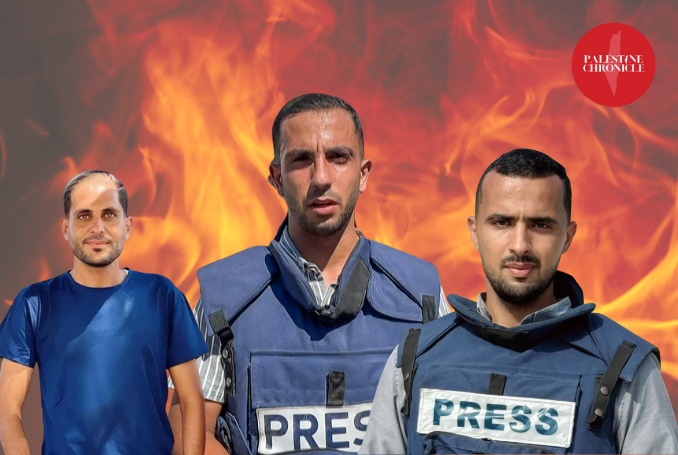
Palestinian journalists seek to document the truth about the Zionists’ brutal siege, while their detractors are working to erase all evidence of the crime scene.

Shortly after the news broke about the Israeli assassination of Palestinian journalist Anas al-Sharif and his five colleagues in Gaza City, a video appeared on my Facebook feed of chef Yotam Ottolenghi making baked haloumi cheese with fennel syrup.

In real time, the two events have nothing to do with each other. However, delving deeper into the realm of the imagination, both represent long-held Israeli efforts to erase the Palestinian presence on the land.

In a statement on the social media platform X, journalist Ramzy Baroud explained Israel’s motives for the murder of  at least 200 journalists in Gaza since October 7, 2023: “silence the truth by murdering those who report it.”

Afterward, they justify these deaths by claiming that the journalists were members of the resistance movement, a claim that is problematic for several reasons.

In a timely excerpt from Perfect Victims: And the Politics of Appeal (2025), Mohammed El-Kurd contends that allies often unwittingly refute the claim that victims, such as these journalists, were affiliated with Hamas. In this way, the characterization of the civilian as a “neutral figure” has depoliticized the Palestinian cause, rendering it a “humanitarian crisis” where “revolutionaries are not part and parcel of your nation.”

In the U.S., too, police shootings of Black, Brown and poor people are often justified by slandering the victim’s reputation post-mortem. This should come as no surprise, since the institution of policing harks back to its origin as slave catchers, along with its more present-day exchange of training with the Zionist state.

“It is not enough for a Palestinian to be a journalist to be deemed human,” concludes El-Kurd,  “they must be ‘unaffiliated.’”

For “Israelis,” this effort must prove difficult as they are taught to see Hamas everywhere, much like Americans were told to look for communists during the Second Red Scare in the 1950s. The latter were in our bathrooms, under our beds, and if we were not watchful, we might mistakenly marry one.

In “The Hamas are Coming: A View of the Violence from Inside Israel” (2021), Miko Peled writes of this phenomenon that has informed Israeli hasbara (propaganda) for years.

“There are never Palestinians, never people, only ‘The Hamas’ — and ‘The Hamas’ is, by the way, male and singular (in Hebrew),” Peled writes.  “’The Hamas thinks;’ ‘The Hamas believes;’ ‘The Hamas should know;’ ‘When the Hamas understands, he will stop;’ and finally, ‘When The Hamas is hit hard he will never dare to attack Israel again.’”

Not much has changed in Israeli hasbara since Peled wrote that piece nearly four years ago. Indeed, the New York Times, taking its cue, as usual, from Israeli sources, repeated that “Mr. al-Sharif,” whom the Israeli military accused of being a Hamas fighter posing as a reporter, but was really “the head of a terrorist cell,” thus the IDF “had taken steps to mitigate civilian harm,” though which civilians, Palestinians or “Israelis,” it does not say.

Barbs were then thrown back and forth. Al-Jazeera called the killing  “a desperate attempt to silence the voices exposing the impending seizure and occupation of Gaza” while the “Israeli Government” accused “Al Jazeera reporters of serving the interests of Hamas by presenting an exaggerated and distorted picture of conditions in Gaza.”

“The instinct of many defenders of Palestinians is to dispel the connection between the slain Palestinian media workers and their supposed political leanings, as if anywhere in the world these exist in isolation,” El-Kurd explains.

Just as El-Kurd implicates himself in this process, so do I. There have been times when I’ve distanced martyrs from supporting the armed resistance as if this gives us a more legitimate cause to mourn.

When we sanitize the dead in this way, however, “we are inadvertently reifying the colonial rationale that killed them and rendered them killable in the first place,” El-Kurd concludes, so perhaps it is better to just reply “So what?” Indeed, if Zionist soldiers and PR workers can find a place for themselves in global media, why do supporters of Palestine find the need to detach their heroes from armed resistance that occupies a legitimate role in the struggle?

There are many documented reasons as to why Israel targets journalists in the Gaza Strip. Significantly, Palestinian journalists seek to document the truth about the Zionists’ brutal siege, while their detractors are working to erase all evidence of the crime scene.

Moreover, for Western journalists, even those sympathetic to the cause, the only picture they can paint is that of victims who are barely surviving in the rubble.

In an interview with Beacon Press, historian Roxanne Dunbar-Ortiz describes a similar settler colonial narrative that pertains to Indigenous people in the Americas. Asked to explain the most enduring myth pertaining to Native Americans, Dunbar-Ortiz mentions the idea of “eliminationism,” a notion that does away with Native people.

Indeed, at the turn of the 20th century, the myth of the Vanishing Indian was at its zenith, thus allowing the mainstream population to view Native people as noble relics who exist only in the glory days of their past. These same people who at one time they had license to kill Native people are seen now as no longer a threat, subdued as they were in the last Indian massacre at Wounded Knee.

In reality, Native people have survived over 500 years of continual genocide, survival being an “active word,” Dunbar-Ortiz makes clear, involving  “an enormous amount of resistance and cultural continuity.”

On the other hand, “victimry” is a more common version, she concludes, because people can feel sorry about the state of Indian Country but without the requirement that they must do anything about it. “So they’re not really then dealing with the reality that Native people are here,” and like the Palestinians, “they’ve resisted, they’ve survived, they haven’t changed their mind about who they want to be and how they want the future to be.”

In “Sumoud: The Unyielding Heart of the Palestinian Cause in Palestine,” Ramzy Baroud describes a similar trajectory for Palestinians. “The profound and unrelenting struggles endured by Palestinians should, by any rational expectation, have irrevocably concluded the Palestinian cause. Yet, the struggle for freedom in Palestine is at its zenith.”

Like the experience of Native Americans, Zionist attempts to erase the presence of Palestinians goes back many decades. Nevertheless, the Palestinian resistance has endured, Baroud continues, due to the “concept of sumoud,” resilience that is akin to Dunbar-Ortiz’s explanation of “survival,” an active process that involves resistance and cultural endurance.

“Palestinian journalists in Gaza are themselves the story and the storytellers,” writes Ramzy Baroud. “Their success or failure to convey the story with all its factual and emotional details could make the difference between the continuation or the end of the Israeli genocide.”

From Refaat Alareer, the poet/teacher/ journalist who asked before his death that his life become a story to ensure that life goes on, to Anas Al-Sharif’s final testament written shortly before his death, Palestinian journalists have been responsible for conveying the truths of Gaza to the world, but they also leave a legacy that inspires future generations to carry on their work.

“Do not let chains silence you or borders restrain you. Be bridges toward the liberation of the land and its people, until the sun of dignity and freedom rises over our stolen homeland,” Al-Sharif wrote, shortly before his death.

With that last statement, Al-Sharif foretells his own assassination. His message is not one of victimhood, though, but rather a plea that others carry on his work.

On August 11, Dareen Tatour, the Palestinian poet who knew from experience the danger of rebellious words, posted a new poem written to honor the Al-Jazeera team murdered the day before.

Imprisoned for her verse “Resist, My People, Resist Them,” the poet is not so optimistic now that words can stop a bullet. Under the banner Martyrs of the Word and Image—They Left But the Word Remained, Tatour charged that their deaths were the consequence of a world gone silent to their pain.

“They are gone / but the truth remains,” she says, dependent on her to carry it, or “leave it to be bombed again” in the wake of her silence.

Unlike the person that she was ten years ago, Tatour knows now that “the road is longer and harsher,” yet still she is undeterred, for she continues “to write for them [the slain journalists], to be the echo of their voices,” because in this way, the Palestinian narrative will be triumphant.

– Benay Blend earned her doctorate in American Studies from the University of New Mexico. Her scholarly works include Douglas Vakoch and Sam Mickey, Eds. (2017), “’Neither Homeland Nor Exile are Words’: ‘Situated Knowledge’ in the Works of Palestinian and Native American Writers”. She contributed this article to The Palestine Chronicle.

CrossFireArabia

CrossFireArabia
Dr. Marwan Asmar holds a PhD from Leeds University and is a freelance writer specializing on the Middle East. He has worked as a journalist since the early 1990s in Jordan and the Gulf countries, and been widely published, including at Albawaba, Gulf News, Al Ghad, World Press Review and others.

Related Posts

Analysis: Why Did Hezbollah Enter This War?

Hezbollah’s entry into the war reflects strategic calculations shaped by Israeli escalation, regional alliances, and Lebanon’s fractured politics.

Key Takeaways

  • Israel has repeatedly violated the ceasefire in Lebanon through airstrikes, raids, and surveillance operations.
  • Hezbollah’s response has so far remained limited compared to Israel’s sustained military actions.
  • Lebanon’s political leadership has failed to present a unified response to Israeli attacks on Lebanese territory.
  • Hezbollah’s intervention reflects strategic concerns about Israel’s long-term plans in Lebanon and the broader war against Iran.
  • The coordination between Iran, Hezbollah, Ansarallah, and Iraqi factions suggests the Axis of Resistance continues to operate collectively.

A Regional War Expands

Hezbollah’s decision to enter the ongoing regional confrontation did not occur in isolation. The latest escalation began when the United States and Israel launched major strikes against Iran, triggering waves of Iranian retaliation across the region.

The conflict quickly expanded beyond Iran itself. Iranian retaliatory strikes targeted US military assets and positions across the Gulf. The war rapidly assumed the character of a wider regional confrontation involving multiple actors aligned along competing geopolitical blocs.

Within this context, attention turned to Lebanon, where Hezbollah—one of the most powerful non-state actors in the Middle East—began limited military operations against Israeli positions along the border.

The central question quickly emerged: Why did Hezbollah enter the war?

The answer lies in a combination of military, political, and strategic considerations that go far beyond the immediate battlefield.

Did Hezbollah Violate the Ceasefire?

A central claim advanced by Israel and some Western governments – and even anti-Hezbollah factions in Lebanon itself – is that Hezbollah’s actions represent a violation of the ceasefire arrangements that followed previous rounds of conflict along the Lebanese border.

However, the reality on the ground presents a far more complex picture.

For months, Israel has carried out continuous violations of Lebanese sovereignty through airstrikes, drone surveillance, artillery fire, and cross-border incursions.

According to Lebanese government figures and reports by the United Nations Interim Force in Lebanon (UNIFIL), Israel has committed thousands of violations of Lebanese airspace and territory since the ceasefire arrangements took effect.

Lebanese officials have repeatedly documented Israeli overflights, drone operations, and missile strikes inside the country. UNIFIL has also confirmed frequent violations of Lebanese airspace by Israeli aircraft.

These actions have not been merely symbolic. Israeli strikes have caused civilian casualties and extensive destruction of homes and infrastructure in southern Lebanon.

Villages near the border have experienced repeated bombardments, forcing families to flee and damaging agricultural land and civilian property.

At the same time, Israeli officials have openly signaled that they have no intention of withdrawing fully from Lebanese territory or halting military operations.

Several Israeli leaders have stated publicly that Israel intends to maintain military pressure on Hezbollah and potentially establish a longer-term security presence along the border.

In this context, Hezbollah’s response—limited strikes against Israeli military positions—cannot easily be framed as the violation of a functioning ceasefire.

Rather, Hezbollah and its allies argue that no real ceasefire existed, given the scale and persistence of Israeli violations.

Did Hezbollah Violate Lebanese Consensus?

Another argument advanced by critics inside Lebanon is that Hezbollah’s intervention undermines national consensus and drags the country into a war it cannot afford.

Lebanon’s government, which maintains close ties with Western governments and the United States, has repeatedly blamed Hezbollah for escalating tensions.

However, the government has struggled to provide a convincing explanation of how it interprets Israel’s continued attacks on Lebanese territory.

While condemning Hezbollah’s actions, Lebanese authorities have largely failed to respond militarily—or even diplomatically in an effective way—to Israeli strikes.

The Lebanese state has not fired a single bullet at Israeli forces despite repeated attacks inside its territory. This has deepened the political divide within Lebanese society.

Lebanon has long been fractured along sectarian, ideological, and geopolitical lines. Some factions align closely with Western and Gulf states, while others view themselves as part of the Axis of Resistance, which includes Iran, Hezbollah, Ansarallah in Yemen, Palestinian resistance factons and several Iraqi factions.

Within this divided political landscape, there has never been a unified national consensus regarding confrontation with Israel.

For many Lebanese—particularly in communities that have historically borne the brunt of Israeli attacks—Hezbollah’s military posture is viewed as a form of deterrence rather than escalation.

So Why Did Hezbollah Enter the War?

Hezbollah’s decision to join the conflict appears to reflect a broader strategic calculation.

From Hezbollah’s perspective, the Israeli war was likely to expand regardless of its immediate actions.

Israeli leaders have repeatedly declared their intention to reshape the regional balance of power and weaken Iran and its allies.

For Hezbollah, the prospect of Iran being significantly weakened carries profound implications.

If Iran’s position in the region were severely damaged, Hezbollah could find itself facing Israel largely alone—while simultaneously confronting pressure from the United States, Western governments, and regional Arab powers aligned with Washington.

In such a scenario, Hezbollah could be isolated militarily and politically.

Entering the war now, while Iran remains actively engaged and regional allies are mobilized, allows Hezbollah to operate within a broader coalition rather than as an isolated actor.

It also ensures that Hezbollah retains influence over the eventual diplomatic outcome of the conflict.

Wars in the Middle East often conclude not with decisive military victories but through negotiated exits once the architects of war decide to pursue a political strategy.

By participating in the conflict, Hezbollah guarantees that it will have a seat at the negotiating table when such an exit strategy eventually emerges.

Does This Mean the Axis of Resistance Has Been Reborn?

Some analysts have framed the current coordination between Iran, Hezbollah, Ansarallah, and Iraqi factions as the “rebirth” of the Axis of Resistance.

But the reality may be more nuanced.

The Axis of Resistance was never destroyed. Instead, each actor within it has often had to adapt to its own domestic political realities.

Hezbollah operates within Lebanon’s complex sectarian political system. Iraqi factions must navigate Baghdad’s fragile state institutions. Ansarallah governs large parts of Yemen under conditions of war and blockade. Hamas remains focused on defeating the Israeli-US scheme aimed at disarming resistance and ethnically cleansing Palestinians from Gaza,

These differing political contexts often limit how openly each actor can coordinate with the others. Yet recent developments suggest that the axis is functioning in a coordinated manner.

Iranian strikes across the region, Ansarallah’s operations in the Red Sea, and Hezbollah’s engagement along the Lebanese border indicate a level of strategic alignment.

The current conflict has therefore revealed not the rebirth of the axis but its continued operational existence.

Our Strategic Analysis

Hezbollah’s intervention reflects a calculated strategic move rather than an impulsive escalation.

Israel’s continued military pressure on Lebanon, combined with the wider war against Iran, created conditions in which Hezbollah perceived long-term risks in remaining passive.

By entering the conflict in a limited but coordinated manner, Hezbollah seeks to shape the strategic environment before the war reaches a stage where diplomatic negotiations become inevitable.

In doing so, Hezbollah is signaling that the future of Lebanon—and the broader regional balance of power—cannot be determined without its participation.

Palestine Chronicle

Continue reading
Israel’s Next AI Solution to Gaza

The Israeli and US plans aiming to transform the Gaza Strip into an economy lacking financial sovereignty are extremely concerning. The plans suggest abolishing cash currency and enforcing a transition to a digital economy managed by external entities aligned with Israel.

This would change access to money and basic transactions from a fundamental right into a revocable privilege, making food, medicine, and shelter dependent on security decisions and military assessments. It reflects a coercive restructuring of daily life aimed at pushing the population toward poverty and displacement, managed through technology.

After over two years of financial blockade, Liran Tancman, an Israeli businessman and former officer in Israeli Intelligence Unit 8200, who has been involved with the Gaza Humanitarian Foundation (GHF), said at an event in Washington that rebuilding Gaza depends on restoring its digital and economic connectivity. He outlined a vision for creating a “secure digital backbone” to support electronic payments, education, and financial services, alongside an “Amazon-like logistics system”. This approach aims to transition the economy from a rights-based framework to one focused on operational and security control.

Introducing digital wallets as a technical solution for reconstruction functions as a cover for a new phase of engineering control over the population and increasing economic reliance on Israel. This strategy transforms financial technology into a programmable instrument for collective regulation, enabling real-time monitoring, arbitrary restrictions, and selective freezing of funds amidst ongoing blockade and occupation, all while lacking Palestinian sovereignty over data, financial systems, operational conditions, or options to object.

Subjecting the right of access to financial resources to a security authority, whether directly or indirectly, undermines the core of economic and social rights. It damages the right to food and human dignity and breaches international humanitarian law, which prohibits collective punishment and criminalising the population. Additionally, it violates the prohibition on the use of starvation as a warfare tactic and conflicts with the fundamental obligation to protect civilians and guarantee their access to essential survival needs.

Any digital infrastructure established under occupation or international tutelage without full Palestinian sovereignty over data and financial systems risks becoming a tool for collective control and subjugation. Israel has frequently enforced arbitrary movement restrictions based on vague and non-appealable security reasons, raising fears that similar restrictions could extend to access to financial resources.

Euro-Med Monitor warns that creating a digital financial system under Israeli control could serve as a comprehensive coercion tool against Palestinians, especially journalists, activists, and human rights defenders. Digital wallets might be frozen based on a single decision, or individuals could be assigned broad security labels, resulting in the loss of access to funds without proper oversight, due process, or remedies. This situation risks making essential rights to food, medicine, and shelter dependent on unchecked security judgments.

Israel’s extensive security classification system for Palestinians, which designates hundreds of thousands as having political or national affiliations, could potentially be used as a financial weapon under such a framework to block access to their wallets and enable coercion. This situation is similar to the current restrictions on travel for medical care or movement freedom, often justified by “lack of security approval,” despite the lack of clear standards or real chances to contest these decisions.

The threat goes beyond simply denying funds; it involves turning the economy into a network of conditions and restrictions. Basic services would become dependent on political and security compliance, while aid, salaries, and trade could be used as tools for classification. People would be tracked through digital records that decide their access to essential needs. This method risks reinforcing arbitrary discrimination and could lead to collective punishment that affects both individuals and groups.

Restricting the development of advanced internet services to areas like the so-called “New Rafah,” combined with partial reconstruction efforts, raises concerns about using technology as a pressure tool to alter demographics and enforce coercive changes. Digital services risk becoming a privilege tied to geographic location rather than a universal public right, thereby weakening the principles of non-discrimination and equitable access to services.

Euro-Med Monitor emphasises Tancman’s crucial role in the GHF, which is associated with contentious aid distribution methods amid the Gaza genocide. Field data indicate that the foundation’s policies helped engineer starvation in the enclave, resulting in about 1,200 civilian deaths and injuries to thousands more during food access efforts. He is also among those who suggested tying aid distribution to “biometric” checks, effectively turning relief efforts into mechanisms for data gathering, coercion, and security control.

Any digital or economic initiative that overlooks the occupation’s realities and provides the occupying power with more control tools over the population’s lives does not contribute to rebuilding Gaza or facilitating recovery. Instead, it solidifies an illegal system of domination and risks turning technology into a means to prolong violations and maintain the blockade in a “smart” manner. In this form, the blockade becomes programmable, with punishment that is swift and direct, serving as leverage to drive the population into poverty, displacement, and uprooting by limiting livelihoods and linking survival to security policies.

The reconstruction efforts and any transitional phase must be grounded in respect for international humanitarian law and human rights law, guarantee full Palestinian sovereignty over resources, systems, and data, and ensure the separation of humanitarian arrangements from security and intelligence functions.

Euro-Med Monitor underscores the prohibition on linking any financial services, humanitarian aid, or access to basic necessities to “biometric” verification, security classifications, or political conditions. It advocates adopting the principle of data minimisation and preventing the transfer or sharing of data with any third party, particularly security bodies or companies contracted with them.

Since October 2023, Israel has barred all cash entries into Gaza and enforced a strict financial blockade, resulting in the closure of all bank branches during the genocide. Although some branches later reopened partially, they were still not allowed to bring in cash, thereby preventing cash withdrawals.

Euro-Med Monitor urges rejection of any financial or digital arrangements imposed on Palestinians under occupation or made in their name without real Palestinian sovereignty, independent civil representation, and enforceable oversight and appeal processes. The idea of “consent” in the context of occupation lacks legitimacy as long as Palestinians do not control money and data.

Any system that does not guarantee full Palestinian sovereignty over data, infrastructure, standards, and governance, and that grants the occupying power or its agents the ability to access, disable, or freeze operations, remains an unlawful instrument of control, regardless of any humanitarian or developmental framing.

All digital systems should undergo regular independent audits focusing on privacy, cybersecurity, and human rights impacts, with the results openly published. Full transparency is required regarding funders, owners, operators, contractors, and contractual conditions. Euro-Med Monitor calls for safe non-digital alternatives and opposes making survival or access to services dependent on digital wallets, which could exclude vulnerable groups or those without connectivity or technical means.

The establishment of independent and effective appeal mechanisms with well-defined jurisdiction, competent judicial authority, and quick decision-making regarding asset freezes or transaction restrictions is crucial. These mechanisms should ensure transparency in operational standards and objection procedures and require that decisions be reasoned.

Euro-Med Monitor urges the establishment of an independent Palestinian civil authority to govern the financial and technological systems without interference from the occupation. It emphasises that genuine economic progress depends on lifting unlawful restrictions on crossings, cash flow, goods, and communications, rather than replacing a physical blockade with a “smart” digital one that increases dependency and perpetuates violations.

Continue reading

You Missed

Iran Halts Attacks on Neighboring States Unless…

Iran Halts Attacks on Neighboring States Unless…

Iranian govt spokesman: 30% of victims are children; 165 of them killed among 1300 civilians who died by US/Israeli bombing

Iranian govt spokesman: 30% of victims are children; 165 of them killed among 1300 civilians who died by US/Israeli bombing

White House: ‘We destroyed more than 30 Iranian ships and are moving to destroying the navy completely’

White House: ‘We destroyed more than 30 Iranian ships and are moving to destroying the navy completely’

White House: ‘We Have 4 to 6 Weeks to End The Military Operations in Iran’

White House: ‘We Have 4 to 6 Weeks to End The Military Operations in Iran’

IRGC: Iran Has Not Closed The Hormuz Strait Except to Ships Linked to Israel/USA

IRGC: Iran Has Not Closed The Hormuz Strait Except to Ships Linked to Israel/USA

Hezbollah Launches 18 Rockets on Israel

Hezbollah Launches 18 Rockets on Israel