Israel Destroys 30,000 Beehives in Gaza

Gaza’s beekeeping sector is facing the risk of collapse as Israel’s genocidal war has destroyed apiaries, wiped out vegetation and prevented beekeepers from reaching key grazing areas in the eastern Gaza Strip.

According to 2025 data from the Cooperative Society of Beekeepers in Gaza, the honey production and beekeeping sector has suffered losses estimated at around $39 million since October 2023.

The society said nearly 30,000 beehives were destroyed. Before the war, those hives supplied Gaza’s local market with around 380 to 400 tons of honey annually.

The damage also affected livelihoods across the sector, with Israel destroying more than 85% of vegetation and forest grazing areas, leaving more than 6,000 workers without jobs and harming the income of 905 registered beekeepers across Gaza by mid-2026.

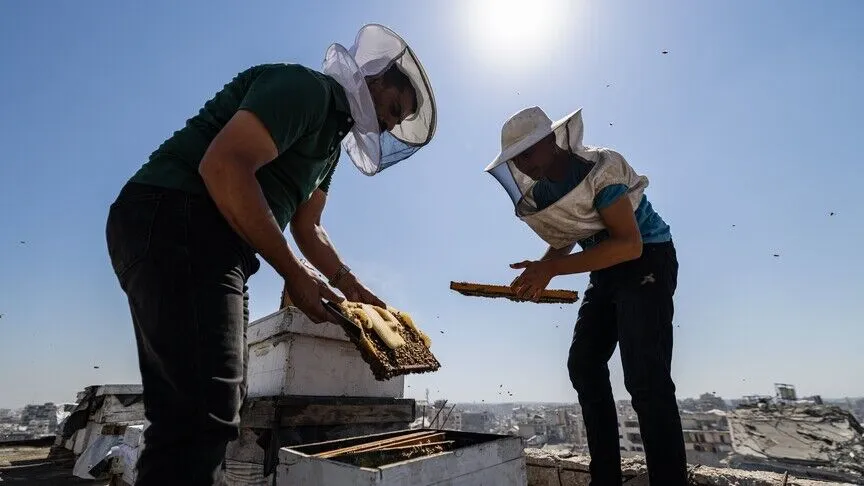
In the town of Al-Zawaida in central Gaza, Palestinian beekeeper Amin Eid and his son continue caring for the few remaining hives amid the destruction, trying to preserve a profession inherited by the family.

“Gaza had 905 beekeepers before the war and used to export locally produced honey, but the war radically changed the reality of the profession,” Eid told Anadolu.

“The Israeli army’s advance and the imposition of the so-called ‘Yellow Line’ prevented beekeepers from reaching areas east of Salah al-Din Street, which had been among the main grazing zones for bees,” he said.

“The beekeeper who used to own 300, 400 or even 500 hives now has only 10 or 20 and is trying to start again with the fewest resources and highest costs,” Eid said.

The “Yellow Line” refers to the separation line to which the Israeli army withdrew under the first phase of a US plan to end the war in Gaza, which took effect in October 2025.

“Insecurity and continued restrictions on access to eastern areas are preventing beekeepers from relocating their hives, as any attempt to move them there puts their owners at risk,” Eid said.

He also pointed to soaring production costs, saying a box of wax sheets has risen from around 30 shekels ($9,83) before the war to between 1,200 shekels ($393,20) and 1,500 shekels ($491,50), while the price of a hive frame has reached 15 shekels ($4,92) to 20 shekels ($6,55).

Severe shortage

Beekeepers also face a severe shortage of wood and boxes needed to rebuild hives. The crisis worsened after some people used parts of damaged hives as firewood during fuel shortages and famine.

Eid urged international organizations and agricultural groups to provide beekeeping supplies, including wax, frames, boxes and sugar, and to enable beekeepers to access safe natural grazing areas.

“Gaza has the capacity to produce high-quality natural honey, but Israeli restrictions prevent it from using these resources,” he said.

“We used to call honey yellow gold,” he said. “We can achieve self-sufficiency if supplies are available and grazing areas are reopened.

There is no need to import honey when beekeepers can produce natural Palestinian honey.”

​​​​​​​Despite the destruction, Gaza’s beekeepers continue to seek alternatives to preserve their hives, including moving them to coastal areas and residential neighborhoods and relying on small wild plants, as the sector remains a key source of food security and income for hundreds of Palestinian families struggling to survive. Anadolu

CrossFireArabia

CrossFireArabia
Dr. Marwan Asmar holds a PhD from Leeds University and is a freelance writer specializing on the Middle East. He has worked as a journalist since the early 1990s in Jordan and the Gulf countries, and been widely published, including at Albawaba, Gulf News, Al Ghad, World Press Review and others.

Related Posts

Mojtaba Khamenei in ‘Full Physical Health’

Iranian President Masoud Pezeshkian said Monday that Supreme Leader Mojtaba Khamenei is in “full physical health” following a seven-hour meeting.

“We met with the Leader of the Revolution and discussed all manner of issues. Physically, he was in full health,” Pezeshkian said during a meeting cited by the semi-official Tasnim news agency.

“He offered his guidance, and I raised the concerns and problems. He listened to what I had to say with ease,” he added.

The official IRNA news agency earlier reported that Khamenei and Pezeshkian held a seven-hour long meeting to discuss challenges facing the country.

“Maintaining unity and cohesion was the most important advice that the Supreme Leader of the Revolution emphasized,” Pezeshkian said.

He added that the meeting primarily focused on people’s livelihoods, employment and housing, as well as “the problems caused by sanctions.”

Iran is engaged in a military conflict with Washington since the US and Israel launched a joint offensive against Tehran in February, fueling regional tensions. Iran retaliated with attacks targeting regional countries hosting US military assets.

Iran and the US agreed to a ceasefire in April and subsequently signed a memorandum of understanding in June aimed at ending their military conflict and reaching a lasting peace agreement.

​​​​​​​The deal, however, collapsed last month with Tehran and Washington exchanging attacks for nearly two weeks before US President Donald Trump abruptly halted the bombardment amid reports of talks to resolve the conflict according to Anadolu.

Continue reading
Facing The Israeli Gun: 108 Cases Against Journalists in July

The Freedoms Committee of the Palestinian Journalists Association has documented 108 cases of crimes, attacks, and violations against journalists and media workers in last July 2026. These included arrests, beatings, interrogations, detentions, and prevention from covering events, as well as attacks with stun grenades and tear gas, settler assaults, raids on homes and media outlets, and the confiscation and destruction of equipment.

The Freedoms Committee confirmed that 58 cases of detention and prevention from covering events topped the list of documented violations in that month of July, while restrictions on journalists’ work continued as they covered events in the field.

The committee also recorded 11 attacks by settlers against journalists and media crews, including physical assault, pushing, threats, and preventing journalists from carrying out their work, particularly while covering events and attacks in various areas of the West Bank.

The committee also documented 12 cases of journalists being targeted with stun grenades and tear gas, which in several instances resulted in journalists suffering from suffocation while covering raids, attacks, and field events.

Regarding physical assaults, the Committee documented six cases of beatings, in addition to four cases of journalists sustaining serious injuries while performing their journalistic duties and covering events in the Gaza Strip. These injuries included those caused by shrapnel from rockets and shells.

Concerning arrests, the committee documented two cases of journalists being detained, while also recording four cases of interrogation, as part of measures targeting journalists while performing their work or due to their journalistic activities.

The committee also monitored four cases of raids on homes and media outlets, some of which involved searches, tampering with contents, and interrogations of journalists. Additionally, one media outlet was closed and its contents confiscated.

With regard to journalistic equipment, the committee recorded three cases of confiscation and destruction of equipment, along with two cases of deletion of video footage during the prevention of journalists from covering events or attacks against them while performing their duties.

The Committee for Freedoms also documented two cases of journalists being barred from Al-Aqsa Mosque, where decisions were issued preventing them from entering the mosque’s courtyards for specific periods.

The field reports documented by the Committee during the month show that the attacks were not limited to one type of violation, but extended from arrest, interrogation, and detention to physical assault, targeting with tear gas and stun grenades, as well as preventing coverage, confiscating equipment, and deleting footage.

These findings confirm the continued exposure of Palestinian journalists to multiple risks and restrictions while performing their professional duty of reporting and documenting events, amidst repeated instances of prevention, detention, and attacks on media crews in various locations.

The Palestinian Journalists Association demands guarantees for the protection of journalists and their ability to perform their work without threats, attacks, or harassment. It also calls for respect for press freedom and the public’s right to access information, and for holding accountable those responsible for attacks and violations against journalists and media crews. Quds Press

Continue reading

You Missed

Oliver Stone: Israel’s Policy on Palestine Will be Judge by History as One of The Darkest…

Oliver Stone: Israel’s Policy on Palestine Will be Judge by History as One of The Darkest…

Gaza: No Trucks, No Aid, Israeli-style

Gaza: No Trucks, No Aid, Israeli-style

Israeli Holds 1700 Palestinian Remains For Bargaining

Israeli Holds 1700 Palestinian Remains For Bargaining

View of The Abu Taha Family in Yafa, 1940

  • By marwan
  • August 10, 2026
  • 10 views
View of The Abu Taha Family in Yafa, 1940

Mojtaba Khamenei in ‘Full Physical Health’

  • By marwan
  • August 10, 2026
  • 12 views
Mojtaba Khamenei in ‘Full Physical Health’

Melissa Barrera: ‘I am Not Afraid of Losing My Career…’

Melissa Barrera: ‘I am Not Afraid of Losing My Career…’