Israel Seeks to ‘Expand’ War on Gaza

Israel’s security cabinet is expected to decide this week whether to expand the nearly 22-month war in the Gaza Strip and on the future of ceasefire negotiations, Israeli media reported.

Channel 12 television said the security cabinet will discuss the option of intensifying attacks on Gaza, even at the risk of endangering the lives of Israeli hostages in the enclave.

The plan has divided Israel’s leadership.

Strategic Affairs Minister Ron Dermer, Finance Minister Bezalel Smotrich, National Security Minister Itamar Ben-Gvir, Prime Minister Benjamin Netanyahu’s military secretary Maj. Gen. Roman Gofman and Cabinet Secretary Yossi Fuchs reportedly support expanding the offensive.

Advocates for pursuing a ceasefire and prisoner exchange include Israeli army Chief of Staff Eyal Zamir, Foreign Minister Gideon Saar, Shas Party leader Aryeh Deri — who recently withdrew from the government — National Security Adviser Tzachi Hanegbi, Mossad Director David Barnea, Nitzan Alon, who is overseeing the hostage file for the military, and members of the Shin Bet negotiating team.

Netanyahu and Defense Minister Israel Katz are undecided on whether to intensify attacks or continue negotiations, according to the report.

Channel 13 also said that Zamir expressed to his close circle concerns that expanding the attacks could endanger the lives of the hostages and that he would not approve such moves without clear political orders.

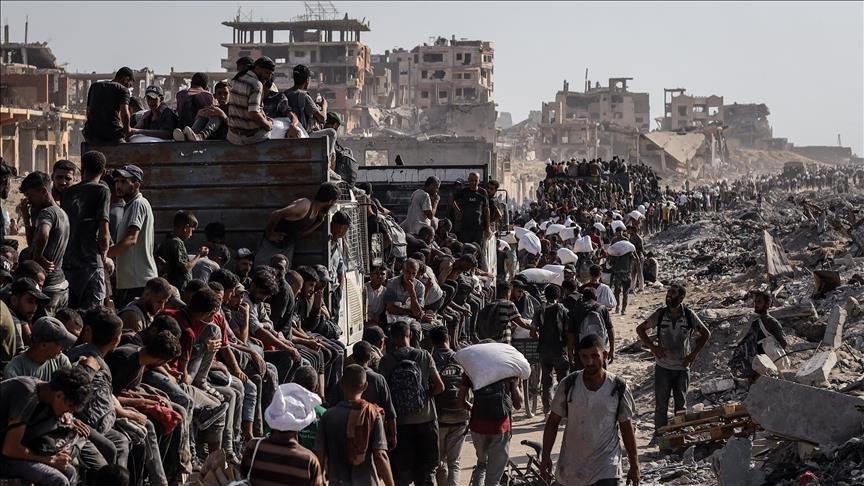
Separately, the Haaretz daily reported that preparations are underway for expanding Israeli military operations in Gaza, which is already facing a humanitarian disaster due to the ongoing assault.

The report said that Zamir is expected to approve a “phased attack plan.” Under the new plan, “sensitive areas” — including refugee camps sheltering Palestinians who have been displaced multiple times — would be targeted in ground offensives.

The army has so far avoided such ground attacks in these areas due to the Israeli hostages, the report said, but the new plan is expected to be presented to the government.

A senior Israeli official told Haaretz that “there is a growing understanding that Hamas is not interested in a deal.”

“Therefore, the prime minister is pushing for the release of hostages as part of a military resolution, combined with the delivery of humanitarian aid to areas outside combat zones and, as much as possible, to regions not under Hamas control.”

The Israeli army, rejecting international calls for a ceasefire, has pursued a brutal offensive on Gaza since Oct. 7, 2023, killing more than 60,800 Palestinians, most of them women and children.

Last November, the International Criminal Court issued arrest warrants for Netanyahu and his former Defense Minister Yoav Gallant for war crimes and crimes against humanity in Gaza, according to Anadolu.

Israel also faces a genocide case at the International Court of Justice for its war on the enclave.​​​​​​​

  • CrossFireArabia

    CrossFireArabia
    Dr. Marwan Asmar holds a PhD from Leeds University and is a freelance writer specializing on the Middle East. He has worked as a journalist since the early 1990s in Jordan and the Gulf countries, and been widely published, including at Albawaba, Gulf News, Al Ghad, World Press Review and others.

    Related Posts

    US/Israel Used 3000 Missiles in First 36 Hours of War

    More than 3,000 precision-guided munitions and interceptors were used in the first 36 hours of the US-Israeli offensive against Iran, revealing a major weakness in the supply chain.

    Estimates by the Payne Institute indicated that Iran launched over 1,000 weapons across the region, including around 380 ballistic missiles, 700 Shahed drones, and 50 air defense missiles, prompting large-scale interception attempts by the US, Israel, and Gulf countries that have been targets of Iranian retaliatory attacks.

    During the opening phase of the campaign, US forces used a wide range of offensive weapons, including 210 JDAM precision-guided bombs, 120 Tomahawk cruise missiles, 120 low-cost drones, and 90 AGM-88 anti-radiation missiles targeting Iranian radar systems.

    Israeli forces also conducted extensive strikes, using about 280 Spice-guided bombs, 140 smart bomb kits, 70 Rampage supersonic missiles, and 50 Delilah cruise or loitering missiles, according to the estimates.

    Defensive systems were also heavily used to intercept Iranian attacks. The US fired approximately 180 SM-2/SM-3/SM-6 naval interceptors, 90 Patriot PAC-2/PAC-3 missiles, and 40 THAAD interceptors, while Israel deployed 70 Iron Dome Tamir interceptors, 40 Arrow missiles, and 35 David’s Sling interceptors.

    Regional partners also participated in air defense efforts, with Gulf states launching about 250 Patriot PAC-3 interceptors and 30 THAAD missiles, the estimates showed.

    The intense exchange of missiles and drones underscored a broader strategic challenge, according to media reports. While defensive systems have largely intercepted incoming attacks, the cost and volume of munitions used are placing significant strain on Western supply chains.

    Replenishing these arsenals is not only a financial challenge but also a supply-chain issue tied to critical minerals, including cobalt, tungsten, and rare earth elements that are essential for guidance systems, electronics, and rocket motors.

    Many of these materials are sourced from limited suppliers, with China dominating several key mineral markets, raising concerns that prolonged conflict could expose vulnerabilities in Western defense manufacturing capacity. Anadolu

    Continue reading

    You Missed

    Iran Halts Attacks on Neighboring States Unless…

    Iran Halts Attacks on Neighboring States Unless…

    Iranian govt spokesman: 30% of victims are children; 165 of them killed among 1300 civilians who died by US/Israeli bombing

    Iranian govt spokesman: 30% of victims are children; 165 of them killed among 1300 civilians who died by US/Israeli bombing

    White House: ‘We destroyed more than 30 Iranian ships and are moving to destroying the navy completely’

    White House: ‘We destroyed more than 30 Iranian ships and are moving to destroying the navy completely’

    White House: ‘We Have 4 to 6 Weeks to End The Military Operations in Iran’

    White House: ‘We Have 4 to 6 Weeks to End The Military Operations in Iran’

    IRGC: Iran Has Not Closed The Hormuz Strait Except to Ships Linked to Israel/USA

    IRGC: Iran Has Not Closed The Hormuz Strait Except to Ships Linked to Israel/USA

    Hezbollah Launches 18 Rockets on Israel

    Hezbollah Launches 18 Rockets on Israel