Jennifer Lopez Donates $4.5 M to Gaza

American singer and songwriter Jennifer Lopez donated $4.5 million in humanitarian aid to support Palestinians in Gaza.

The fund aims to alleviate people’s suffering and provide assistance to medical facilities in the strip.

CrossFireArabia

CrossFireArabia

Dr. Marwan Asmar holds a PhD from Leeds University and is a freelance writer specializing on the Middle East. He has worked as a journalist since the early 1990s in Jordan and the Gulf countries, and been widely published, including at Albawaba, Gulf News, Al Ghad, World Press Review and others.

Related Posts

Sliman Mansour: The Artist Who Carried Palestine on His Canvas

CROSSFIREARABIA – The old Palestinian bends forward beneath an almost impossible weight. His face is tired, his body appears exhausted and ropes cut across his shoulders. Yet what he carries is not an ordinary load.

On his back is Jerusalem.

For more than half a century, Palestinian artist Sliman Mansour painted variations of that same burden: A people carrying a homeland through occupation, dispossession, exile and war, yet refusing to put it down.

Mansour, one of the towering figures of Palestinian art, died on Monday, 24 August, at the age of 79. He leaves behind hundreds of works and an artistic language so deeply woven into Palestinian identity that some of his images long ago escaped the confines of galleries and became part of popular culture.

His best-known painting, Jamal al-Mahamel — “Camel of Hardships” or “Camel of Burdens” — became perhaps the defining image of his career.

Created in the early 1970s, it depicts an elderly Palestinian porter struggling forward with Jerusalem strapped to his back. The Dome of the Rock rises from the city he carries.

The image became enormously popular. It was reproduced as posters, cards and prints and appeared in Palestinian homes and refugee camps and far beyond Palestine. Its significance was immediately understandable: Palestinians might be separated from their homeland, but they continued to carry it with them.

It was an extraordinary achievement for a painter.

Mansour had transformed a political argument into an image.

Painting Palestine Into Existence

Born in Birzeit in 1947, Mansour belonged to the generation whose lives unfolded alongside the great ruptures of modern Palestinian history.

He studied art in Jerusalem and emerged as a significant artist after the 1967 war, when questions of land, identity, occupation and displacement increasingly dominated Palestinian cultural life. From the 1970s onward, his paintings helped establish what became a recognisable visual language of Palestinian resistance and identity.

Look closely at Mansour’s paintings and the same symbols repeatedly emerge.

There are olive trees.

There are orange trees.

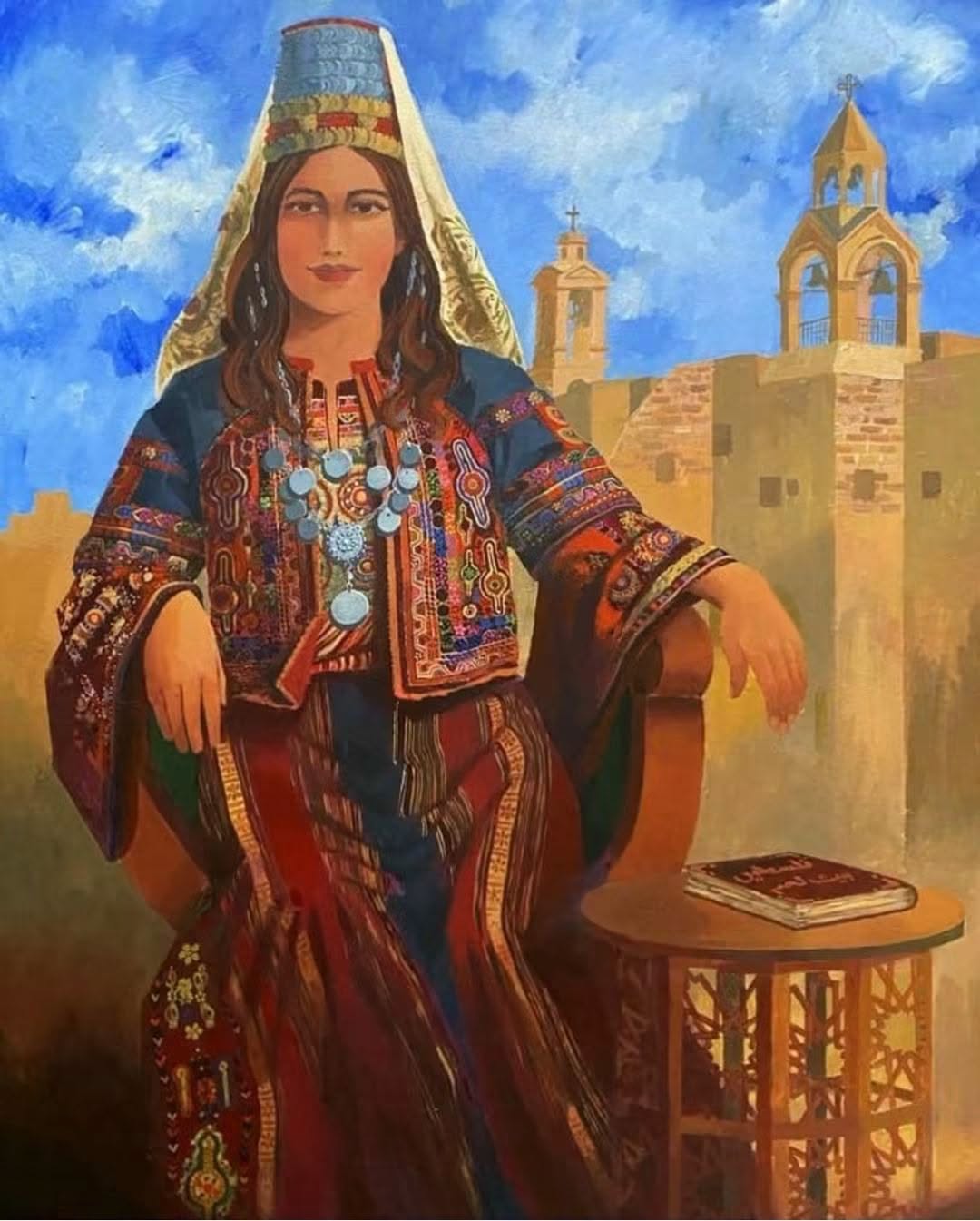
There are Palestinian women wearing elaborately embroidered traditional dresses.

There are peasants, villages, stone terraces and agricultural landscapes.

And there is Jerusalem.

None of these elements were accidental.

The orange tree could evoke the Palestinian lands and communities lost during the Nakba of 1948. The olive tree represented rootedness and attachment to land and became associated in Mansour’s visual vocabulary with the territories occupied in 1967. Traditional embroidery carried memory, place and identity. Palestinian women frequently appeared as almost maternal representations of Palestine itself according to the Routledge Encyclopaedia of Modernism.

Mansour therefore rarely needed to paint politicians.

He painted Palestine instead.

And that was political enough.

When Paint Itself Became Political

Perhaps the clearest example of how completely Mansour intertwined politics and art came during the First Intifada.

Palestinians were being encouraged to boycott Israeli products. Mansour and fellow artists Vera Tamari, Tayseer Barakat and Nabil Anani developed the artistic movement known as New Visions.

Their response was remarkable.

Why, they asked in effect, should Palestinian artists resisting occupation paint their resistance using materials purchased from the occupying economy?

They began rejecting imported and Israeli art supplies and experimenting instead with materials taken from the Palestinian environment — mud, clay, coffee, henna, straw and other locally available substances.

The politics had moved beyond the subject of the painting.

Now it was inside the painting itself.

Palestinian earth was no longer merely something Mansour depicted.

Palestinian earth became the material with which he made art.

The Palestinian Museum has described the New Visions artists as responding directly to the Intifada’s boycott campaign by using natural Palestinian materials. The movement became an important episode in the development of contemporary Palestinian art as highlighted in The Palestinian Museum⁠.

For Mansour, this was not simply artistic experimentation. It represented an extraordinary merging of culture, economics, resistance and national identity.

A painting made from Palestinian soil carried a meaning that imported paint could not.

Art Under Occupation

There was another reason Mansour understood art politically: Palestinian artists themselves encountered the mechanisms of occupation.

Mansour recalled that exhibitions were censored, artworks confiscated and artists imprisoned. He said Israeli authorities even prohibited Palestinian artists from using the four colours associated with the Palestinian flag — red, green, black and white as per the Jerusalem Story⁠.

That experience helped transform art into another contested Palestinian space.

A painting could be seized.

A poster could be forbidden.

Colours could become political.

An olive tree could represent resistance.

Jerusalem could be carried on an old man’s shoulders.

And a traditional Palestinian dress could become an assertion that a culture threatened by displacement remained alive.

That is where Mansour’s importance extends beyond painting.

He helped make memory itself a form of resistance.

The Art of Sumud

One word repeatedly associated with Mansour’s work is sumud — steadfastness.

It is difficult to find a better description.

His Palestinians are not usually superheroes. They are villagers, mothers, labourers and elderly people. They can appear tired, contemplative or burdened.

But they remain.

The olive tree remains.

The village remains.

The embroidered dress remains.

Jerusalem remains.

And even when Palestinians themselves have been displaced, Mansour’s paintings insist that their relationship with the land has not disappeared.

That explains why Jamal al-Mahamel became so powerful.

The elderly man is visibly exhausted. Jerusalem is almost impossibly heavy.

Yet he does not drop it.

The United Nations has described Mansour’s work as providing a visual translation of sumud, while his imagery became part of Palestinian collective identity and a cornerstone of the country’s visual culture as per United Nations Digital Library⁠.

More Than One Famous Painting

The enormous popularity of Jamal al-Mahamel sometimes obscured the breadth of Mansour’s work.

His paintings repeatedly returned to Palestinian women, rural communities, Jerusalem, dispossession and the landscape.

In Jerusalem in the Heart, the city is held close to the body of a Palestinian woman, with the golden Dome of the Rock forming the visual centre of the composition.

Elsewhere, olive trees stand almost like human witnesses.

His women wear Palestinian embroidery not merely because it is beautiful but because embroidery itself carries geography and memory. Patterns traditionally associated with particular towns and villages become declarations of origin.

The land, meanwhile, is rarely simply background scenery.

Terraces, hills, villages and trees demonstrate human attachment to place.

For a population repeatedly confronted with displacement, Mansour’s landscapes effectively say:

We were here. We worked this land. We remember it. We belong to it.

An Artist Who Helped Build an Art Movement

Mansour’s contribution was also institutional.

He helped establish and develop organisations that gave Palestinian artists spaces in which to work, exhibit and teach. He was associated with the League of Palestinian Artists, later helped establish the Al-Wasiti Art Center in East Jerusalem, taught generations of younger artists and participated in the development of Palestinian artistic institutions. His work was exhibited internationally and received major Arab and international recognition.

His importance, therefore, cannot be measured by Jamal al-Mahamel alone.

He belonged to a generation that helped establish modern Palestinian visual culture under extraordinarily difficult political circumstances.

There was another dimension to this achievement.

Palestinian art was doing something that politics alone could not always accomplish.

It could cross borders.

A painting required no passport.

A poster could travel where its creator could not.

An image of an old man carrying Jerusalem could be understood in Ramallah, Amman, Beirut, Cairo, London or New York.

Mansour helped turn Palestinian art into a vehicle through which Palestinians could tell their own story.

Palestine Without a Speech

Perhaps that is the secret of Sliman Mansour’s longevity.

His paintings are unmistakably political, yet many do not resemble conventional political art.

There are no lengthy manifestos written across his canvases.

Instead there is an old man.

A woman.

A tree.

A village.

A dress.

A handful of Palestinian soil.

And Jerusalem.

The politics comes from what these things have been forced to mean.

When a people fear losing their land, painting an olive tree becomes political.

When villages have disappeared, painting the old landscape becomes political.

When displacement threatens memory, painting traditional Palestinian dress becomes political.

And when sovereignty over Jerusalem remains at the centre of one of the world’s longest conflicts, painting an elderly Palestinian carrying the entire city upon his shoulders becomes intensely political.

That was Mansour’s particular genius.

He did not merely paint Palestinian politics.

He painted the human weight of being Palestinian.

The Palestinian Ministry of Culture, announcing his death, said Mansour’s work had become part of the Palestinian people’s visual and national memory and described his paintings as witnesses to Palestinian history and guardians of identity.

It is difficult to imagine a more appropriate description.

Sliman Mansour spent more than half a century painting a people determined not to disappear.

Now Palestine says goodbye to the painter.

But the old man in Jamal al-Mahamel continues walking.

Bent beneath the weight, exhausted perhaps, but still carrying Jerusalem.

And still refusing to put it down.

Continue reading

You Missed

Gaza: Bringing the Dead Home From Beneath the Rubble

  • By marwan
  • August 25, 2026
  • 12 views
Gaza: Bringing the Dead Home From Beneath the Rubble

Sliman Mansour: The Artist Who Carried Palestine on His Canvas

Sliman Mansour: The Artist Who Carried Palestine on His Canvas

Morocco-Israel: Normalization Stops at The Top

  • By Heba
  • August 24, 2026
  • 4 views
Morocco-Israel: Normalization Stops at The Top

Albanese Calls For World Force to Protect Civilians in Gaza, West Bank

Albanese Calls For World Force to Protect Civilians in Gaza, West Bank

40 Million Tons of Rubble: Gaza Ministry Faces Challenges in Removing it

40 Million Tons of Rubble: Gaza Ministry Faces Challenges in Removing it

Join The Queue For The Drops

Join The Queue For The Drops