Keeping Israel’s Secret in The Closet

Israel continues, in a deliberate and institutionalised manner, to implement a systematic policy aimed at erasing physical evidence of genocide, war crimes, and crimes against humanity committed over the past two years in the Gaza Strip. This policy is carried out through a series of field and administrative measures, including the prevention of international journalists and independent investigation committees from entering Gaza, in an attempt to obstruct any criminal investigation or field documentation that could establish the truth and confirm Israel’s legal responsibility.

The recent decision by the Israeli Supreme Court granting the government an additional delay regarding the entry of independent journalists into Gaza reflects the institutional complicity within the Israeli state apparatus in concealing crimes and protecting their perpetrators. The judiciary thus provides a legal cover for government policies designed to suppress transparency and erase field evidence of crimes committed in Gaza.

The continued prevention of international journalists and investigators from entering Gaza forms part of a consistent and coordinated policy exercised by Israeli authorities through their executive, security, and judicial arms to keep the crimes beyond international scrutiny and obstruct any independent accountability or investigation into the grave violations committed.

The ongoing ban on independent journalists entering Gaza represents a long-standing Israeli policy since the beginning of the military assault on the Strip. It aims to deprive the world of witnessing the reality on the ground by imposing a complete media blackout and preventing all documentation and international monitoring tools from accessing the crime scenes.

Despite the enforcement of the ceasefire agreement on 11 October, Israel continues to deny entry to international journalists, except for limited tours organised under the supervision and escort of the Israeli army. As a result, all scenes shown from the field remain under military censorship and devoid of the independent coverage guaranteed by international standards of press freedom.

The killing of 254 Palestinian journalists and the ban on the entry of international media workers exemplify an integrated Israeli policy aimed at concealing the truth and monopolising the narrative by maintaining tight control over the media scene and preventing any independent oversight or field documentation. This policy not only withholds information but also strips victims of their right to tell their story to the world, turning their tragedy into a one-sided account narrated by the very perpetrator of the crime.

Israel’s actions to erase evidence of genocide include continuing to prevent the entry of the UN-mandated Independent International Commission of Inquiry on the Occupied Palestinian Territory, the investigation team of the International Criminal Court, as well as fact-finding missions and other international mechanisms specialised in investigating grave crimes. This deliberate obstruction of international justice constitutes a violation of Israel’s obligations under international humanitarian law.

Israeli authorities also block the entry of forensic teams and forensic anthropology experts who should secure crime scenes, examine human remains, and document biological and physical evidence proving mass killings, genocide, and the use of prohibited weapons and projectiles. This obstruction undermines a fundamental pillar of international criminal investigation, aiming to destroy material evidence before examination, deny victims and their families the ability to identify their loved ones, and prevent the international community from verifying the nature and scale of the crimes committed.

Israel further refuses to allow the entry of essential equipment and materials needed for exhuming bodies and identifying victims, including laboratory tools, autopsy instruments, and DNA analysis kits. This has left hundreds of bodies unidentified and deprived families of their basic human right to know the fate of their loved ones and bid them farewell with dignity.

Among these are around 195 bodies that Israel handed over without any details about their identities or circumstances of death, many of which showed clear signs of torture and summary execution. These findings indicate extrajudicial killings and inhumane treatment of Palestinian detainees and prisoners, including those subjected to enforced disappearance.

The continued retention of bodies and prevention of independent investigations constitute an additional form of collective punishment against Palestinian families, denying victims their basic human right to be identified and buried with dignity.

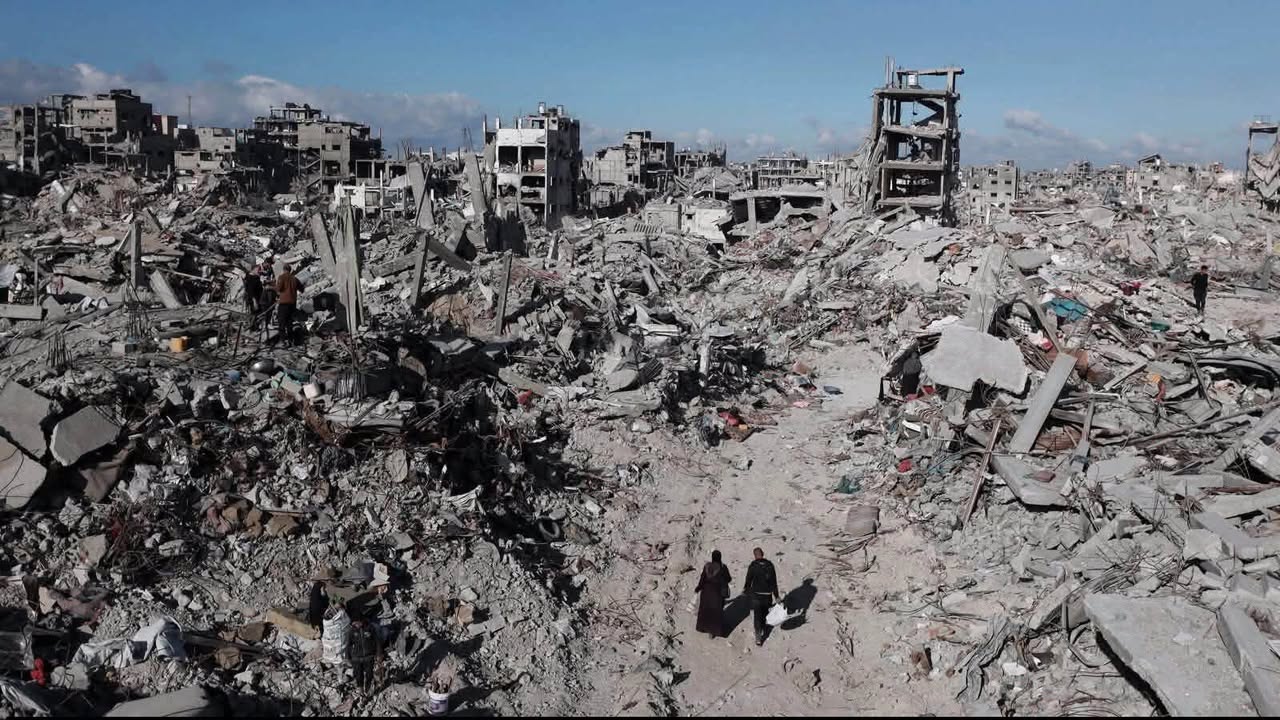
Israel has also carried out the total erasure of several cities, towns, villages, camps, and residential blocks where horrific mass killings occurred. Satellite images and field testimonies documented show that Israeli forces removed the surface layers of the ground, levelled targeted areas, destroyed rubble, and transferred it to unknown locations, effectively erasing potential physical evidence such as munitions remnants, bodies, original patterns of destruction, and explosion traces.

Israel continues to exercise full, unlawful military control over roughly 50 per cent of the Gaza Strip, reshaping the geography entirely through demolitions, bombardments, and bulldozing, and establishing new military routes and bases atop the ruins of destroyed buildings and farmland. This goes beyond military occupation, amounting to an engineered redesign of the field landscape to erase material evidence and prevent future verification of the crimes committed.

Israeli military deployment in these areas, coupled with the targeting of anyone approaching what it calls the “yellow line”, effectively isolates half of the Strip and turns it into a no-go zone, blocking journalists, researchers, and humanitarian teams from entering and preventing any genuine field documentation of the mass killings and widespread destruction that took place there.

Such acts constitute a flagrant violation of fundamental principles of international humanitarian law, which obligate parties to a conflict to preserve crime scenes until independent investigations are completed and to ensure that evidence is not tampered with. They also contravene the International Court of Justice’s ruling obligating Israel to take all necessary measures to prevent genocide, including preserving evidence and preventing its destruction.

Israel continues to withhold hundreds, possibly thousands, of bodies, including those of Palestinian prisoners and detainees killed under unclear circumstances, preventing autopsies and forensic examinations that could verify causes of death. This is a blatant violation of Article 130 of the Third Geneva Convention, which obliges occupying powers to respect the remains of the deceased and return them to their families without delay.

Denying victims justice and preventing the world from knowing the truth are not merely additional violations but an extension of the crime of genocide itself. Through these actions, Israel seeks to erase the traces of its crimes, obliterate collective memory, and strip Palestinians of their right to narrate their story and existence, attempting to eliminate both the victim and the evidence of their existence.

The international community and relevant United Nations bodies must ensure the immediate entry of international journalists and correspondents into the Gaza Strip and enable them to work freely and independently, without military oversight or escort. This is essential to guarantee transparency, expose the truth about the crimes committed, and allow urgent international access for forensic experts and specialists in forensic anthropology and explosives to secure crime scenes and collect physical and biological evidence before it is lost or tampered with.

Reconstruction and debris removal in areas where massacres occurred must be carried out with full consideration of evidence preservation and documentation, as any reconstruction effort that fails to do so will effectively serve as a tool to erase the truth and destroy the forensic memory of the crimes committed.

The international community and UN agencies are urged to support the establishment of a specialised framework for managing Gaza’s debris that links reconstruction and dismantling processes to the preservation and documentation of evidence—making adherence to this framework a prerequisite for any construction or debris removal activity.

There is also an urgent need to disclose the lists of the forcibly disappeared, missing persons, and bodies, reveal burial locations, return remains to their families, and allow international and UN mechanisms to conduct independent investigations into the crimes committed. Perpetrators must be brought to justice before international courts to ensure accountability, compensation, and redress for victims and their families.

The UN Human Rights Council should act swiftly to activate and reinforce existing monitoring and investigation mechanisms, enabling them full access to the Gaza Strip to protect crime scenes and ensure that evidence is not destroyed or altered. These mechanisms must be provided with the necessary technical and logistical support to operate independently and effectively.

The International Criminal Court must expand its ongoing investigation into the situation in Palestine to include the ongoing genocide and the systematic erasure of evidence, and take practical measures to protect crime scenes and related evidence. This includes establishing a dedicated field office for Palestine, similar to the one created for Ukraine, to coordinate on-site investigations, collect forensic evidence, and ensure continuous international oversight over the investigation process.

Any delay in such intervention will grant Israel more time to complete the destruction of evidence and the physical traces of its crimes, undermining the international community’s duty to protect truth and uphold justice. Saving the truth in Gaza is no longer merely a moral obligation, but a legal and humanitarian imperative that cannot be delayed.

EuroMed Human Rights Monitor

CrossFireArabia

CrossFireArabia

Dr. Marwan Asmar holds a PhD from Leeds University and is a freelance writer specializing on the Middle East. He has worked as a journalist since the early 1990s in Jordan and the Gulf countries, and been widely published, including at Albawaba, Gulf News, Al Ghad, World Press Review and others.

Related Posts

Israel Ethnically Cleanses South Lebanon

By Lylla Younes

BEIRUT—On March 28, George Saeed, 62, and his 24-year-old son Elie were driving back to their home in Debel, a village in southern Lebanon close to the border with Israel. It was a route Saeed knew well. He ran a small laundromat beneath his house, where he washed uniforms for a Polish unit in the United Nations peacekeeping force stationed in the nearby village of Tiri. The trip from Tiri used to take a few minutes, but after the main road was bombed by the invading Israeli military he had begun taking a longer route through the neighboring village of Rmeich.

That afternoon, villagers saw George’s car pass through Rmeich and enter Debel, disappearing along the village’s steep, winding roads. When they were roughly 60 meters from their house, the crackle of gunfire rang out, followed by the blare of a stuck car horn.

Elie Louqa, Saeed’s nephew and the former mayor of Debel, was in Beirut when he got a call from his brother describing what had happened. He began contacting UN peacekeepers (UNIFIL), the Lebanese Army, and the Red Cross, asking them to reach the car. Both the Red Cross unit in Rmeich and the nearby UNIFIL contingent told Louqa they could not secure permission from their superiors to move.

After about 90 minutes, a group of young men from the village decided to go themselves. Carrying white blankets and mattresses to signal they were civilians, they reached the site of the attack and found the father and son dead inside their bullet-ridden car. They pulled the bodies out and carried them to the village cemetery for burial.“You won’t find a man with cleaner hands. He was generous to a fault,” Louqa told Drop Site News. “Go and ask the people of our villages who George Saeed was.

”The killings were just one in a series of attacks on residents of several villages along the southern border who have chosen to remain in their homes despite repeated sweeping displacement orders by the Israeli military covering all of southern Lebanon.

Earlier this week, the Lebanese army announced its forces had withdrawn from southern border villages, leaving residents without even the semblance of protection. At least six Lebanese soldiers have been killed by Israel over the past month. The army said its troops had to “reposition” as they were being encircled and cut off from their supply lines but claimed it continued to “stand by residents” by “maintaining a group of military personnel” in the villages. What this meant in practice, according to residents, was that soldiers from the area could stay in their homes provided they did not wear army uniforms or carry arms.

“We don’t know why the army made this decision,” said Boutros al-Rai, a local farmer and civilian administrator. “For us, its presence made us feel protected.”Drop Site News is reader-supported. Consider becoming a free or paid subscriber.

Lebanon is being ravaged as Israel’s escalated assault enters its second month. More than 1,300 people have been killed, including over 120 children, and over 4,000 injured in a relentless onslaught. Israel has issued displacement orders covering around 15% of Lebanese territory and more than 1.1 million people—about a fifth of the country’s population—have been forced from their homes. Emergency workers have also been increasingly targeted, with over 50 killed over the past four weeks.

Despite a ceasefire agreement in November 2024, Israel continued to carry out near daily attacks and occupied five hilltop positions on Lebanese territory. When Hezbollah fired rockets into Israel on March 2 in solidarity with Iran after the U.S. and Israel launched a war on Tehran, Israel launched a full scale aerial assault and ground invasion on Lebanon.

Israeli Defense Minister Israel Katz announced on Tuesday that the Israeli military plans to occupy the entire area south of the Litani River and will not allow hundreds of thousands of residents to return to their homes, making a reference to areas in Gaza that have been completely razed in the genocide. “The return of over 600,000 residents of the area south of the Litani River will be completely prohibited until the safety and security of residents of the north is ensured, similar to the model of Rafah and Beit Hanoun in the Gaza Strip,” Katz said.

The Israeli military also appears to be engaged in a campaign to ethnically cleanse southern Lebanon of its Shia residents. Around three weeks ago, Israeli military officials called the heads of a cluster of majority Christian villages in southeastern Lebanon and ordered them to force out any “displaced people” that had taken refuge there, according to a municipal official in one of the villages, who spoke to Drop Site on condition of anonymity. “Displaced people” was a thinly-veiled reference to Shia residents who had been forced to flee nearby towns like Khiam.

U.S. Ambassador to Lebanon Michel Issa used explicitly sectarian language two weeks ago in referencing Israel’s military campaign in the south. “We asked the Israelis to leave the Christian villages in southern Lebanon and requested that the army keep a unit stationed there,” Issa said in a meeting with Maronite Patriarch Cardinal Mar Bechara Boutros Rah.

Over the past week, the Israeli military made a new round of phone calls to leaders in majority Sunni villages Chebaa and Kfarchouba, warning them to not accept any non-locals into their village. Mohammad Hammoud, a spokesperson for the town of Chebaa, confirmed the authenticity of a video circulating online showing a call received on Tuesday by local leader Ibrahim Nabaa. Over the phone, an Israeli soldier warned that the village would be targeted if officials failed to keep resistance fighters out. Hammoud said that the municipality had organized a small police force to conduct patrols at night and make sure no outsiders entered—measures that, he hoped, would spare residents their homes and land.

As part of its invasion of southern Lebanon, the Israeli military is in the midst of a scorched earth campaign, systematically destroying homes and civilian infrastructure in border villages. Louqa, the former mayor of Debel, said he fielded frantic calls on Wednesday from village residents who told him that occupation forces had begun to blow up homes on the village periphery. The homes were empty, he explained, because in times of war, residents often move closer to the village center for safety.

“These homes are in Debel—not on the outskirts, not kilometers away,” Boutros al-Rai, a local official told Drop Site, adding that at least 10 houses had been demolished on Wednesday alone. “They’re blowing them up one by one. We don’t know why or how.”Around 1,700 people remain in Debel, according to al-Rai, down from 2,500 before the war. Once the escalation began on March 2, residents started making trips to the nearby village of Rmeich to buy essential goods. But after the killing of George and Elie Saeed last week, and without any support from UNIFIL or the withdrawn Lebanese army, that route was no longer considered safe.

“People have supplies for a week or two,” al-Rai said. “They rely on each other. But it’s not enough for much longer.”

Access to medical care is also severely limited. In Rmeich, where about 6,000 people remain, there is no hospital. Residents depend on coordinated evacuations, typically requiring approval from the Lebanese Army as well as UNIFIL, which then communicates with Israeli occupation forces.

Elie Shoufani, a local official and Red Cross volunteer, said the process is inconsistent. “Sometimes we get permission quickly, sometimes we don’t.”Earlier this week, a 48-year-old man, Paul Mu’awwad, went into cardiac arrest and died before he could get treatment. “We didn’t get permission to take him for emergency care,” Shoufani said, adding that Mu’awwad had left behind a wife and six children. “If we had been able to reach a hospital, he might have lived.

”Over the past month, residents in Debel, Rmeich, and nearby Ein Ebl have relied largely on aid convoys from the International Committee of the Red Cross, which in the past have been accompanied by the Lebanese army.

“Now that the army has left, we don’t know what will happen,” Shoufani said.UNIFIL troops have also limited their movement after Israeli airstrikes killed three Indonesian peacekeepers in southern Lebanon over a 24 hour period last week. Residents say this has further reduced their options.

“All we ask is for a way to move the injured or reach medical care,” Louqa said. “A mechanism to respond when we call. God will take care of the rest.”Al-Rai described the difficulty and humiliation of displacement in a state with overburdened shelters and skyrocketing rents. More than anything, he worried that if he abandoned his home, it would be destroyed by Israeli occupation forces. He, like the others in his village, was determined to stay put.

“These are our homes, our livelihoods, our villages, the homes of our parents and grandparents,” he said. “These are not places that can be left behind.” Drop Site

Continue reading
Happy Parents: Premature Babies Returned to Gaza

“I am meeting my daughter for the first time. It’s as if today is the day of her birth. I can’t describe my feelings.”

By Abdel Qader SabbahJawa Ahmad, and Sharif Abdel Kouddous

KHAN YOUNIS, GAZA—Ahmed Al-Harsh waited outside Nasser Hospital in Khan Younis on Monday to meet his son, a toddler and the only other survivor of his entire family.

“I’m waiting for my son Mahmoud. I haven’t seen him in two and a half years except once, before he was transferred to Egypt. I’ve been waiting for two and a half years,” Al-Harsh, 31, told Drop Site News.

Mahmoud is one of 28 Palestinian infants who were evacuated to Egypt as premature babies in November 2023 from the neonatal intensive care unit in Al-Shifa Hospital in Gaza City, as the Israeli military laid siege to the medical complex and raided it. Mahmoud and seven other children were returned to Gaza on Monday to be reunited with their families, or what was left of them.

On October 14, 2023, one week into Israel’s genocidal assault on Gaza, the Israeli military bombed the Al-Harsh’s family home in the Jabaliya refugee camp. Al-Harsh’s entire family was killed in the attack—his four-year-old daughter, his father, mother, brother, sisters-in-law, nephews, and nieces. Al-Harsh initially thought his wife, who was eight months pregnant at the time, had also been killed. He only later learned that she had been gravely injured and had given birth to their son, Mahmoud, in hospital before succumbing to her injuries.

(Left) Ahmed Al-Harsh outside Nasser Hospital in Khan Younis as he waits for his son, Mahmoud, to arrive after 2.5 years in Egypt. (Right) Ahmed Al-Harsh holds up a photo of his son Mahmoud on his phone. March 30, 2026. Screenshots of video provided by Abdel Qader Sabbah.

Al-Harsh was able to see Mahmoud only once before he was taken to the neonatal intensive care unit in Al-Shifa’s hospital for care. He had been staying in Beit Lahia, unable to move amid the escalating Israeli assault. In November, Israel laid siege to Al-Shifa hospital, surrounding the medical complex and cutting it off from the rest of Gaza City before raiding it on November 15. Doctors inside scrambled to keep their patients alive, including the nearly 40 premature babies in the hospital’s neonatal intensive care unit, Mahmoud among them. There was no electricity and incubators were failing. The World Health Organization, which was able to coordinate a one-hour visit to Al-Shifa at the time, described the hospital as a “death zone.”

After much negotiation, 31 premature babies were evacuated from Al-Shifa on November 19 and taken to Rafah. UNICEF said the conditions of the babies had been “rapidly deteriorating” inside the besieged hospital. Five died before they could be evacuated. The next day, 28 of the babies were transported across the border to Egypt for treatment. None were accompanied by family members.

For the past two and a half years, Al-Harsh has seen his son only in photos or videos sent to him from Egypt—first as an infant, then a toddler. “The feeling is indescribable. What can I tell you about this feeling?” he said. “These two years felt like forty, even more—a lifetime. During this time, I was a body without a soul. I couldn’t work or do anything.”

Video of the convoy arriving at Nasser Hospital in Khan Younis bringing eight children who were evacuated from Gaza to Egypt in November 2023. March 30, 2026. Video provided by Abdel Qader Sabbah.

By early afternoon on Monday, the convoy from Egypt finally arrived. A Red Crescent ambulance and UN vehicles escorted a large bus carrying the children. Families crowded around the doors as they pulled up outside Nasser Hospital. The children were passed into the waiting arms of family members, most of them meeting for the first time, in scenes of joy. Al-Harsh appeared overwhelmed with emotion as he held Mahmoud, chubby, bespectacled and crying, in his arms. When Mahmoud grabbed a bottle of water and drank thirstily, Al-Harsh broke down and wept.

“Every human being needs the love of a mother and father. I am 31, I lost my mother and father, and I’m still suffering,” Al-Harsh said. “This boy—where do I find him a mother? Where do I find him his mother? When he grows up and asks about his mother, what do I tell him?”

At least four of the babies who were evacuated to Egypt died while there, Dr. Ahmed Al-Farra, the director of the pediatric department at Nasser Hospital, told Drop Site. He added that the children who returned to Gaza, while healthy, would require additional medical and psychiatric evaluation.

Gaza’s health care system has been systematically destroyed by the Israeli military since October 2023. Every single hospital was attacked and 25 were completely shut down while 13 remain partially functioning, according to Gaza’s Health Ministry. Despite a “ceasefire” that went into effect in October, Israel has continued near daily attacks in Gaza, killing over 700 Palestinians since then. Israel has also continued to severely restrict the amount of humanitarian aid, fuel, medicine and other essentials, allowing in an average of only 200 trucks daily instead of the 600 agreed upon in the deal.

At the onset of the U.S.-Israeli war against Iran on February 28, Israel reinforced a total siege on Gaza, citing “security concerns.” The Kerem Shalom crossing was partially reopened three days later. The Rafah Crossing between Gaza and Egypt—which had only opened in early February for medical evacuations and for Palestinians returning to Gaza—was also closed at the onset of the Iran war and only reopened on March 18. Roughly 20,000 people are on waiting lists for medical evacuation abroad, 4,000 of them children, according to the Health Ministry.

The Gaza Health Ministry this week warned of a severe shortage of generator fuel that threatened hospital operations. The Ministry said that remaining generators are “worn out and prone to repeated breakdowns,” placing critical departments such as intensive care, surgery, neonatal units, and dialysis at risk of shutting down. Israeli forces have allowed the entry of only 1,240 fuel trucks out of the 8,350 that were supposed to enter over the 167 days since the ceasefire agreement took effect—a compliance rate of just 14.8%—according to the latest statistics from officials in Gaza shared with mediators and obtained by Drop Site. The Health Ministry warned that 90 generators are already out of service, while 11 are running on limited supplies. All hospitals in Gaza remain fully dependent on emergency back-up generators, according to OCHA.

Regardless of the continued Israeli siege and daily military assaults, the families who were finally reunited with their children in Gaza on Monday after nearly two and a half years of separation, described the moment as nothing short of miraculous.

Sundus Al-Kurd was among them. She was badly wounded in an Israeli airstrike on her family home in Beit Lahia on October 22, 2023. Her daughter Habibat Al-Rahman was killed in the attack. Eight months pregnant, Al-Kurd was rushed to hospital where doctors operated on her to save her life and conducted an emergency delivery to save her unborn daughter, Bissan.

“On the day I gave birth to my daughter, I lost her only sister,” Al Kurd said.

“When I woke up, I asked, ‘Where is my daughter?’ They told me, ‘Your daughter is fine and doing well,’” she added. “They told me she was in an incubator and that due to my health condition I wouldn’t be able to care for her.”

Al-Kurd continued to recover from her injuries and was unable to see her daughter before the Israeli military attacked Al-Shifa in November 2023.

“I was evacuated from the hospital with difficulty and I asked to take my daughter with me, but they said I wouldn’t be able to care for her due to my medical condition,” she said.

Having lost her other daughter, parents, and two siblings during the war, Al-Kurd said she could not bear the thought of losing Bissan, whom she described as “a gift and compensation from God.” Al-Kurd did not know what had happened to her daughter until much later when she found out she had been among the 28 premature babies evacuated to Egypt.

Sundus Al-Kurd holds up a traditional Palestinian dress she brought for her daughter Bissan, who returned to Gaza after being evacuated to Egypt 2.5 years ago for medical treatment. Khan Younis. March 30, 2026. Screenshot of video by Abdel Qader Sabbah.

“Today, after two and a half years, God willing, we will be reunited with our daughter,” Al-Kurd said. She brought a traditional Palestinian dress for Bissan to wear. When her daughter finally arrived in the convoy to Nasser hospital, Al-Kurd held her tightly before dressing her in the white and red dress as relatives took turns embracing her.

“I am meeting my daughter for the first time,” she said. “It’s as if today is the day of her birth. I can’t describe my feelings.” Drop Site

Continue reading

You Missed

Trump: Tunes, Ceasefire and Hormuz

Trump: Tunes, Ceasefire and Hormuz

Israeli Looters in Lebanon

  • By marwan
  • April 23, 2026
  • 17 views

Ayat, Qamar Bid Farwell to Their Martyr Dad

Ayat, Qamar Bid Farwell to Their Martyr Dad

‘We Killed Our Own Then Blamed Hamas’

‘We Killed Our Own Then Blamed Hamas’

An Unholy War!

An Unholy War!

‘Journalist Khalil Trapped Under Rubble Left to Die’

‘Journalist Khalil Trapped Under Rubble Left to Die’