Lebanon: Women Forced to Deliver on Roads

As the UN Secretary-General touched down in Beirut on Friday in solidarity with the people of Lebanon, UN agencies highlighted the dangers for civilians and particularly pregnant women and migrant workers, amid ongoing airstrikes and rocket fire between Hezbollah fighters and Israel. 

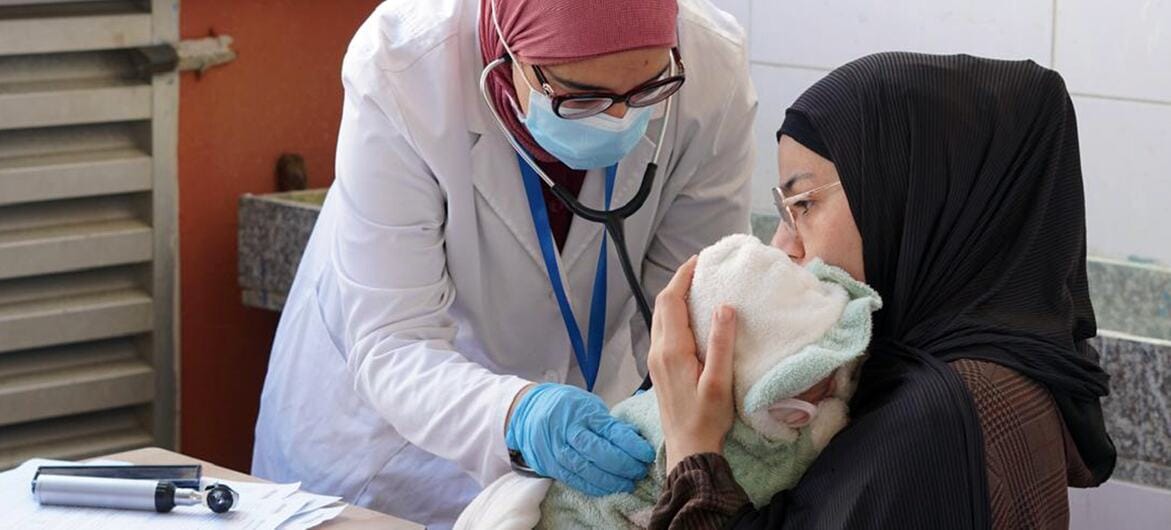
“There’s 11,600 pregnant women who are affected, 4,000 are anticipated to give birth over the next three months,” said Anandita Philipose, Lebanon Representative for the UN population fund, UNFPA

Many of these women have been forced from their homes, cut off from essential health services and forced to give birth in dangerous conditions, some even by the side of the road.”

The situation across Lebanon has escalated dramatically – and notably in the south, Beirut, Mount Lebanon and the Bekaa Valley – since war erupted across the Middle East, sparked by Israeli-U.S. strikes in Iran on 28 February, Iranian counterstrikes in many Gulf States, Hezbollah rocket fire into Israel and Israeli airstrikes in response.

Health care hit

According to UNFPA, 55 hospitals and clinics have been forced to close, either because they are in zones impacted by Israeli mass evacuation orders, “or because there’s been direct damage to them”, Ms. Philipose added.

The UN peacekeeping mission in Lebanon, UNIFIL, has recorded daily rocket, missile and drone attacks on Israel and the occupied Golan from Lebanon and artillery fire, air and drone strikes by Israeli soldiers, who have made “ground incursions up to seven kilometres (4.3 miles) into Lebanon”, said Kandice Ardiel, UNIFIL spokesperson.

Speaking via video from the force’s headquarters in Naqoura close to the Blue Line separating Lebanon from Israel, Ms. Ardiel highlighted a significant escalation on Wednesday evening. That involved more than 100 projectiles “fired from Lebanese territory and over 100 projectiles fired right back from Israel, as well as seven airstrikes within our area of operations”.

Nonetheless, “things have been more quiet yesterday. We haven’t seen so much activity, and I haven’t seen any numbers from today, but I’ll say here in Naqoura, it’s been fairly quiet…nonetheless, it’s a very volatile situation and anything can change at any moment.”

Migrant vulnerability

As the violence continues, the UN migration agency, IOM, warned that more than 822,000 people have been displaced so far inside Lebanon alone, with migrants “particularly vulnerable” and with “nowhere to go”, said Mathieu Luciano, IOM Chief of Mission in Lebanon.  

“Lebanon hosts 200,000 migrants. They come here for work and they’re particularly vulnerable,” he said from Beirut. “They come from Ethiopia, from Sri Lanka, from Kenya, Sudan, Bangladesh and other countries and most of them were working in agriculture, construction, also domestic workers, and the crisis has hit them hard. It left many with nowhere to go and relying on community organizations, churches, their embassies and NGOs for safety.”

According to the UN refugee agency, UNHCR, more than 4.1 million people have been internally displaced in Afghanistan, Iran, Lebanon and Pakistan since the beginning of the escalation.

Help to leave Iran 

Inside Iran, IOM said that it has already assisted migrants to return home from Iran. “We have requests to assist others. Right now, the barrier is resources to be able to do so,” said David John, Director of Movement, Resettlement and Labour Pathways at the agency.

“So far, the numbers that are being mentioned are that some 11,400 Iranians have crossed into Türkiye, while over 24,600 Afghans have returned from Iran back into Afghanistan. Both figures are remaining currently within the daily average crossings,” UNHCR spokesperson Babar Baloch told journalists in Geneva.

The UN agency has found work-arounds to counter supply chain disruption caused by the war. “Despite ongoing airspace closures and many time disruptions, UNHCR has been able to respond quickly,” Mr. Baloch explained. “Essential relief items are pre-positioned across the region, including Termiz in Uzbekistan, strategically close to Iran and several country-level warehouses.” UN News

  • CrossFireArabia

    CrossFireArabia
    Dr. Marwan Asmar holds a PhD from Leeds University and is a freelance writer specializing on the Middle East. He has worked as a journalist since the early 1990s in Jordan and the Gulf countries, and been widely published, including at Albawaba, Gulf News, Al Ghad, World Press Review and others.

    Related Posts

    Dr Hussam Abu Safiya: Before and After

    Activists on social media circulated a photo on Wednesday of imprisoned Palestinian doctor Hussam Abu Safiya, director of Kamal Adwan Hospital in northern Gaza, during his appearance before an Israeli military court.


    The photo clearly showed signs of his deteriorating health. Abu Safiya appeared to have lost a significant amount of weight, with visible signs of extreme exhaustion and emaciation, along with his long beard. This comes amidst reports from his family and human rights organizations that he is being subjected to torture, ill-treatment, and medical neglect in Israeli prisons.

    Abu Safiya’s last public appearance was in February 2025, when an Israeli television channel broadcast footage of him in chains being violently led by Israeli soldiers inside a prison while being interrogated by Israeli intelligence officers.

    Abu Safiya’s family had previously warned of the continued deterioration in his health, confirming that he was being subjected to torture and ill-treatment, in addition to significant weight loss due to the harsh conditions of his detention.

    Abu Safiya is considered one of the most prominent medical professionals in the Gaza Strip. He garnered widespread attention during the war for his insistence on continuing his work at Kamal Adwan Hospital despite the bombing and siege. He was the last to leave the hospital after it was stormed by the occupation forces, having refused to evacuate it while large numbers of wounded and sick people remained inside during the large-scale attack launched by the occupation on the northern Gaza Strip in what became known as the “Generals’ Plan.”

    Continue reading
    Israeli Attacks on Christians Spike to 88 Cases

    By Dr Marwan Asmar

    The year 2026 maybe the worst experienced by Christians experienced in the occupied territories as the West Bank, Gaza and Jerusalem.

    A latest study by the Religious Freedom Data Center (RFDC) reported there have been 88 reported cases of attacks and harassment on Christians carried out in the Palestinian territories so far this year.

    It points out 63 attack cases were carried out in the second quarter of this year alone which would mean 2026 is set to register a new record of abuse against Christians.

    This is far higher than that of 2025 which stood at 181 cases.

    The violations include spitting incidents and verbal insults, and vandalism of cemeteries, gravestones, statues, and crosses. This is in addition to racist graffiti and desecration of Christian religious sites. Most of these acts are concentrated in the Old City of Jerusalem, Mount Zion, and the vicinity of the Armenian Patriarchate.

    https://www.facebook.com/reel/966328405876006

    The RFDC was set up 2023 in Jerusalem to combat the growing anti-Christian harassment and violence in Israel, particularly in the Old City of Jerusalem that grew in the last years from extremist rightwing Jewish religious nationalists and settlers who are left free to roam the city under the protection of the Israeli army.

    Nun Violently Attacked

    Last April a nun at the French Biblical and Archaeological School in the Old City was violently attacked. As shown by a CCTV camera the attacker came at the nun from behind, shoving her violently to the ground and kicking her.

    Two months later a priest from the Latin Patriarchate was attacked outside a restaurant near the Damascus Gate of the Holy City. Eye-witness reports show the priest was cornered, repeatedly spat at, and insulted verbally by three Jewish men.

    The incident was reported on the 4th of June by the RFDC. The victim, Father Firas Abedrabbo, a parish priest of the Latin Church in Ein Arik, near Ramallah, was assaulted after his  lunch with friends.

    His name was reported in the media unlike the 48-year-old French nun who also worked as a researcher at the Archaeological School. Her name was never released to protect her identity, it was reported.

    Dr Marwan Asmar is a writer based in Amman and is the editor of www.crossfirearabia.com

    Continue reading

    You Missed

    Dr Hussam Abu Safiya: Before and After

    Dr Hussam Abu Safiya: Before and After

    Israeli Attacks on Christians Spike to 88 Cases

    Israeli Attacks on Christians Spike to 88 Cases

    UN Red Alert Lebanon

    UN Red Alert Lebanon

    Last Wedding in Tantura

    Last Wedding in Tantura

    Battle of Wills: Resistance V. Israeli Settlements

    Battle of Wills: Resistance V. Israeli Settlements

    A Public Letter: Stop Smearing Euro-Med

    A Public Letter: Stop Smearing Euro-Med