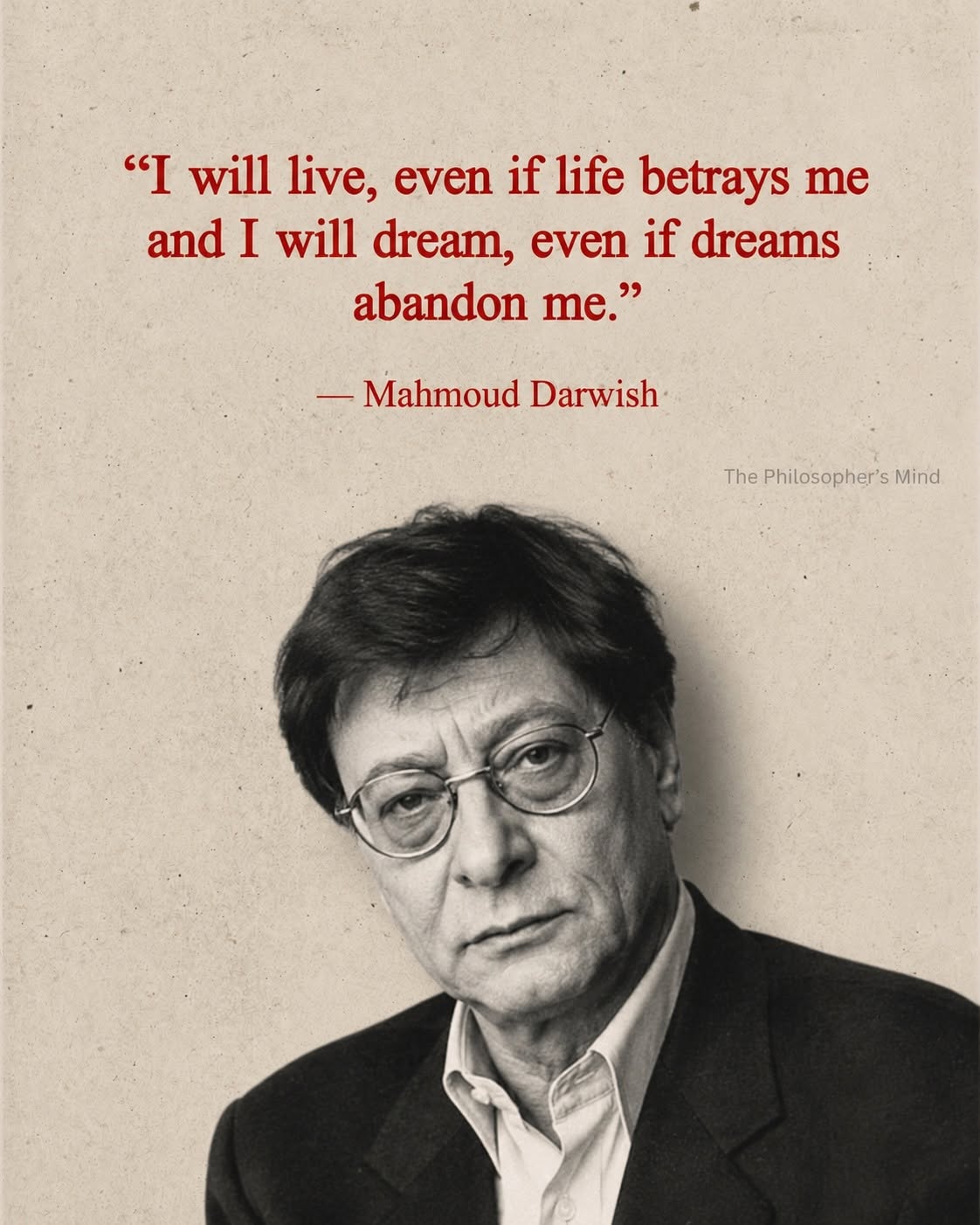
Mahmoud Darwish: I will live, even if life betrays me and I will dream, even if dreams abandon me

Mia Schwab writes:

Mahmoud Darwish lived much of his life in exile, stripped of his citizenship and forced to navigate a world that often felt designed to erase his identity. Despite decades of displacement and political turmoil, he became a global symbol of endurance, proving that the most radical thing a person can do is refuse to be broken by their circumstances.

I will live, even if life betrays me and I will dream, even if dreams abandon me.

This sentiment is more than mere optimism. It is a philosophy of stubborn persistence. Darwish suggests that even when reality fails to meet our needs or live up to its promises, our commitment to existing and imagining remains our final, untouchable freedom. It is a reminder that while we cannot always control what life does to us, we remain the sole masters of our internal resolve.

What is one dream you refuse to give up, regardless of how the world looks right now?

CrossFireArabia

CrossFireArabia


Dr. Marwan Asmar holds a PhD from Leeds University and is a freelance writer specializing on the Middle East. He has worked as a journalist since the early 1990s in Jordan and the Gulf countries, and been widely published, including at Albawaba, Gulf News, Al Ghad, World Press Review and others.

Related Posts

Margot Saba Abdo: A Photo Pioneer in Jerusalem

Margot Saba Abdo (1901 – 1974) was an exceptional female Palestinian photographer who worked in Jerusalem in the 1930s. Historian, sociologist Salim Tamari says she displayed a skill and mastery of the lens that surpassed Karimeh Abbud, another woman photographer from Nazareth at the time.  Margot was born in Jerusalem to a Greek mother whose brother was the Meltiadis Savvides (Saba), a well-known photographer working there in his Savvides Studios. This is where Margot learned to take pictures in her youthful years.

However, after her education at the Greek Orthodox school where she learned Arabic, Greek, English and Russian she joined her brother’s studio, Daoud Abdo. When he went to work as the chief photographer at the Palestinian Museum, Margot managed the studio. This was from 1930 to 1948 where she worked at family portraits. After the 1948 Nakba, she moved first to Cairo and then to Beirut, again working with her brother in his studio.

Continue reading

Leave a Reply

Your email address will not be published. Required fields are marked *

You Missed

Mahmoud Darwish: I will live, even if life betrays me and I will dream, even if dreams abandon me

Mahmoud Darwish: I will live, even if life betrays me and I will dream, even if dreams abandon me

Margot Saba Abdo: A Photo Pioneer in Jerusalem

Margot Saba Abdo: A Photo Pioneer in Jerusalem

Mustapha Barghouti: ‘Repression Will Not Deter The Palestinian People’

Mustapha Barghouti: ‘Repression Will Not Deter The Palestinian People’

Gaza: Thousands For The Egyptian Aid Worker Who Organized World Cup Screenings

Gaza: Thousands For The Egyptian Aid Worker Who Organized World Cup Screenings

Man Behind An Arab Media Giant

Man Behind An Arab Media Giant

2.2m Gazans Forced Into 100 Square Kilometers

2.2m Gazans Forced Into 100 Square Kilometers



