CrossFireArabia
By Dr Birsen Gaskell
A piercing alarm wailing through the corridors of the hospital for the third time this evening. I swiftly climb down the stairs to the emergency room four floors down. A crushing dread fills my chest, as the wailing of the alarm signals a mass casualty is expected. I push through the crowd piling up in the ER: “Tafadal … tafadal (please go ahead).” A child drops a torn bag spilling pieces of bony flesh. A man shrieks, the meat is a small shredded arm, ashen fingers hanging loosely attached.
The child struggles to put the shredded arm back into the bag, he looks around for help. He sweeps the amputated arm aside, away from the passing crowd. His gaze falls on me just a moment. I quiver at the calm of his face. I search for tears, anger, fear, something recognizable in his eyes but the void there like a black hole sucks me in. Child, when did you stop being a child? He will later keep peering through the ajar ER door to see if the relative or friend whose torn off arm was shoved into a bag is still alive.
The resuscitation room is quickly filled with the smoke of burned flesh. Five bodies and some missing body parts are thrown onto the stretchers. The rest are taken to the next room, a plain room with another five stretchers. I scan the room, all the bodies seem limp, unconscious. I start with one by feeling for a pulse; a teenager, burned extensively with shrapnel wounds all over her chest and face. Her long curly hair seem to be still burning slowly. No pulse. I move to the next.
A toddler again with shrapnel wounds all over his bony little body. His arms and feet burned. He has an open skull, eye sockets blackened. He has a feeble pulse but he won’t make it. I move to the next one. Another burned child with a missing arm and crushed pelvis. A doctor is putting a chest drain on each side of his little chest. Chest drains are an easy call in the ER, the majority of patients have them as most blast injuries blow the chest cavity up with air sweeping from outside crushing the lungs down. The only way to get the lungs up again is putting tubes through the chest to deflate the air around the lungs. Sterility is no concern, chest drains are put in in a flash. I let the team carry on.
The next one is another child. I see shrapnel entries on his face, blast injuries on his bare feet. He’s unconscious but has a pulse. “Lazim oksijen (oxygen needed),” I shout. My voice is swallowed in the cacophony of the ER. I grab a nurse by the elbow, demanding oxygen. He goes out to fetch an oxygen cylinder but comes back empty handed. I scan the child with ultrasound. He has blood in his abdomen and around his lungs. A local doctor is with me now. Most doctors speak excellent English. I give my findings, we agree to send him to computer tomography (CT) to check for brain injury. We can’t treat patients with head injuries in this hospital. The only neurosurgical team is based in the European Gaza Hospital in southern Khan Yunis. Without adequate airway support, the child soon is ushered to the CT.
After a week here I’m used to hearing explosions
The fifth casualty is also a child. He is already intubated by the team but still bleeding from his crushed, half-amputated arm. The cloth wrapped round his arm as a tourniquet is soaked in blood. He has penetrating crushing injuries in his genitals and pelvis, his leg twisted. He is covered with so much blood, it’s difficult to inspect his injuries. With such severe injuries he’s unlikely to survive but there’s talk of moving him to an operating theater in order to stop his bleeding. I agree. We scoop him to a theater with no monitoring. His relatives grab the stretcher outside, carrying him swiftly. I rush to the stairs to alert the team in the theater. Before I reach the first landing, a shuddering blast fills my ears, shaking the windows and doors. The waves of the blast push me against the wall like a gale. I halt. That was close! But I quickly realize not close enough for me to stop. After a week here I’m used to hearing explosions, blasts, bombs in the background, some strong enough to shake the entire hospital building.
I soon find out the airstrike was just outside the main hospital gate. A tent with a Press sign was hit, setting off fire that soon will engulf the other tents around it. I now expect another wave of casualties. “Some have to be treated on the floor as the ER is pretty full now,” I think, then my thoughts shift to the child in the theater. I continue climbing the stairs. After a two-hour battle amputating his arm, exploring his abdomen and pelvis, and fixing his broken leg temporarily that painted the whole theater with blood, he makes it to the intensive care unit only to die the next day with organ failures. The mortality rate in the ICU is very high as well as in other parts of the hospital. Far too many patients with far too few resources, hardly any antibiotics or other meds, premature discharges to welcome new admissions, the hospital is often the last stop for the injured.
It is now 2 am. I feel a migraine kicking in, think I must drink some water but the taps aren’t safe to drink from. I must go to our accommodation room for a drink but I head towards the ER instead. The crowd outside the resuscitation room is bigger now. The cacophony is louder. It’s chaos in the ER, with some patients lying on the floor. I smell the familiar burned flesh. There’s ongoing cardiopulmonary resuscitation on a child whose body is covered with soot mixed with blood. The CPR is short lived, he’s dead. I watch his lifeless face, his eyes half open. I secretly feel relieved for him knowing he will no longer wake up to the sounds of explosions as he has been for the past nearly 600 days, no longer spending the day hungry and thirsty, no longer having to be displaced yet again from his makeshift tent or ruins of his city, no longer feel freezing cold overnight or scorching hot during summer days, no longer will miss his old school, his friends, his family, some of whom died or are thought to be dead. I stroke his dirty bare feet, think: “Now you’re safe little man, no one can hurt you.” Just then another crushing airstrike booms all around us! The lights go off.
Bombardment of Gaza never stops
The fourth floor of the main hospital building where the ICU unit is located in the middle is the designated assembly point for our team in case of a direct airstrike. I manage to climb the stairs to the assembly point with my cellphone flashlight. By the time I reach the assembly point the generator kicks in, the lights are back on. I don’t see anyone else from the team other than the usual traffic that never stops in and out of the ICU. I rush to the accommodation area, and we’re all fine. The strike was just outside the walls of the hospital’s east side.
We watch the massive smoke clouds billowing up right across the balcony of the accommodation. Dr. Osama instructs the team to stay in the accommodation for the time being, away from the balcony and windows. Ambulance sirens remain loud for hours to come. I lie down with a blooming migraine but can’t sleep as we spend the rest of the night with low-flying supersonic jets hovering the air above. Drones humming loudly as usual in between the sounds of jets. The bombardment of Gaza never stops.
I hear Rachael say: “Hold on.” Someone knocks on the door impatiently. “It’s for you,” says Rachael, seeing me raised in bed. What time is it? “Still very early” she says. I’m needed in theaters urgently. Anesthetic nurses are overwhelmed with no anesthetist around. My migraine is here to stay. I gobble up some painkillers and leave. Inside the theater room there’s so much blood on the floor, it swashes and ripples around every time I walk over. It’s a young girl with her chest cavity open. I see her heart fibrillating. “Lazim kalb compression (heart compression needed).” She doesn’t make it. The most efficient workers here are the cleaners. After returning from the bathroom, I see the operating room already clean and ready for the next case.
“Ahmad, where is Dr. Fayez?” I ask the anesthetic nurse. “In his office, he’s not well.” I find him having tea on a broken office chair. He offers me tea. I know that there’s no point in saying no as the hospitality of Palestinians always wins out. He turns on the mini plastic kettle behind him and pulls out some loose tea from the drawer of his table. “Feeling okay?” I ask. He doesn’t hear me as the kettle makes a buzz and vibrates violently. “You know what I really really miss, Doctor Birsen?”
He leaves me in suspense, brewing the tea in the kettle. “I miss drinking tea with sugar. Really miss tea with sugar so much. I don’t find sugar in the market anymore.” I nod. “You feeling okay?” “Better now … When we have a bad night I always get chest pain.” I say: “Ohh … shall we check you over?” He responds “It’s not new, doctor, I’m diabetic, hypertensive. Every time I hear a big explosion I get chest pain. I worry not about myself, but about my boys. They can’t survive without me.” He turns his face as his voice cracks. He wipes his eyes. Dr. Fayez has six boys. Touch between the genders is not customary here. But I put my hand on his shoulder for few seconds as he weeps quietly.
“They haven’t been out for the last 18 months. We don’t let them out to play, they’re always inside.” Their home took a hit by an airstrike on the neighboring house that knocked down part of their house down too. They survived with minor injuries. Since then they’ve been displaced five times. Now they live with other relatives in a damaged building with no windows. He was in Nasser Hospital when the neighborhood was invaded by ground troops.
When the staff and patients were led outside, he came very close to being abducted at a checkpoint. He told me: “I saw a toddler left alone screaming. I couldn’t leave him. I picked him and carried him with me. He kept screaming all the way to the checkpoint, IDF (Israeli army) soldiers who were pointing guns at us got annoyed by this. They let me through when most of the staff got held off and taken away. This small child saved my life.” I say: “You rest, Dr. Fayez, I’ll take over today.”
Many martyrs found in the ground
It’s going to be a long day. I desperately need my morning coffee. Our housekeeper Jamal makes coffee for me with the little coffee mocha I brought with me. I give half to him. We sip our coffee as we look out over the balcony. Several smoke clouds hang over the Rafah area. The air is very thick with the pollution of constant explosions. We watch the kids collecting garbage in the desolate ground of the hospital building.
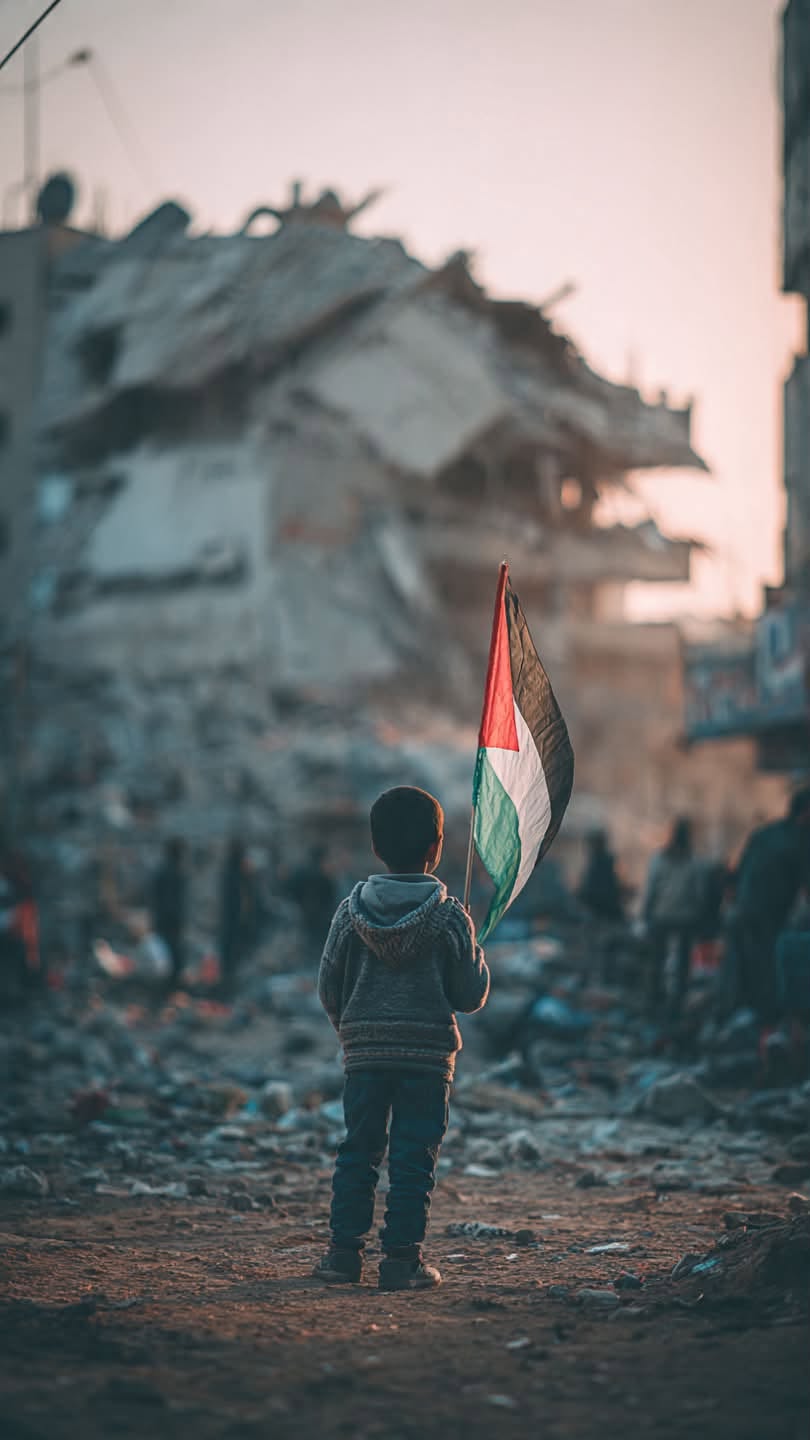
The skeletons of ambulances, furniture, and hospital equipment and what’s left of them is scattered around. Some buried partially. Following the ground invasion almost a year ago, the Israeli army damaged and burned down the properties of the hospital. Children rummage around the hospital grounds every morning collecting anything they can find useful for burning fire. Every morning, when they should have been in school, they roam around the ruins of city to collect what’s left of it.
Jamal points to the hospital ground, says: “We found many shuhada (martyrs) in the ground.” He is talking about the mass graveyards that were dug out after the Israeli army withdrew from the area. The same evening on the same balcony, Jamal speaks in Arabic as my Jordanian colleague translates with a trembling voice. In December 2023, Jamal got trapped in Northern Gaza under a complete siege, constant bombardment, and a strict curfew lasting a month.
His neighborhood was reduced to ruins with decaying dead bodies scattered around. He saw his brother and his family home hit by a rocket and later made many attempts to save and retrieve their bodies. But with quadcopters hovering around, he couldn’t make it out. A week later from his windows he sees dogs eating human flesh, one of which he knows is his brother’s lifeless body. Jamal rubs his fists between his legs, says “Alhamdulillah” (praise be to God), and leaves us in silence.
Dr Birsen Gaskell, an anesthesia specialist, is a volunteer doctor for Doctors Without Borders. She visited the Nasser Hospital in Khan Younis, Gaza in April 2025.


 Heba
Heba
 Saleem Ayoub Quna