Trending News:‘These Are Your Israeli Soldiers’Welcome to Gaza: ‘We Are Not Leaving’A Woman From GazaBalcony of LifeWho is Afraid of Palestinian Revolutionary Art?In The Past: Za’atar Coffee Shop in JerusalemSweet Tooth in Damascus GateA Life After The War!Beit Sahour Family, 1930Civil Defense Recovers 55 Bodies Under Debris of Gaza BuildingGideon Levy on 7 OctoberJordan Appoints New Army ChiefKey of ReturnScene From GazaFighting For Water!A Tribute to a CartoonistMom, Kids in CharcoalHussam Abu Safiya: The Doctor HostageThe Girl, The Smile and The SlipperBlair Asked PA to Remove Palestine From TextbooksTeacher’s Cartoon Not to ForgetThe Broom SellerSummer MadnessMartyred After Engaging An Israeli ForceKids of The SeaPalestinian Dresses & HeritageYoussef Heikal: Last Mayor of YafaA Traditional Dress TributeIsrael’s War: Lebanese Deaths Spikes to 4354 With 12325 Injured26 Raids on Al Aqsa, Ban on Athan in Ibrahimi Mosques 155 TimesIsrael Arrest 500 Palestinians in AugustA Child From GazaGaza Death Toll Spikes to 73,470, Israel Kills 8, Injures 31 in 24 HoursDefense Systems Intercept 13 Ballistic Missiles Over JordanHunted! HRF Files Complaint Against Genocide Soldier in GreeceAmnesty Calls For Release of Dr Abu SafiyaIn August Alone: 2,030 Israeli Army, Settler Attacks on West Bank PalestiniansIsrael Slammed For ‘Jewish Curriculum’ on East JerusalemPresident Xi Visit to Cairo, 1st in 10 YearsBritish Row: Netanyahu’s Son Says Falklands Belong to ArgentinaThe True Tale of The Moral FighterClowning in The SandIsraeli Army: Settler Attacks Puts The West Bank in Resistance-modeGlorious Past: The Red Bidas Palace!Bushra Al Tawil: Punished For Holding The CameraAnalysis: Israel Assassinates to Change The Power BalancePalestinian Journalists, Nidal and Haitham, MissingA Traditional Wear, Bethlehem 1880Israeli Gunboats Fire at, Injure 5 Gaza FishermenChristian Schools Strike in Jerusalem. Why?Inside The Home of A Musician, 1940Slain Footballer Adds to The 1,014 Sportsmen Killed by IsraelIsraeli Army Probes 27 Cases of Looting by its Soldiers in Gaza, LebanonPoll: 74% of College Students Believe Israel is Committing GenocideStarry Night Over Bethlehem‘We Are Killing Like We Haven’t Killed Since 1967’Thobe: Identity, Thread and NeedleNetanyahu and The Settlers: Cart and Horse in ActionPupils From The Bishop’s School, JerusalemJerusalem’s Mamilla in The 1940sVolunteers Collect Stones From Destroyed Mosque To Rebuild it in The FutureDestitution Gaza: Girl With The ChildOmer Bartov: ‘Its Genocide’Existence…The Girl With The White HorseBen-Gvir Mocks Palestinian Prisoners in Their CellsCamel of Hardships….Israeli Army Blows up a Home For The Elderly!Where Did They Go! Up to 3000 People Just VanishedSaid Elatab: A Journey of FlowersAutumn LeavesAya Faqaha Reunited Parents After Israeli Prison‘I am The Earth’Handala Never Dies1,660 Israeli Settlers, Army Violations in The West Bank in a WeekIsraeli Settlers, Army Besiege Qusra Families For 21 Days900 Fires Caused by Israeli Settlers in The West BankGazans Protest The Bombing of Their Water PlantSoap-making in Yafa – Early 1920sSliman Mansour: ‘Artist of The Intifada’Palestinian Hassan Arar Freed After 22 Years in Jail‘My Curious Camera’The Road to BethlehemMy Homeland, My Palestine233 Bodies Recovered From Under The Gaza Wreckage, 174 Still MissingFlying Kites and The Politics of Fear‘No Rest Even in Death:’ Israel Holds on The Bodies of 1700 PalestiniansIsraeli Army Forced to Release The Body of a 15-Year-Old it Kept For 9 Months‘My Tent, My Museum’Tradition and IdentityPhoto Removal in Deauville Exhibit Raises Anger Among The French Gaza’s Vanishing Minarets: Israel Destroys More Than 1,000 Mosques Since 7 October 2023Art in Revolution: The Dove, The Girl and The Rope‘Dr of The Poor’ Passes Away in NablusGetting Ready For School in GazaBeware! Qusra and The Next NakbaIsraeli Settler Attacks Spiked by 63 percent in the Occupied West BankA Jerusalem Wedding, 1945A Prisoner to RememberThe Woman in Two Colours
Trending News:‘These Are Your Israeli Soldiers’Welcome to Gaza: ‘We Are Not Leaving’A Woman From GazaBalcony of LifeWho is Afraid of Palestinian Revolutionary Art?In The Past: Za’atar Coffee Shop in JerusalemSweet Tooth in Damascus GateA Life After The War!Beit Sahour Family, 1930Civil Defense Recovers 55 Bodies Under Debris of Gaza BuildingGideon Levy on 7 OctoberJordan Appoints New Army ChiefKey of ReturnScene From GazaFighting For Water!A Tribute to a CartoonistMom, Kids in CharcoalHussam Abu Safiya: The Doctor HostageThe Girl, The Smile and The SlipperBlair Asked PA to Remove Palestine From TextbooksTeacher’s Cartoon Not to ForgetThe Broom SellerSummer MadnessMartyred After Engaging An Israeli ForceKids of The SeaPalestinian Dresses & HeritageYoussef Heikal: Last Mayor of YafaA Traditional Dress TributeIsrael’s War: Lebanese Deaths Spikes to 4354 With 12325 Injured26 Raids on Al Aqsa, Ban on Athan in Ibrahimi Mosques 155 TimesIsrael Arrest 500 Palestinians in AugustA Child From GazaGaza Death Toll Spikes to 73,470, Israel Kills 8, Injures 31 in 24 HoursDefense Systems Intercept 13 Ballistic Missiles Over JordanHunted! HRF Files Complaint Against Genocide Soldier in GreeceAmnesty Calls For Release of Dr Abu SafiyaIn August Alone: 2,030 Israeli Army, Settler Attacks on West Bank PalestiniansIsrael Slammed For ‘Jewish Curriculum’ on East JerusalemPresident Xi Visit to Cairo, 1st in 10 YearsBritish Row: Netanyahu’s Son Says Falklands Belong to ArgentinaThe True Tale of The Moral FighterClowning in The SandIsraeli Army: Settler Attacks Puts The West Bank in Resistance-modeGlorious Past: The Red Bidas Palace!Bushra Al Tawil: Punished For Holding The CameraAnalysis: Israel Assassinates to Change The Power BalancePalestinian Journalists, Nidal and Haitham, MissingA Traditional Wear, Bethlehem 1880Israeli Gunboats Fire at, Injure 5 Gaza FishermenChristian Schools Strike in Jerusalem. Why?Inside The Home of A Musician, 1940Slain Footballer Adds to The 1,014 Sportsmen Killed by IsraelIsraeli Army Probes 27 Cases of Looting by its Soldiers in Gaza, LebanonPoll: 74% of College Students Believe Israel is Committing GenocideStarry Night Over Bethlehem‘We Are Killing Like We Haven’t Killed Since 1967’Thobe: Identity, Thread and NeedleNetanyahu and The Settlers: Cart and Horse in ActionPupils From The Bishop’s School, JerusalemJerusalem’s Mamilla in The 1940sVolunteers Collect Stones From Destroyed Mosque To Rebuild it in The FutureDestitution Gaza: Girl With The ChildOmer Bartov: ‘Its Genocide’Existence…The Girl With The White HorseBen-Gvir Mocks Palestinian Prisoners in Their CellsCamel of Hardships….Israeli Army Blows up a Home For The Elderly!Where Did They Go! Up to 3000 People Just VanishedSaid Elatab: A Journey of FlowersAutumn LeavesAya Faqaha Reunited Parents After Israeli Prison‘I am The Earth’Handala Never Dies1,660 Israeli Settlers, Army Violations in The West Bank in a WeekIsraeli Settlers, Army Besiege Qusra Families For 21 Days900 Fires Caused by Israeli Settlers in The West BankGazans Protest The Bombing of Their Water PlantSoap-making in Yafa – Early 1920sSliman Mansour: ‘Artist of The Intifada’Palestinian Hassan Arar Freed After 22 Years in Jail‘My Curious Camera’The Road to BethlehemMy Homeland, My Palestine233 Bodies Recovered From Under The Gaza Wreckage, 174 Still MissingFlying Kites and The Politics of Fear‘No Rest Even in Death:’ Israel Holds on The Bodies of 1700 PalestiniansIsraeli Army Forced to Release The Body of a 15-Year-Old it Kept For 9 Months‘My Tent, My Museum’Tradition and IdentityPhoto Removal in Deauville Exhibit Raises Anger Among The French Gaza’s Vanishing Minarets: Israel Destroys More Than 1,000 Mosques Since 7 October 2023Art in Revolution: The Dove, The Girl and The Rope‘Dr of The Poor’ Passes Away in NablusGetting Ready For School in GazaBeware! Qusra and The Next NakbaIsraeli Settler Attacks Spiked by 63 percent in the Occupied West BankA Jerusalem Wedding, 1945A Prisoner to RememberThe Woman in Two Colours
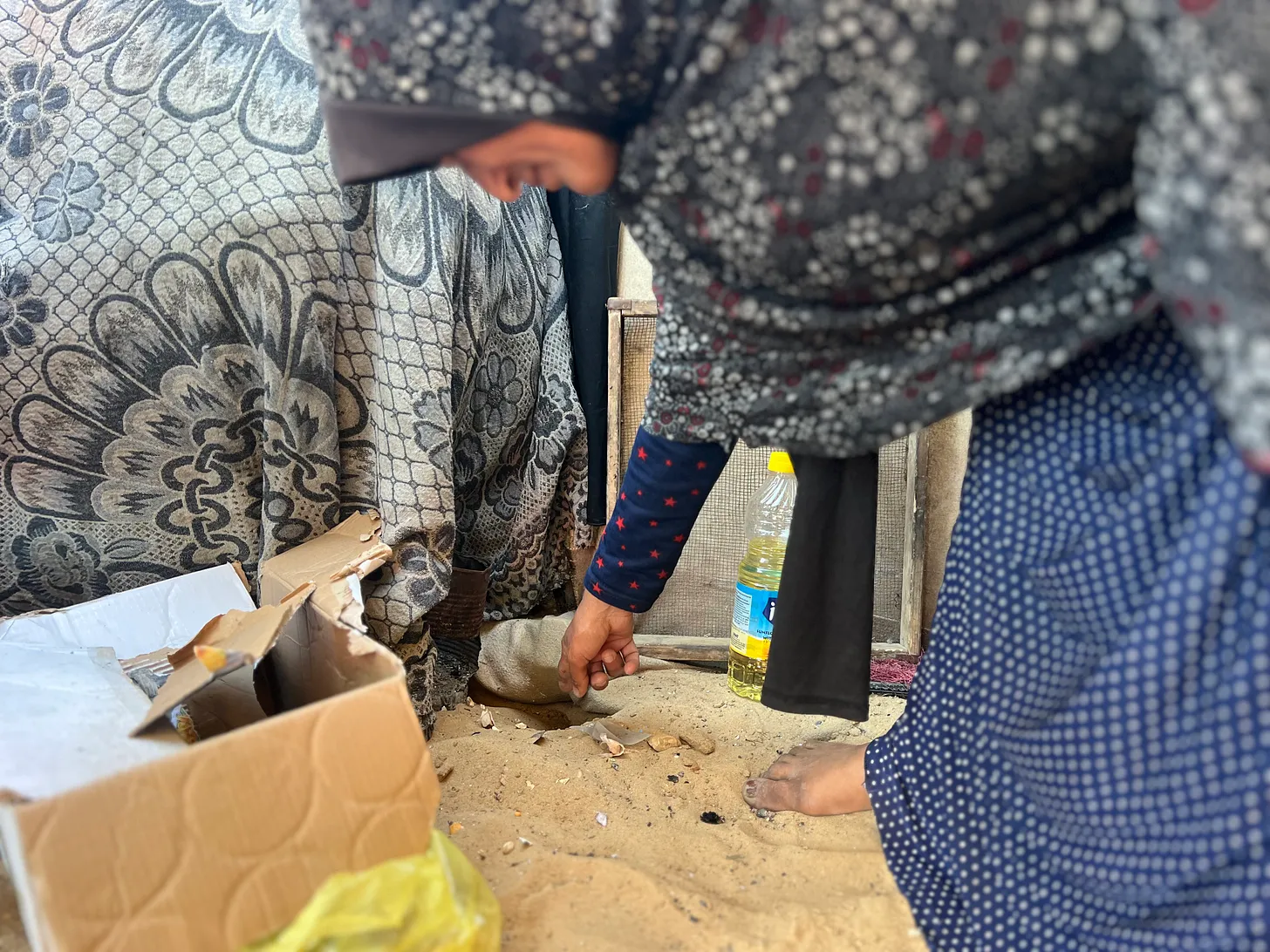
GAZA CITY, Gaza—Nahla Al-Majdob woke up in the middle of the night last week to her seven-year-old daughter, Aya, screaming in their tent. “I turned on my phone light but I didn’t see anything at first,” Al-Majdob told Drop Site News. “Then I noticed bite marks on Aya’s toe.” It was not the first time. “I’ve woken up many nights to find rats around our mattresses,” she said. “Sometimes they’re right next to us, sniffing.”
Like nearly all Palestinians in Gaza, Al-Majdob and her family were forced from their home by the war and have been living in a flimsy tent near what used to be the port on the shoreline of Gaza City. Compounding the hardships of displacement is a growing population of rodents menacing families across the enclave.
“The rats come out from the rubble and the garbage,” Al-Majdob said. “They crawl over our clothes and gather where we store food. If we leave anything out, it will be contaminated.”
Al-Majdob, her husband, and her daughter, are all diabetic, making them particularly vulnerable to infection from rat bites. Her family has come to fear the night, when the rats forage in the dark, chewing through tents, clothes, and flesh.
“Before the war, I would never eat anything touched by rodents, but now, if I find them in the white flour, I sift it and use it anyway,” she said. “If I throw everything away, we will starve.”
She added that the rodents also appear to have become bolder as their numbers have grown. “They’re not afraid of us anymore,” she said. “I push them away with a stick or anything I can find, but they keep coming back after a few minutes.”
Nahla Al-Majdob with her daughter, Aya, in their tent in Gaza City on April 22, 2026. Photos by Ahmed Dremly.
Palestinian families in Gaza are living in overcrowded tents and makeshift shelters, surrounded by waste and debris, with limited access to safe water and sanitation services. Among the widespread and severe environmental health hazards that result from the conditions, the United Nations reported this month, is a proliferation of rodents as well as cockroaches, flies, and other pests, contributing to disease transmission.
In a rapid assessment of more than 1,600 displacement sites across Gaza this month, the UN found that, in over 80% of them, rodents and pests were frequently visible, affecting 1.45 million people. Practically all of the affected families reported skin infections, including scabies, lice and bedbugs, with more than 70,000 cases recorded so far in 2026.
On April 12, Amani Abu Selmi was absorbed in preparation for her upcoming wedding, which was just one week away. She has lived with her family of five in a makeshift tent near Nasser Hospital since 2024 after their home in Khan Younis was destroyed in an Israeli airstrike. She went through the traditional rituals of a bride-to-be, checking and showing each piece of clothing to friends and relatives who stopped by. The next morning, her joy was shattered. Rats had chewed their way inside and shredded her belongings.
Abu Selmi’s mother, Ghalia, was returning from the market when she found her younger daughter, 13-year-old Samar, running toward her screaming that something terrible had happened. Inside the tent, Ghalia found Amani standing in shock, holding up pieces of her torn bridal dresses.
“The mice and rats spared nothing,” Ghalia told Drop Site. “These were new clothes for her, and now they were riddled with holes. I started crying because I knew how hard it had been for us to afford them in the first place.”
Amani had tried to protect her clothes from rodents, covering them with a wooden board weighed down by stones. But the rats and mice had burrowed underneath.
“She was especially heartbroken over her hand-embroidered Palestinian thobe,” Ghalia said. “She had dreamed of wearing it the morning of her wedding. It’s part of our tradition.” Rodents, fleas, and insects have long been an issue in their tent but Ghalia said the situation has deteriorated dramatically over the past three months.
Several days ago, Ghalia said she found her 19-year-old son’s eye had swollen shut. “There were small bite marks near his eye. He didn’t even realize what had happened until I asked him. He said he felt something on his face while sleeping,” she said. She took her son, Raef, to the nearest Red Crescent clinic, where doctors confirmed that the wound had become infected and prescribed him a course of antibiotics.
“They move all day inside the tent freely,” Ghalia said. “Even when it’s full of people, they dig tunnels underneath us.” She said she caught 20 mice in a single day using sticky traps, but it did little to contain the problem. “I tried to block their holes with mud again and again, but they always come back,” she said. “It’s terrifying. I can’t live like this anymore.”
Majd Sukar, the head of the Preventive Health Department for the Gaza Municipality, told Drop Site that complaints about rodents have significantly increased since the so-called ceasefire in October 2025, when the Israeli military halted its scorched earth bombing campaign even though it continues smaller scale attacks on an almost daily basis.
“The scale of destruction in Gaza has created ideal breeding grounds,” Sukar said. “The Israeli blockade on rodenticides, the mountains of uncollected waste, and untreated sewage are the primary drivers of this crisis.”
The municipality’s efforts to tackle the situation have also been severely limited by Israel. “We’ve lost most of our municipal vehicles in Israeli attacks,” Sukar said. “We simply don’t have the capacity to remove waste or respond effectively.”
Israeli restrictions on aid into Gaza have hampered efforts to deal with the growing rodent infestation. According to Doctors Without Borders, Israel has repeatedly denied the entry of multiple items needed for basic health sanitation, including rodenticide and insecticide.
“We’ve tried to find alternatives,” Sukar said. “We worked with Gaza’s university experts and tested different alternatives, but none were effective. Even many local initiatives have failed. Many people have brought us homemade poisons, but they don’t work either.”
The municipality has launched awareness campaigns, advising families to store food securely, clean their surroundings, and seek medical care immediately after bites, especially for children and those with chronic illnesses. Yet Sukar said they are fighting a losing battle.
“Rats are now everywhere in Gaza, in destroyed homes, shelters, hospitals, everywhere.” Reports have also grown of a large, particularly aggressive and adaptable rat known as the Norway rat. “We urgently appeal to the UN Secretary-General that we need waste removal equipment and pest control supplies. This is not a secondary issue, it’s a public health catastrophe,” Sukar said.
“We are suffering from two wars,” he added. “The war of bombs, and the war of rats.”
Saber Dawas in his tent inside Al-Yarmouk stadium in Gaza City on April 19, 2026. Photos by Ahmed Dremly.
Saber Dawas, a 38-year-old father of six, has tried desperately to keep the rats at bay inside their tent in a displacement camp in Al-Yarmouk stadium in central Gaza City.
He tried storing food in plastic containers, sealed bags, and even a cleaned drum for storing flour. “It didn’t matter,” Dawas said. “A rat chewed straight through the drum.”
Even though food is expensive and scarce, he ends up throwing away whatever he suspects was contaminated. He now suspends most of his food supplies in plastic bags from a wooden stick wedged into the tent’s frame, hoping to keep it out of the reach of rodents.
He said he sleeps lightly, constantly on alert. “Sometimes I feel like I’m guarding my family all night,” he added. “We’re at the beginning of summer. This will only get worse.”
Ahmad Dremly is the Gaza-based project coordinator for We Are Not Numbers. He is a journalist, translator, and educator and contributed this article to Drop Site
Dr. Marwan Asmar holds a PhD from Leeds University and is a freelance writer specializing on the Middle East. He has worked as a journalist since the early 1990s in Jordan and the Gulf countries, and been widely published, including at Albawaba, Gulf News, Al Ghad, World Press Review and others.
CROSSFIREARABIA – By August 2026, scarcely a mosque in Gaza escaped the war. Ancient Mamluk sanctuaries, neighbourhood prayer halls and modern mosques were reduced to rubble, while worshippers, imams and religious scholars killed. The scale raises a question that goes beyond battlefield damage: Were all these buildings legitimate military objectives, or has part of Gaza’s religious and cultural landscape been destroyed?
In Gaza today, the absence of the minaret has become almost as noticeable as the presence of the rubble.
For generations the skyline of Gaza City, Jabalia, Deir al-Balah, Khan Younis and Rafah was punctuated by domes and slender minarets. Mosques were not merely buildings entered five times a day for prayer. They were landmarks by which neighbourhoods identified themselves, places where families met, children studied the Quran, charitable committees distributed assistance and generations marked births, marriages and deaths.
After nearly three years of Israeli military attacks, much of that religious landscape has disappeared.
The latest figures supplied by Gaza’s Ministry of Awqaf and Religious Affairs and reported by the Palestine Information Center on 25 August 2026 state that 1,244 mosques out of the Gaza Strip’s 1,275 have been targeted since 7 October 2023. Of these, 1,077 have been completely destroyed.
That means roughly 98 percent of Gaza’s mosques have been struck or otherwise affected, according to the ministry, and about 84 percent of the entire pre-war stock of mosques has been completely destroyed.
The ministry says only a fraction of Gaza’s pre-war religious infrastructure is presently functioning normally. In August 2026 it reported 224 standing mosques and 428 temporary prayer spaces, many assembled from timber, canvas and whatever material could be salvaged from the ruins. Sixty-five damaged mosques had been provisionally made usable.
The figures have risen dramatically as the war has continued. In October 2024 the ministry reported 814 mosques completely destroyed and another 148 damaged. By February 2025 it said 834 were completely destroyed and 275 severely damaged. By August 2026 the complete-destruction count had risen to more than 1,070.
International organisations use more conservative figures because they count only sites they have individually verified. OHCHR reported that, according to the Gaza Ministry of Endowments, 995 mosques and three churches had been partly or completely destroyed by 31 May 2025. UNESCO, using satellite imagery and site assessments rather than accepting the entire ministry inventory, had independently verified damage to 164 cultural sites by March 2026, including important religious monuments.
The difference therefore does not necessarily mean one side is counting inaccurately. They are measuring different things: Gaza’s ministry is attempting a comprehensive administrative inventory, while UNESCO and other UN bodies generally record only individually verified cultural properties.
The assault began almost immediately
Some of the first mosques disappeared within 48 hours of the 7 October attacks.
At approximately 4:30 a.m. on 9 October 2023, Israeli warplanes struck the Sheikh Ahmed Yassin Mosque in Gaza City’s crowded al-Shati refugee camp. Human-rights documentation subsequently reviewed by Airwars says the four-storey mosque was completely destroyed and three civilians were killed — two women and a girl. Around a dozen others were reported injured.
Nearby, the Al-Gharbi Mosque was also destroyed. Palestinian documentation says several missiles struck the mosque and three civilians in the area were killed. Because several mosques in al-Shati were attacked in the same period, casualty attribution varies between reports.
Then came the Abdullah bin Omar, or Al-Sousi Mosque, also in al-Shati.
An Airwars investigation records that an Israeli airstrike at approximately 11:10 a.m. on 9 October destroyed the mosque, killing 10 to 11 civilians and injuring around 60. At least two children and several women, including a pregnant woman, were among the dead according to the sources it examined.
A joint appeal submitted by Palestinian human-rights organisations Al-Haq, Al Mezan and the Palestinian Centre for Human Rights to UN special procedures likewise recorded 11 civilians killed when Israeli aircraft struck Al-Sousi Mosque.
Other mosques reported struck during the opening weeks included Yarmouk Mosque, Abbas Mosque, Ishteiwi Mosque, Sheikh Shaaban Mosque, Shama’a Mosque, the Islamic University Mosque, Habib Muhammad Mosque in Khan Younis, Saad al-Ansari Mosque in Beit Lahia, Imam Ali Mosque in Jabalia, Al-Aqsa Martyrs Mosque in Nuseirat, Al-Omari Mosque in Jabalia, Anwar Aziz Mosque in Jabalia and Fatima al-Zahra Mosque in al-Zahra City.
These were not confined to Gaza City. From the first weeks the pattern stretched from Beit Lahia and Jabalia in the north, through Gaza City and the central camps, to Khan Younis and Rafah in the south.
Worshippers killed while gathered for prayer
One of the most disturbing characteristics of a number of attacks is their timing.
OHCHR has investigated the 15 November 2023 strike on Ihya al-Sunnah Mosque in the Sabra neighbourhood of Gaza City. The mosque was crowded with men and boys gathering for evening prayer.
The UN human-rights office says at least 63 Palestinians were killed.
More unusually, investigators were able to assess the probable weapon. OHCHR concluded that the strike was highly likely carried out with a precision-guided MK-83-class munition. The Israeli military did not publicly announce a target or justification for that particular attack, according to the UN investigation.
That distinction is important.
In most attacks on Gaza’s mosques it is possible to establish that an airstrike, artillery round, tank shell or demolition destroyed the structure. It is not possible to responsibly name the exact bomb model. Photographs of ruins alone rarely establish whether the weapon was an MK-82, MK-83, MK-84, GBU-series guided bomb or another munition.
Where there is forensic evidence, however, the picture becomes clearer.
The most notorious example came at Al-Tabaeen School and its mosque/prayer hall in Gaza City’s al-Daraj district on 10 August 2024.
Thousands of displaced Palestinians were sheltering in the compound. The strike came during Fajr, the dawn prayer.
Gaza Civil Defence ultimately reported more than 90 dead; early Palestinian government statements placed the figure around 100. Reuters reported the Civil Emergency Service’s estimate of about 100 deaths, while CNN reported at least 93.
CNN’s weapons analysis identified debris from at least one US-manufactured GBU-39 Small Diameter Bomb, a precision-guided weapon.
Israel acknowledged carrying out the attack. It said the prayer compound contained a Hamas and Islamic Jihad command-and-control facility and said militants were among those killed, while disputing the Palestinian casualty figure.
Palestinian officials and witnesses said the victims had assembled for dawn prayers.
Whatever the competing descriptions of those present, it remains one of the deadliest documented attacks on a place being used for Muslim worship during the war.
Deir al-Balah: Another mosque filled with displaced families
The Shuhada al-Aqsa Mosque beside Al-Aqsa Martyrs Hospital in Deir al-Balah became another refuge for Palestinians who had already lost their homes.
Shortly after midnight on 6 October 2024, Israeli aircraft struck it.
Safa reported 21 people killed in the mosque alone, with dozens wounded. In the combined attacks on the mosque and nearby Ibn Rushd School, Palestinian officials initially reported 24 deaths and 93 injuries; subsequent international reports put the combined toll at least at 26.
Israel confirmed attacking the Shuhada al-Aqsa Mosque structure, saying Hamas personnel were operating from a command centre embedded there. The military said it used “precise munitions”, surveillance and intelligence intended to reduce civilian casualties. It did not publicly identify the specific bomb model.
This is an important example of the central dispute surrounding many mosque attacks.
Israel says mosques lose their protection from direct attack when Hamas or Palestinian Islamic Jihad uses them for military purposes. Palestinians argue that Israel has repeatedly invoked this explanation without publicly presenting evidence sufficient for independent scrutiny, particularly where displaced civilians were known to be sheltering in the same buildings.
Rafah’s Al-Farouq Mosque
Southern Gaza was no sanctuary either.
On 22 February 2024, an Israeli airstrike flattened the Al-Farouq Mosque in Rafah’s Shaboura area. Photographs showed little more than slabs of broken concrete where the mosque had stood.
Reuters reported at least seven bodies brought out following that night’s attacks on the mosque and neighbouring houses. WAFA likewise reported seven Palestinians killed in the Rafah bombardment, although available reporting does not establish that every one of the seven was actually inside the mosque.
The distinction matters: In a densely built city, a bomb dropped on a mosque may kill people in the mosque, in adjacent houses or in the street. Casualty totals should therefore not automatically be assigned to the mosque itself unless eyewitness or medical documentation establishes the location.
Great Omari Mosque: Destroying layers of history
Human loss is only one dimension of what happened.
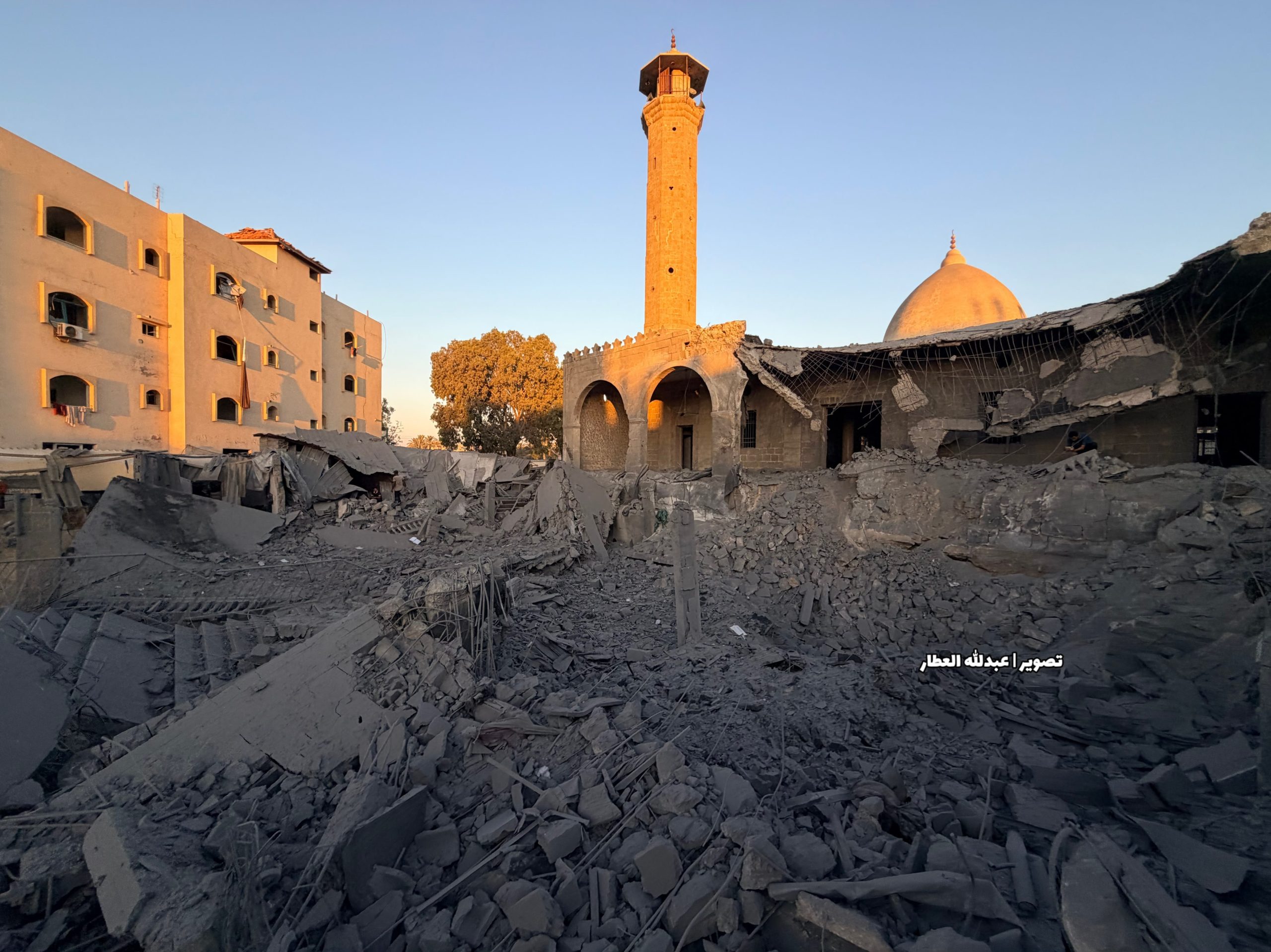
At the heart of Gaza City’s old al-Daraj quarter stood the Great Omari Mosque, Gaza’s most important historic mosque and one of the oldest religious structures in Palestine.
Its architecture was itself a history book.
The site carried layers associated with antiquity, Byzantine Christianity, the Crusader period and Islamic Gaza. Parts of the structure incorporated a Crusader basilica. Mamluk and Ottoman rulers enlarged and embellished it. Its façade preserved a Gothic-style entrance arch, while its courtyard, marble mihrab, sandstone masonry and distinctive minaret spoke to later Islamic architectural traditions. UNESCO describes it as an architectural fusion and one of the principal monuments demonstrating Gaza’s continuous sacred history.
The complex covered approximately 4,100 square metres and was built largely of local kurkar sandstone. Historical inscriptions recorded Mamluk rulers, while the mosque’s library held old books and manuscripts.
It was struck more than once.
ICOMOS Palestine documented damage to its minaret in November 2023 and a devastating second Israeli airstrike around 7 December 2023, which destroyed most of the main structure.
Photographs afterwards showed the minaret rising almost alone from mountains of stone.
The precise bomb used in the December attack has not been independently established. It should therefore be described simply as an Israeli airstrike, rather than assigning it a particular bomb type without forensic evidence.
The loss is greater than that of one mosque. UNESCO’s description of Gaza’s historic centre stresses that the Omari represented the city’s successive Byzantine, Crusader, Mamluk and Ottoman layers — material evidence that Gaza was never an ahistorical refugee enclave but a Mediterranean city with centuries of urban continuity.
Ibn Uthman: A Mamluk masterpiece disappears
Another extraordinary loss occurred in Shuja’iyya.
The Ibn Uthman Mosque, built in stages between the late 14th and early 15th centuries, was one of Gaza’s finest surviving examples of Burji Mamluk architecture.
Its courtyard, porticoes, domed mihrab and decorative stonework made it, after the Great Omari Mosque, one of the most celebrated historic mosques in Gaza. Inscriptions preserved the names of Mamluk patrons and even a 15th-century decree concerning taxation in Gaza.
An Israeli airstrike destroyed the mosque during fighting in Shuja’iyya in July 2024. UNESCO has since independently listed Ibn Uthman among Gaza’s damaged cultural properties.
A structure surviving approximately six centuries had disappeared in seconds.
Sayed Hashem and Gaza’s sacred geography
The Sayed Hashem Mosque was another landmark damaged in the opening months of the offensive.
Situated in Gaza City’s old quarter, it is traditionally associated with Hashem ibn Abd Manaf, the great-grandfather of the Prophet Muhammad (PBUH), who according to local tradition died in Gaza while travelling through the region.
ICOMOS Palestine reported the mosque damaged by Israeli fire during the war and identified it among the city’s important historic religious losses.
Its importance to Gazans therefore extended beyond architecture. The shrine helped give Gaza one of its traditional names, Ghazat Hashem — “Gaza of Hashem.”
Destroying or severely damaging such a building consequently affects not only contemporary worship but a place-name, a historical narrative and a community’s relationship with its city.
A mosque dating from 1951 becomes the latest casualty
The destruction has continued well beyond the first two years of the war.
On 24 August 2026, Israeli aircraft destroyed Abu Salim Mosque in Deir al-Balah, according to Gaza’s Ministry of Awqaf and the Palestine Information Center.
Built in 1951 by Hajj Muhammad Abu Salim, it was among the early mosques of modern Deir al-Balah and had become a centre for Quran classes and community and religious activities. The attack also destroyed the prayer hall of Asqalan Mosque in al-Shati camp, while the Al-Radwan Mosque prayer hall in western Gaza City sustained damage.
The exact munition used against Abu Salim Mosque has not been publicly verified.
Its destruction is significant precisely because it was not an imperial monument or medieval masterpiece. Heritage is also accumulated living memory: Weddings, funerals, Ramadan nights, children’s lessons and the voices of successive imams.
The imams and preachers who died
The destruction also followed Gaza’s religious personnel.
Gaza’s Ministry of Awqaf said early in 2024 that more than 100 scholars, preachers, imams, muezzins and Quran teachers had already been killed.
By 2026 the number was considerably higher.
Figures published by the Palestine Information Center in August 2026 said that by the end of 2025, 233 Muslim imams, preachers and religious educators and 20 Christian clergy had been killed. Other ministry figures published in February 2026 spoke of more than 330 ministry employees, religious scholars and imams killed across the broader religious establishment.
Among prominent religious figures killed was Sheikh Yusuf Salama, a former Palestinian minister of religious affairs and former preacher at Al-Aqsa Mosque, killed when his home in Maghazi refugee camp was bombed. The preacher and imam Wael al-Zard died of wounds after an attack on his home, while Walid Oweidah, who headed a Quran memorisation department in the Ministry of Awqaf, was also killed in an attack on his home in Gaza City’s Sabra district.
These cases must be distinguished from people killed inside mosques. The available evidence shows many religious personnel were killed in homes or elsewhere, rather than during the actual destruction of their mosque.
What bombs were used?
There is no credible evidence that a single type of bomb explains the destruction of Gaza’s mosques.
The documented methods include air-delivered precision-guided bombs and missiles, artillery fire, tank fire, bulldozing and controlled demolitions using explosives placed directly inside structures.
In several cases the exact weapon can be identified. OHCHR assessed the November 2023 Ihya al-Sunnah Mosque attack as highly likely involving a precision-guided MK-83 munition. CNN identified the remains of a US-made GBU-39 Small Diameter Bomb at the Al-Tabaeen mosque/prayer-hall strike according to a United Nations report.
Amnesty International found another category of destruction entirely: Buildings blown up after Israeli troops had gained control of them.
Its investigation verified 43 videos depicting attacks on 34 mosques and documented at least 12 mosques destroyed in controlled demolitions. Amnesty specifically examined the Al-Dhilal Mosque in Bani Suheila and Al-Istiqlal Mosque in Khan Younis, concluding that manually placed explosives were used while Israeli forces controlled the locations.
That evidence matters because a controlled demolition is fundamentally different from a split-second airstrike during active combat. The question of immediate military necessity becomes harder to answer when troops already control a building and have the ability to search, secure or isolate it.
Did Israel have a military purpose?
Israel says unequivocally that it did.
The Israeli military has published a series of statements alleging Hamas and Palestinian Islamic Jihad used mosques as weapons-storage facilities, meeting points, tunnel entrances and command centres. It says intelligence and material captured in Gaza demonstrated military use of “dozens of mosques.”
For individual attacks including Al-Tabaeen, Shuhada al-Aqsa and Al-Farouq, Israel has stated that militants or command structures were operating in or from the buildings.
International humanitarian law does not make a mosque immune under every conceivable circumstance. A place of worship being genuinely used for military action can lose its normal protection for the duration of that use. Even then, the attacking force remains bound by the principles of distinction, proportionality and precautions to protect civilians.
The harder question is whether a military explanation plausibly accounts for destruction on the scale documented in Gaza.
Here the evidence becomes much more troubling.
Amnesty International examined controlled demolitions in which Israeli troops appeared to be in physical control of religious and cultural properties and concluded in several cases that there was no evident imperative military necessity for destroying them. The organisation said the evidence suggested destruction itself may in some cases have been the objective.
OHCHR has reached similarly serious conclusions concerning the pattern rather than every individual strike. Its 2026 overview highlighted attacks during prayer times and reported that 17 mosques were struck during April 2024, including eight around Eid al-Fitr on 11 and 12 April. It said Israel had not presented evidence substantiating the loss of civilian protection for those places and concluded that the timing, weapons and pattern raised concerns that places of worship were either directly targeted or attacked without adequate precautions.
Those findings do not prove that every demolished mosque was intentionally attacked because it was a mosque. Nor do they establish that no mosque was ever militarily used.
They do, however, make it difficult to explain the destruction of virtually an entire religious landscape simply as incidental collateral damage.
More than buildings
International recognition of the cultural dimension has expanded as the ruins have accumulated.
A UN report noted the destruction or damage of the 800-year-old Sheikh Zakaria Mosque, the Great Omari Mosque and other important religious sites. UNESCO has independently confirmed damage to the Great Omari and Ibn Uthman mosques among the cultural properties it has monitored.
The Great Omari is now included within Gaza’s historic centre on Palestine’s UNESCO World Heritage Tentative List, which emphasises the survival in one urban landscape of Byzantine, Crusader, Mamluk and Ottoman architectural layers.
This is what statistics such as 1,077 completely destroyed mosques cannot convey.
A mosque is concrete and stone, but it is also sound: The dawn call to prayer; children’s voices reciting after school; a Friday congregation spilling onto the pavement; Ramadan evenings; neighbours meeting one another five times a day.
Destroy enough of them and something less visible is damaged — the system through which a community remembers itself.
That may explain why Gazans have begun erecting prayer spaces in tents and beneath sheets of plastic almost as quickly as the permanent structures disappear. By August 2026 Gaza’s Ministry of Awqaf said 428 temporary prayer spaces were operating across the Strip.
The minarets may have fallen, but the congregations have not disappeared.
And that leaves a question that any eventual investigation of the Gaza war will have to confront mosque by mosque, strike by strike:
What military necessity required each of these buildings to be destroyed — and where no such necessity can be demonstrated, was Gaza losing not merely a battlefield structure, but part of its religious history and collective memory?
The question becomes more urgent, not less, when the destroyed building is a 600-year-old Mamluk mosque, a packed prayer hall at dawn or a neighbourhood mosque built in 1951.
For Gaza, reconstruction will therefore involve more than replacing bricks.
It will mean reconstructing a landscape of worship, memory and history that, according to its own Ministry of Awqaf, has been almost entirely erased from the physical map of the Strip.
CROSSFIREARABIA — Almost everything needed to run a government has been attacked or disrupted in Gaza: Offices, police stations, roads, communications networks, schools, hospitals, municipal equipment and the homes of the civil servants themselves.
Yet the administrative machinery has not entirely stopped.
Nearly three years after the beginning of the war, an extraordinary and politically consequential reality remains visible beneath Gaza’s physical destruction: Civil servants continue reporting for duty, police officers still attempt to maintain public order, Civil Defence crews dig bodies from collapsed buildings, health officials maintain casualty and hospital records, agricultural officials intervene in food-market problems, local-government employees work on water and roads, and education officials continue trying to organize schooling.
Gaza’s administration today bears little resemblance to a normally functioning government. It operates from damaged buildings, temporary locations and whatever facilities remain available. Salaries have largely disappeared. Equipment is scarce. Thousands of employees have themselves been displaced or bereaved.
But the administration continues.
And that distinction — between a government that functions normally and an administrative structure that simply refuses to cease functioning — is important.
In August, the Government Media Office made the point unusually explicitly while calling upon the National Committee for the Administration of Gaza to enter the Strip and assume its responsibilities.
The office said administrative, legal and logistical preparations for transferring responsibilities had been completed, but added that the existing technical and professional cadres would continue carrying out their duties so that essential services continued and an administrative vacuum did not develop.
That statement says much about what remains underneath Gaza’s ruins.
The 40,000
Perhaps the least visible survivors of the war are Gaza’s government employees.
Estimates associated with discussions over Gaza’s future administration have put the number of existing civil and security personnel at roughly 40,000.
They include teachers, doctors, nurses, engineers, accountants, ministry administrators, municipal employees, technicians, police officers, Civil Defence personnel and thousands of other public-sector workers.
Their existence has now become one of the issues surrounding the proposed transfer of administration to the National Committee for the Administration of Gaza.
But “employee” has acquired an entirely different meaning in Gaza.
The Palestine Information Center reported in June that government employees were no longer receiving anything resembling a normal salary. Some were waiting roughly 100 days for payments of no more than 1,000 shekels.
Yet many continued working.
The Gaza public-sector employees’ union said in July that employees had continued carrying out their professional and public duties despite what it described as extraordinarily harsh circumstances.
This creates one of the paradoxes of post-war Gaza: The state payroll has effectively ceased functioning normally, while portions of the workforce supported by that payroll continue to work.
A policeman interviewed by the Palestine Information Center described being unable to meet the basic needs of his five children.
He was still a policeman.
Police Without Police Stations
Nowhere is the survival of the administrative structure more visible — or more dangerous — than in Gaza’s police.
Police officers continue appearing in streets and markets and performing public-order duties. The Interior Ministry says police also assist humanitarian organizations and protect public and private property.
The ministry stated in July that police were working to facilitate the operations of local and international relief organizations.
But policing has come at an enormous cost.
The Interior Ministry says Israeli forces have repeatedly targeted police personnel while they were performing internal-security duties.
That continued in August.
A strike on a police facility in Gaza City killed a group of senior officers, according to the Palestine Information Center. Among those named were Brigadier General Ayman Mahmoud Jundiya, acting Gaza Governorate police chief; Colonel Osama Hashem al-Hajin, director of Gaza police operations; and Colonel Fatina Abdel-Jabbar al-Sahar, head of the women’s police department in the governorate.
The Interior Ministry said other senior police officials had previously been killed, including the northern Gaza police chief, the head of internal security in the central governorate and the commander of the Jabalia camp police station.
Israel has alledged that Hamas uses elements of Gaza’s governing and security apparatus for military purposes and has described some people it targets as Hamas operatives. Palestinian officials reject the characterization of Gaza’s civilian police force as a legitimate military target.
Whatever the competing arguments, the consequence on the ground is unmistakable.
Gaza still has police.
And policemen are still dying while performing police work.
Civil Defence: Digging Up Gaza’s Dead
There may be no more haunting example of a functioning public institution than Gaza’s Civil Defence.
Its crews are no longer principally dealing with ordinary fires, traffic accidents or building emergencies.
They are excavating the dead.
Civil Defence spokesman Mahmoud Basal estimated in February that approximately 8,000 bodies remained beneath destroyed buildings, with thousands of other people still classified as missing.
The work continues.
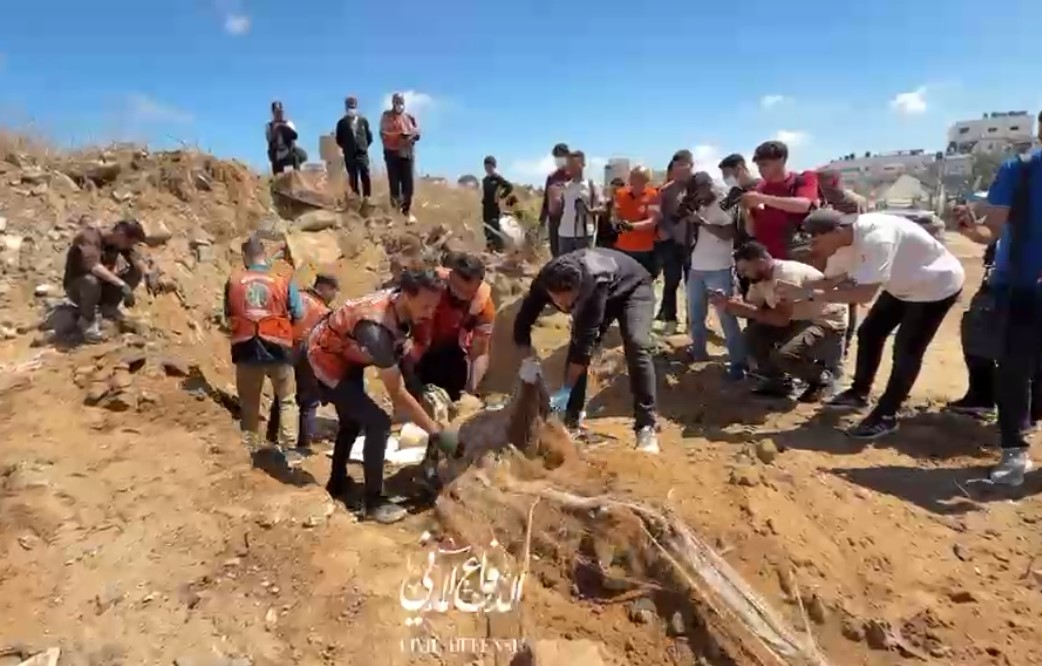
On 24 August, Civil Defence official Mohammed Abu Dan reported that crews had recovered the remains of nine members of the Salmi family from a destroyed house in Gaza City’s Zeitoun neighbourhood.
They had been underneath the ruins since the house was struck on 20 November 2023.
Days earlier, Civil Defence crews recovered 12 bodies from the ruins of the Batniji family home in Zeitoun.
During early August, teams recovered 112 bodies belonging to the Abu Sharia and Hassaina families from a destroyed residential area in the Sabra neighbourhood.
Another 50 bodies recovered from several Gaza City neighbourhoods were gathered at Al-Shifa Medical Complex before burial.
Some had remained underneath their homes for almost three years.
The crews frequently work with rudimentary equipment because the heavy machinery required for systematic excavation remains desperately scarce.
This is administration in its most elemental form: Government employees attempting to give families back their dead.
Clearing the Roads
The enormous debris field covering Gaza has created another government service almost unknown before the war: Keeping a devastated territory physically traversable.
The Ministry of Local Government announced in May that it had begun a field programme with municipalities and the Egyptian committee to reopen and widen roads and remove debris from destroyed buildings.
Work initially included Gaza City, Khan Younis, Jabalia and al-Mughraqa.
Crews have been clearing principal and secondary roads blocked by collapsed towers and apartment buildings.
Removing rubble has therefore become part of keeping the entire remaining administrative system alive.
Water
The same Ministry of Local Government was still convening technical meetings in June.
It adopted a plan with the Coastal Municipalities Water Utility and municipalities to protect Gaza’s principal water pipelines and reduce losses from damaged or unauthorized connections.
That sounds almost mundane.
In Gaza it is anything but mundane.
A ministry capable of convening municipal authorities, identifying infrastructure problems and producing a water-management plan is demonstrating that a layer of technical administration has survived the destruction.
The buildings may disappear.
The engineers remain.
The Health Ministry
The Ministry of Health provides perhaps the clearest example of institutional continuity.
Its hospitals have been devastated and its resources depleted, yet the ministry continues producing daily and periodic statistics, registering casualties and recoveries from beneath rubble and coordinating what remains of Gaza’s medical system.
On 15 August, the ministry warned that only 12 of Gaza’s original 34 oxygen stations remained operational.
The surviving stations were operating above capacity while suffering repeated mechanical failures.
Yet the ministry was still collecting the information.
It was still receiving reports from hospitals.
It was still counting admissions, deaths and injuries.
It was still recording bodies recovered from beneath the ruins.
That continuing statistical infrastructure is itself significant. International news organizations, humanitarian bodies and researchers routinely depend upon Gaza’s health authorities because there is no alternative system capable of maintaining a comparable territory-wide casualty database under the circumstances.
Hospitals have been destroyed.
The health bureaucracy has not completely disappeared with them.
Education Among the Tents
Education presents a similar picture.
There is no conventional education system remaining in large areas of Gaza. Schools have been destroyed, damaged or converted into displacement shelters.
In April the Education Ministry was still issuing territory-wide instructions concerning schools and educational points.
By August, improvised face-to-face schooling was appearing again, including the “Mecca School” established among displacement tents in the Mawasi area.
Classes take place in tents, temporary classrooms and improvised educational points.
This cannot replace Gaza’s destroyed school system.
But teachers are teaching, education officials are coordinating and children are once again being placed into organized learning environments.
The institution has contracted into something primitive.
It has not vanished.
Agriculture and Food
The Agriculture Ministry is also still operating.
In April it publicly addressed the price of agricultural produce entering Gaza and described measures intended to increase supply and reduce prices.
The ministry said it was encouraging traders to import larger quantities while attempting to encourage farmers to increase cultivated acreage.
Again, the importance is not simply agricultural.
A ministry was gathering market information, examining prices, communicating with traders and farmers and attempting to influence food availability.
Those are administrative functions.
They were being performed in the middle of an enclave where agriculture itself had been devastated.
The Government Media Office
Then there is the Government Media Office.
It has become one of the most visible surviving institutions.
Director-General Ismail al-Thawabta and his staff continue issuing statistics, statements and briefings on deaths, humanitarian conditions, border crossings, aid deliveries and ceasefire violations.
On 24 August the office issued another detailed assessment of alleged ceasefire violations, saying it had recorded 4,379 violations over 315 days.
The figures are Palestinian government figures and should be identified as such rather than treated as independently verified statistics.
But their production demonstrates something else.
Somebody is still gathering information.
Somebody is communicating with hospitals, ministries, crossings and emergency services.
Somebody is collating the figures.
Somebody is publishing them.
That bureaucracy survived.
The Aid Battle
Aid statistics have themselves become part of the political struggle.
One correction is important here: the October 2025 ceasefire arrangements called for approximately 600 trucks per day, rather than 500.
The Gaza Government Media Office subsequently argued that actual deliveries repeatedly fell drastically below that level.
Israel and US officials have at various points presented considerably higher aid-entry figures, meaning the methodology — trucks inspected, trucks crossing the boundary, or trucks actually reaching their intended destinations — matters when comparing claims.
The safest conclusion is therefore not that one particular daily number is universally accepted, but that the 600-truck target formed part of the ceasefire arrangement and Palestinian authorities repeatedly maintained that actual humanitarian deliveries fell far short of Gaza’s needs and, during significant periods, below the agreed level.
Government Without Buildings
What survives in Gaza therefore should not be confused with normal government.
It is government stripped almost to its human skeleton.
An engineer with no ministry building.
A policeman whose station has been bombed.
A teacher without a classroom.
A doctor in a partially functioning hospital.
A Civil Defence worker digging through concrete without adequate machinery.
A municipal employee trying to keep water flowing through shattered pipes.
An administrator receiving little or no regular salary.
Yet together they constitute something important: institutional memory and administrative continuity.
This helps explain why Gaza’s roughly 40,000 existing civil and security employees have become such a significant question in negotiations over what comes next.
Removing an administration on paper is relatively straightforward.
Replacing tens of thousands of teachers, engineers, doctors, nurses, technicians, municipal employees, clerks, police officers and emergency workers who know how Gaza operates is something else entirely.
Indeed, the Gaza Government Media Office has now explicitly stated that these professional and technical cadres are prepared to continue working under the National Committee for the Administration of Gaza.
That suggests the argument over Gaza’s future is gradually shifting.
The question may no longer simply be whether the old governmental structure survives.
It is who inherits the people who kept it functioning.
Netanyahu’s Unfinished Objective
For the Netanyahu government, this presents a profound political problem.
Israel has spent nearly three years systematically attacking what it identifies as Hamas’s military and governing capabilities. Enormous parts of Gaza’s physical infrastructure have consequently been destroyed.
But destroying buildings is not synonymous with eliminating administration.
The distinction between Hamas as a political-military organization and the tens of thousands of Palestinians employed in Gaza’s civilian institutions is becoming increasingly important.
A nurse is still needed regardless of who governs Gaza.
So is an engineer.
So is a sanitation worker.
So is a teacher.
So is an ambulance dispatcher.
So is somebody who knows where the underground water pipes run.
Even Gaza’s proposed new administration will require precisely these people if it is ever to govern the territory effectively.
That may ultimately prove to be one of the most consequential realities to emerge from the destruction.
Israel has demonstrated that it can destroy ministries.
It can destroy police stations.
It can destroy schools, roads and municipal buildings.
It can kill officials.
But after nearly three years of war, Gaza still contains an administrative society — tens of thousands of people possessing the knowledge required to operate hospitals, municipalities, emergency services, schools and public institutions.
The Government Media Office’s August announcement may therefore contain the essence of the story.
The political authority can be transferred.
The name at the top can change.
The administrative structure can be reorganized.
But the technical and professional employees will continue working.

 CrossFireArabia