Saudi Arabia will not normalize relations with Israel unless a Palestinian state is established and the war in Gaza ends, the kingdom’s foreign minister said Monday, signaling Riyadh’s clearest stance yet linking recognition to progress on a two-state solution.
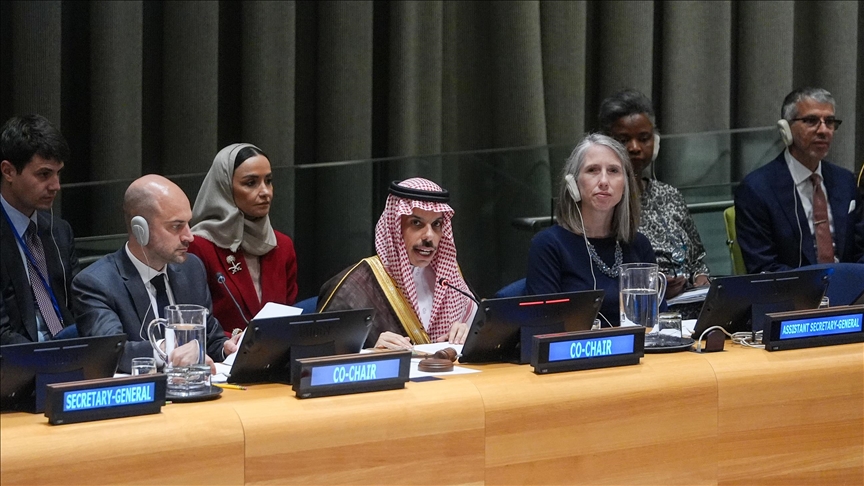
Foreign Minister Prince Faisal bin Farhan made the remarks at a press briefing with his French counterpart Jean-Noel Barrot in New York, following a high-level international conference on implementing the two-state solution, co-hosted by Saudi Arabia and France.
“For the kingdom, recognition is very much tied to the establishment of the Palestinian state,” Prince Faisal said when asked whether Saudi Arabia could relaunch the Abraham Accords recognition for Palestine as a prerequisite for normalizing relations with Israel.
“We certainly hope that the clear consensus shown today – which will be shown tomorrow as well – and the clear momentum towards establishing that Palestinian state can open the conversation about normalization,” he added.
Faisal emphasized that normalization with Israel cannot be discussed while Israel’s genocide continues in Gaza according to Anadolu.
Talks “can only open first if the conflict in Gaza ends and if the suffering of the people of Gaza is alleviated,” he said. “Because there’s no reason, even, or no credibility, to have a conversation about normalization with constant death and suffering and destruction in Gaza.”
“And then we have to talk about the establishment of the Palestinian state. And once that is achieved, then obviously we can talk about normalization,” he added.
More than 20 countries and the EU have urged Israel to lift blockade of aid delivery into Gaza Strip and enable the UN and humanitarian organizations to work independently and impartially.
In a joint statement, foreign ministers of the countries including Australia, Canada, Japan and France, stressed that the population faces starvation and Gaza’s people must receive the aid they desperately need.
Recalling that Israel’s security cabinet is said to have approved a new model for delivering aid into Gaza, which the UN and our humanitarian partners cannot support, the statement stressed that humanitarian principles matter for every conflict around the world and should be applied consistently in every warzone.
“ Humanitarian aid should never be politicised, and Palestinian territory must not be reduced nor subjected to any demographic change,” the readout said.
“As humanitarian donors, we have two straightforward messages for the Government of Israel: allow a full resumption of aid into Gaza immediately and enable the UN and humanitarian organisations to work independently and impartially to save lives, reduce suffering and maintain dignity.”
The statement reiterated an immediate return to a ceasefire and working towards the implementation of a two-state solution, “the only way to bring peace and security to Israelis and Palestinians and ensure long-term stability for the whole region.”
The joint statement was signed by EU officials and the foreign ministers of Australia, Canada, Denmark, Estonia, Finland, France, Germany, Iceland, Ireland, Italy, Japan, Latvia, Lithuania, Luxembourg, the Netherlands, New Zealand, Norway, Portugal, Slovenia, Spain, Sweden and the UK.
Israel, which abandoned the Jan. 19 ceasefire with Hamas, has kept all crossings into Gaza closed to food, medical, and humanitarian aid since March 2, deepening an already severe humanitarian crisis in the enclave.
Israeli Prime Minister Benjamin Netanyahu’s office said Sunday that Tel Aviv will permit the entry of “a basic quantity of food” for Gaza’s population “to prevent the emergence of a hunger crisis.”
He said a famine “could jeopardize the continuation of Operation Gideon’s Chariot,” referring to a new phase of Israel’s ground offensive in northern and southern Gaza.
The Israeli army has pursued a brutal offensive against Gaza since October 2023, killing more than 53,000 Palestinians, most of them women and children according to Anadolu.
French foreign minister “firmly” condemned on Tuesday Israel’s new plan to fully occupy Gaza Strip.
“It is a very firm condemnation, because it goes against international law,” French Foreign Minister Jean-Noel Barrot spoke to the broadcaster RTL.
Barrot noted that Israel’s recently announced plan to fully occupy the Gaza Strip and take control of all humanitarian aid is “not acceptable.”
“The urgent priority is, of course, a ceasefire, but also the massive and unhindered access of humanitarian aid, because the Gaza Strip—the Palestinians living there—are lacking in a dramatic way,” he added.
Barrot reaffirmed that they are working to defend the international humanitarian law alongside other countries.
“Even when there is war, we respect a certain number of rules: we do not target civilians, we do not attack humanitarian workers, and we ensure that humanitarian aid can always reach the people,” he said, reiterating the need to respect the “integrity” of laws of war.
Barrot further highlighted the risk of famine in Gaza, calling for an access to humanitarian aid.
“France calls on Israel to implement a ceasefire, to allow humanitarian aid to reach the population within the enclave of Gaza,” he added.
Barrot also confirmed that France could recognize the State of Palestine once the other countries do the same and commitments are made according to Anadolu.
The Arab world lies in one of the most important global strategic locations, controlling most of the major commercial transportation routes. It is rich in natural agricultural and industrial resources and has always been a prime target for Western colonial powers, which periodically launched military campaigns to occupy and control our world, starting from the heart of the Arab world, Palestine, known as the Holy Land, and expanding to the Levant in the north — Lebanon, Syria, Iraq, and Jordan— then to Egypt, and it’s rich in its fertile Nile River, and finally to the Arabian Peninsula in the south.
When we look back in history, we find these military colonial campaigns against the Arab world—especially Palestine—were numerous, even dating back to before Christ, such as the campaign of Alexander the Great (336 BC–323 BC) and the Roman colonial rule (63 BC–324 AD). Moving on to the ages after Christ, we recall, for example, the eight Crusades over nearly two centuries (1096–1291), followed by Napoleon Bonaparte’s campaign (1799–1801), and finally the Talmudic Zionist campaign initiated by Theodor Herzl in 1896, which continues into the present day.
These post-Christ colonial campaigns were primarily charged with religious fervor and can be termed as religious wars. In fact, Pope Urban II in 1095 described them as a “holy war” to liberate the holy city of Jerusalem from the “brutal” Muslim Arabs. As for Napoleon Bonaparte, who was defeated at the walls of Acca, he promised the Jews he would help them reach the “Promised Land,” holy Jerusalem, if they aided him in his colonial campaign.
Finally, at the present time, Britain, France and Germany came first, followed by all the US presidents who started supporting Zionist colonialism financially, politically and militarily to “recover” the “Promised Land” promised by a “racist” god biased towards the Jews to “rebuild” the alleged Temple of Solomon in the city of Jerusalem and to build Greater Israel.
All these colonial campaigns attempted to divide the Arab world into small, weak states by perpetrating genocides against their many Arab peoples. They destroyed and burned cities, tortured and killed civilians, and raped women, girls, and even boys, just as Zionist Israel is doing now in Palestine. However, past genocides cannot be compared to the brutality and brutality of the Zionist genocide against the Arabs of Palestine, from 1947 to the present day, due to the power of modern, highly destructive and lethal weapons.
The Arab nation was able to defeat all past colonial campaigns because of the people’s sense of belonging to their homeland and their unity, undivided by distance or borders, and led by brave, honorable, national leaders who sought the best for the entire nation.
The western colonialists noticed this inherent sense of belonging within the nation and decided to target it. After World War II, Britain, then the Great Power, agreed with France in the Sykes-Picot Agreement, to break the pact it signed with Sharif Hussein bin Ali. This agreement divided the Middle East into small states, appointing rulers loyal first to Britain and then to the current American administrations.
How can the men in the Arab world sit back while the carnage is unfolding in #GazaGenocide ? Have you all forgotten who you are? Children of Azzam, Mukhtar and the Ouled Darradj? Here are the words from a brother in Khan Younis less than an hour ago. “The Israelis have killed 490… pic.twitter.com/ZhECfHaic3
— Yvonne “Newcastle 🏆” Ridley (@yvonneridley) April 6, 2025
To further weaken these Arab states, the Western Axis powers divided the economies and financial systems of these states, rendering them alien and compete with each other. They also sowed division and religious, regional, and ethnic animosity among the Arab nation, allowing Zionist colonialism to penetrate the Arab world, beginning with Palestine.
Unfortunately, most Arab leaders failed to attempt to restore Arab unity and unify the people, economy, and currency, as the late Egyptian President Gamal Abdel Nasser attempted to. Instead, what was spread was division, hatred, competition, animosity, and even war among Arab peoples, as has happened in Lebanon, Iraq, Syria, and Yemen, and what is currently happening in Arab African countries such as Libya, Algeria, Morocco, and Sudan.
Worst of all is the spread of the philosophy of distancing oneself from the problems of any neighboring Arab country. Some leaders consider that the wars that take place in a neighboring Arab country do not concern them as long as these wars do not affect their country, even in the short term. We see this now clearly in what is happening in Palestine, especially the extermination of the Arabs of Gaza.
The heads of neighboring Arab countries are trying to convince their people that their national interest requires non-interference and to distance themselves to avoid destructive wars and to leave the Palestinians to resist the Israeli occupation alone.
Israel, launching pad
It would be better for these leaders to warn and inform their people that Israel is a launching pad for a broad western colonial campaign aimed firstly at destroying the Arab homeland and colonizing it by planting Zionist terrorism in the form of the Israeli entity which aims to expand from the Nile to the Euphrates, from the far south of the Nile – on the Sudan borders – to the far north of the Euphrates – to the Turkish borders – to build what is called Greater Israel in the Promised Land promised by a racist land broker god to a criminal, savage, genocidal people.
Secondly, for this Zionist entity to grow from Great Israel to Greater Israel it is going to move to the south to include all of the Arabian Peninsula – to recover Khaybar and Yathrib and their dependencies – then move west to the northern coast of the African continent, extending to Morocco and control the entire Arab world, monopolizing the most important strategic locations internationally, and global maritime trade routes between East and West, including the Strait of Hormuz on the Persian Gulf to the Arabian Sea, passing through Bab al-Mandab Strait to the Red Sea, then via the Suez Canal to the ports of occupied Palestine, and from there to the Western world via the Mediterranean Sea to Europe. And across the Giberalter Strait to the Americas – the ultimate goal of the Greater Israel Project.
All we have to do is listen to and understand the Israeli (and American) statements, both public and broadcast, clearly and vociferously, that the goal of Israel and the West is to exterminate all Arabs, just as they did to the Native Americans—they call them Red Indians— to build Greater Israel and control the Arab world and its natural resources. The evidence of these goals is clear, such as the destruction of Iraq and the theft of its wealth, and the establishment of American military bases along the Arab states on the western coast of the Persian Gulf.
We also witnessed how the Western colonial powers destroyed, divided, and weakened Libya and stole its wealth, then spread enmity between Algeria and Morocco, waged a war of extermination in Sudan, and then divided Syria and Lebanon, weakened Jordan, and effectively occupied it with American, British, and French military bases. All that remains is Egypt, which is subjected to economic occupation through conditional World Bank debt and by allowing other countries to purchase Egyptian land, real estate, and companies, which will ultimately lead to Egypt’s economic collapse.
Many people from all over the world, regardless of their ethnicity, religion, or language, are taking to the streets in massive, daily and weekly marches and demonstrations in solidarity with the Arabs of Palestine, against Israeli brutality, against Western countries, and against their own governments, which fund and supports Israel politically and militarily.
They wonder why the Arab peoples don’t take to the streets in solidarity with the Arabs of Palestine, demanding that their Arab governments personally intervene to protect and assist the Palestinians, instead of these governments begging for assistance from the powerless United Nations. Have the Arabs lost their humanity and solidarity with their Arab brothers in Palestine, or are they simply cowards and selfish and unable to do anything?
Dr. Elias Akleh is a Palestinian writer who contributed this article the Arabic Al Rai Al Youm website. This is a translated piece that was slightly edited at the end for the sake of brevity.
Palestinian women are placed at the center of life, according to Imane Maarifi, a French nurse of Moroccan descent who spoke to Anadolu about her volunteer work in Gaza.
“Palestinians have a deep respect for women. Women are really at the center of life, and you can immediately tell that they have been raised in this respect,” Maarifi said.
She described an unexpected sense of equality, noting that she mostly ate meals prepared by men, with women prioritized in serving, and the men being served afterward, if any food was left.
“I imagined, perhaps, a country with a more dominant patriarchy, but to my great surprise, that wasn’t the case,” she said.
Maarifi also observed that female workers were provided a room with a bathroom, while their male colleagues were assigned to a bare room.
“This was my first time in Palestine, and as a humanitarian worker, I was already received with great respect,” she added.
Maarifi highlighted that women in Gaza struggle to access basic materials, such as sanitary pads, while mothers always prioritize their children in all circumstances.
“What I saw among women there were mothers who couldn’t bathe every day because they preferred to use the water to bathe their children,” she said.
She also pointed to the “dire” food situation in Gaza, where constant rice consumption has led to severe digestive problems.
Maarifi noted that when mothers had access to fiber-based foods and dietary aids, they prioritized giving them to their children first.
“Of course, a mother always has that instinct, but in Gaza, under genocide, it becomes even stronger. They completely lose their sense of personal priorities — their only priority is their children,” she added.
She further emphasized that women are celebrated every day in Gaza.
“In Gaza, March 8 happens every day. Women are truly honored every single day. Maybe in the West, we should learn from them,” Maarifi concluded.

 CrossFireArabia