Trump’s War Drums ‘Dampen’

EDITOR’S NOTE: This editorial is written by Abdul Bari Atwan, chief editor of the Arabic Al Rai Al Youm website, on 2 February 2026, on the eve of increasing US military presence sorrounding Iran.

The fact that the Supreme Leader of the Islamic Revolution Ali Khamenei appeared three times in open and public meetings, chatting to ordinary Iranians recently, sends a shocking message to US President Donald Trump and Israeli Prime Minister Benjamin Netanyahu. It shows Khamenei still has the first and final word in Iran, and is not hiding in an underground bunker for fear of assassination; he has not relinquished his leadership and spiritual powers, as some Arab and Western media outlets have promoted in deliberate leaks part of the psychological warfare against Iran, coinciding with the US military buildup in the region.

In contrast top Israeli politicians and military officials are rushing to Washington fearing that President Trump will back down from his aggression threats and replace the military option for a peaceful, negotiated one and reaching an accord that does not include Israeli demands and conditions. Israeli Chief of Staff General Eyal Zamir made a surprise visit to Washington recently and met with senior US military leaders, accompanied by his own top military commanders, including the Israeli Air Force Commander.

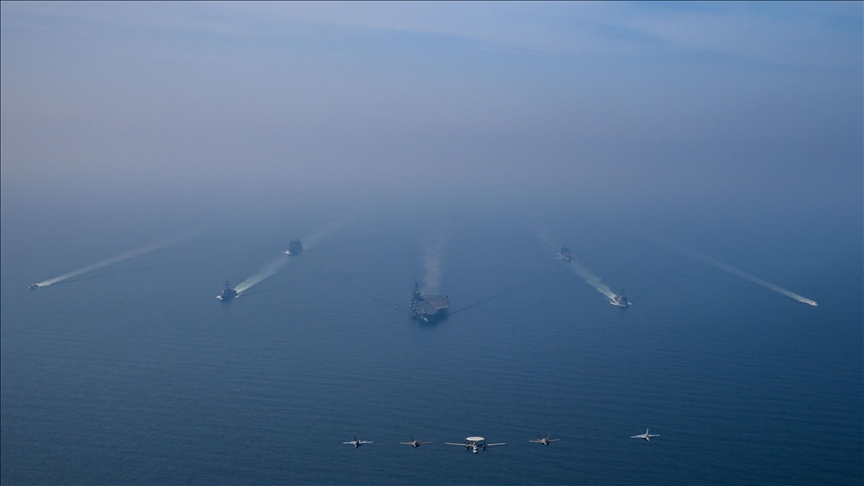
Frankly however Trump may have already lost this war, just as he lost face and credibility by failing to follow up on his threats and translate them into aggressive actions on Iranian soil as he has resorted to sending mediators, with the latest being his friend, Turkish President Recep Tayyip Erdogan, to reopen negotiations with Iran after realizing his naval buildup and aircraft carrier deployments is not yielding results, nor are they intimidating the Iranian leadership into surrendering. Thus, he may be defeated either way, whether he goes to war or resorts to a political and diplomatic solution to the cri

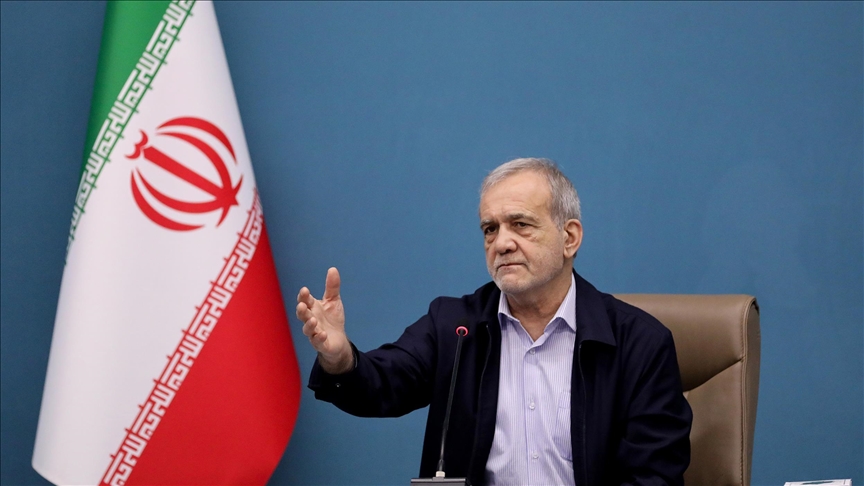
The key to understanding this confusion and perhaps American retreat, and the postponement of military strikes, lies in the threatening message sent by Ayatollah Ali Khamenei to Trump during his meetings with the numerous Iranians on the anniversary of the late Ayatollah Khomeini’s death. The most prominent point was his assertion that “Iran does not initiate wars, but if it is subjected to aggression, it will confront it with all its might and inflict devastating blows on the enemy.” More importantly, he stated “this war will be a broad regional conflict, it will not be swift, decisive, or short-lived,” nor “clean”— meaning, free of casualties.

A “regional war” means all countries, movements, and military factions aligned with the “axis of resistance” will participate, starting with Hezbollah in Lebanon, the Popular Mobilization Forces in Iraq, and Ansar Allah in Yemen. American bases in the region, particularly on the Arabian side of the Gulf, will be legitimate targets, as will all the American soldiers stationed there and whose numbers exceed 70,000.

What terrifies Israel most is not only Trump’s failure to proceed with his aggression against Iran, but also the possibility of reaching an agreement that contradicts all three of Israel’s objectives:

First: Preventing Iran from acquiring nuclear weapons, halting all Iranian uranium enrichment at high levels, and surrendering all its existing stockpile (480 kilograms) to a neutral country. Second: Halting the development and launch of Iranian missiles, and dismantling all long-range missiles, whether hypersonic or multiple-warhead, capable of reaching deep into Israeli territory, particularly Haifa and Tel Aviv, as demonstrated in the 12-day war last June.

Third: Completely ceasing all financial and missile support for resistance movements, especially Hezbollah in Lebanon and its Iraqi counterpart, factions within the Popular Mobilization Forces such as Harakat al-Nujaba, and Ansar Allah in Yemen.

A Reminder

Everyone should be reminded the return of 5,000 American soldiers in coffins to Washington, killed by the Iraqi resistance after the 2003 invasion, forced the then-President Barack Obama to acknowledge defeat and withdraw 160,000 American troops from Iraq in November 2011. This was made to minimize losses. Thus, it is no exaggeration to say that any aggression against Iran today would result in four times that number of American casualties, if not more, in the initial days of the attack. This is due to Iran’s resolve, advanced missiles and drones, and other secret weapons that might be the biggest surprises of this war, should it start.

Perhaps the decline in oil prices, the collapse of gold and silver prices, and the dollar’s shocking depreciation in global financial markets are among the most prominent indicators confirming what was stated above: The diminishing likelihood of war, Trump’s reluctant inclination towards diplomatic solutions and negotiations, and his initial admission of his failure to achieve a military victory to avoid losses and the protracted regional war threatened by the Iranian Supreme Leader, Ayatollah Ali Khamenei. Time will tell.

Continue reading
Donald’s War Bells

By Dr Khairi Janbek

When talking about the stand off between the US and Iran, in fact, anything can happen on the kaleidoscope of endless talks to an endless war. Usually it is possible to predict the reaction of one collective or another with some knowledge, but impossible to predict the reaction of an individual no matter what knowledge is available.

This is especially the case if this individual is Donald Trump. He makes it his business to be unpredictable and depending who tells him what and whether he likes it or not; but at least we can attempt to drive some inference from the situation, a situation which finds the current American president who heavily criticized his predecessors for dragging the United States into protracted wars with dubious results.

In this sense, the operative term is a short and decisive war, which is unclear in terms of what duration in order to be decisive about what? From the term, short and decisive, President Trump seems to know what he wants, which we can pontificate on in a myriad of possibilities, however, and for all intents and purposes, it can only mean a campaign of targeting the current leadership, civilian, military and security, coupled with targeting Iran’s missile and nuclear capabilities.

Alternatively, for a leader obsessed with reality show image, he wishes to drag Iran to the negotiations table, which is not supposed to appear as a negotiations table, rather a table which will show a supposedly humiliated Iran, accepting the terms of the Washington administration: Those terms being a peaceful nuclear programme under close international supervision, no missile development programme, and stopping its support to its current regional proxies.

But the snag in all those plans,seems to be based on the reports indicating that the president has been told, that in order for the war to be decisive, it’s not likely to be a short one, which puts Trump in the conundrum of dragging the US into a protracted war on many other fronts, ranging from Iran to Iraq to Yemen. One is not saying at all that the US military cannot handle it, rather how costly will be the confrontation with Iran and its proxies be to achieve a decisive objective, which Trump desires to achieve in a short war?

In effect, if he does go to war at this point the objective has to change, and the meaning of decisive has also to change, meaning it would have to be regime change, knowing only too well, that there is no viable political alternative to the Mullahs except the Shah of Iran, which Trump doesn’t seem to be too keen on, and no one else in the region; for they are not much qualified to deal with day of regime change in Iran.

Also from an economic point of view: How long can a standing navy fleet stay on alert for war. The matter is not only psychological, but rather financial, as the moving of such a sizable war machine costs millions of dollars, now, if there are sponsors for this big operation and whom are willing to pay the expenses, then the US navy, similar to its Venezuelan operations, can encircle Iran and confiscate its oil shipments in the high seas , but if the US is paying for this big operation, then it won’t be long before we hear about a war breaking out.

Continue reading
Gaza: Changing The Middle East Face

By Mohammad Abu Rumman

The Al-Aqsa Flood operation marked a turning point in the modern political history of the Middle East. Its repercussions have gone far beyond the Palestinian and regional arenas, extending to the international system and reshaping the foreign policies of global powers toward the region.

The timing of the operation was particularly significant: it came at a transitional moment in the regional order, in the absence of consensus among international and regional actors on the rules of the game. While a fragile balance of deterrence existed between the so-called “Axis of Resistance”—led by Iran (alongside the Syrian regime, Hezbollah, Shiite political forces in Iraq, the Houthis in Yemen, and Hamas and Islamic Jihad)—and Israel, the latter was in the midst of a new phase of regional integration through the Abraham Accords.

Several Arab capitals had already normalized relations, and others were on their way, creating an unprecedented political landscape. This shift coincided with the declining influence of traditional Arab powers such as Egypt, Iraq, and Syria, and the rising centrality of the Gulf states. Many analysts began describing this new configuration as a “New Middle East”: wealthy, economically driven, and detached from historical conflicts—unlike the “Old Middle East,” where entrenched crises defined politics.

Turkey, meanwhile, had entered its own phase of recalibration. Once a champion of the Arab Spring and regional Islamist movements, Ankara sought reconciliation with Arab states, even attempting to restore ties with Bashar al-Assad’s regime (though rebuffed by Damascus), while focusing more narrowly on national security and northern Syria.

On the Palestinian front, Israel had grown complacent toward Gaza, convinced Hamas had no incentive to disrupt the status quo. Tensions, however, were mounting in the West Bank, with small armed groups emerging in places like Nablus, Tulkarm, and Jenin. Within Israeli and Western policy circles, talk was spreading about the prospect of a “mini-state in Gaza” as a substitute for a Palestinian state.

At the international level, President Joe Biden’s administration lacked enthusiasm for either the Abraham Accords or Trump’s “Deal of the Century,” yet it effectively followed the same trajectory: pursuing “regional peace” by integrating Israel into a new economic order and reducing the Palestinian question to daily livelihood concerns—employment, services, and economic relief in Gaza and the West Bank—rather than a political resolution.

The Al-Aqsa Flood and the subsequent two-year genocidal war in Gaza shattered these calculations and fundamentally restructured strategic assumptions. Whether the outcome will ultimately benefit or harm the Palestinian cause remains too complex to assess in simple terms, but what is clear is that the pre-October 7 regional order no longer exists.

From a Palestinian perspective, the conflict has restored international attention to the cause, leading to a renewed recognition of its centrality. In the Gulf, the previously dominant security paradigm—which cast Iran as the chief threat while framing Israel as a potential partner—collapsed entirely. A new consensus has emerged: Gulf security is inseparable from the Palestinian issue, and the notion of Israel as a “strategic friend” has been critically reassessed.

Skeptics may argue that these shifts have not altered the balance of power on the ground, and they are partially correct. Yet the strategic narrative has changed. Before October 7, the trajectory was toward the erasure of the Palestinian cause (closing UNRWA, moving the U.S. embassy to Jerusalem, normalization, and de facto annexation of the West Bank). Today, there is growing recognition—regionally and internationally—that Israeli policies themselves are the root of instability, not Iran or other regional actors. As Emirati political scientist Abdulkhaleq Abdulla put it on X (September 25): “When weighing who poses a greater threat to Gulf security and regional stability—Iran or Israel—the evidence points clearly to Israel. Israel’s brutal behavior has made it more dangerous than an exhausted Iran. The Gulf needs a new defensive and geopolitical strategy for the Middle East beyond Iran.”

Israel, however, now perceives a surplus of power and is pressing for a new political and security order that extends beyond the occupied territories. With the partial unraveling of the Iranian alliance and the breakdown of the “Syrian corridor” that once linked Tehran to the Mediterranean, Israel has set its sights on even more ambitious goals, including the proposed “David Corridor” and establishing buffer zones around its borders in Syria, Lebanon, and Gaza.

In response, a tentative regional coalition has begun to take shape, bringing together Saudi Arabia, Egypt, Jordan, and Qatar, with notable support from Turkey and Pakistan. The latter signed a defense pact with Saudi Arabia following Israel’s strike on Qatar and has since become more engaged in regional diplomacy. While fragile and constrained, this alignment presents a rare historic opportunity to rebuild a regional balance of power and establish a new deterrence framework.

Another striking development is the shift in Europe’s stance toward Israel. For the first time, Israel has lost significant ground in Western public opinion and media narratives, particularly among younger generations and in universities. This has pushed Israel closer to isolation—a position from which former U.S. President Donald Trump had tried to rescue it through his proposed Gaza peace plan, which was largely about securing U.S. and Israeli interests, without offering real guarantees for Palestinian statehood or ending the occupation.

In conclusion, it is still too early to judge the full strategic consequences of the Al-Aqsa Flood and the war in Gaza. Scenarios remain open, and outcomes uncertain. Yet one thing is indisputable: the region today is no longer what it was before October 7.

Abu Rumman is an Academic Advisor of the Politics and Society Institute and Professor of Political Science in The University of Jordan and published this article in The Jordan Times.

Continue reading
Israeli Planes Drop 30 Bombs on Yemen

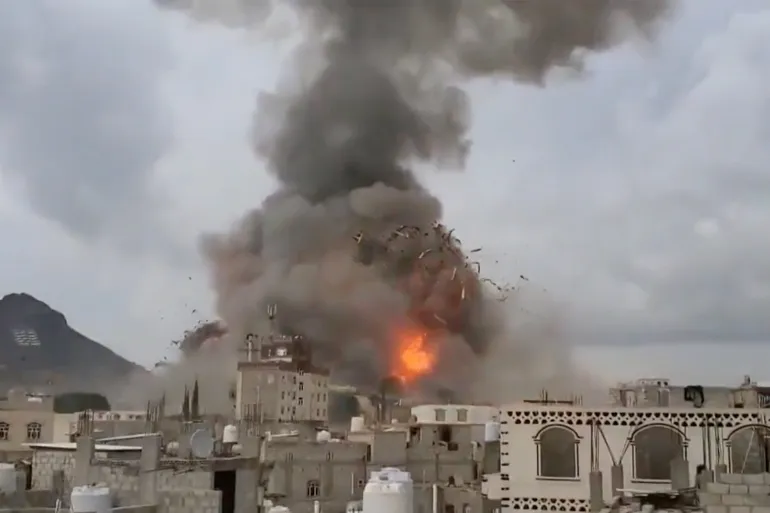
Israeli warplanes struck the Yemeni capital Sana and the Al Jawf Governorate with 30 bombs killing nine people and injuring 118 according to the Yemeni Health Ministry, Wednesday.

It was described as a massive attack in which 10 Israeli warplanes struck 15 Yemeni targets.

The aggression on Sana’a targeted a medical station on 60th Street, southwest of Sana’a, the Moral Guidance Dept., of the Defence Ministry and the headquarters of the “26 September” and “Al-Yaman” newspapers.

A senior official source said the attack on the “26 September” newspaper resulted in the death and injury of a number of male and female journalists.

In Al-Jawf, northeast of the country, the Israeli aggression targeted a government complex in Al-Hazm District.

Yemeni Armed Forces spokesman Brigadier General Yahya Saree stated, “Our air defenses were able to launch a number of surface-to-air missiles while confronting the Zionist aggression against our country.”

Sare’i added in a social media post some combat formations were forced to leave before carrying out their aggression, thwarting the bulk of the attack as reported in almayadeen.

Sare’i denied the Israeli occupation’s allegations of targeting missile launchers, asserting its raids targeted purely civilian targets.

He emphasized this brutal aggression will not pass without a military response.

An Israeli Air Force source told Israeli media that “the attack on Yemen involved more than 10 fighter jets, and more than 30 munitions were used against 15 sites.”

A senior Yemeni military source confirmed to Al-Mayadeen the aggression struck purely civilian targets, noting that the government complex in Al-Jawf is a building serving citizens and has no military connection.

The source emphasized that targeting civilian facilities will not “stop Yemen from fulfilling its role,” noting that the occupation’s targeting of the government complex is evidence of its incompetence and failure.

The aggression on Yemen “will not stop us from supporting Gaza and disciplining the Israeli entity,” he continued.

The Yemeni armed forces have continue their operations against Israel, directing strikes at various targets, including Ben Gurion Airport and imposing a ban on Israeli ports.

Continue reading
How Will Israel Stop The Houthi Missiles!

By Dr Marwan Asmar

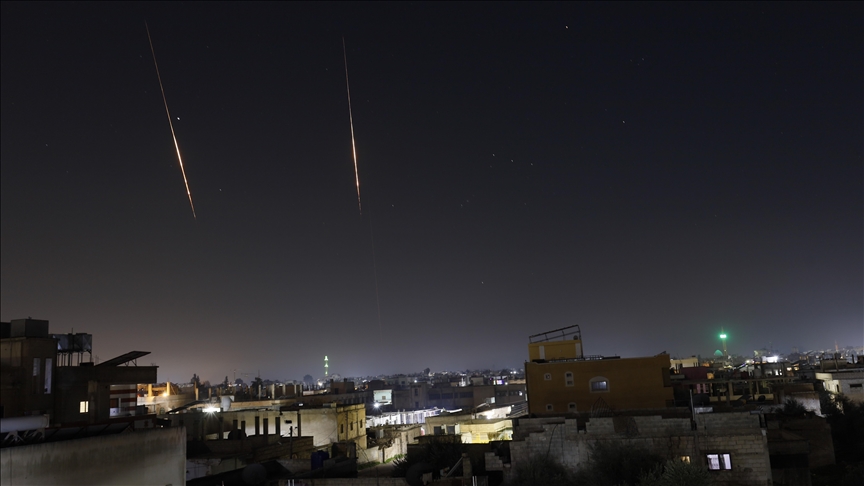
Houthis missiles continue to rain down on Israel and that’s not an understatement. Only in this past month of May Israel was subject to 16 ballistic missiles. That’s almost one every two days. Sometimes two missiles were fired in one day.

On Thursday another ballistic missile was fired on Tel Aviv that stopped a football match for at least 10 minutes in a packed stadium of 30,000 people. Among the spectators, who were ordered to lie down, was Israeli president Isaac Herzog who was scurried to safety. 

The incoming missile for Ben Gurion Airport set sirens in over 300 major cities, towns, villages and settlements between Tel Aviv and Jerusalem.

In addition to that, and something that has become normal for Israelis since 7 October, 2023, 3 to 4 million hurried to underground shelters disrupting their lives and work processes.

This is not to say anything about the continuing psychological blows inflicted on them, and on a daily basis. This is the first time they have been subjected to what has become a set of nightmare occurrences first from Hezbollah and now the Houthi missiles travelling over 2000 kilometers north diagonally over the Red Sea to hit Israeli targets.

Thursday’s attack was in response to Wednesday’s Israeli bombing – the second time since 6 May – of the Sanaa International airport. Israeli bombs already destroyed the airport and the last attack made through 10 Israeli warplanes finished off the only aircraft left that belonged to the Yemeni airlines. The plane had just arrived in Sanaa from the Jordan capital of Amman.

And a day before that the Houthis had fired another missile on Tel Aviv. While most of the missiles are fired down by the Israeli forces before they reach their targets they have created tremendous confusion in the Israeli airwaves. Today tens of airlines have stopped flying to Tel Aviv despite the pleadings of the Israeli government that Israeli airports are safe. 

Since January 2025, 35 ballistic missiles have been launched on Israel from different locations in Yemen. Also, since early this year, 14 so-called attack drones were launched from Yemen to strike targets in Israel. 

As well, and only since March 29 missiles and 9 drones were fired from Yemen because Israeli Prime Minister Benjamin Netanyahu relaunched the war on Gaza on 19th March. Despite the Israeli precautions and ground batteries that shot down these missiles, they have created much debris on the ground when they came down to earth.

With the 16 ballistic missiles launched in May, four drones were also fired on different Israeli cities, statistics provided and confirmed by the Israeli army. It further states that  since 7 October 2023 the Houthis launched 70 missiles on Israeli sites, including ports, airports,  the Mossad headquarters in Tel Aviv and many more.

The Israeli army state these exclude the 330 drones that were fired on Israel over the past 19 months of the Israel genocide on Gaza taking the number of Palestinian deaths to 54,321 with the number of injuries at 123,770.

As a result, the Houthis succeeded in imposing an air embargo on Israel in May as their leadership insists. Their projectiles have stopped 10s of international airlines from flying to the Ben Gurion Airport with British Airways and the low-cost Ryanair being the latest to suspend flights.

These are the latest to follow the Lufthansa group which include SWISS, Austrian Airlines, Brussels Airlines and Eurowings. They have already stopped going to Tel Aviv and are watching the situation carefully before they take the step of resetablishing air connections.

Since 4 May other planes that suspended flights to Israel include  Latvian airline, AirBaltic, easyJet, United Airlines, Iberia and Transavia.

However, among the few foreign airlines that recently resumed flight services to Israel are Air France, Delta, Wizz Air, Ethiopian Airlines, Etihad Airways and Greece’s Aegean Airlines states The Times of Israel.

Unprecedented

The Thursday ballistic missile was unprecedented because the Israeli president was watching. The match had to stop while he was rushed away to safety. The Israeli media says the match was stopped twice when the missiles were launched from Yemen and when tens of thousands of people were told to lie on the ground for 20 minutes and a second time when spectators booed Herzog.

The Houthi leadership already warned the Israelis to do “what it will” because it will not stop firing the ballistic missiles on Israel until the latter stops its war on Gaza.

They say that Israel can bomb Yemen as much as it wants but it will not stop the missiles on Tel Aviv and different areas like Eilat.  Despite putting on a strong face Israel is in a quandary. About 30 Israeli warplanes took part in destroying the Sanaa Airport on 5 May but the Yemenis have not flinched.

Now, the Israeli Minister Israel Katz is in a vehement mood and is warning that Israel will continue to bomb and re-bomb existing sites till the end if need be. Truth be told however, the Israelis are bombing indiscriminately as they don’t know and figure out where the Houthis missiles are being fired from in Yemen.

Netanyahu is convinced that Iran is supplying the Houthis with the missiles and that’s why he wants to hit the country but the problem with that is the Trump administration at present is  talking to Tehran about reaching an agreement on its nuclear file and is sending direct messages to Netanyahu to lay off that country and not attempt any foolish act like striking its nuclear facilities.

Thus only time will tell how international relations will unravel especially since Trump reached a deal with the Houthis at the beginning of May that they would stop bombing them if they desist from attacking American ships and planes. The previous months or so the US waged a military campaign on the Houthis that led to nowhere but a costly war of $1 billion.

With the US out of the way, it can be said the Houthis are having a field day on continuing their strikes on Israel. Their message is simple: Stop bombing Gaza and we will stop striking Israel.

Continue reading