Still Governing Among the Ruins: How Gaza’s Civil Administration Survived the War
CROSSFIREARABIA — Almost everything needed to run a government has been attacked or disrupted in Gaza: Offices, police stations, roads, communications networks, schools, hospitals, municipal equipment and the homes of the civil servants themselves.
Yet the administrative machinery has not entirely stopped.
Nearly three years after the beginning of the war, an extraordinary and politically consequential reality remains visible beneath Gaza’s physical destruction: Civil servants continue reporting for duty, police officers still attempt to maintain public order, Civil Defence crews dig bodies from collapsed buildings, health officials maintain casualty and hospital records, agricultural officials intervene in food-market problems, local-government employees work on water and roads, and education officials continue trying to organize schooling.
Gaza’s administration today bears little resemblance to a normally functioning government. It operates from damaged buildings, temporary locations and whatever facilities remain available. Salaries have largely disappeared. Equipment is scarce. Thousands of employees have themselves been displaced or bereaved.
But the administration continues.
And that distinction — between a government that functions normally and an administrative structure that simply refuses to cease functioning — is important.
In August, the Government Media Office made the point unusually explicitly while calling upon the National Committee for the Administration of Gaza to enter the Strip and assume its responsibilities.
The office said administrative, legal and logistical preparations for transferring responsibilities had been completed, but added that the existing technical and professional cadres would continue carrying out their duties so that essential services continued and an administrative vacuum did not develop.
That statement says much about what remains underneath Gaza’s ruins.
The 40,000
Perhaps the least visible survivors of the war are Gaza’s government employees.
Estimates associated with discussions over Gaza’s future administration have put the number of existing civil and security personnel at roughly 40,000.
They include teachers, doctors, nurses, engineers, accountants, ministry administrators, municipal employees, technicians, police officers, Civil Defence personnel and thousands of other public-sector workers.
Their existence has now become one of the issues surrounding the proposed transfer of administration to the National Committee for the Administration of Gaza.
But “employee” has acquired an entirely different meaning in Gaza.
The Palestine Information Center reported in June that government employees were no longer receiving anything resembling a normal salary. Some were waiting roughly 100 days for payments of no more than 1,000 shekels.
Yet many continued working.
The Gaza public-sector employees’ union said in July that employees had continued carrying out their professional and public duties despite what it described as extraordinarily harsh circumstances.
This creates one of the paradoxes of post-war Gaza: The state payroll has effectively ceased functioning normally, while portions of the workforce supported by that payroll continue to work.
A policeman interviewed by the Palestine Information Center described being unable to meet the basic needs of his five children.
He was still a policeman.
Police Without Police Stations
Nowhere is the survival of the administrative structure more visible — or more dangerous — than in Gaza’s police.
Police officers continue appearing in streets and markets and performing public-order duties. The Interior Ministry says police also assist humanitarian organizations and protect public and private property.
The ministry stated in July that police were working to facilitate the operations of local and international relief organizations.
But policing has come at an enormous cost.
The Interior Ministry says Israeli forces have repeatedly targeted police personnel while they were performing internal-security duties.
That continued in August.
A strike on a police facility in Gaza City killed a group of senior officers, according to the Palestine Information Center. Among those named were Brigadier General Ayman Mahmoud Jundiya, acting Gaza Governorate police chief; Colonel Osama Hashem al-Hajin, director of Gaza police operations; and Colonel Fatina Abdel-Jabbar al-Sahar, head of the women’s police department in the governorate.
The Interior Ministry said other senior police officials had previously been killed, including the northern Gaza police chief, the head of internal security in the central governorate and the commander of the Jabalia camp police station.
Israel has alledged that Hamas uses elements of Gaza’s governing and security apparatus for military purposes and has described some people it targets as Hamas operatives. Palestinian officials reject the characterization of Gaza’s civilian police force as a legitimate military target.
Whatever the competing arguments, the consequence on the ground is unmistakable.
Gaza still has police.
And policemen are still dying while performing police work.
Civil Defence: Digging Up Gaza’s Dead
There may be no more haunting example of a functioning public institution than Gaza’s Civil Defence.
Its crews are no longer principally dealing with ordinary fires, traffic accidents or building emergencies.
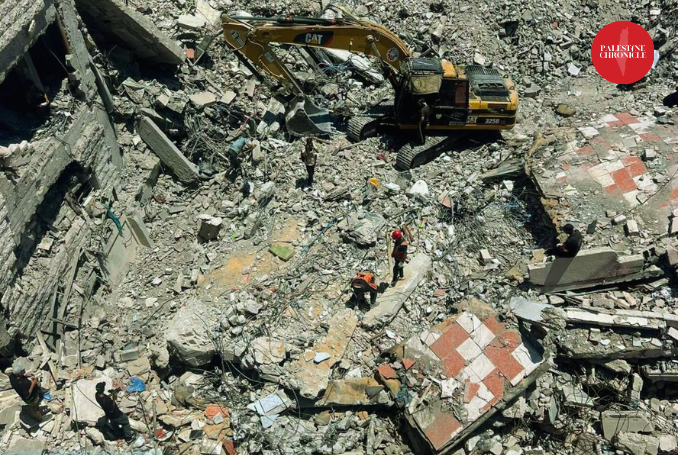
They are excavating the dead.
Civil Defence spokesman Mahmoud Basal estimated in February that approximately 8,000 bodies remained beneath destroyed buildings, with thousands of other people still classified as missing.
The work continues.
On 24 August, Civil Defence official Mohammed Abu Dan reported that crews had recovered the remains of nine members of the Salmi family from a destroyed house in Gaza City’s Zeitoun neighbourhood.
They had been underneath the ruins since the house was struck on 20 November 2023.
Days earlier, Civil Defence crews recovered 12 bodies from the ruins of the Batniji family home in Zeitoun.
During early August, teams recovered 112 bodies belonging to the Abu Sharia and Hassaina families from a destroyed residential area in the Sabra neighbourhood.
Another 50 bodies recovered from several Gaza City neighbourhoods were gathered at Al-Shifa Medical Complex before burial.
Some had remained underneath their homes for almost three years.
The crews frequently work with rudimentary equipment because the heavy machinery required for systematic excavation remains desperately scarce.
This is administration in its most elemental form: Government employees attempting to give families back their dead.
Clearing the Roads
The enormous debris field covering Gaza has created another government service almost unknown before the war: Keeping a devastated territory physically traversable.
The Ministry of Local Government announced in May that it had begun a field programme with municipalities and the Egyptian committee to reopen and widen roads and remove debris from destroyed buildings.
Work initially included Gaza City, Khan Younis, Jabalia and al-Mughraqa.
Crews have been clearing principal and secondary roads blocked by collapsed towers and apartment buildings.
The significance goes beyond traffic.
Without passable roads, ambulances cannot reach hospitals. Water tankers cannot reach displacement camps. Food cannot reach markets. Civil Defence machinery cannot reach collapsed buildings.
Removing rubble has therefore become part of keeping the entire remaining administrative system alive.
Water
The same Ministry of Local Government was still convening technical meetings in June.
It adopted a plan with the Coastal Municipalities Water Utility and municipalities to protect Gaza’s principal water pipelines and reduce losses from damaged or unauthorized connections.
That sounds almost mundane.
In Gaza it is anything but mundane.
A ministry capable of convening municipal authorities, identifying infrastructure problems and producing a water-management plan is demonstrating that a layer of technical administration has survived the destruction.
The buildings may disappear.
The engineers remain.
The Health Ministry
The Ministry of Health provides perhaps the clearest example of institutional continuity.
Its hospitals have been devastated and its resources depleted, yet the ministry continues producing daily and periodic statistics, registering casualties and recoveries from beneath rubble and coordinating what remains of Gaza’s medical system.
On 15 August, the ministry warned that only 12 of Gaza’s original 34 oxygen stations remained operational.
The surviving stations were operating above capacity while suffering repeated mechanical failures.
Yet the ministry was still collecting the information.
It was still receiving reports from hospitals.
It was still counting admissions, deaths and injuries.
It was still recording bodies recovered from beneath the ruins.
That continuing statistical infrastructure is itself significant. International news organizations, humanitarian bodies and researchers routinely depend upon Gaza’s health authorities because there is no alternative system capable of maintaining a comparable territory-wide casualty database under the circumstances.
Hospitals have been destroyed.
The health bureaucracy has not completely disappeared with them.
Education Among the Tents
Education presents a similar picture.
There is no conventional education system remaining in large areas of Gaza. Schools have been destroyed, damaged or converted into displacement shelters.
Nevertheless, educational administration continues.
In April the Education Ministry was still issuing territory-wide instructions concerning schools and educational points.
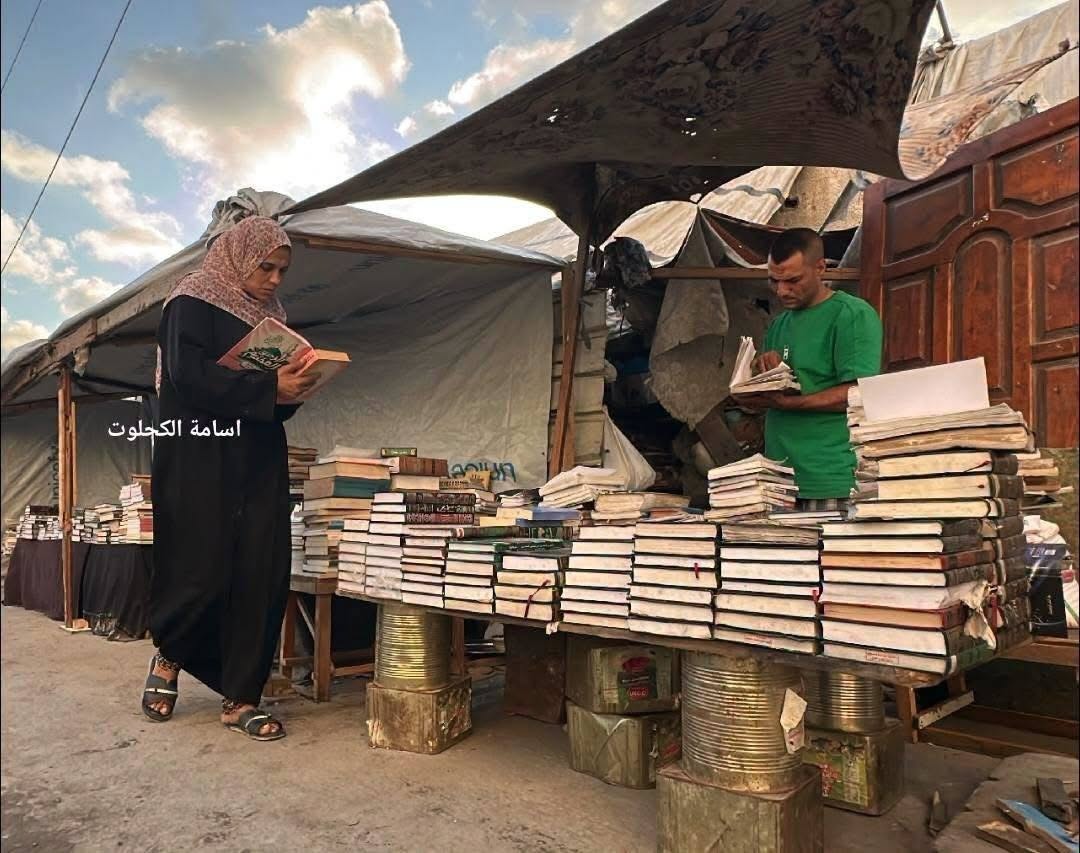
By August, improvised face-to-face schooling was appearing again, including the “Mecca School” established among displacement tents in the Mawasi area.
Classes take place in tents, temporary classrooms and improvised educational points.
This cannot replace Gaza’s destroyed school system.
But teachers are teaching, education officials are coordinating and children are once again being placed into organized learning environments.
The institution has contracted into something primitive.
It has not vanished.
Agriculture and Food
The Agriculture Ministry is also still operating.
In April it publicly addressed the price of agricultural produce entering Gaza and described measures intended to increase supply and reduce prices.
The ministry said it was encouraging traders to import larger quantities while attempting to encourage farmers to increase cultivated acreage.
Again, the importance is not simply agricultural.
A ministry was gathering market information, examining prices, communicating with traders and farmers and attempting to influence food availability.
Those are administrative functions.
They were being performed in the middle of an enclave where agriculture itself had been devastated.
The Government Media Office
Then there is the Government Media Office.
It has become one of the most visible surviving institutions.
Director-General Ismail al-Thawabta and his staff continue issuing statistics, statements and briefings on deaths, humanitarian conditions, border crossings, aid deliveries and ceasefire violations.
On 24 August the office issued another detailed assessment of alleged ceasefire violations, saying it had recorded 4,379 violations over 315 days.
The figures are Palestinian government figures and should be identified as such rather than treated as independently verified statistics.
But their production demonstrates something else.
Somebody is still gathering information.
Somebody is communicating with hospitals, ministries, crossings and emergency services.
Somebody is collating the figures.
Somebody is publishing them.
That bureaucracy survived.
The Aid Battle
Aid statistics have themselves become part of the political struggle.
One correction is important here: the October 2025 ceasefire arrangements called for approximately 600 trucks per day, rather than 500.
The Gaza Government Media Office subsequently argued that actual deliveries repeatedly fell drastically below that level.
Israel and US officials have at various points presented considerably higher aid-entry figures, meaning the methodology — trucks inspected, trucks crossing the boundary, or trucks actually reaching their intended destinations — matters when comparing claims.
The safest conclusion is therefore not that one particular daily number is universally accepted, but that the 600-truck target formed part of the ceasefire arrangement and Palestinian authorities repeatedly maintained that actual humanitarian deliveries fell far short of Gaza’s needs and, during significant periods, below the agreed level.
Government Without Buildings
What survives in Gaza therefore should not be confused with normal government.
It is government stripped almost to its human skeleton.
An engineer with no ministry building.
A policeman whose station has been bombed.
A teacher without a classroom.
A doctor in a partially functioning hospital.
A Civil Defence worker digging through concrete without adequate machinery.
A municipal employee trying to keep water flowing through shattered pipes.
An administrator receiving little or no regular salary.
Yet together they constitute something important: institutional memory and administrative continuity.
This helps explain why Gaza’s roughly 40,000 existing civil and security employees have become such a significant question in negotiations over what comes next.
Removing an administration on paper is relatively straightforward.
Replacing tens of thousands of teachers, engineers, doctors, nurses, technicians, municipal employees, clerks, police officers and emergency workers who know how Gaza operates is something else entirely.
Indeed, the Gaza Government Media Office has now explicitly stated that these professional and technical cadres are prepared to continue working under the National Committee for the Administration of Gaza.
That suggests the argument over Gaza’s future is gradually shifting.
The question may no longer simply be whether the old governmental structure survives.
It is who inherits the people who kept it functioning.
Netanyahu’s Unfinished Objective
For the Netanyahu government, this presents a profound political problem.
Israel has spent nearly three years systematically attacking what it identifies as Hamas’s military and governing capabilities. Enormous parts of Gaza’s physical infrastructure have consequently been destroyed.
But destroying buildings is not synonymous with eliminating administration.
The distinction between Hamas as a political-military organization and the tens of thousands of Palestinians employed in Gaza’s civilian institutions is becoming increasingly important.
A nurse is still needed regardless of who governs Gaza.
So is an engineer.
So is a sanitation worker.
So is a teacher.
So is an ambulance dispatcher.
So is somebody who knows where the underground water pipes run.
Even Gaza’s proposed new administration will require precisely these people if it is ever to govern the territory effectively.
That may ultimately prove to be one of the most consequential realities to emerge from the destruction.
Israel has demonstrated that it can destroy ministries.
It can destroy police stations.
It can destroy schools, roads and municipal buildings.
It can kill officials.
But after nearly three years of war, Gaza still contains an administrative society — tens of thousands of people possessing the knowledge required to operate hospitals, municipalities, emergency services, schools and public institutions.
The Government Media Office’s August announcement may therefore contain the essence of the story.
The political authority can be transferred.
The name at the top can change.
The administrative structure can be reorganized.
But the technical and professional employees will continue working.
Amid Gaza’s ruins, they already are.