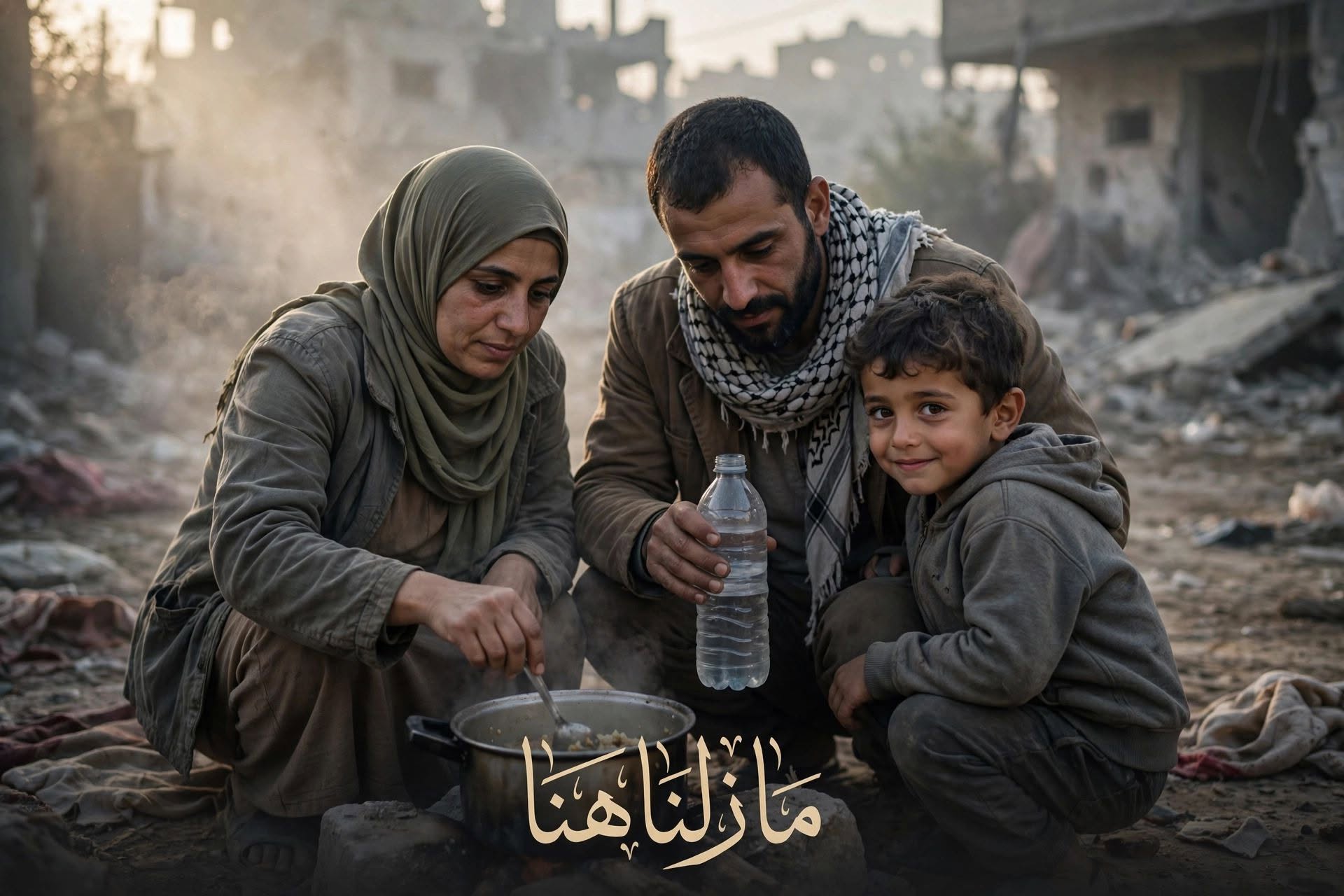
‘We Are Still Here – Gaza’

From Sameer Kafina

Gaza… When Survival Becomes an Achievement

In Gaza, survival is no longer a given.

Waking up in the morning, finding water, getting a meal, searching for a safe place for your children, opening your eyes to find your loved ones still by your side… things that were once ordinary details in people’s lives have now become an achievement worth telling.

Those of us who live far from the war may not realize what it means for “tomorrow” itself to become a wish.

In Gaza, there are people who don’t ask for a life of luxury, nor grand dreams. All they want is for another night to pass without loss, for their children to find something to eat, for a roof over their heads to remain, and for them to be able to say in the morning: We are still here.

And perhaps this is why we shouldn’t see the people of Gaza only as victims.

They are also people resisting life itself; trying to preserve their families, what remains of their homes, their children, and some semblance of life amidst all this devastation.

We may not see this struggle in pictures.

But it happens every day. A woman tries to prepare a meal with what little she has left, a father searches for water, a child tries to laugh, and a family tries to sleep despite the fear.

These are not small details.

In a place where death is so close, clinging to life becomes an act of resistance.

Gaza doesn’t just need us to remember its dead.

It also needs us to remember its living… who try every morning to tell the world:

We are still here.

  • CrossFireArabia

    CrossFireArabia
    Dr. Marwan Asmar holds a PhD from Leeds University and is a freelance writer specializing on the Middle East. He has worked as a journalist since the early 1990s in Jordan and the Gulf countries, and been widely published, including at Albawaba, Gulf News, Al Ghad, World Press Review and others.

    Related Posts

    The Mecca Agreement: Is This The Beginning?

    By Helmi Al-Asmar

    In politics, not all agreements are created equal. Some accords are signed only to be forgotten, while others open a new chapter in history. The question that arises today is: To which category does the Mecca Agreement belongs to?

    For more than a century, the Islamic world has lacked an independent security system capable of protecting its interests outside the sphere of influence of major powers. Alliances have come and gone, and coalitions have shifted, but security decisions have often remained hostage to international balances rather than stemming from regional will.

    Today, three of the most important players in the Islamic world are coming together: Saudi Arabia with its political, economic, and religious weight; Turkey with its advanced industrial and military base; and Pakistan with its military strength, strategic expertise, and possession of nuclear weapons. The convergence of these elements within a single defense framework makes it difficult to treat the agreement as a mere passing news item.

    But history also teaches us that texts alone do not create transformations. What gives any agreement its true value are the practical steps that follow: joint command, integration of military industries, intelligence sharing, unified defense systems, and regular exercises. Only then can it be said that the agreement has moved from paper to reality.

    Conversely, this step will not pass without regional and international powers reassessing their calculations. The United States, Russia, China, Iran, and Israel will all interpret the agreement through the lens of its potential impact on the balance of power in the Middle East and the Islamic world.

    However, the greatest challenge may not be external, but internal. Can the three countries overcome their differing priorities and interests and transform the political declaration into a long-term strategic project? This is the real test.

    The Mecca Agreement may be just another milestone in the history of agreements, or it may be the first spark for building a different Islamic security system. Therefore, the question is not: What does the agreement stipulate? But rather: What will happen after its signing?

    The answer will not be written in the final statement, but rather in the coming years.

    Are we witnessing the beginning of a new chapter, or a major event destined for the archives of politics?

    Only time will tell.

    This opinion was originally written in Arabic and appeared in the Jo.24 website and republished in crossfirearabia.com

    Continue reading
    Thinking of Hind Taher

    Hind al-Husseini Remembered

    From AbdelKader Muhtadi

    In one of the darkest moments Jerusalem experienced in 1948, Hind Taher al-Husseini transformed her noble humanitarian stance and compassion into an enduring educational and social legacy.

    Born in Jerusalem on 25 April, 1916, Hind al-Husseini was a virtuous educator, a humanitarian activist, a staunch advocate for women’s education, and a pioneer of volunteer social work. In April 1948, she met 55 Palestinian children, most under the age of nine, who had survived the Deir Yassin massacre and were left homeless and without a guardian. She initially took them in at a temporary shelter before moving them to her family home in the Sheikh Jarrah neighborhood.

    On her 32nd birthday, she officially founded the Arab Child Home. What began as an orphanage evolved into a comprehensive educational institution offering schooling, vocational training, literacy programs, kindergarten, and boarding facilities. Her vision extended beyond childcare to include advancing women’s education and social development. She founded a museum of Palestinian folklore in 1960 and contributed to the establishment of the Nashashibi Center for Culture and Literature to preserve Arab and Islamic cultural heritage. During the 1967 war, the Dar al-Tifl al-Arabi (Arab Child Home) was transformed into a clinic for treating the wounded, and was later rebuilt after sustaining damage.

    Her community service garnered widespread international recognition. She received Jordanian medals for her social work and education, as well as the German Order of Merit, First Class, and served as a member of the Palestinian National Council.

    Hind al-Husseini passed away in Jerusalem on September 13, 1994, leaving behind a legacy that stands as a testament to how compassion, education, and institution-building can transform humanitarian work into a lasting and impactful social force.

    #PalestinianPersonalities #HindAlHusseini #Jerusalem #HistoryOfPalestine #DarAlTiflAlArabi #Education #SheikhJarrah

    Continue reading

    Leave a Reply

    Your email address will not be published. Required fields are marked *

    You Missed

    ‘We Are Still Here – Gaza’

    ‘We Are Still Here – Gaza’

    The Mecca Agreement: Is This The Beginning?

    The Mecca Agreement: Is This The Beginning?

    Thinking of Hind Taher

    Thinking of Hind Taher

    Yafa Train Station 1910

    • By Heba
    • August 12, 2026
    • 4 views
    Yafa Train Station 1910

    Palestine Embroidered

    • By marwan
    • August 12, 2026
    • 4 views
    Palestine Embroidered

    Balfour in The Unholy Trinity

    Balfour in The Unholy Trinity