Trending News:World Cup: Egypt Makes Ever Win Against New ZealandMeet Karimeh Abbud – First ‘Lady Photographer’ of PalestineMarriage Among The Ruins‘Displacement Steals a Person’s Life’ – Camp Palestinians in Lebanon Face Israeli BombsPoll: 92.1% of Israelis Say Iran ‘has won’ The WarIsrael is ‘Killing’ The Ceasefire on LebanonAl Jazeera Demands Israeli Officials be Punished For Killing its ReportersOlmert: Its a ‘Campaign of Ethnic Cleansing’‘Sneeze and You Might Well Get Shot’ – UNICEF Man in GazaAl Jazeera Cameraman Among 10 Palestinians Killed in GazaAl Rimawi Freed After 25 Years in JailIsraeli Battalion Officer Linked in The Killing of Little Hind Tank-Torched in Lebanon 60,000 Hold Friday Noon Prayers in Al AqsaBreaking: Four Israeli Soldiers Killed in Southern Lebanon, 17 Injured according to Hebrew mediaAmidst War 50,000 Lebanese Return HomeOn ‘Average 12 Children Are Killed…Maimed Every Day,’ – UNICEF Chief in LebanonLebanon: Israel Kills 3,884 Civilians, Injures 11,856Belgium Lawsuit: Israeli Soldiers Will be Hunted DownAll on Video: This is What Israeli Soldiers Did in Gaza!Occupation and Israeli Violence“Hay Mr Trump Israel is ‘Eating’ Into Gaza”Sheikh Naim Qassem in Defiant Mood, Calls For Israeli Withdrawal…Third Year: Israel on UN ‘Black List’ Because of Child Atrocities1 Israeli Killed, 10 Injured in South LebanonLama Khater Speaks of Abuse, Torture, in Israeli JailsOde to a HomelandThe Little Ball Unites The Big Globe!Will The US-Iran Deal Last?The Wedding, Our Wedding…Traditional Palestine‘No You Can’t See MoU With Iran’ – TrumpGuterres Praises US-Iran DealIsraeli Targeting: Euro-Med Office in Gaza Shuts DownAt 73,008 Killed Gaza Buries Its DeadTrump Ticks Off Israel in Rebuke…Three-year-old Rayan Shot Point-blankWorld Cup Through Gazan EyesYaffa 1934The A, B, C of a Post-Sanctions IranThe Orange SellerTaleb Al-Rifai No Longer a KuwaitiCeasefire And Defeat: Iran Won The War Breaking: Trump Announces Reopening of Hormuz StraitBreaking: Iran-US Reach a DealThe First Palestinian FilmmakerThe Nation Story…In Memory of Sakakini and FamilyAsma Toubi: 1st Female Voice on Radio JerusalemGuterres Condemns Israeli Strikes on BeirutLimited Iran Strike: Concept and International DimensionsArabism From The Skies?Crisis in Yemen: I in 3 Women Die in Childbirth984 Palestinians Killed Since The CeasefireUS-Iran: Deal Today, Deal Tomorrow!Hassan Al Karmi: The Dictionary-MakerIbn Batuta: ‘Prince of Muslim Travelers’Fatima Cates: First British Muslim in LiverpoolLayali Al Khatib: First Palestinian Contender Into SpaceEisenkot: Netanyahu Fails in His Wars on Gaza, Lebanon and IranAnadolu Launches ‘Gaza Trilogy’ WebsiteImprisoned For Refusing to Leave His PatientsSuleiman Mansour: A Painter For PalestineFrancesca Albanese Picks Olives For PalestineTrump: No Plans to Seize Iran’s UraniumCeasefire No: Israel Seeks to ‘Eat’ Into GazaDr. Hassan Ahmadian: Trump Forced to Seek a Deal on IranPalestinian Flag Raised Slovenia Presidential PalaceGaza Holds Collective Wedding For AmputeesIsrael Denies Entry of French JournalistDr Hussam Abu Safiya: Before and AfterIsraeli Attacks on Christians Spike to 88 CasesUN Red Alert LebanonLast Wedding in TanturaBattle of Wills: Resistance V. Israeli SettlementsA Public Letter: Stop Smearing Euro-MedIsrael on Gaza Killing Spree as World Looks AwayDid Little Malak Deserve Death?Handala in IrelandOccupied Palestinian Territories in CrisisPalestinian Journalists Under Attack – 55 Israeli Violations in MayJordan Footballers Delighted For World Cup MatchesWorld Cup: Trump, Political Footballing and Iran – A View From AmmanA Red Flower And a Little LoveDiving in a War ZoneNetanyahu, Iran and The ‘Destructive’ Israeli PersonalityIran Anounces End of Israel Attacks, Warns of More If…31 Missiles Fired on Israel From Iran, Yemen‘I Hate Israel’Confrontation: Iran-Israel Trade Fresh Military Strikes…Single Bullet! Dutch Report = European Press Prize = GazaYemeni Missile Fired on IsraelIran Strikes Israel With 10 Ballistic MissilesIsraeli Gunboat Kills Gaza FishermanIsraeli Soldiers Continue to Fall in LebanonIran: ‘Strategic Patience’ to ‘Sustained Confrontation’Israeli Settlers Carry Out 1,659 Attacks in MayIsrael Soldiers Shoot, Kill Baby in Hebron59 Years of Israeli Occupation…Memorizing The 1967 War Defeat!Open War: 1967 Naksa Remembered
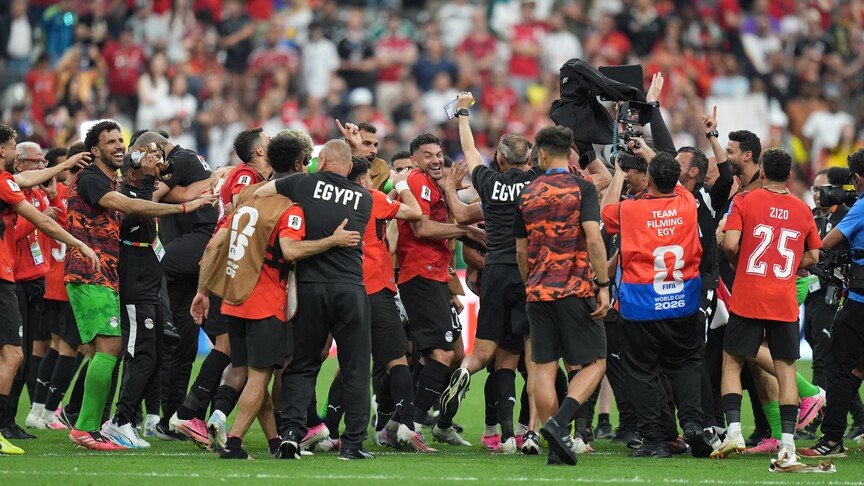
Egypt claimed their first-ever World Cup victory as they came from behind Sunday to beat New Zealand 3-1 at BC Place in Vancouver, Canada, moving to the top of Group G and strengthening their push for a place in the knockout stage.
Egypt entered the match as favorites, with Mohamed Salah and Omar Marmoush leading the attack and a large Egyptian crowd filling the stadium.
But New Zealand struck first after a poor piece of defending from the Pharaohs.
Defender Finn Surman rose above the Egyptian back line in the 15th minute and powered home a header from Tim Payne’s corner to give the All Whites a surprise lead.
Egypt pushed for a response but had to wait until the second half to break through.
Mostafa Ziko brought Egypt level in the 58th minute, meeting Mohamed Hany’s cross with a well-placed header to make it 1-1.
Nine minutes later, Ziko helped complete the turnaround.
The forward exchanged a quick one-two with Salah, who cut inside and bent a powerful left-footed strike past the New Zealand goalkeeper to put Egypt ahead.
Trezeguet then sealed the victory with a superb header from Salah’s outswinging corner, giving Egypt breathing room and sending their supporters into celebration.
The result marked a major step for Egypt, who had opened their campaign with a 1-1 draw against Belgium.
With four points from two matches, the Pharaohs moved to the top of Group G and boosted their hopes of advancing to the knockout stage.
New Zealand, who drew 2-2 with Iran in their opening match, slipped to the bottom of the group with one point. Anadolu
Dr. Marwan Asmar holds a PhD from Leeds University and is a freelance writer specializing on the Middle East. He has worked as a journalist since the early 1990s in Jordan and the Gulf countries, and been widely published, including at Albawaba, Gulf News, Al Ghad, World Press Review and others.
To get married in Gaza today is no easy feat. Its no longer an individual choice or a natural development for the young men and brides of the enclave. Under this genocide, it has become complex social and economic equation governed by the consequences of the continuing Israeli war on the Gaza Strip and the collapse of its civil society and many of its sectors. Between a housing crisis and unprecedented rise in the cost of living and “preparing a home”, 1000’s of young people find themselves unable to form a family, or even think of getting married.
Iman al-Rifai did not choose to seek refuge in Burj al-Shamali in south Lebanon for the camp is far away from Lubya, her hometown in the Tiberias district. Nor did she choose to to move to al-Badawi camp in the north of the country.
The forced displacement of Iman and her family was not their first in the latest Israeli war on Lebanon. It is their third. On the two previous occasions, they moved to Ain al-Hilweh camp in Sidon to remain close to their original camp.
In the 2024 war, Iman and her family were forced to flee to Syria and from there to Nahr al-Bared camp before returning to Burj al-Shamali after the ceasefire was declared. Each time, she preferred forced displacement to protect her children whilst leaving her husband behind. He like many of the other men, refused to leave, choosing to stay put despite the Israeli bombing.
“I’m now displaced with my children. But I am also scared. Honestly, both options are difficult. Staying under bombardment is hard, and being displaced is also difficult, but you try as much as possible to protect your life and the lives of your children,” said Iman, pointing out the feeling of being lost about the decision to flee or not never leaves her.
“Every time I’m forced to leave, I feel like I won’t come back. This feeling never leaves me, and it keeps me in a state of anxiety and fear. I’m even afraid to buy certain things. I feel that if I buy these things, it means I’m going to stay longer, I see it as a bad omen.”
Iman sums up displacement in one word: “Oppression.” It destroys a person from inside, the life of the family members is turned upside down, and this tremendously effects their psychological stability. “The anguish resulting from the past displacement of our families endured, and which we have experienced and has extended to our children. My children, who are not yet 17, already lived through two wars and five displacements, as if this is our fate in this country, as if this is what was written for us,” she ends with a sigh.
Iman’s situation is similar to that of many others, except for some of the details. Displacement, as everyone agrees is harsh in every aspect of life, regardless of whether one is in a shelter, with relatives, or in rented apartments.
Psychological Costs of Displacement
Bassam Jamil, who originally came from Tiberias, fled from Syria to Lebanon in 2013 during the Syrian war and eventually settled in Baalbek in the Bekaa Valley. But Lebanon has not been kind to Palestinian refugees especially from Syria like Jamil. It has placed more restrictions on them, even greater than those placed Palestinian refugees already living in Lebanon. This included the denial of legal residency and any other civil rights and leaving most of them fearful of being imprisoned, deported, or separated from the rest of the family.
“Refuge is like a stone in our throats and chests, preventing us from talking or breathing,” said Jamil, who fled from the al-A’edeen camp in Syria to a rural area for several days before crossing the border into Lebanon.
His displacement journey did not end there. In the 2024 Israeli war on Lebanon, he was forced to flee to Zahle and seek refuge in a shelter in one of the city schools, with his Alzheimer’s-afflicted father, his mother, and sister. Unlike other Palestinians in Lebanon who are embraced by the local community in the different camps, Jamil has never felt he “belonged or even a warm welcome”.
“Instead,” he says, “there is a strange competitiveness from the local community, as if our presence among them will deprive them of privileges and livelihoods.” Jamil believes “displacement to another camp is more difficult than displacement outside of it, given this strange competitiveness among the downtrodden.” He and his family have chosen to remain in Baalbek in this current war because of the great difficulties they faced during their previous displacements, economically and psychologically.
“The act of being displaced is one that follows a state of emergency and this means we are not prepared for its psychological, financial, and even physical costs. For us, it is the implementation of a harsh judicial ruling against our will,” Jamil says with a sigh.
Displacement Steals Human Lives
The United Nations Relief and Works Agency for Palestine Refugees (UNRWA), in its latest report on the emergency response in Lebanon—from May 20 till June 2—shows a 59 percent increase in the number of displaced refugees at the agency’s emergency shelters in the Siblin Institute in the south and the Battir School in the Nahr al-Bared camp in northern Lebanon. The increase from 1,264 to 2,148 displaced persons followed evacuation warnings and the ongoing Israeli aggression against camps and communities in Tyre, particularly the Rashidieh, Boss, and Burj al-Shamali camps.
The UN agency indicates there are 728 displaced Lebanese, 724 displaced Palestinians from Lebanon, 436 displaced Syrians, 241 displaced Palestinians from Syria, 15 displaced persons of other nationalities, and four unregistered Palestinian refugees.
Rania Saadallah was forced to flee from the Rashidieh camp in Tyre to a relative’s home in Sidon. Her displacement was multiple; between the first and second displacement, she lost her ailing mother. “The hardest part about this displacement is leaving my mother alone, it’s as if I’m leaving a part of me in the south,” she explained. Saadallah hasn’t let the Israeli attacks and constant eviction notices stop her from sneaking out from time to time to visit her mother’s grave. However she said that displacement steals a person’s life, “it’s as if you move from one world to another, a world that is alien to you, doesn’t belong to you, where the most basic elements of privacy are absent.”
Like other displaced refugees, Saadallah won’t even consider the possibility of not returning to return to her camp. “Its a slow death,” she said emphatically. For Saadallah and many like her, the camp has become “a small homeland” that cannot be severed from the refugee’s life. Just returning to the camp would revive our souls,” she pointed out.
The reality of forced displacement for Palestinian refugees is not limited to the 2024 and 2026 wars. Palestinian refugees have a long history of displacement during the past successive wars and internal conflicts in Lebanon. Studies indicate that there have been multiple waves of forced Palestinian displacement within Lebanon, beginning in the 1960s and continuing till this day. Some of these waves have led to the destruction of several Palestinian camps, such as Tal al-Zaatar, Jisr al-Basha, Nabatieh, and Nahr al-Bared, resulting in the displacement of many if its residents to other camps.
Historically, there has been a “demographic movement” within the camps, said Jaber Suleiman, a researcher in refugee and forced migration studies while attributing this movement to the destruction of the camps and/or other factors. Suleiman believes that under the current political conditions and the ongoing Israeli threat in the south and should it extend north of the Litani River, many residents of the camps and communities around Tyre who sought refuge in other camps may be forced to remain there, with some family members, with young people, staying in the original camp.
“The return of those who are displaced is linked to the return of the situation in the south to normalcy. If they cannot return quickly, they will remain in the camps they fled to and build new lives, as has happened before.”
Suleiman attributes the permenant displacement to economic factors and cost. “Those displaced to camps can stay with relatives or friends, and there is greater availability of aid from various organizations. Furthermore, many believe that displacement to a camp guarantees them a greater commitment from UNRWA,” he emphasized, adding that it is the “economic factors are the driving force and not location.”
Ali Hweidi, Director-General of the 302 Foundation for the Defense of Refugee Rights, agrees with this assessment, stressing the primary factor controlling the refugee displacement—whether to other camps, outside the camps, or reluctance to leave—is economic.
Hweidi pointed to available statistics indicating that “a smaller number of displaced people went to UNRWA shelters in southern and northern Lebanon, while the majority moved to camps, communities, and cities north of the Zahrani River, such as Mieh Mieh and Ain al-Hilweh camps, the city of Sidon, Wadi al-Zina, and others.”
He added most of these refugees are staying with acquaintances or relatives because renting is virtually impossible, “which places an additional burden on relatives and acquaintances,” especially since the unemployment rate among Palestinian refugees, according to UNRWA, has reached 45 percent, while the poverty rate exceeded 80 percent before the latest Israeli aggression. But Huweidi attributed the reluctance of some to flee to two reasons: Financial constraints and a lack of privacy.
A study by the Palestinian Human Rights Organization “Shahed,” published last March, indicated that the Israeli war contributed to deepening the economic crisis for Palestinian refugees in Lebanon, the majority of whom live below the poverty line and rely primarily on humanitarian aid. The study also showed the disruption of economic activity and the closure of many facilities and services as a result of the Israeli bombing and led to increased unemployment and food insecurity in the camps.
According to the study, many refugees lost their jobs outside the camps, specifically in cities like Beirut and Tyre, due to security risks and movement restrictions imposed in the war, leaving many families without any source of income. The “Shahed” study indicated concerns about deteriorating living conditions and food insecurity have become a real preoccupation for Palestinian refugees, hiking up psychological stress and social tension among camp residents.
Who is meeting the needs of the displaced?
The majority of Palestinian refugees displaced by this last war believe the shortcomings in providing assistance extend to all parties, from UNRWA to the various Palestinian factions and Lebanese state. The role of UNRWA has been limited to providing two shelters and some in-kind and cash assistance.
“The biggest pitfall for UNRWA was its lack of an emergency plan and pre-prepared scenarios for dealing with the displacement, despite many indicators which point to a security breakdown in Lebanon and the direct and indirect impact on the camps,” explained Hweidi. He noted UNRWA launched its emergency plan after the start of the Israeli aggression against Lebanon and allocated a budget exceeding $12 million to meet the needs. “However, it is striking that the agency relies primarily on its partners to provide everything within the shelters—food, water, and other necessities—and then distributes it.”
Suleiman pointed out to the historical failure to meet the needs of displaced persons, whether during the Lebanese Civil War or subsequent Israeli wars on Lebanon, by either UNRWA or other Palestinian factions. “The scale of the needs is always far greater than the services provided, given the ongoing deficit in UNRWA’s budget, which only allows it to offer the bare minimum, such as opening shelters,” he continued.
Suleiman and Hweidi agree the Palestinian factions offer virtually nothing. “The role of the different factions is limited to counting the displaced persons in the camps.” Suleiman sarcastically remarks: “The factions’ role has become limited to criticizing UNRWA rather than providing services,” placing the greatest burden on the UN agency and civil society.
Walid al-Ahmad, secretary of the Popular Committee in the Mar Elias camp in Beirut, says the displaced people seek the help of the Popular Committee upon their arrival at the camp. The committee role is usually collecting data of the families sheltering in the camp, and these are mostly Lebanese. He did however, say some Palestinian families who were displaced came to Burj al-Barajneh when Beirut’s southern suburb was threatened and faced eviction notices by the Israelis.
Al-Ahmad said as well that the main reason why displaced people contact Popular Committees is because of the services they provide. “As the Popular Committee in the Mar Elias camp, we have provided mattresses, blankets, personal hygiene items, and some food supplies since the beginning of the displacement, in addition to providing hot meals.”
He added that some organizations have also provided parcels, food, psychological support, and supplies for the elderly, as well as organizing recreational activities for the displaced.
In this context, social activist Dalal Shahrour, in the Beddawi camp, confirms the number of displaced families in the camp, according to the latest statistics from the Popular Committee, reached 400. “What usually happens is that the displaced persons stay with relatives until they can rent their own home. Those who cannot afford to rent are transferred by the Popular Committee to the shelter in the Batir school in the Nahr al-Bared camp,” Shahrour explained, emphasizing that the majority of displaced people go to the Popular Committee to register because various organizations rely on the data provided by the Popular Committees to distribute aid. She confirmed that only a small number of those who are well-off do not wish to receive aid register with the Popular Committee.
Shahrour considers the fluctuating number of displaced people, especially during this war, to be one of the most significant challenges facing the committee. “The numbers change with every ceasefire announcement and every evacuation notice,” she said, adding the scarcity of aid is another challenge to meet the need of the displaced.
With each wave of displacement, displaced persons lose a part of themselves and their human dignity. With each wave of displacement, the chances of survival in an environment fraught with daily challenges diminish.
“We face, as much as possible, the choice between waiting or pursuing the dream of return—two oppressive paths, each with its own heavy price,” says Bassam Jamil. Have the dreams of displaced refugees, once focused on returning to their villages and cities in occupied Palestine, now narrowed down to return to the camps, homes, and lives they were forced to leave behind?