Many Faces of Colonialism

By Ismail Al Sharif

“I don’t admit that a wrong was done to the Native Americans in America or the Blacks in Australia. Rather, stronger peoples of a higher standard than the rest of the world came and took their place… That’s the way of life” – Churchill.

Last 26 August, US ambassador to Turkey—and President Trump’s special envoy to Lebanon—went up to the press conference podium following the US delegation’s meeting with Lebanese President Michel Aoun. In a familiar scene repeated in world capitals, journalists in the crowded room rushed to ask their questions simultaneously, all seeking direct answers from the ambassador.

This time, however, the ambassador confronted the Arab journalists addressing them with a tone of arrogance filled with contempt. He said: “The moment things turn into chaos, as if you were behaving like animals, we will leave immediately. Behave in a civilized manner; this is the essence of the problem in this region.” He then reiterated: “Please remain calm… The moment things devolve into animal-like chaos, we will withdraw immediately.”

His remarks sparked a wave of anger and condemnation. The Lebanese Journalists Syndicate demanded an official apology, while the Lebanese presidency issued a statement expressing its rejection of these offensive remarks. Ambassador Tom Barrack was later forced to backtrack, acknowledging his use of the term “animal” was inappropriate.

But Barrack is merely a recurring example of a colonialism that has not changed. He reminds us of Leopold II, King of Belgium, who displayed Africans as exhibits in humiliating human zoos. He is no different from the ex-Israeli Defense Minister Yoav Galant, the war criminal who called Palestinians “human animals.”

He is a natural extension of a deeply-rooted colonial mentality, embodied in the Sykes-Picot Agreement, which divided the Ottoman Empire’s legacy as spoils of war, or the Berlin Conference, when Bismarck distributed the African continent as gifts among the European colonial powers. The bitter truth is that colonialism’s view of us has never changed.

In the past, they labeled us as barbarians and savages and described our peoples as backward and our races as inferior. These old colonial terms evolved, cloaked in glittering and attractive slogans such as sustainable development, good governance, spreading democracy, protecting human rights, promoting reform, fighting terrorism, and establishing peace. But the essence and ultimate goal remained the same: Plundering our wealth and tightening control over our peoples.

In the Belgian Congo under Leopold II, in the late 19th and early 20th centuries, rubber-mining companies imposed mandatory production quotas on African villages, and anyone who failed to meet the required quota had their hands amputated as punishment.  Today, the same scene is being repeated in different forms: A million Iraqi children being killed to control oil under the false pretext of “weapons of mass destruction.”

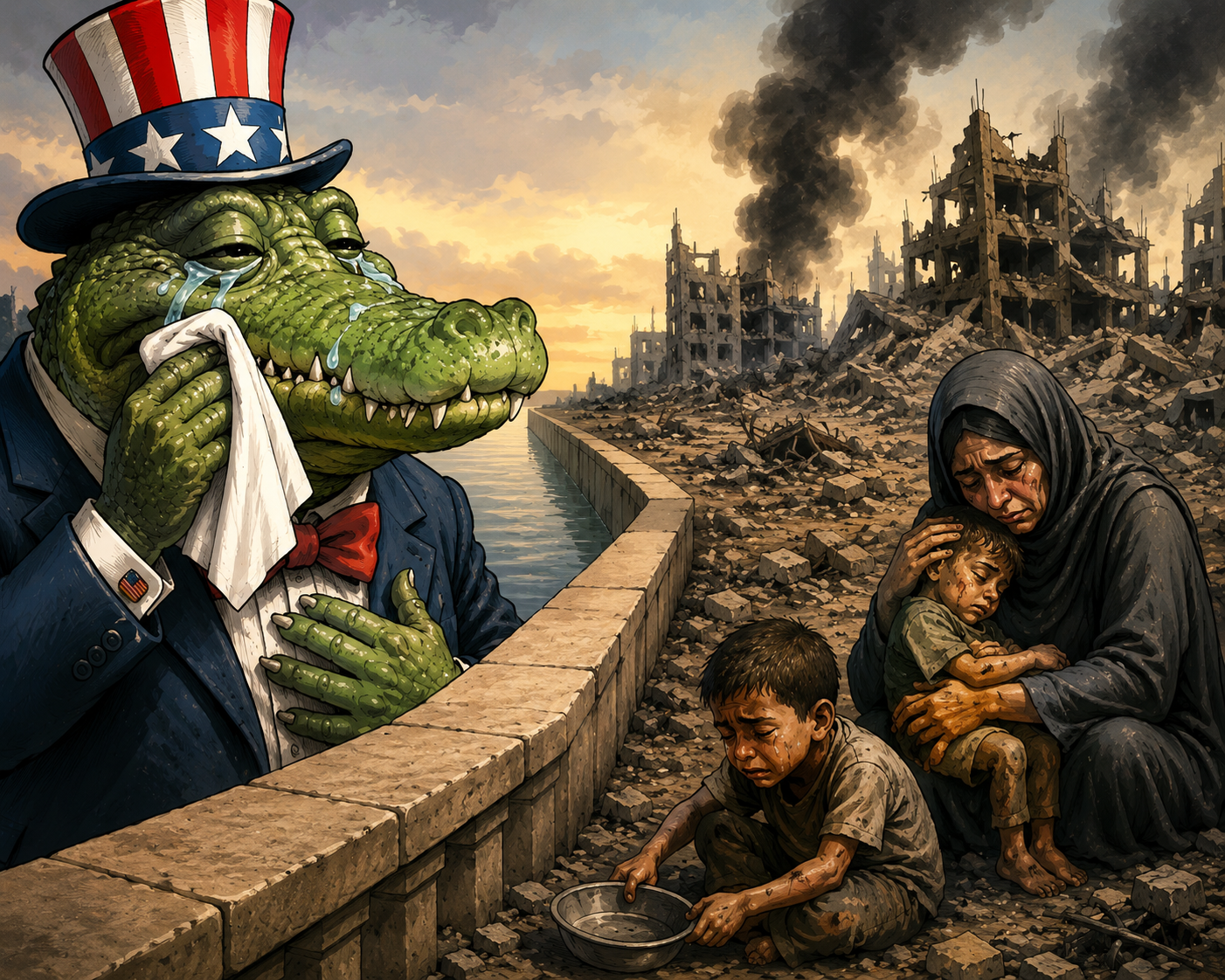
In Gaza, the most heinous crimes of modern genocide are being committed to plunder gas resources, simply because Hamas dares to challenge Western hegemony and refuses to submit to it.

Barrack represents the naked face of colonialism, without embellishment or falsification; he is the blunt and frank expression of the Western view of us. In an interview with National News on 22 September, he stated with shocking clarity: “We don’t trust any of you; our interests are incompatible. The term ‘ally’ is inaccurate in describing our relationship with you, but our relationship with Israel is completely different; it is an exceptional and emotional relationship. As for peace, it is just an illusion that will never be achieved. Might makes right, and I personally oppose the establishment of a Palestinian state.”

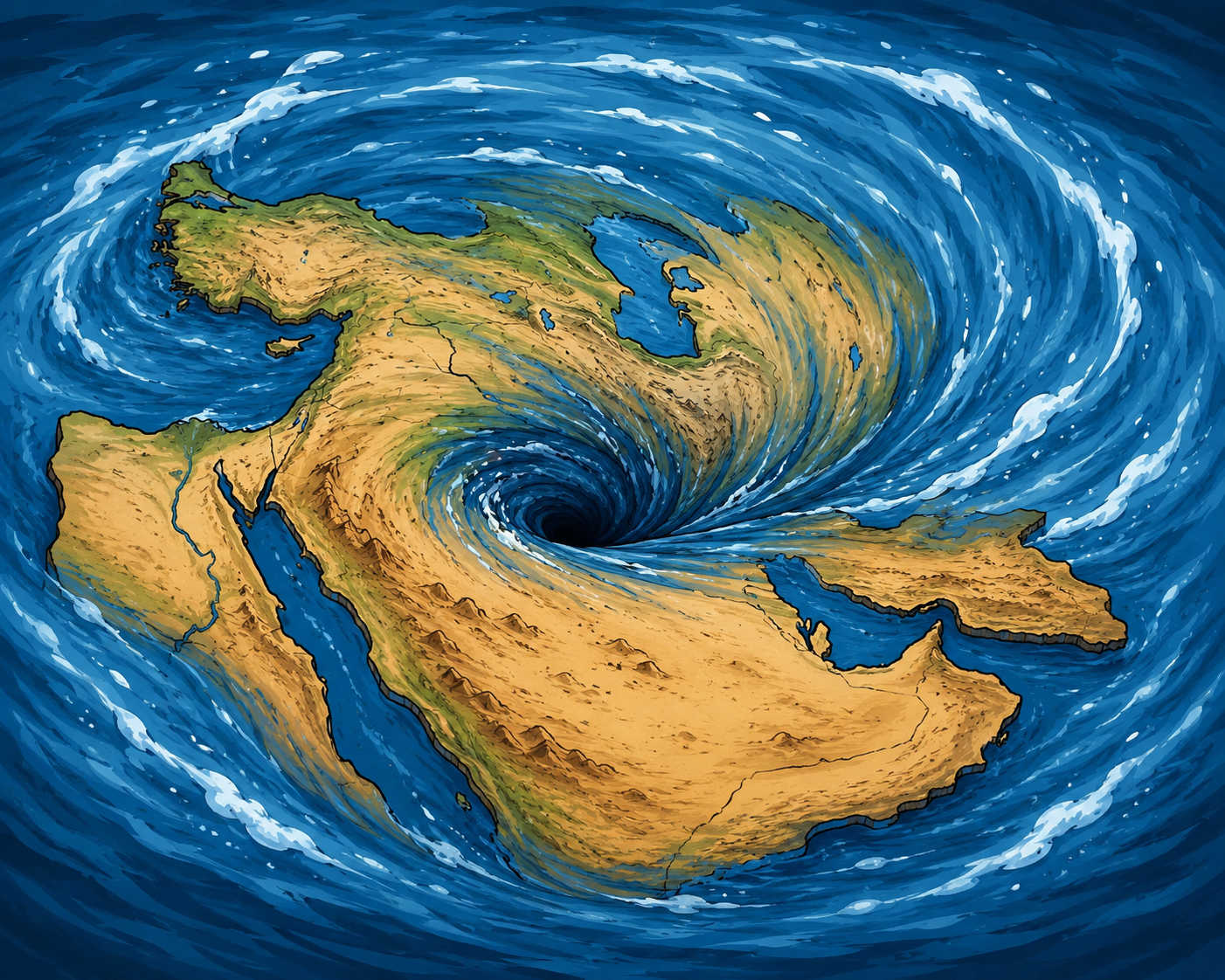
In a subsequent statement to Al Jazeera, Barrack went further, saying with disdain: “There is no such thing as the Middle East; it is just a collection of scattered tribes and villages.” As for the countries you claim exist, they were created by the British and the French.”

Barrack’s statements may have been intentional and deliberate, aiming to reveal the true face of the colonial project, as part of an American strategy to pressure the Arabs in the context of redrawing the map of the region. Perhaps the deeper goal behind this rhetoric is to implant concepts of backwardness, impotence, and division deep within our collective consciousness, so that we internalize and believe in them, and thus act accordingly, making it easier for colonial powers to subjugate us and impose their control over us.

The late intellectual Edward Said expressed this truth profoundly when he said: “The most dangerous form of domination is not direct military occupation, but rather internalizing and believing the stereotype that the colonizer paints about us.” From this perspective, every word Barrack utters is not merely a passing blunder or a spontaneous slip of the tongue, but rather a clear embodiment of a deeply rooted colonial mentality that views Arabs, Muslims, and all other oppressed peoples of the earth as inferior and worthless to Westerners.

Similarly, the late intellectual, thinker and activist Frantz Fanon, and one of the prominent pioneers of anti-colonial thought, emphasized that true and most dangerous colonialism begins when we view ourselves through the eyes of the colonizer. Therefore, the first and fundamental step on the path to true liberation is to reject these imposed terms, which seek to define our inferior status and portray us as nations of lesser value and civilization than others.

We are not merely the “Middle East,” the “Third World,” or the “developing countries,” as they like to classify us. We are an ancient nation with deep roots in history. We are the bearers of one of the greatest and oldest human civilizations, the Arab-Islamic civilization, with our authentic and deeply-rooted identity, our immortal Arabic language, our deeply-rooted culture, and our history spanning thousands of years. We have made sublime civilizational contributions to the progress of humanity as a whole, and we are a beacon that has illuminated the paths of science, thought, knowledge, and enlightenment for the world.

This article by Ismail Al Sharif was originally written in Arabic for the Addustour daily.

CrossFireArabia

CrossFireArabia

Dr. Marwan Asmar holds a PhD from Leeds University and is a freelance writer specializing on the Middle East. He has worked as a journalist since the early 1990s in Jordan and the Gulf countries, and been widely published, including at Albawaba, Gulf News, Al Ghad, World Press Review and others.

Related Posts

Occupation and Israeli Violence

By Najla M. Shahwan

In the context of Israel’s unlawful occupation and its imposition of a system of apartheid against all Palestinians, and against the backdrop of its ongoing genocide in Gaza, Israeli authorities have been recently accelerating its violations of international human rights and humanitarian law in pursuing its policy of ethnic cleansing in the occupied West Bank.

This policy has been implemented through the forcible displacement of Palestinians in refugee camps, Bedouin and herding communities in the West Bank, as well as the creation and expansion of settlements , acts that amount to the war crime of unlawful deportation and transfer.

Palestine’s Permanent Mission to the UN on June 12 sounded the alarm over the newest largest wave of forced displacement of Palestinians in the occupied West Bank.

During a briefing held by the Palestine’s Permanent Mission to the UN in Geneva, Palestine’s Permanent Representative, ambassador Ibrahim Khraishi, warned of the unprecedented deterioration of conditions in the occupied West Bank amid the upsurge of colonist attacks, colonial settlement expansion, and the ongoing military offensive on the refugee camps of Jenin, Tulkarm and Nur Shams, which has triggered the largest wave of forced displacement in the West Bank since 1967, alongside widespread destruction of infrastructure, homes and civilian facilities.

He stressed that the West Bank was witnessing a dangerous escalation at the political, economic and humanitarian levels due to Israel’s unbridled annexation and settler-colonialism policies, arrests, extrajudicial killings, colonist violence, and the continued withholding of Palestinian clearance revenues.

On his part, UNRWA representatives outlined the latest developments in the northern West Bank, pointing to escalating destruction and the forced displacement of more than 45,000 Palestinians, attacks on infrastructure and medical facilities, and Israeli measures aimed at demolishing the Agency’s premises in occupied Jerusalem.

Israeli authorities have been accelerating annexation through a state-driven campaign of ethnic cleansing targeting Palestinian Bedouin and herding communities in Area C of the occupied West Bank, while committing the crime against humanity of forcible transfer.

The Israeli government has made formal annexation an explicit policy objective .

It has accelerated settlement expansion and land grabs, increased financial and logistical support to settlements, and has armed settlers, thereby enabling a brutal state-sanctioned campaign of settler violence and of forced displacement of Palestinians from Area C.

This area constitutes over 60 per cent of the occupied West Bank and has long been central to Israel’s efforts to control land and demographics, given its natural resources, vital grazing and agricultural land.

Communities in Area C have been facing growing risks of displacement and settlement expansion.

The Jordan Valley and South Hebron Hills have been areas under particular pressure where residents have faced repeated raids, demolitions and damage to infrastructure. Restrictions on access to land and essential services have also increased pressure on these communities and State -backed settler violence and home demolitions have forcibly displaced thousands of Palestinians in, emptying out over 100 villages entirely.

In the Gaza Strip , Israel’s ongoing military operations and evacuation orders despite the ceasefire have displaced roughly 90 per cent of the population (approximately 1.9 million people), with much of the civilian infrastructure destroyed to create long-term buffer zones.

Families have been displaced from their neighborhoods many times – and the last time they were uprooted, they were homeless for more than six months.

Israel’s ‘voluntary emigration’ plan from Gaza is its latest attempt to ethnically cleanse Palestinians from the Strip .

Israel’s defense minister has advanced plans to remove Palestinians from the Gaza Strip through “voluntary emigration”.

Israel Katz said late last May that the plans would take place “at the proper time and in the proper manner”.

Israel’s security cabinet approved a proposal by Katz in March to establish a directorate within his ministry to facilitate “migration” from the enclave.

Despite the Israeli genocide in Gaza, which has killed more than 73,000 Palestinians and wrought utter destruction on the coastal enclave, the vast majority of Palestinians there say they will never abandon their home.

Proposals for the removal of Palestinians from the Gaza Strip have been repeatedly raised during the course of the Israeli genocide.

Though some ministers have framed the move to remove Palestinians as a voluntary option, other Israeli officials have been explicitly calling for forced expulsion, which is a war crime.

Article 49 of the Fourth Geneva Convention prohibits an occupying power from forcibly transferring , deporting or displacing occupied people from an occupied territory while the Rome Statute of the International Criminal Court names deportation by “expulsion or other coercive acts” a crime against humanity.

Ninety-two per cent of Gaza’s homes have been destroyed or damaged. None of its 37 hospitals is fully functional. Aid trucks cut from 4,200 a week to 590 when Israel sealed the crossings in February, families burning trash to cook whatever arrives, children frozen to death last winter for lack of shelter materials Israel would not allow in.

The Yellow Line, the boundary of Israeli control drawn by the ceasefire, keeps moving west, swallowing water points and clinics, with Palestinians killed for approaching a line that approaches them. More than 986 Palestinians have been killed since the “ceasefire” was signed in October 2025.

Amid the expanding Israeli military incursions record levels of settler violence, and impending annexations , the overwhelming majority of the Palestinians in the West Bank and Gaza are fiercely resisting displacement , viewing it as a permanent severing from their homeland .

The writer is a Palestinian author, researcher and freelance journalist and contributed this article to the Jordan Times

Continue reading
Arabism From The Skies?

By Capt. Osama Shaqman

Ten years ago, I ended my official flight, but I didn’t sever my connection with the skies above. When a pilot retires he doesn’t bid farewell to the sky; rather, he carries it in his memory, in his silence, in his gaze upon the earth, and in his understanding of life, people, borders, and destiny.

For over 40 years, I roared above cities, seas, deserts, and mountains. I saw the earth from a height unseen by eyes bound by the earth, and I saw the Arab world stretching from the ocean to the gulf, separated not so much by mountains or seas, but by politics, disputes, fear, and mistrust. From the skies, borders appeared as silent, lifeless lines, but on the ground, they were transformed into high walls separating brother from brother, and Arab from Arab.

From the cockpit

From the cockpit, I learned that an airplane doesn’t reach its destination through loud voices, nor through mere desire, nor through emotional impulse. It arrives when there is a clear destination, a precise plan, a harmonious crew, vigilant monitoring, mutual trust, and discipline that knows no improvisation. Likewise, nations don’t rise with slogans, nor do they weather storms with speeches, neither do they enter the future with divided decisions, conflicting visions, and a fear of their own disunity that outweighs their own weakness.

The higher I ascended in the skies, the more I felt that the Arab world is vaster than our disagreements, that Arab history is deeper than our crises, and that what unites us is far greater than what divides us. A single language resonates in our hearts, a long history of glory and suffering, a shared religion, civilization, culture, and destiny, and peoples who share similar joys and sorrows, dignity and hope. Yet, an Arab still sometimes needs a long journey to reach his brother, the borders between us remain harsher than the distances, and visas and barriers continue to turn our one nation into scattered islands in a single sea.

Today, as I look back on the years from the vantage point of life and experience, I ask myself: When will we break free from this predicament? When will we realize that division is no longer our destiny, but a costly choice? When will we understand that the world does not wait for the weak, and that nations that fail to unite around their own interests will find themselves vulnerable to the interests of others?

We have seen many Western nations unite after long wars, after bloodshed, conflict, and devastation. They learned from their pain, opening borders, unifying markets, bringing universities closer together, and facilitating the movement of people, ideas, and goods. Yet we, possessing bonds what others lack, still hesitate before taking a step that should be natural: which is that for every Arab to feel at home in any Arab land.

I am not advocating for the abolition of homelands; for every homeland is a memory, a dignity, a flag, and a legacy of martyrs. But I call for a broader Arab horizon, for unity of interests, economic integration, educational continuity, research cooperation, open borders, and respect for the sovereignty of each nation, without this sovereignty becoming isolation or estrangement.

Two wings of a single plane

Algeria remains Algeria, Egypt remains Egypt, Jordan remains Jordan, Morocco remains Morocco, Iraq remains Iraq, the Levant remains the Levant, and the Gulf remains the Gulf; but the entire Arab nation can be the two wings of a single plane, not scattered parts of a structure that has lost its ability to take off.

From the skies, I learned that the greatest danger is not the storm, but the loss of direction. A plane may face fierce winds, may fly through dark clouds, may be rocked in the heart of the sky, but it survives if the compass remains working and if the pilot knows where he wants to land. A nation that loses its compass, however, may possess wealth, population, and history, but it remains adrift in a turbulent sky without a clear destination.

Our compass today must be clear: Knowledge before noise, action before slogans, dignity before fear, unity before division, and humanity before narrow calculations. No nation can rise without investing in the minds of its children, and no people can progress while limiting their horizons to the dreams of their youth.

O Arab nation, we have waited too long in the hall of history. It is time for us to leave our seats of waiting and allow the plane of renaissance to take off. We lack neither fuel, for our resources are abundant; nor a runway, for our land is vast; nor history, for our past is glorious. What we lack is resolve, courage, and the confidence that we can be together without one of us negating the other.

Open the borders between minds first, and the borders between nations will follow. Open universities to Arab students, markets to Arab labor, hospitals to Arab people, libraries to Arab researchers, airports to Arab travelers, and hearts to Arab trust. A nation that fears its own children will not be respected by others, and a nation that closes its doors to itself will not enter the future through its widest gates.

I retired from flying 10 years ago, but I did not retire from dreaming. I still believe that this nation is capable of rising if it is true to itself, rises above its petty differences, and understands that the heavens do not recognize the borders created by fear.

From the memory of 40 years in the skies, I say with the sincerity of age and experience: The Arab nation is not poor in potential, but rather poor in resolve. It is not weak in its essence, but rather weakened by fragmentation. It is not incapable of taking off, but it needs someone to unify its direction, awaken its confidence, and open the runway to the future.

So when will we leave the land of division?

When will we break the chains of fear?

When will we open our borders as the heavens have opened their gates to us?

A nation created to have two wings cannot remain with one wing broken. The land I saw from the skies is one, and hearts deserve to see it as well: One in dignity, one in destiny, one in the dream.

This article was first published in the Jo24  Arabic website and reprinted in crossfirearabia.com.

Continue reading

You Missed

Israel Continues to Target Children – UN Report

Israel Continues to Target Children – UN Report

‘We Must Resist The Israelisation of Our Societies – Francesca Albanese

‘We Must Resist The Israelisation of Our Societies – Francesca Albanese

Kier Starmer Quits The Labour Party Leadership

Kier Starmer Quits The Labour Party Leadership

Israel Killed Raghad on The Way to School

Israel Killed Raghad on The Way to School

Trump, Netanyahu Rift Hits Rock Bottom: View From Amman

Trump, Netanyahu Rift Hits Rock Bottom: View From Amman

Youngest Palestinian Doctor Gets Guinness

Youngest Palestinian Doctor Gets Guinness