CrossFireArabia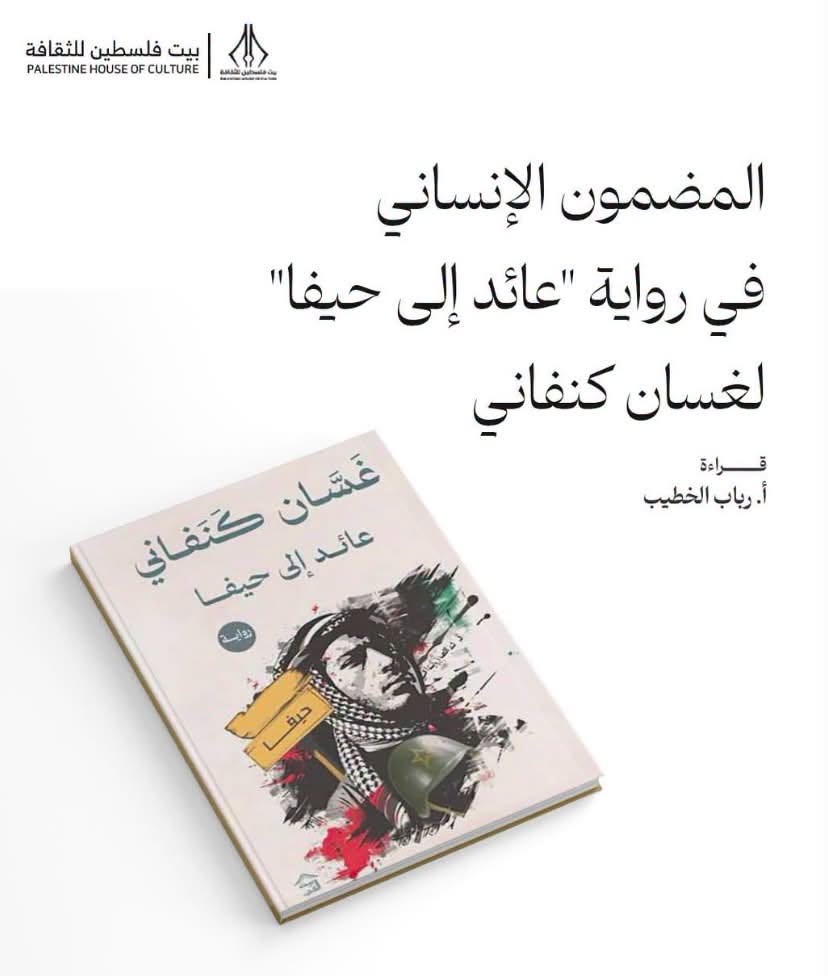
This is literary work delves into a profound human experience and expresses the feelings, questions, and conflicts within the human psyche; it achieves a unique impact, distinct from a narrative that merely records reality.
Transcending events and immersing oneself in the depths of humanity, revealing its ever-changing circumstances, allows us to fully understand the motivations behind human actions leading his story to become relevant and timeless.
In his novel “Returning to Haifa,” written in Arabic Ghassan Kanafani doesn’t make the narration of the Nakba his central theme, but the framework in which this unique human experience unfolds.
Kanafani selects details from the events of 1948 that allow us to understand the psychological and human condition of the couple, Said and Safiya. He recounts the events of the Jews and the British closing and opening roads, the firing of bullets and shells at unarmed civilians, and the human stampede towards the sea, all to understand the human condition of a mother and father who left Haifa, abandoning their infant son in his cradle.
Kanafani compels us to empathize with the mother who carried the weight of guilt for 20 years, simply because she went out for a few minutes to look for her husband, thinking she would see him coming from the end of the street, reassure herself, and then quickly return to her child. Saeed’s guilt is no less agonizing; he too lived for 20 years with the guilt of not being able to reach home and save his son that night.
Kanafani immerses the reader in the parents’ tragedy as a profound human experience embodying helplessness, guilt, and loss. These human emotions intertwine throughout the novel.
In the scene where Saeed and Safiya arrive in Haifa after 20 years of absence, Kanafani reveals the deep connection between a person and the place they have lived in. He describes the streets, the fields, and the sea, and as soon as their car enters the city, memories crumble like a wall whose stones have fallen one upon another.
Kanafani prioritized the simplest things to convey the human tragedy, and their impact was deeper than any discourse on the Nakba. When Saeed approaches the house in his car, he parks in his usual spot. He describes the clothesline that has changed, the graffiti on the wall that remains unchanged after all these years, the neighbor’s door, the broken step, the replaced doorbell, and then the details inside the house: The table, the curtains, pictures of Jerusalem on the wall, the peacock feathers in the vase, the chairs that have changed and those that remain.
These details serve to convey the couple’s feelings in that situation and allow the reader to empathize with their emotions and sorrow.
Kanafani expresses the impact of these details on the scene through Safiya’s words about Miriam: “She acts as if she is in her own home.” These words express her feeling that the house is still hers despite everything that has happened. Similarly, Saeed’s question about the missing feathers, the intensity of his voice as he asks about them, reveals the extent of a person’s attachment to the details of their home.
The human dimension of the novel reaches its climax in the reunion between Saeed and Safiya with their son, Khaldoun. The meeting is no longer simply between parents and son, but rather a confrontation between two human experiences, each shaped by different circumstances. They stand before him, and that moment, which they have awaited for 20 years, becomes the most poignant of the novel.
Kanafani uses this encounter as an entry point for a dialogue that explores human issues transcending the Palestinian cause. He is not preoccupied with determining the victor, but rather poses questions that resonate with every human being: What is the meaning of fatherhood? Is it based solely on blood ties? What is the meaning of homeland? Is it merely the place where one is born, or is it a stance, a responsibility, and a sense of belonging?
He then connects these questions to the concept of manhood, asserting that rights are insufficient unless one is capable of defending them and bearing the responsibility for them. He also raises a profound ethical question when he examines the relationship between right and power: Does the weakness of the oppressed justify the injustice inflicted upon them? Does power grant its possessor the right to seize another’s land?
Kanafani offers no ready-made answers to these questions, but leaves them open, allowing them to become part of the human experience that the reader shares with the novel’s characters.
Kanafani doesn’t divide his characters into good and evil, nor does he force the reader to take sides. He doesn’t portray Khaldoun or Dov as inherently villainous. Instead, he clarifies that their personalities are shaped by their upbringing and the ideology they received from their parents and society, emphasizing the idea that a person is a product of their environment and choices.
He also doesn’t portray Saeed as victorious in the dialogue simply because of the righteousness of his cause. Rather, he grants each character their human justifications and allows them space to defend themselves—a characteristic that imbues this scene with its profound humanity and allows it to transcend the confines of the Palestinian issue.
Kanafani concludes his novel with a political and intellectual transformation in Saeed’s character, following a long journey of pain, self-reflection, and acknowledgment of mistakes. For Saeed, the homeland transforms from a realm of memories and lost possessions into a homeland of action and future stances.
Saeed tells Khaldoun that his brother Khaled has joined the resistance fighters, and that he might one day meet him on the other side of the battlefields. In reality, Saeed had tried to stop Khaled from joining. He leaves Haifa and confesses to Safiya that he was wrong to try to prevent his son, and he hopes to arrive home to find that he has already left.
The humanistic content of the novel “Returning to Haifa” explains its prominent place in Arabic and world literature. The novel has been translated into several languages and has attracted the attention of researchers and critics, who have analyzed its time, place, plot, dialogue, and characters in academic studies. It has also been adapted for television.
Kanafani succeeded in transforming the Palestinian cause into a universal human experience that resonates with every reader, regardless of their nationality, language, or culture.