Last Wedding in Tantura

Tantura was a Palestinian fishing village of around 1,500 residents located south of Haifa. On May 22–23, 1948, during the Nakba, the village was captured and ethnically cleansed by the Alexandroni Brigade. Testimonies and historical accounts indicate that more than 200 unarmed villagers and disarmed fighters were massacred and buried in mass graves.

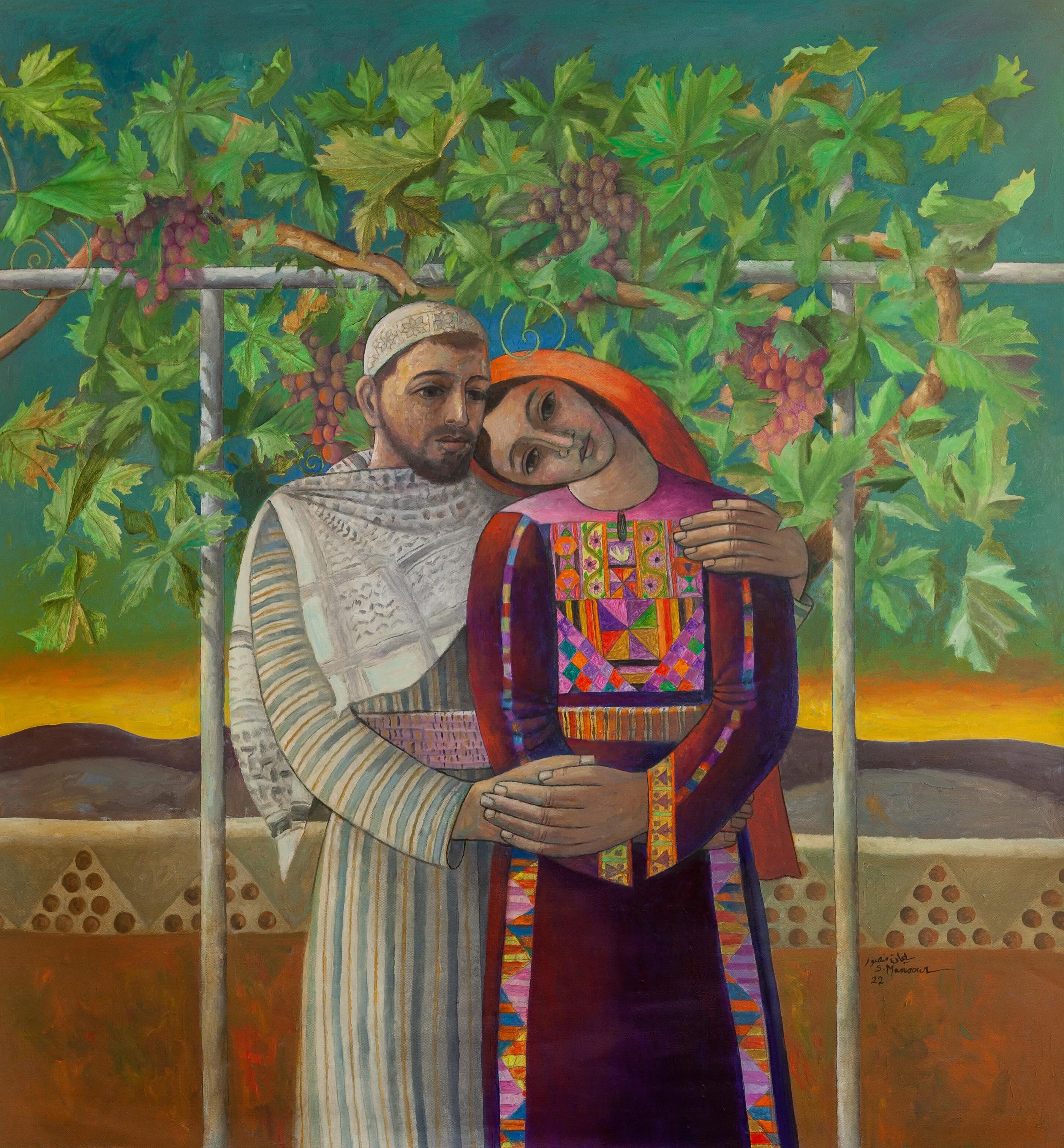
Tantura symbolizes far more than the destruction of a single village. It represents the violent interruption of ordinary Palestinian life in 1948: homes abandoned, families torn apart, futures stolen, and entire communities turned into memory overnight.

Yet even in loss, Palestinians continue to insist on dignity, memory, and survival. It is also a reminder that our love for one another, and for our land, remains stronger than displacement and erasure.
.
Last wedding in Tantura (العرس الاخير في الطنطورة), acrylic and oil on canvas, 2022

Continue reading
Israeli Soldiers: ‘…We Had to Kill Arabs’

Newly disclosed testimonies by Israeli soldiers and archival documents published by Israeli newspaper Haaretz have shed new light on the displacement of Palestinians and Syrians during and after the 1967 Arab-Israeli war, with accounts describing killings, expulsions, destruction of villages and widespread looting.

The investigation, published ahead of the 59th anniversary of the war and authored by Adam Raz, a researcher at the Akevot Institute for Israeli-Palestinian Conflict Research, is based on previously unpublished soldiers’ testimonies, military records, government correspondence and archival material.

According to the report, approximately 300,000 Arabs were expelled or displaced from the West Bank, Gaza Strip and the occupied Syrian Golan Heights during and after the June 1967 war.

Haaretz said many of the testimonies originated from discussions held among Israeli soldiers in kibbutzim, Israel’s collective farming communities, shortly after the war. While some excerpts later appeared in the influential 1967 book, The Seventh Day: Soldiers Talk about the Six-Day War, numerous accounts describing alleged war crimes remained unpublished for decades.

Several testimonies cited by the newspaper describe killings of prisoners, civilians and refugees. One soldier was quoted as saying: “At first I wasn’t willing to execute Arabs who weren’t resisting. Then we came to the conclusion that we had to kill.”

Another soldier described operations in Gaza after the war, saying: “Human lives didn’t matter. You could kill, there was no law. No one would say a word to you.”

A third testimony referred to what the soldier described as “punitive expeditions” in Gaza’s refugee camps. “We caught guys, lined them up and eliminated them. In retrospect, it looks like murder,” he said.

Shoot-at-sight orders for West Bank returnees

The report also cites testimonies and archival documents alleging that Israeli forces were ordered to prevent Palestinians who had fled across the Jordan River from returning to the West Bank after the fighting ended.

According to Haaretz, soldiers received instructions to shoot people attempting to cross back into the territory.

The newspaper cited testimony later published by former Israeli lawmaker Uri Avnery, who quoted a soldier as saying troops had received orders to “shoot, to kill, without prior warning.”

Another soldier recalled questioning whether such orders applied even if families with children were crossing the river. According to the testimony, he asked: “If I hear babies crying, should I shoot then too?” and was told: “Don’t be a girl.”

Haaretz said military records indicated that by early September 1967, nearly 150 Palestinians had been killed while attempting to return from Jordan. The newspaper also cited statements by senior Israeli military officials acknowledging the existence of orders aimed at preventing refugee returns.

According to the investigation, displacement during the war was not solely the result of battlefield conditions. The report cites government discussions and military documents suggesting that senior Israeli political and military leaders viewed the departure of Arab residents as desirable and, in some cases, encouraged or facilitated it.

Among the most prominent examples highlighted by the report was the expulsion of residents from the Latrun villages of Imwas, Yalo and Beit Nuba west of Jerusalem. The villages were captured during the war and their approximately 8,000 residents were ordered to leave, according to the investigation.

Haaretz reported that the villages were subsequently demolished and their inhabitants prevented from returning. The area later became the site of Canada Park.

‘Population transfer’

The newspaper also cited testimony from Ishai Amrami, a deputy battalion commander during the war, who later described what he witnessed as “an attempt at massive population transfer.”

The investigation further details events in Qalqilya and other communities near the Green Line, where residents were allegedly encouraged or forced to leave through military pressure, loudspeaker announcements, transportation arrangements and destruction of homes.

According to the report, tens of thousands of Palestinians also fled or were displaced from refugee camps in the Jericho area and elsewhere in the West Bank. Many carried memories of the 1948 Nakba and feared another permanent displacement.

The report revisits events in Gaza as well, where soldiers described raids, arrests and killings in refugee camps after the war. One soldier was quoted as saying: “We would roam through refugee camps in Gaza and carry out purges.”

Another testimony stated: “Every man we saw was a combatant,” while acknowledging that civilians may also have been among those killed.

Beyond the Palestinian territories, Haaretz reported that approximately 120,000 Syrians left or were expelled from the Golan Heights after Israeli forces captured the territory from Syria.

The newspaper cited military documents and testimonies indicating that villages in the Golan Heights were later demolished to prevent residents from returning. According to the report, Israeli commander Elad Peled later described a decision to bring in bulldozers and destroy villages “so there would be nowhere to return.”

Haaretz also cited reports submitted by Syria to the United Nations and records from the International Committee of the Red Cross alleging intimidation, forced displacement, looting and destruction of civilian property in the occupied territory.

Israel warned of legal repercussions

The investigation further describes what it says was widespread looting in areas captured during the war. According to the report, soldiers, civilians and local authorities participated in the removal of property from Palestinian and Syrian homes, schools, businesses and public institutions.

Among the documents cited is a previously unpublished 1967 letter by Theodor Meron, then legal adviser to Israel’s Foreign Ministry. According to Haaretz, Meron warned that expulsions of civilians constituted “a serious violation of the Geneva Convention” and could create diplomatic complications for Israel.

The report says Israeli officials were aware of legal concerns surrounding the expulsions but nevertheless approved measures aimed at preventing displaced populations from returning and consolidating control over newly occupied territories.

The Six-Day War began on June 5, 1967, and ended with Israel capturing the West Bank, East Jerusalem, the Gaza Strip, the Sinai Peninsula and the Golan Heights. While Israel later returned Sinai to Egypt under the 1979 peace treaty, it continues to occupy the West Bank and the Golan Heights.

For Palestinians, the conflict is remembered as the Naksa, or setback, which triggered a new wave of displacement nearly two decades after the 1948 Nakba and remains a defining event in collective Palestinian memory. Anadolu

Continue reading
Israel’s War on Truth

By Ramzy Baroud

The killing of seven Palestinian journalists and media workers in Gaza on August 10 has prompted verbal condemnations, yet has inspired little to no substantive action. This has become the predictable and horrifying trajectory of the international community’s response to the ongoing Israeli genocide.

By eliminating Palestinian journalists like Anas al-Sharif and Mohammed Qraiqeh, Israel has made a sinister statement that the genocide will spare no one. According to the monitoring website Shireen.ps, Israel has killed nearly 270 journalists since October 2023.

More journalists are likely to die covering the genocide of their own people in Gaza, especially since Israel has manufactured a convenient and easily deployed narrative that every Gazan journalist is simply a “terrorist”. This is the same cruel logic offered by numerous Israeli officials in the past, including Israeli President Isaac Herzog, who declared that “an entire nation” in Gaza “is responsible” for not having rebelled against Hamas, effectively stating that there are no innocent people in Gaza.

This Israeli discourse, which dehumanizes entire populations based on a vicious logic, is frequently repeated by officials who fear no accountability. Even Israeli diplomats, whose job in theory is to improve their country’s image internationally, frequently engage in this brutal ritual. In comments made in January 2024, Israeli ambassador to the UK, Tzipi Hotovely, callously argued that “every school, every mosque, every second house has access to tunnels,” implying that all of Gaza is a valid military target.

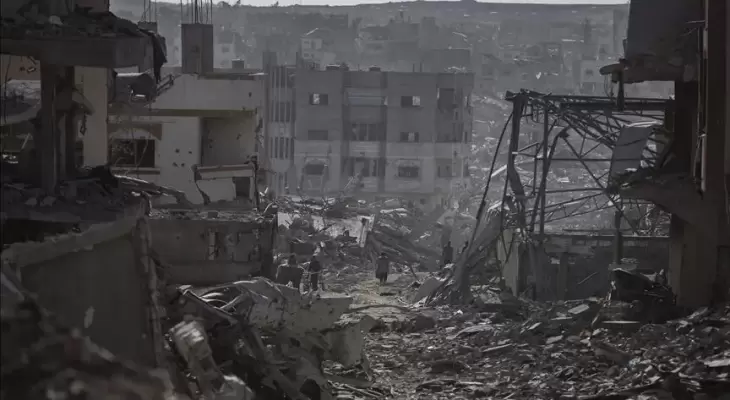
This cruelty of language would be easily dismissed as mere rhetoric, except that Israel has, in fact, according to Euro-Med Human Rights Monitor reports, destroyed over 70 per cent of Gaza’s infrastructure.

While extremist language is often used by politicians around the world, it is rare for the extremism of the language to so precisely mirror the extremism of the action itself. This makes Israeli political discourse a uniquely dangerous phenomenon.

There can be no military justification for the wholesale annihilation of an entire region. Yet again, the Israelis are not shying away from providing the political discourse that explains this unprecedented destruction. Former Knesset member Moshe Feiglin chillingly said, last May, that “Every child, every baby in Gaza is an enemy… not a single Gazan child will be left there.

But for the systematic destruction of a whole nation to succeed, it must include the deliberate targeting of its scientists, doctors, intellectuals, journalists, artists and poets. While children and women remain the largest categories of victims, many of those killed in deliberate assassinations appear to be targeted specifically to disorient Palestinian society, deprive it of societal leadership, and render the process of rebuilding Gaza impossible.

These figures powerfully illustrate this point: according to a report released by the United Nations Office for the Coordination of Humanitarian Affairs, based on the latest satellite damage assessment conducted in July, 97 per cent of Gaza’s educational facilities have been affected, with 91 per cent in need of major repairs or full reconstruction. Additionally, hundreds of teachers and thousands of students have been killed.

But why is Israel so intent on killing those responsible for intellectual production? The answer is twofold: one unique to Gaza, and the other unique to the nature of Israel’s founding ideology, Zionism.

First, regarding Gaza: Since the Nakba in 1948, Palestinian society in Gaza has invested heavily in education, seeing it as a crucial tool for liberation and self-determination. Early footage shows classrooms being held in tents and open spaces, a testament to this community’s tenacious pursuit of knowledge. This focus on education transformed the Strip into a regional hub for intellectual and cultural production, despite poorly funded UNRWA schools. Israel’s campaign of destruction is a deliberate attempt to erase this generational achievement, a practice known as scholasticide, and Gaza is the most deliberate example of this horrific act.

Second, regarding Zionism: For many years, we were led to believe that Zionism was winning the intellectual war due to the cleverness and refinement of Israeli propaganda, or hasbara. The prevailing narrative, particularly in the Arab world, was that Palestinians and Arabs were simply no match for the savvy Israeli and pro-Israeli public relations machine in Western media. This created a sense of intellectual inferiority, masking the true reason for the imbalance.

Israel was able to “win” in mainstream media discourse due to the intentional marginalisation and demonisation of Palestinian and pro-Palestinian voices. The latter had no chance of fighting back simply because they were not allowed to, and were instead labeled as “terrorist sympathizers” and the like. Even the late, world-renowned Palestinian scholar Edward Said was called a “Nazi” by the extremist, now-banned Jewish Defense League, who went so far as to set the beloved professor’s university office on fire.

Gaza, however, represented a major problem. With foreign media forbidden from operating in the Strip per Israeli orders, the Gazan intellectual rose to the occasion and, in the course of two years, managed to reverse most of Zionism’s gains over the past century. This forced Israel into a desperate race against time to remove as many Palestinian journalists, intellectuals, academics, and even social media influencers from the scene as quickly as possible—thus, the war on the Palestinian thinker.

The Israeli logic, however, is destined to fail, as ideas are not tied to specific individuals, and resilience and resistance are a culture, not a job title. Gaza shall once more emerge, not only as the culturally thriving place it has always been, but as the cornerstone of a new liberation discourse that is set to inspire the globe regarding the power of intellect to stand firm, to fight for what is right, and to live with purpose for a higher cause.

Ramzy Baroud is a journalist, author and the Editor of The Palestine Chronicle. He is the author of six books. His forthcoming book, ‘Before the Flood,’ will be published by Seven Stories Press. His other books include ‘Our Vision for Liberation’, ‘My Father was a Freedom Fighter’ and ‘The Last Earth’. Baroud is a Non-resident Senior Research Fellow at the Center for Islam and Global Affairs (CIGA). His website is www.ramzybaroud.net

Jordan Times

Continue reading
Rebuilding Gaza: The Arab Plan V. Trump’s Displacement

By Michael Jansen

The Muslim world has added its considerable weight to the plan adopted by the Arab summit for the reconstruction of Gaza while Palestinians remain in the strip. A meeting last week in Jeddah at foreign minister level of the 57-member Organisation for Islamic Cooperation extended full support to the detailed plan drawn up by Egypt. Therefore, both the Arab world and worldwide Muslim Umma have rejected the proposal of Donald Trump to expel 2.3 million Palestinians from Gaza and transform the devastated coastal trip into a “Middle Eastern Riviera.”

The 91-page $53 billion Egyptian plan itself is a major accomplishment as it was drawn up in less than 30 days. Its framework was presented last month to a mini-summit in Saudi Arabia of the Gulf countries, Egypt and Jordan, and approved on by Arab foreign ministers ahead of the maxi-summit.

https://twitter.com/swilkinsonbc/status/1896998936856105132

During the first six-month $3 billion stage of the plan Hamas would cease administering Gaza and a committee of Palestinian technocrats overseen by the Palestinian Authority would clear rubble from the main north-south Salaheddin highway. Palestinian residents would shift to seven relatively clear sites where 200,000 temporary housing units would be built to shelter 1.2 million. Additionally, 60,000 damaged buildings would be repaired to house thousands. Egypt and Jordan would train a Palestinian police force to enable a reformed Palestinian Authority to take over Gaza’s governance from Hamas. Nothing was said about disarming Hamas’ military wing which could be a contentious issue.

The second $20 billion two-year reconstruction stage would focus on permanent housing and rehabilitation of agricultural land, electricity, water, sewage and telecom-munications. The third 2.5-year stage costing $30 billion would continue with housing and build an industrial zone, a fishing port, a commercial seaport, and an international airport. Funding would be raised from donors in the Gulf, Europe, the US and international financial institutions. Disbursement and investment would be internationally supervised.

It is hardly surprising that the US and Israel should reject the Arab/Muslim plan. US National Security Council spokesman Brian Hughes issued a statement which said, “The current proposal does not address the reality that Gaza is currently uninhabitable, and residents cannot humanely live in a territory covered in debris and unexploded ordnance. President Trump stands by his vision to rebuild Gaza free from Hamas. We look forward to further talks to bring peace and prosperity to the region.” Trump, however, did not propose a Gaza free from Hamas but a Gaza free from Palestinians. This is neither acceptable nor legal under international law.

Despite, Hughes dismissal, Washington appears to be divided. Trump’s regional envoy Steve Witkoff said, “There’s a lot of compelling features” in Egypt’s plan for postwar Gaza, and observed that there was “a path” for Hamas to leave Gaza.

The Israeli foreign ministry said the Egyptian plan “fails to address the realities of the situation.” For the ministry these “realities” were created by the October 7th, 2023, raid on southern Israel by Hamas which killed 1,200. Naturally, the ministry reiterated Israel’s support for Trump’s plan as “an opportunity for the Gazans to have free choice based on their free will.” By this, the ministry meant bombed and starved Palestinians would freely choose to leave Gaza although Gazans have said they have chosen to stay in the strip despite dire conditions.

https://twitter.com/MiddleEastEye/status/1898059822869737723

Gazans are determined to resist a second Nakba, their catastrophic 1948 expulsion from their cities, towns and villages. This left them homeless, landless and stateless and the world has done nothing to remedy their situation over the past 77-years although the “path” to a Palestinian state has been charted since 1988 when the Palestinian National Council issued the Palestinian Declaration of Independence and a call for a mini-state in East Jerusalem, the West Bank and Gaza, 22 per cent of the Palestinian homeland.

 While 30 per cent of Gazans are indigenous, 70 per cent were driven into the Gaza strip from nearby areas. Many still live in UN refugee camps. More than 30,000 took part in the Great March of Return by protesting along the border between Gaza and Israel. The demonstrations began on March 30, 2018, and continued until December 27, 2019. The mainly peaceful protesters demanded the right to go home in areas conquered by Israel in 1948 and an end to the Israeli blockade of Gaza. Israeli snipers opened fire at protesters, killing 266 youngsters and injuring almost 30,000 others, Gaza’s health ministry reported. Many of the injured received crippling wounds in the legs.

These demonstrations should have been proof positive that Gazans are not going anywhere else. For them, Gaza is their home, their present and their future. The Arab plan is designed to provide a decent life for native Gazans and refugees alike in a scrap of territory which amounts to one per cent of their occupied Palestinian homeland.

The writer is a columnist in The Jordan Times.

Continue reading
Israel Must Not Be Allowed to End UNRWA

As Israel shuts down UNRWA in Gaza and the occupied West Bank, the move serves a strategic purpose: Undermining Palestinian national liberation and the right of return.

Sara Troian

By Sara Troian

This week, Israel’s ban on the United Nations Relief and Works Agency (UNRWA) takes effect, cutting off its services in its two main areas of operation in Palestine; namely, Gaza and, the occupied West Bank, including east Jerusalem.

Established in 1949 in response to the Nakba, UNRWA was meant to provide humanitarian aid and protect Palestinian rights until a just resolution to the refugee crisis was achieved. Central to this is the Palestinians’ inalienable right of return, which Israel has consistently denied.

Beyond the 5.4 million UNRWA-registered refugees, at least five million more Palestinians have been forcibly displaced by Zionist colonisation. The right of return belongs to them all.

Calculated attack on Palestine

In October, the Israeli parliament passed two bills targeting UNRWA. The first prohibits the agency from operating within the 1948 borders. The second bars Israeli officials from engaging with UNRWA in any capacity.

These laws are designed to remove Palestinian rights to a homeland and further weaken the agency that serves them. They also mark the culmination of decades of attacks by Israel and its allies seeking to dismantle UNRWA as part of the broader Zionist settler-colonial project.

For the 2.1 million Palestinians in Gaza, this will cripple efforts to rebuild the warmth of their homes and the safety of life-sustaining infrastructure vaporised by Israel’s annihilatory violence. This will further obstruct the restoration of life and the healing from nights spent beneath skies ablaze with fire and days suspended between slow and quick death in dwindling food rations.

In the West Bank and east Jerusalem, 49,000 students will be forced out of UNRWA schools, and will be left either without education or, in Jerusalem, to the whims of Israeli curricula that distort, dehumanise and erase their history and culture.

Nearly a million Palestinians will be denied medical care. The loss of thousands of jobs will further drive Palestinians into economic precarity, deepening the cycle of engineered de-development.

Political goals and neoimperial strategies

The dismantling of UNRWA is not just a humanitarian crisis; it is a political manoeuvre. Zionism has slated Palestine for erasure as part of a broader regional strategy. In this imperialist framework, the US and EU finance oppression, Israel enforces it, the local bourgeoisie complies, and the UN provides a thin veil of legitimacy.

The timing of the ban aligns with Israel’s shifting tactics. While the intensity of genocide in Gaza has momentarily slowed, violence in the West Bank—particularly in Jenin and Tulkarem refugee camps—has escalated. Zionist forces use airstrikes to destroy life-sustaining infrastructure, obstruct healthcare, and drive mass evacuations, all while continuing the daily expansion of settlements and mass arrests.

Palestinians today face the same oppressive forces as during the 1936-39 revolt: self-serving leadership, Arab regime complicity, and Zionist-imperialist domination.

At the core of these dynamics is Palestinian refugeehood—a fundamental consequence of Zionist colonisation. Since 1948, Israel has displaced over 10 million Palestinians, most, descendants from the Nakba, severing them from their homeland.

The right of return threatens Zionism’s foundation because it challenges Israel’s colonial reality, built on destruction and displacement.

The Zionist-Western axis‘ attacks on UNRWA aim to depoliticise its mandate, while crystallising Palestinian refugeehood into a permanent humanitarian crisis to be managed.

While the status of Palestinian refugees and their right of return cannot be solely determined by UNRWA or any international agency–as it is a condition that stems from the implementation of Zionist settler-colonialism– these attacks weaken the agency’s ability to advance Palestinian political claims within the UN.

Moreover, heavy reliance on donor-driven funding has transformed the agency into a semi-corporate entity, dependent on fluctuating foreign funding, further undermining its capacity to support Palestinian political aspirations. This, however, is a symptom of the neoliberal exploitation that, disguised as humanitarianism, treats Palestinians as disposable and expendable subjects to Western imperial expansion.

Palestinians are therefore held hostage by a global structure designed to rob them of their autonomy. This is reflected, for example, in the fact that all senior UNRWA officials are non-Palestinian, making decisions for 5.4 million refugees, yet often against their quest for national liberation.

Integration?

Meanwhile, US imperialism has dealt another blow by freezing all USAID projects–except for those in Israel and Egypt– and halting military aid to all countries except Israel, Egypt and Jordan.

The suspension of USAID serves as a coercive tool to absorb the thousands of Palestinians whom Israel’s brutal campaign aims to expel in the coming months. For example, in Jordan, where USAID plays a critical role in supporting public services like healthcare, justice, and water supply, the freeze pressures the Kingdom to participate in this plan, which has been in the works for years, but only recently the US has openly encouraged Egypt and Jordan to endorse a new wave of forced Palestinian exile.

In recent years, experts and international bodies have proposed integration into host countries or resettlement in third countries as pathways to securing a modicum of rights and emancipation for Palestinians who have been forcefully encamped for over seven decades.

While access to civil and political rights in places of exile is crucial, these proposals must not be weaponised to suppress the central struggle for return. At this moment, such narratives risk legitimising forced expulsions, under the guise of legal solutions, erasing Palestinian claims from the global agenda.

Access to rights must never serve as a strategy to downplay or marginalise the central struggle for return and efforts to secure it. At this moment, it is crucial to recognise how such narratives and solutions can be exploited—either to hinder Palestinian survival amid genocide or to suppress resistance against forced displacement.

Read More

Türkiye condemns Israel’s ban on UNRWA in occupied Palestinian territories

Many Palestinians in the West Bank already hold Jordanian citizenship—remnants of the Nakba and Oslo. If Palestinians will be forced to relocate to Jordan or third states under the pretense of naturalisation and resettlement, this strategy, framed as a legal solution, will ultimately legitimise further forced expulsions and erase their right of return from the international agenda.

This will facilitate the elimination of 10 million Palestinians as a political force challenging Western imperial expansion.

The time for return

A just solution cannot emerge from the very institutions and structures that have perpetuated Palestinians’ plight and the plundering of their land for decades. Such alternatives merely rebrand subjugation of the people.

The answer lies in the steadfastness of Palestinians themselves. Over the past 16 months, in defiance of over a century of disenfranchisement and exile, including 480 days of settler-colonial erasure, Palestinians alone have transformed return from a distant dream, into a tangible reality.

As displaced Palestinian in Gaza flood back towards their destroyed homes in Gaza City, Beit Lahiya, Jabaliya, and Beit Hanoun, this marks only the beginning of their Great March of Return. Eighty percent of Gaza’s population descends from those expelled from 247 villages in central-southern Palestine through waves of Zionist massacres.

This must be the guiding principle for any just and lasting solution—one that restores Palestinians to their homes, land, and dignity from which they have been forcibly expelled for far too long.

SOURCE: TRT World


Sara Troian

Sara Troian

Sara Troian is a Hume PhD Scholar in the Department of Law and Criminology at Maynooth University. Her PhD research examines the tension between international law and settler-colonialism in Palestine.

Continue reading