CrossFireArabia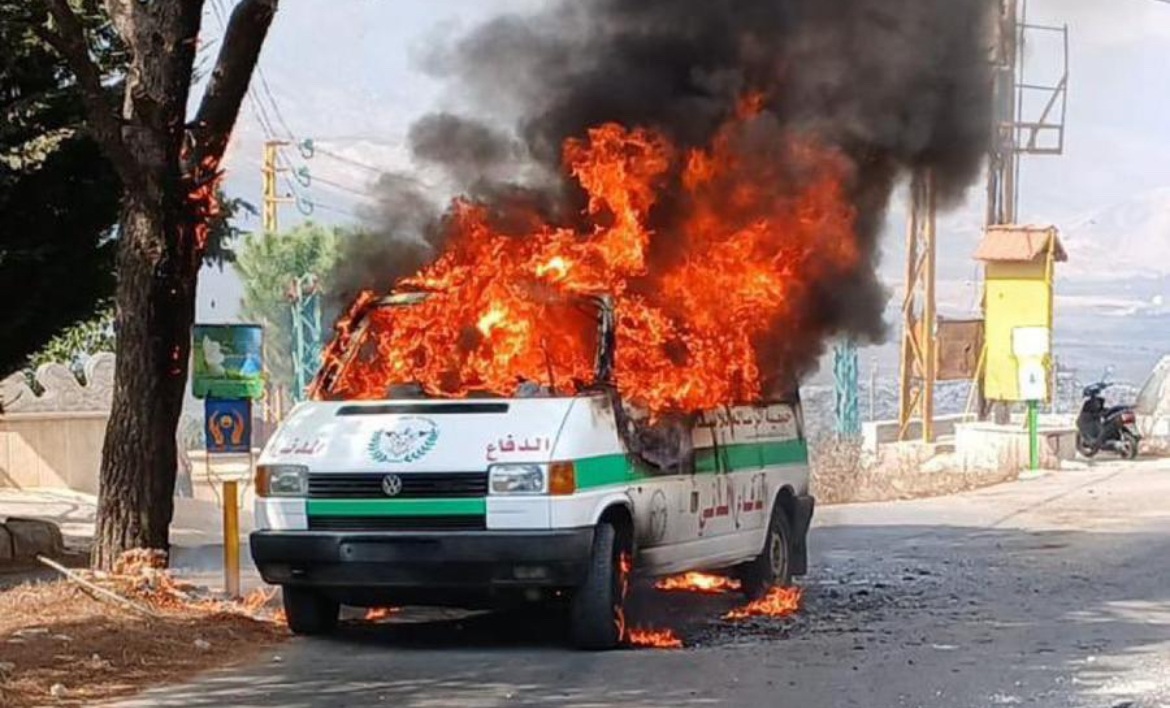
The Israeli army’s escalated military attacks against civilians and residential areas in Lebanon, particularly in the South and Bekaa regions, along with the issuance of evacuation orders, raising alarm in the region. Urgent international intervention is required to prevent the massacres and other atrocities being carried out by Israel in the Gaza Strip for more than 11 months from occurring in Lebanon as well.
Israel’s army carried out over 330 raids in over 117 Lebanese towns and cities today, 23 September 2024, according to the Euro-Med Monitor field team. These raids were directed towards civilian residential areas in southern Lebanon and various areas of the Bekaa region. As a result, 274 people—including 21 children—have been killed and over 1,024 individuals—including women, children, and paramedics—have been injured as of the early afternoon hours. As of the time of writing, Israeli airstrikes are still in progress, with the frequency of shelling attacks on residential areas rising.
In both the Gaza Strip and Lebanon, the Israeli army deliberately denies civilians enough time to escape the areas being bombed, offering them no real protection from the dangers arising from military operations. Instead, Israel randomly and directly targets civilian buildings, including the buildings of surrounding hospitals and schools.
For instance, the inhabitants of Lebanon’s Bekaa Valley, which spans an area of about 4,429 square kilometres, were given just two hours to evacuate when the Israeli army issued evacuation orders. However, it would take many citizens at least three hours to leave areas within the valley. Moreover, the Israeli army neglected to designate safe zones to which people could escape—just as it has been doing in the Gaza Strip—showing that Israel either ignores the legal obligation to direct people to safe zones, or targets areas it has designated as safe. Since Israel began bombing Lebanon, dangerous conditions as well as significant challenges to the evacuation process have been documented.
The Israeli army is required by international humanitarian law to take all reasonable measures prior to any military attack in order to prevent, or at the very least reduce, harm to civilians and civilian property. This entails, among other things, providing the civilian populace with a sufficient amount of warning prior to the commencement of the attack; allowing them enough time to flee; and, unless circumstances dictate otherwise, enabling them to take protective action and relocate to safe areas.
International humanitarian law states that civilians who are unable or unwilling to leave an area are still protected as civilians, and that Israel is still obligated to protect them to the extent that they need to be shielded from harm simply because of their presence in the area.
In addition to towns in the Bekaa Valley, the Israeli army struck over 117 towns in the south of Lebanon, including some that saw serial and repeated raids, like Aitaroun, Ansar, Kfar Reman, Haris, Sarafand, and other villages in the districts of Tyre, Sidon, and Nabatieh. The Israeli army also announced that it had begun a third wave of raids and aggression against Lebanon.
Israel also used drones to light fires in southern Lebanon’s forests at the same time as it conducted warplane strikes, suggesting that Israel has been burning agricultural lands with white phosphorus—a weapon that is prohibited by international law due to the severity of burns it can cause. These burns often reach the bones of victims, and the severe fires caused by white phosphorus can destroy property, buildings, crops, and soil. It is likely that the Israeli military has been using white phosphorus in its attacks on Lebanon since its first attack on the country following the start of its genocidal war in the Gaza Strip on 8 October 2023.
Today’s military build-up in Lebanon follows an Israeli army raid on Friday 20 September 2024 into Beirut’s southern suburbs. The raid caused the collapse of two residential buildings, killing over 37 people—including children—and leaving more bodies trapped under the rubble, with the search for victims still ongoing.
Israeli forces launched a random and illegal attack on Lebanon earlier, on 17 September 2024, using radio and pager explosions. The attacks resulted in at least 32 fatalities, including two children as well as medical staff members, and 3,250 injuries, including to a diplomat. There were 200 cases of critical injuries, and 500 serious injuries to the eyes and limbs specifically.
All of the aforementioned Israeli attacks are grave breaches of the Fourth Geneva Convention, the Additional Protocol, and international humanitarian law in general. These treaties require warring parties to always distinguish between civilians and combatants and offer special protection to vulnerable populations like journalists and the elderly, in addition to providing special protection to women and children. The Fourth Geneva Convention on the Protection of Civilians, its regulations, the Fourth Hague Convention, and Article 48 of the First Additional Protocol all attest to this; customary rules of international humanitarian law also support this.
International humanitarian law also prohibits indiscriminate attacks that do not distinguish between military and civilian targets, including attacks that do not target specific military objectives or that use combat means or methods incapable of being directed at a specific military objective.
The international community must act swiftly to stop Israel from repeating its genocide in the Gaza Strip in Lebanon, by safeguarding Lebanese civilians and stopping the situation from deteriorating further. Additionally, effective sanctions must be placed on Israel, such as a complete ban on arms exports, and Israel must be cut off from all forms of political, intelligence, and financial support. Finally, Israel must be held responsible for its ongoing crimes against peoples that occur on their own territory.