Beyond Extermination: Zionist Strategy to End Palestinians
By Nawaf Al-Zaru
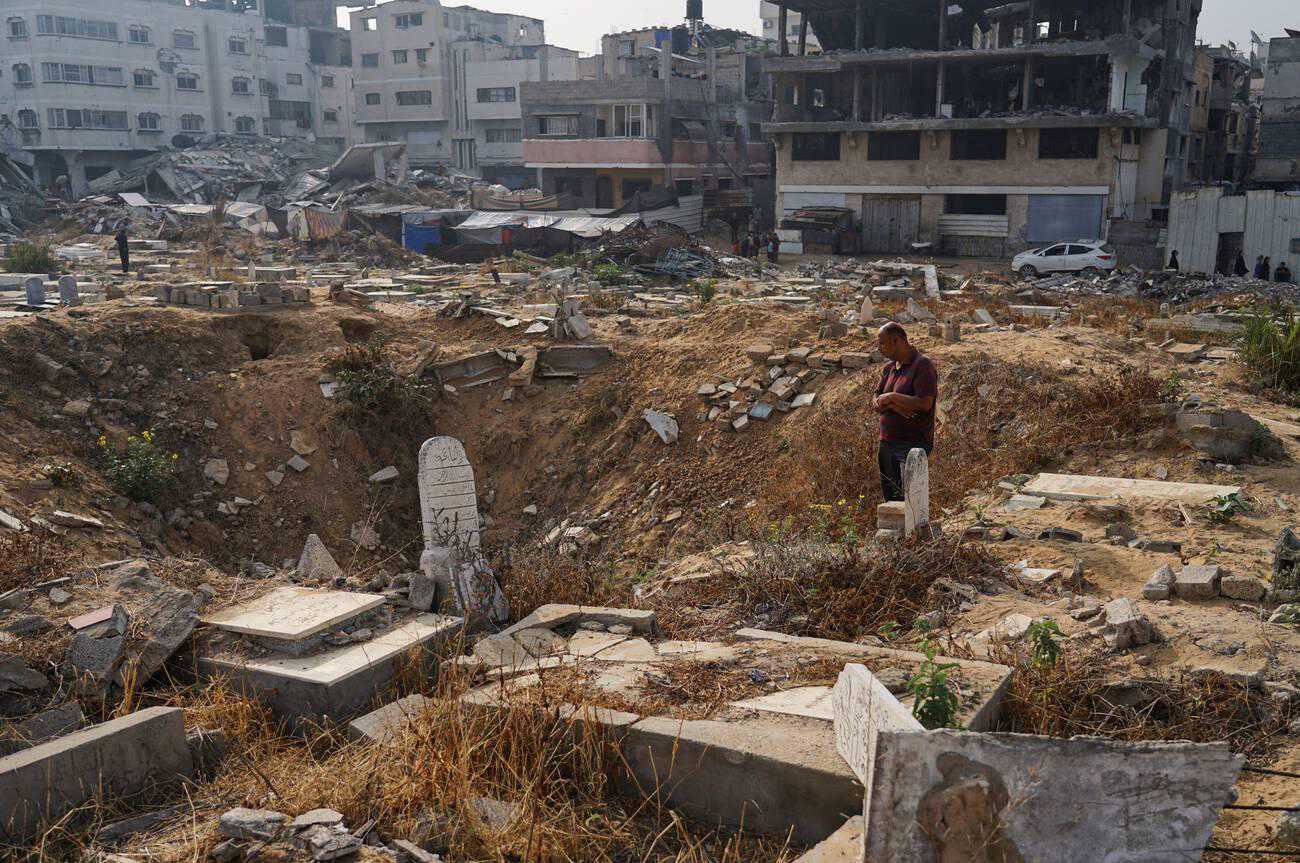
In light of what is happening in Gaza — a Zionist war of extermination of complete destruction and annihilation of entire neighborhoods and demolition of homes on the heads of its people in the many cities, towns, and villages of the Strip, amounting to a policy of ethnic cleansing — coupled with the revealed plans to displace and resettle them, and in light of the silent, genocidal war of uprooting in the West Bank, it is to be asserted this war is but another stage in the Zionist terror campaign against Palestinian existence and civilization.
Our people have faced more than 77 years of policies of ethnic cleansing and open Zionist war crimes in Palestine, but today the world remains silent, failing to show the same resolve as it does elsewhere, and with lame-duck international institutions like the World Criminal Court failing despite the Israeli atrocities and military incursions in Gaza, Jenin, Nablus, Tulkarm-Nur Shams, Aqabat Jabr camp, Hebron and many other areas.
We have never witnessed such widespread destruction, mass killings, or genocide to children, women, and the elderly. We have never seen entire families burned alive as we have seen in Palestine since the beginning of the Nakba and the establishment of the Zionist entity in 1948.
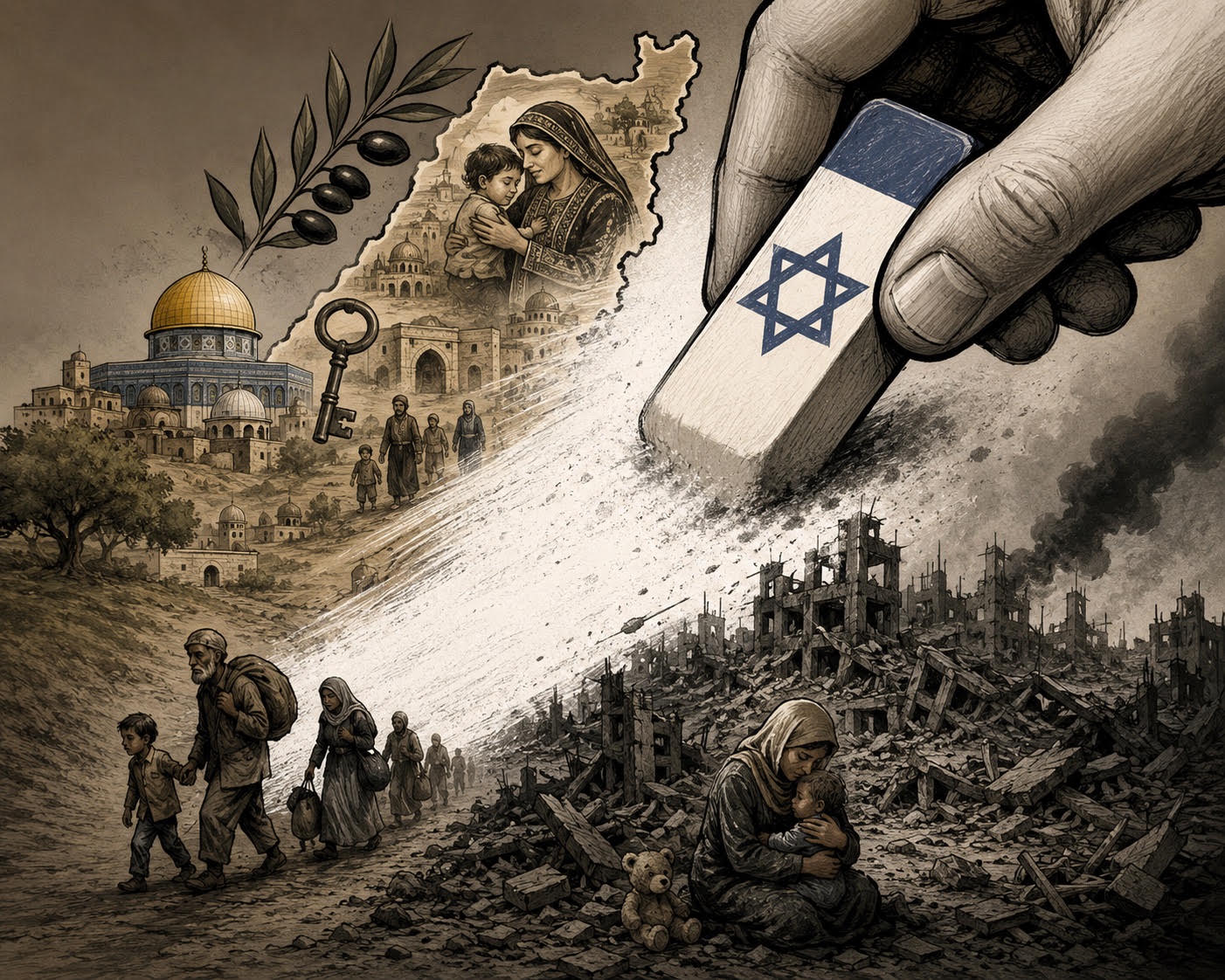
We have never seen the complete demolition of cities, towns, villages, and neighborhoods, nor the complete erasure of a people’s civilization as is happening in Palestine, and Gaza especially. All these crimes were and continue to be committed in Palestine, broadcast to the eyes of the entire world, yet this world remains unmoved and untouched…!
Here, we will point to documents and testimonies related to the systematic destruction of Palestinian society as we have repeatedly mentioned in previous studies and reiterate here:
That the true, undeclared objectives of the Israeli occupation army is: Total destruction and demolition of Palestinian society.
Let’s set the record straight: What Benjamin Netanyahu and his Zionist war cabinet declared around-the-clock about their war aims — eliminating Hamas’s military capabilities and freeing the hostages (prisoners) — are nothing but false and deceptive objectives for public consumption. Their true, undeclared goals are the genocide of the Palestinian people, especially women and children, complete destruction of infrastructure (leveling everything above ground), and the mass displacement of Palestinians, with the entire Gaza Strip becoming uninhabitable.
An Israeli officer who served in the Gaza Strip revealed that the army’s missions here is almost entirely limited to securing large-scale demolition operations, which is a clear admission of the complete destruction of infrastructure and homes as being one of the war’s main objectives. In its July 18, 2025 edition, the Haaretz newspaper quoted the officer, identified only by his initials as saying: “The soldiers’ families need to understand what’s happening there. The primary, and almost sole, mission of the [Israeli] forces is securing the bulldozers’ demolition operations…”
He explained the operations are carried out under a military designation known as “roof-to- ground,” aiming to systematically destroy neighborhoods and infrastructure. According to the officer’s testimony, the Israeli army’s operations in the Gaza Strip are based on “massive demolition of homes,” without any precise intelligence about specific targets, repeating “what is happening is simply widespread destruction, carried out according to a pre-planned operational strategy and indicators.”
Meanwhile, Ronen Bergman, military affairs commentator for Yediot Aharonot, confirmed very early in this war “military pressure does not lead to the release of the hostages in Gaza, and the Israeli leadership knows this very well, but it is used as a pretext to continue the genocidal and destructive ground war.” Similarly, in an article by Joshua Frank published in the US Nation Magazine (January 16, 2024) he stated that “for Israel, brutality is the objective of its campaign against Gaza.” He asserted “Israel’s goal in bombing the Gaza Strip is to render it uninhabitable by the end of its relentless military campaign.”
So as not to confuse people about the true Zionist objectives behind this genocidal war, and to follow events with a strategic reading of the developments on the ground and the current and potential political agendas, he pointed to Israeli writer Yuval Abraham who documented the Israeli war plan objectives. He explained: According to sources who spoke to the joint research team, the targets in Gaza bombed by Israeli aircraft can be divided broadly into four categories:
The first category includes what are known as “tactical targets,” of standard military targets such as armed military cells, weapons depots, ground- and anti-tank missile launchers, launch pits, mortar positions, military headquarters, observation posts, and so on.
The second category refers to “underground targets,” primarily tunnels dug by Hamas under neighborhoods and under civilian homes. Air strikes on these targets can lead to the collapse of houses above or near the tunnels.
The third category of targets— most important and dangerous— are the “targets of force” including high-rise buildings and residential towers in city centers, and public buildings such as universities, banks, and government offices. The aim behind the deliberate bombing and destruction of such targets is to force the Palestinian community to emigrate.
The final category consists of “family homes.” The stated purpose of these attacks is to destroy private residences in order to assassinate a resident suspected of being an activist in Hamas or Islamic Jihad. However, Palestinian testimonies from the current war confirm that none of the families killed included any activists from these organizations.
The Israeli army, as demonstrated around-the-clock in Gaza and Lebanon, gives special attention to the third and fourth categories that are regarded as the true major strategic objectives and mean the complete annihilation of everything Palestinian on the land of the Gaza Strip.
Netanyahu’s strategy is to destroy Palestinian society in Gaza and force its population to leave
The defeat of 7 October, 2023, prompted Netanyahu to make the most important decision of his political career: To destroy and displace Palestinian society in Gaza as punishment for what happened in the settlements surrounding Gaza, just as the first Nakba is narrated in the Israeli narrative as punishment for the Palestinians for rejecting the partition plan and attacking Jewish society. Implementation is hesitant and statements are confusing, but actions are clear: “The government is rushing towards the annihilation of Gaza,” as Minister of Heritage Amichai Eliyahu states. This is the “complete victory” Netanyahu promised (Aluf Benn, Haaretz on 31 July, 2025).
Israelis: ‘We are all criminals and part of the genocidal family’
Israeli analyst Michael Sfard confirms the systematic nature of the destruction: “Israel is destroying Gaza now. Call it ethnic cleansing, call it annihilation, you can call it genocide, call it whatever you want. I have no doubt that whoever coined the term genocide, the Polish-Jewish jurist Raphael Lemkin, would have written with tears of shame that the Jewish state is committing genocide in Gaza. It is destroying the place and liquidating the human group that lives there. The physical destruction of Gaza’s space is systematic, house after house, public building after public building, infrastructure after infrastructure… A place that was home to more than a million people has been reduced to rubble. Educational institutions, clinics, shops, water, electricity, and sewage infrastructure, streets and sidewalks, all of it has turned to ash.”
Data calculated based on aerial photographs indicates 70 percent of the buildings in the Gaza Strip were either completely destroyed or damaged beyond repair. This was before Operation Gideon’s “Arava 2” and the fulfillment of the Defense Minister’s promise to the rabbis of “religious Zionism” that “Gaza will be like Beit Hanoun” (Michael Sfard, Haaretz, 29 August, 2025).
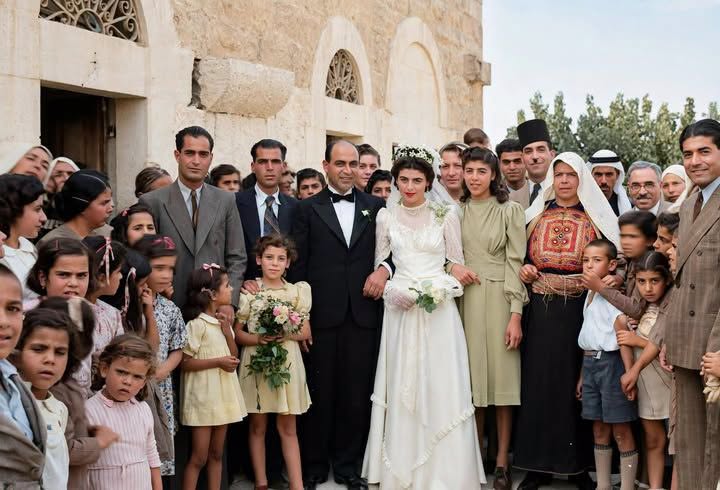
Researcher Dr. Walid Mustafa confirmed in his study, “The Mass Destruction of Palestinian Villages,” that “62.6% of all Palestinian villages that existed in Palestine were demolished by the Zionists. If we consider that some districts of Palestine did not fall entirely under enemy control in 1948, we find that the 468 villages destroyed before 1967 constituted 78.4% of the 598 Palestinian villages that fell under Zionist control that year.” The study’s documented tables also state “the number of Palestinian sites…” The number of villages that existed in Palestine according to the 1931 administrative divisions was 755, of which 472 were destroyed during 1948. At that time, they had 52,812 houses, and their population, according to the 1945 census, was 338,428.
In a report by the Israeli writer Zafrir Rinat, published in Haaretz and titled “Where Did the Arab Villages Disappear To?”, he stated: “Historians critical of the Zionist movement, in particular, such as Dr. Ilan Pappe, argue that the disappearance of Palestinian villages from their locations is part of a systematic and programmed policy to erase their existence in order to fabricate a new history that aligns with the Zionist narrative, which claims that the land was empty and was transformed into a green and prosperous land due to the activities of the Keren Kayemeth LeIsrael (KKL), also known as the Jewish National Fund and other similar organizations.” Pappe further states “the history of Palestine is being transferred to the era of the ancient Talmud.”
Another study in recent years by Naga Kedmon (as part of Peace and Development Studies commissioned by the University of Gothenburg in Sweden and directed by Professor Oren Yiftachel of Ben-Gurion University) found that “the Keren Kayemet forests, which include 86 Palestinian villages, are referred to as ‘Moroccan.’ While most sites have directional signs, only 15 percent mention the Arab village at the site, and the majority of texts in brochures, newspapers, and advertisements do not mention the names of the Palestinian villages at all, nor do they acknowledge their Arab identity.”
In this context, the Israeli newspaper Haaretz exclusively revealed a “premeditated campaign to demolish mosques.” Its correspondent, Meron Rapaport, noted “Israel demolished at least 120 mosques in the Palestinian villages it occupied in 1948, in addition to some Christian churches. It even demolished several synagogues…during this campaign.” He explained “this demolition, often carried out with dynamite, was intended to eliminate any Arab presence in the country and to preserve only what remained of Jewish heritage, erasing any Arab trace. It was as if the Israelis wanted to say this land belonged only to the Jews, and that there was no Arab presence in it.”
In his extensive report, which draws on a recently published book in London by Israeli archaeologist Raz Kletter, Rapaport adds he “was not surprised by what the Israelis did to the Palestinians at that time in terms of displacement and destruction, because if the Arabs had been victorious, they would not have done anything different.”
Rapaport quotes from Kletter’s book: “What happened was the radical destruction of cities and villages, the destruction of an entire civilization, with its present and its past, and of landmarks of life spanning 3,000 years, even the remaining synagogues in the demolished Arab neighborhoods, mosaics, and fortresses. Had it not been for some fanatics on this subject, like Yehoshua Heschel Yevin and others, they would have wiped everything off the face of the earth.” He emphasizes that “the demolition aimed to eliminate the remnants of the Arab presence that disturbed the Israeli leaders.”
Thus, the documents released from the Israeli army archives reveal “since the establishment of the State of Israel in 1948, the Israeli army has worked to erase the traces of Arab villages and towns whose inhabitants were displaced and wiped off the map. It also carried out campaigns to blow up mosques and shrines on the orders of the then-commander of the Southern Front, Moshe Dayan, who, according to the Israeli historian, transformed Palestine into a devastated desert to obliterate the existing Arab civilization and establish Israel upon it.”
If we add to this to the myriad of Israeli, Palestinian, and British documents, it can be confirmed the policy of the comprehensive demolition of Palestinian cities and villages, and the policy of the mass expulsion of the Palestinian people, were considered fundamental pillars of the Zionist movement and the State of Israel.
This policy was considered one of the most closely guarded secrets in Israel, as Professor Israel Shahak confirms: “Before 1948, within the territory that became the State of Israel, this matter was one of the most closely guarded secrets in Israeli life. There is no publication, book, or pamphlet that discusses their number or locations. This is intentional, so that the accepted official myth of an empty land would be readily disseminated in Israeli schools and told to visitors and tourists.”
Therefore, we say that perhaps the Hebrew/Zionist documents and testimonies related to the Nakba and ethnic cleansing and the total destruction of Palestine at the hands of Zionist organizations and the Zionist state, which are being revealed gradually over widely-spaced periods, are among the most important documents that can condemn the generals of those organizations and the Zionist state for committing premeditated war crimes, and even bring them before the International Criminal Court, if the world is serious about that.
Perhaps the data of the current Palestinian scene, where the occupying state is committing a total holocaust against our people in Gaza, constitutes a blatant indictment against Zionist crimes that necessitates bringing the politicians and generals of the Israeli occupation state before the International Criminal Court without any hesitation if the world were serious…
This article by Nawaf Al Zaru was published on the Arabic Rai Al Youm website and reproduced on crossfirearabia.com. Mr Al Zaro lives in Amman, Jordan and is well-known for his extensive research on Palestinian affairs and the Israeli occupation of the West Bank and the Gaza Strip. He has published many books and frequently contributes to Jordanian and Arab newspapers.

 CrossFireArabia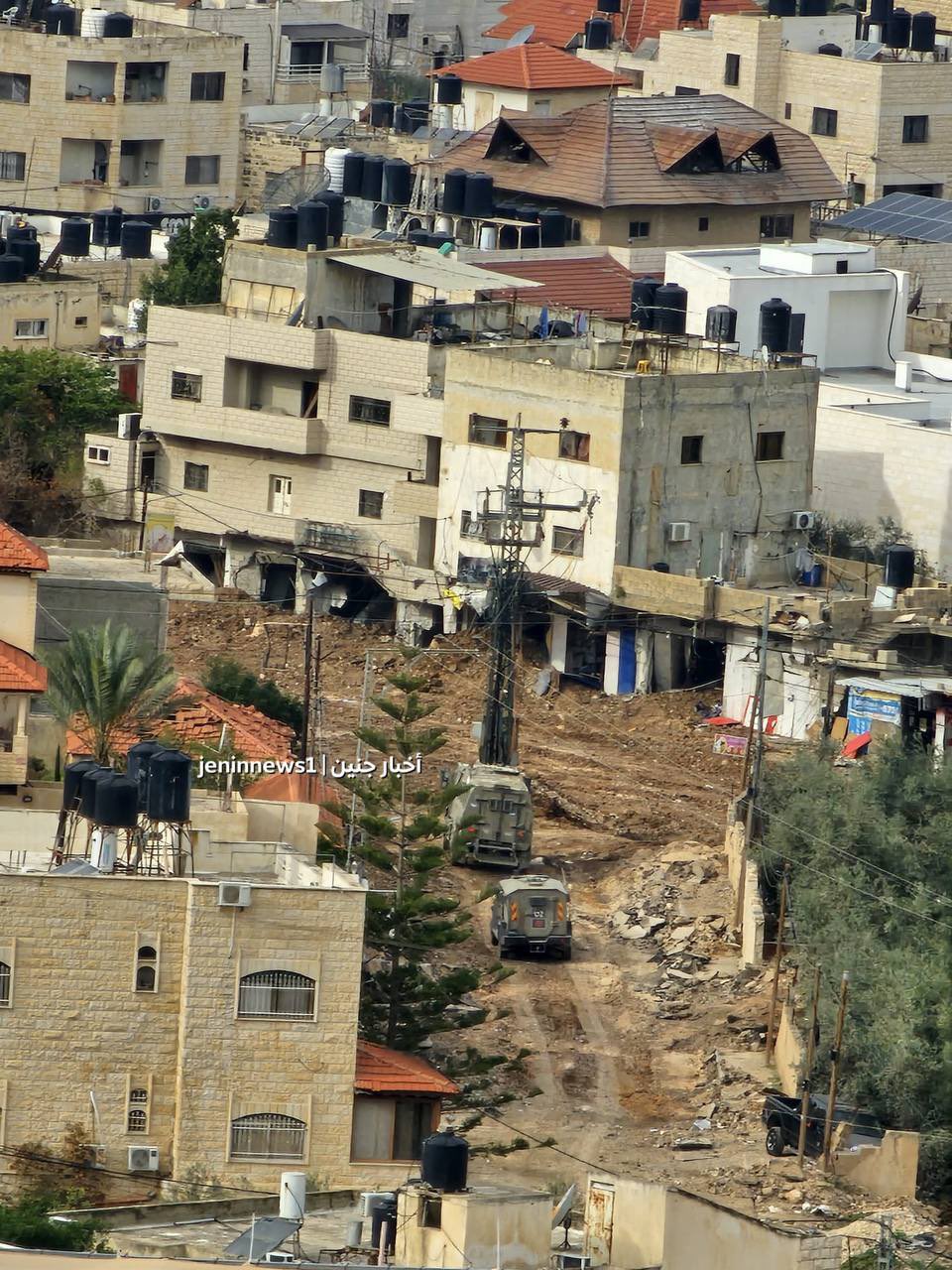


 Saleem Ayoub Quna