Cobwebs and Impotence! 

By Dr Khairi Janbek

A few personal reflections which certainly don’t resolve the Middle East puzzle, and one hopes don’t add to the already existing puzzle.

In any case, the Arabs tend to be a vocal people of tradition, consequently, all that can be done, is limited to the terms of providing the best description to circumstances rather than providing practicable and working solutions.

One can’t say that at times there are in fact idealistic solutions which can work only in the imagination, and indeed there is plenty of that, but to face other nations’ aggression; specifically Israel’s self-proclaimed defense of its national security, Arabs tend to counter that with competition between themselves as who is the most eloquent electronically.

Essentially and apparently, the Rabs are currently in a weak state, and weakness does corrupt, and if the current circumstances persist, will lead to absolute impotence. 

For generations the Arabs have followed the so-called western path to development, while some, in order to spite the West, followed the socialist path to development, the mirage was the same, and failure no different, and with international relations, the policy has been habitually leaning on the Americans to fend off Iranian threat, leaning on Russia to fend off American threat, and leaning on Israel to fend of the threat coming from each other, which prompts the logical question: Why don’t they lean on each other?

Well, part of the answer comes from an incident from my pre-retirement days, as one was looking out of the window of the airplane passing over an area in Turkey full of dams, the VIP I had the honor of accompanying said the prophetic words which stayed with me “good luck to them, all what we did, we conspired against each other.” 

The fact remains, that a form of catharsis is needed in inter-Arab relations, which probably requires more of psychological analysis than political, because the phenomenon of seeking allies from the presumed enemy lines, as opposed to allies from the so called brethren camp, requires plenty of reflection. The ethos of common culture, religion, geography are nothing but folklore the doesn’t have the idea of common interest in its composition.

Alas, a folkloric nation that derives its strength from rhetoric can only remain a reactive nation, and in order to become an active nation, it has to clean up from its mind, the cobwebs of memory and start acting to the basis of common Arab interests.

Dr Janbek is a Jordanian writer based in Paris, France
Continue reading
Chessboard Middle East

By Dr Khairi Janbek

When the British conquered the territory, they didn’t exactly know where to draw the borders of Palestine. British Prime Minister Lloyd George conferred with his French counterpart Clemenceau and suggested that the borders of Palestine be defined on biblical basis; in accordance with its ancient boundaries from “Dan to Beersheba”.

But what about the sparsely populated territory east of the River Jordan? Although in 1915 the British promised the territory to the Sharif of Mecca in the McMahon correspondence, in the early years of the British control, it remained part of Palestine, and not until 1922 did the British separate it from the rest of Palestine and named Emir Abdullah of the Hashemite dynasty as the ruler of the new country Transjordan.

Even when the borders of Palestine became clear to the British, the borders of the future Jewish National home remained open to dispute. Lord Balfour’s letter, spoke vaguely of the establishment ‘ in Palestine of a National home for the Jewish people’ he did not refer to the whole of Palestine or any specific part of it.

Among the Zionists, the borders of Palestine were just as blurred. The ideal borders, as mapped by the Zionist delegation at the Paris Peace Negotiations, included south Lebanon (Northern Galilee) and a stretch of land east of the River Jordan as far as the line of the Hijaz Railway.

Chaim Weizmann continued to believe that the land east of the River Jordan should be part of the Jewish National Home. Thus reiterated in his Congress speech in 1921: “The questions of borders will be answered when Cis-Jordan will be so full of Jews that we will have to expand to Transjordan.”

The right-wing Israeli revisionists continued to claim until the 1950s, the whole of Palestine on both sides of the Jordan River.

However, there was a brief glimmer of hope that an Arab-Jewish understanding might in fact be possible when Emir Faisal, later King of Iraq, and Chaim Weizemann signed an agreement in 1919, recognizing the right of the Jews to immigrate to Israel, but reality on the ground created a different set factors, when Faisal’s condition of far reaching Arab independence in the region was not fulfilled, he declared the agreement no longer valid, in any case, the agreement did not include representatives of the Palestinian Arabs.

Also in the post-World War I, another claim on Palestine was made in March 1920, when the General National Syrian Congress, declared that Palestine was nothing but the southern part of the Greater Syria State.

Dr Janbek is a Jordanian writer based in Paris, France
Continue reading
Palestinian State and The Poker Game

By Dr Khairi Janbek

Israeli Prime Minister Benjamin Netanyahu is a politician above all else. He is dogmatist in rejecting a Palestinian state, and a pragmatist when he talks about it, but all that depends on the position taken by the United States. 

Ever since one can remember from the days of the Oslo Agreements, a Palestinian state, as a term swung between two conceptions: A future project on the ground, and a slogan up-in-the-air to pander on, and as many from my generation remember the rather acerbic comment: Gaza-Jericho First of 1993 which came to be the first and the last.

The Israeli government of that time, believed that it would bring the Palestinians to independenance as interlocutors in determining the occupied West Bank of Jordan that came about by discussing the issue through a joint Jordanian-Palestinian delegation.

However, the little that was agreed upon started to be eroded by the first Netanyahu government, which at times implicitly and at times explicitly acted in the way so as to negate the Oslo agreements with impunity.

One would like to say that since then plenty of water has passed under the bridge, but when it comes to the Palestinian issue, it’s always the same water and the same bridge.

At this point one must say that everywhere in the media there are supposedly leaks and plans about the day after with regards to the Gaza Strip. However, the only consensus between the international community at large and officialdom of the Arab world, is that Hamas should surrender its weapons. But really what happens next?

Silence in the Arab world rules the scene which is in a way saying what cannot be said, which is in other words don’t involve us directly but we shall try to do what we can. This is habitually the Arab position in always being reactive rather than active.

And now on the international scene is the big drive to recognize a Palestinian state, which is for the time being affirming a point of principle, and towards which Israel is actually debating the annexation of the West Bank, as if to say, if the West Bank is reoccupied by Israel, where is this Palestine you want to recognize?

And adding insult to injury, the Washington administration has refused entry to Palestinian President Mahmoud Abbas and the PNA leadership to attend the UN General Assembly meetings. This indicates that it does not recognize that there is a leadership of the Palestinians.

However, and despite saying this, one wishes to be able to say that we might be jumping the proverbial gun, in the sense that, the issue is just a matter of tit-for-tat telling states: You recognize Palestine we take measures to counter that, but alas the Israeli annexation was contemplated long before the international recognition of a Palestinian state.

Now, what will it mean if Israel does go ahead and annexes the West Bank and cancels the Palestinian authority? Well, once again the international community, to the exclusion of the USA, will have to consider the West Bank as and Israeli occupied territory, and once again, the world will have to go back to the Security Council for an attempt to resolve the issue.

Dr Khairi Janbek is a Jordanian columnist living in Paris, France.

Continue reading
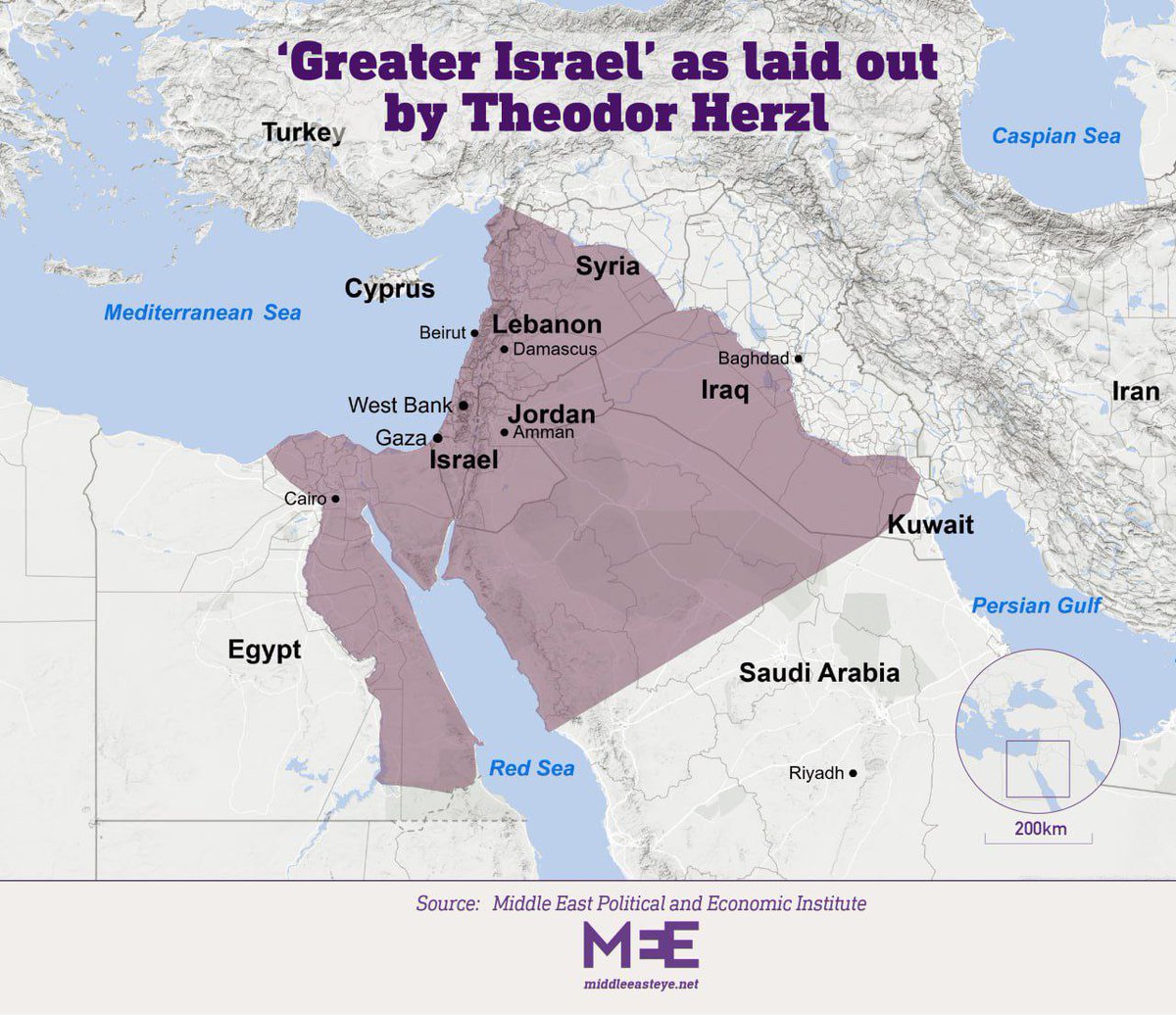
Greater Israel – A Confused Concept

Dr Khairi Janbek

The question of Greater Israel had always been there, swinging between Jewish religion and Zionist politics. Essentially it is a vague concept and interpreted according to the inclination of different groups inside Israel.

When Theodore Herzl talked about the land of Israel he defined it as being between the brook of the Nile and the Euphrates, with the debate being at the time, whether and area between the two rivers or actually all the way to both rivers.

Even when the state of Israel was established, its borders were not defined. It was the 1967 war which ignited the Greater Israel concept among the various Jewish groups with Israel occupying the West Bank, Sinai and the Golan Heights.

However, the recent pronouncements made by the Israeli government regarding this issue, started to ring bells of danger and awakened Arab fears especially, when the world sees Israeli military operations to retake Gaza, putting plans to annex the West Bank of Jordan and occupying territories in South Lebanon, annexing the Golan Heights and moving the Golan Heights and moving further into Syrian territories.

But where did the notion of Greater Israel originally came from, the idea which the father of Zionism Herzl defined? In fact it was taken from the book of Genesis in the Hebrew bible the Tanakh, where God grants Abraham and his descendants a vast expanse of land stretching from the brook of Egypt to the Euphrates. 

Some Israelis refer to a narrower vision mentioned in the Book of Deutronomy, where God instructs Moses to lead the Israelites in taking possession of Palestine, Lebanon, and parts of Egypt, Jordan and Syria.

Others invoke the Book of Samuel which describes lands secured by Kings Saul and David, including Palestine, Lebanon, and sections of Jordan and Syria. In fact those whom hold those beliefs, the pursuit of Greater Israel, is not merely political, it is the fulfillment of divine mandate, a reclamation of land they see as rightfully theirs.

At the same time, some Zionist currents have used the concept of Greater Israel to advocate for political territorial expansion of the state of Israel maintaining control over the West Bank, claim Gaza and the Golan Heights, parts of south Lebanon as being part of Israel and so on.

Essentially the term Greater Israel can refer to several different concepts depending on the ideological, religious or political context.

Dr Janbek is a Jordanian writer based in Paris, France
Continue reading
Israel and The Lunatic Fringe

By Dr Khairi Janbek

So long as the fringe remains a fringe, it can be managed, controlled and probably defeated. But the problem arises when the fringe starts to be defined as a wider being and acting as mainstream.

Case in mind, a fringe political and philosophical movement emerged in the West calling itself as the Dark Renaissance, in other words, a movement attacking the concepts of the Renaissance as the cause of the ills of European civilization.

It says that democracy, equality and human rights concepts should be totally erased, and equal opportunities should not be the norm of ruling societies, rather technology governed by a group of technocrats should be ruling the world.

Moreover, all countries and nations are not equal, therefore strong countries and stronger nations should tell the weaker ones what to do and how to behave.

Now as one said from the start, this was a fringe movement, but unfortunately, the fringe has become the mainstream in international power politics.

The Israeli government has started talking about the question of “greater Israel” but indeed, one thinks as many others do, that this is nothing but an illusion. At the same time, and from the perspective of the western dark renaissance, one wonders to what extent Israel will have support for this illusion in the worst case scenario, and total indifference in the best case scenario.

The current Israeli government is resorting to the rhetoric of the pre-creation Israel, and acting as if the peace treaties and normalisation with Arab countries are nothing but a stepping stone to its dreams of conquest.

Now, how will the world power brokers react to the Israeli Magaly ideas, as in fact they were the guarantors of Arab-Israeli peace agreements and normalisation processes is to be fowned upon. More interestingly, one wonders how the main world power brokers would have reacted, had the Arab countries facing up to Israeli delusions, using the same rhetoric it was using before the creation of its state of Israel prior to 1948.

From what it seems, Israel can say what it likes, and dream as it wishes, but the Arabs can neither talk nor even dare of dreaming.

One wonders about the objectives of this “greater Israel” talk by the Israeli government. The only thing that one concludes is that the Israeli government is trying to throw around big plans and projects in order to cover up other plans involving the West Bank and Gaza, so that at the end of the day, it can say I am giving concessions regarding my greater Israel plans, but each concession Israel gives, is a slap in Arab faces.

Dr Janbek is a Jordanian writer based in Paris. France

Continue reading