Palestinian State and The Poker Game

By Dr Khairi Janbek

Israeli Prime Minister Benjamin Netanyahu is a politician above all else. He is dogmatist in rejecting a Palestinian state, and a pragmatist when he talks about it, but all that depends on the position taken by the United States. 

Ever since one can remember from the days of the Oslo Agreements, a Palestinian state, as a term swung between two conceptions: A future project on the ground, and a slogan up-in-the-air to pander on, and as many from my generation remember the rather acerbic comment: Gaza-Jericho First of 1993 which came to be the first and the last.

The Israeli government of that time, believed that it would bring the Palestinians to independenance as interlocutors in determining the occupied West Bank of Jordan that came about by discussing the issue through a joint Jordanian-Palestinian delegation.

However, the little that was agreed upon started to be eroded by the first Netanyahu government, which at times implicitly and at times explicitly acted in the way so as to negate the Oslo agreements with impunity.

One would like to say that since then plenty of water has passed under the bridge, but when it comes to the Palestinian issue, it’s always the same water and the same bridge.

At this point one must say that everywhere in the media there are supposedly leaks and plans about the day after with regards to the Gaza Strip. However, the only consensus between the international community at large and officialdom of the Arab world, is that Hamas should surrender its weapons. But really what happens next?

Silence in the Arab world rules the scene which is in a way saying what cannot be said, which is in other words don’t involve us directly but we shall try to do what we can. This is habitually the Arab position in always being reactive rather than active.

And now on the international scene is the big drive to recognize a Palestinian state, which is for the time being affirming a point of principle, and towards which Israel is actually debating the annexation of the West Bank, as if to say, if the West Bank is reoccupied by Israel, where is this Palestine you want to recognize?

And adding insult to injury, the Washington administration has refused entry to Palestinian President Mahmoud Abbas and the PNA leadership to attend the UN General Assembly meetings. This indicates that it does not recognize that there is a leadership of the Palestinians.

However, and despite saying this, one wishes to be able to say that we might be jumping the proverbial gun, in the sense that, the issue is just a matter of tit-for-tat telling states: You recognize Palestine we take measures to counter that, but alas the Israeli annexation was contemplated long before the international recognition of a Palestinian state.

Now, what will it mean if Israel does go ahead and annexes the West Bank and cancels the Palestinian authority? Well, once again the international community, to the exclusion of the USA, will have to consider the West Bank as and Israeli occupied territory, and once again, the world will have to go back to the Security Council for an attempt to resolve the issue.

Dr Khairi Janbek is a Jordanian columnist living in Paris, France.
Continue reading
Greater Israel – A Confused Concept

Dr Khairi Janbek

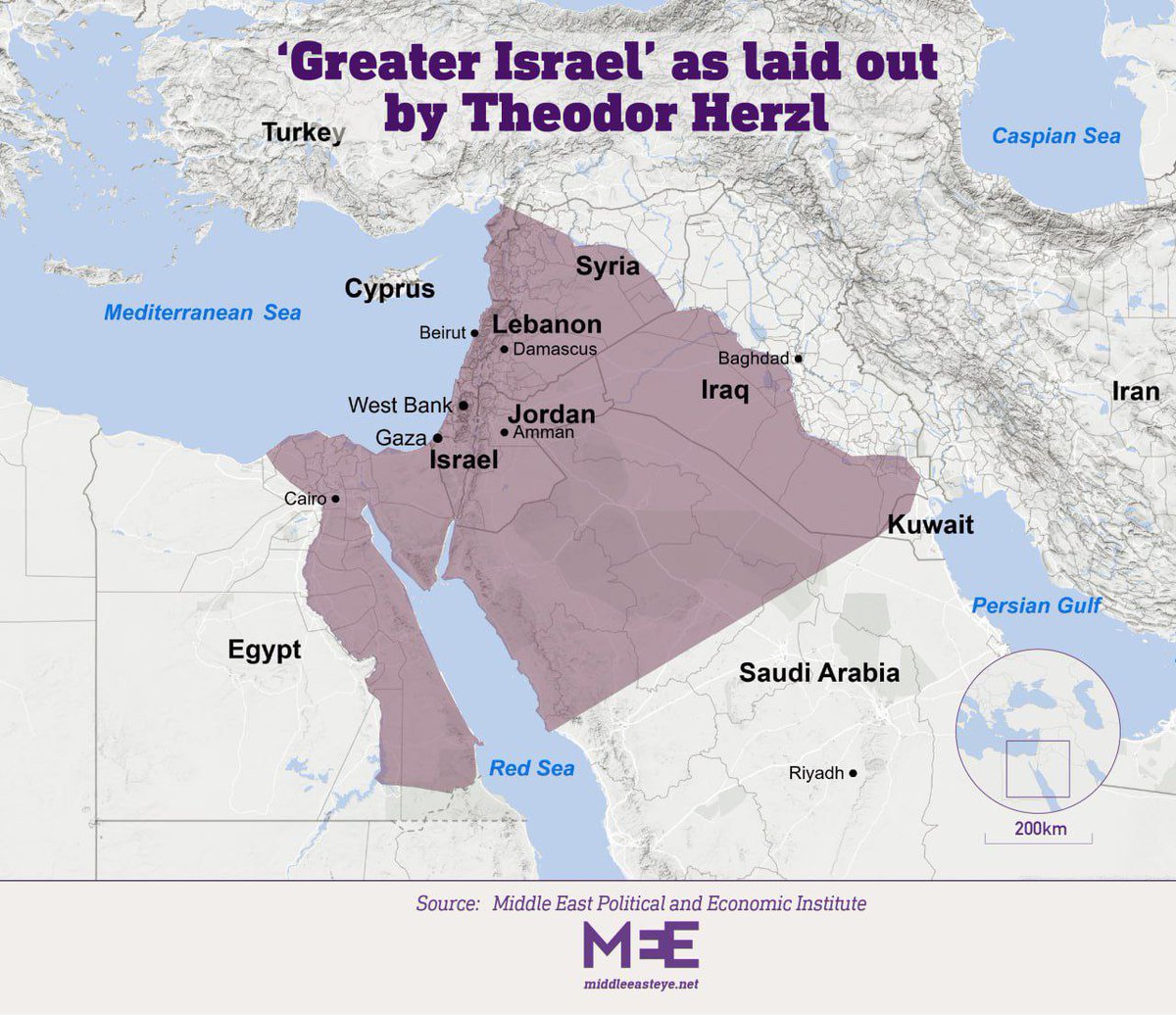
The question of Greater Israel had always been there, swinging between Jewish religion and Zionist politics. Essentially it is a vague concept and interpreted according to the inclination of different groups inside Israel.

When Theodore Herzl talked about the land of Israel he defined it as being between the brook of the Nile and the Euphrates, with the debate being at the time, whether and area between the two rivers or actually all the way to both rivers.

Even when the state of Israel was established, its borders were not defined. It was the 1967 war which ignited the Greater Israel concept among the various Jewish groups with Israel occupying the West Bank, Sinai and the Golan Heights.

However, the recent pronouncements made by the Israeli government regarding this issue, started to ring bells of danger and awakened Arab fears especially, when the world sees Israeli military operations to retake Gaza, putting plans to annex the West Bank of Jordan and occupying territories in South Lebanon, annexing the Golan Heights and moving the Golan Heights and moving further into Syrian territories.

But where did the notion of Greater Israel originally came from, the idea which the father of Zionism Herzl defined? In fact it was taken from the book of Genesis in the Hebrew bible the Tanakh, where God grants Abraham and his descendants a vast expanse of land stretching from the brook of Egypt to the Euphrates. 

Some Israelis refer to a narrower vision mentioned in the Book of Deutronomy, where God instructs Moses to lead the Israelites in taking possession of Palestine, Lebanon, and parts of Egypt, Jordan and Syria.

Others invoke the Book of Samuel which describes lands secured by Kings Saul and David, including Palestine, Lebanon, and sections of Jordan and Syria. In fact those whom hold those beliefs, the pursuit of Greater Israel, is not merely political, it is the fulfillment of divine mandate, a reclamation of land they see as rightfully theirs.

At the same time, some Zionist currents have used the concept of Greater Israel to advocate for political territorial expansion of the state of Israel maintaining control over the West Bank, claim Gaza and the Golan Heights, parts of south Lebanon as being part of Israel and so on.

Essentially the term Greater Israel can refer to several different concepts depending on the ideological, religious or political context.

Dr Janbek is a Jordanian writer based in Paris, France

Continue reading
Israel and The Lunatic Fringe

By Dr Khairi Janbek

So long as the fringe remains a fringe, it can be managed, controlled and probably defeated. But the problem arises when the fringe starts to be defined as a wider being and acting as mainstream.

Case in mind, a fringe political and philosophical movement emerged in the West calling itself as the Dark Renaissance, in other words, a movement attacking the concepts of the Renaissance as the cause of the ills of European civilization.

It says that democracy, equality and human rights concepts should be totally erased, and equal opportunities should not be the norm of ruling societies, rather technology governed by a group of technocrats should be ruling the world.

Moreover, all countries and nations are not equal, therefore strong countries and stronger nations should tell the weaker ones what to do and how to behave.

Now as one said from the start, this was a fringe movement, but unfortunately, the fringe has become the mainstream in international power politics.

The Israeli government has started talking about the question of “greater Israel” but indeed, one thinks as many others do, that this is nothing but an illusion. At the same time, and from the perspective of the western dark renaissance, one wonders to what extent Israel will have support for this illusion in the worst case scenario, and total indifference in the best case scenario.

The current Israeli government is resorting to the rhetoric of the pre-creation Israel, and acting as if the peace treaties and normalisation with Arab countries are nothing but a stepping stone to its dreams of conquest.

Now, how will the world power brokers react to the Israeli Magaly ideas, as in fact they were the guarantors of Arab-Israeli peace agreements and normalisation processes is to be fowned upon. More interestingly, one wonders how the main world power brokers would have reacted, had the Arab countries facing up to Israeli delusions, using the same rhetoric it was using before the creation of its state of Israel prior to 1948.

From what it seems, Israel can say what it likes, and dream as it wishes, but the Arabs can neither talk nor even dare of dreaming.

One wonders about the objectives of this “greater Israel” talk by the Israeli government. The only thing that one concludes is that the Israeli government is trying to throw around big plans and projects in order to cover up other plans involving the West Bank and Gaza, so that at the end of the day, it can say I am giving concessions regarding my greater Israel plans, but each concession Israel gives, is a slap in Arab faces.

Dr Janbek is a Jordanian writer based in Paris. France

Continue reading
Palestinian State Out of Gaza Horrors?

It is hoped that the appeals for more recognitions of the Palestine state in the UN General Assembly in New York will increase pressure on Israeli Prime Minister Benjamin Netanyahu and his coalition partners to drastically change course and make the Palestinian state a reality.

Notwithstanding the US neutrality recognition, at least as things stand now, coupled with the increased efforts from the European Union, Israel stands to be ostracized in the international community.

One point remains rather curious however, is UK’s Premier Keir Starmer’s condition being that Britain will recognize a Palestinian state if Israel refuses to accept a ceasefire on Gaza.

For all intents and purposes, it seems what Starmer is interested in, is basically a ceasefire and then Palestinian state, but then again this is for the British government to ponder on in the face of the rolling train of recognitions.

But what does this recognition entails in practical terms? It basically means the stalled Oslo negotiations since 1993 are to be revived again, and if need be on different terms than what was envisioned before. Here one says different terms because the Oslo agreements were guaranteed by the world powers and nothing came out of them.

Indeed much more must be done by the world community, especially that now, we have a more difficult and intransigent Israeli government which needs above all else to accept, at least in principle, the two-state solution.

But also and at the same time time, the recognition of a Palestinian state entails the recognition of a Palestinian leadership with the ability and responsibility to represent the Palestinian people.

One supposes there is a general consensus on that now since the current PNA has become defunct and its current leadership obsolete in front of the immense responsibilities and tasks ahead.

In brief, it would be a mere rhetorical smokescreen to call on recognizing a Palestinian state without actually paving the way for the creation of such a state by totally changing the current PNA leadership via honest elections supervised by the international community and which represent the will of the Palestinian people.

Of course one cannot but insist, that the Arab role in the newly envisaged peace process is crucial. One also cannot help but think that the role of Saudi Arabia will be crucial for the next phase. For  start, the precondition of Saudi for any form of dealings with Israel, is for the latter to accept the principle of two-state solution, and in fairness it must be clarified that the French-Saudi initiative which led Emmanuel Macron to recognize a Palestinian state was supposed to be declared in in Paris.

But now due to this effort, it has become an international case at the UN. Israel has failed with all of its endeavors to normalize relations with Saudi Arabia without giving any concessions, mainly the acceptance of the precondition of the recognition of the two-state solution, and now it is facing both the pressure of the international community and the condition of the Saudis, especially they shift their strategy from the UAE to India, and without the Saudis they will have nothing in the Gulf.

But still there is the bleeding wound of Gaza, the wound which can never start to heal without a collective Arab effort led by the Saudis which takes back to the conundrum of Israel’s acceptance of the principle of Palestinian state. Only then can Saudi Arabia lead the Arab effort, to first of all disarm Hamas, give an amnesty to Hamas members, and exile its leadership out of Gaza, in the hope of rehabilitating the strip and start in earnest the reconstruction efforts.

Continue reading
Middle East in a Cracked Mirror

By Dr Khairi Janbek

Every time the “new Middle East” which by the way has exciting resonance, be it conspiratorially or optimistically, is raised, one sees the new concept as exactly resembling exactly the old Middle East or is of the same replica.

We have grown accustomed to seeing the big turmoil in the Middle East, wars and regime changes, and each time we fall into the trap of seeing a conspiracy to change the boundaries of the Middle East, boundaries created with accords between Britain and France after WWI and which all countries of the region decry and condemn yet ironically fighting tooth and nail to preserve.

But what is this bogey which insinuates conspiracies and evil behind the cloak of a new Middle East.

Infact it started off idealistically as a reformist movement, basically economic as well as political reform, but with constant instability in the region, the term started to take another meaning, basically new alignments and new political understandings for the countries of the Middle East.

Essentially the way one sees it, the term now refers not to geography or reform – economic or political – but rather who are going to be the major players in the regions, who will be pulling the strings and will they relate to each other despite their contradictions and convergences.

For much of the recent history of the region the Trinity of Turkey, Israel, and Iran were the frame which contained the Arab problems within the Arab world, but as we have been seeing in recent history, these major players became part of the problems of the Arab world through their interference, seeking expansion or guaranteeing what they claim to be their national security concerns.

Now, and in the Donald Trump era, the concept of a new Middle East is still on track regarding the notion of who will be the new forces pulling the strings in the area, as for all intents and purposes, Iran as it seems has been relegated to a more background position regarding the affairs of the region, and Turkey with a circumscribed role, especially that the PKK, the leitmotif of Turkish interference in the area have laid down their arms.

Of course, now Israel is the power par excellence and the major player, but it needs a balancing actor from the Arab world this time, and the most likely candidate is Saudi Arabia.

However a Saudi balancing actor to Israel, is just not an easy feat to achieve, because such an actor cannot be based on contradictions alone, but also requires convergence. And this supposed convergence relies on the point of principle, the two-state solution to the Palestinian problem.

Now one is really not aware of the reasons behind Netanyahu’s rejection of the two-state solution, but certainly he is a hostage of his political alliances that keep his government afloat, thus making him avoid going back to court, and even worse, a possible jail term. As certainly for his allies, the rejection of a two-state solution is a point of principle.

Consequently, one believes, without the common ground with Saudi Arabia, of putting back on the table the issue of the two-state solution, there won’t be a new Middle East of two major actors, but rather one temporary major actor, being Israel for a temporary new Middle East!

Continue reading