Netanyahu, Mount Hermon and Arab Silense
By Awni al-Rajoub
What is happening? What remains of the dignity of an Arab nation that stands before such a grave scene and then moves on as if nothing has happened?
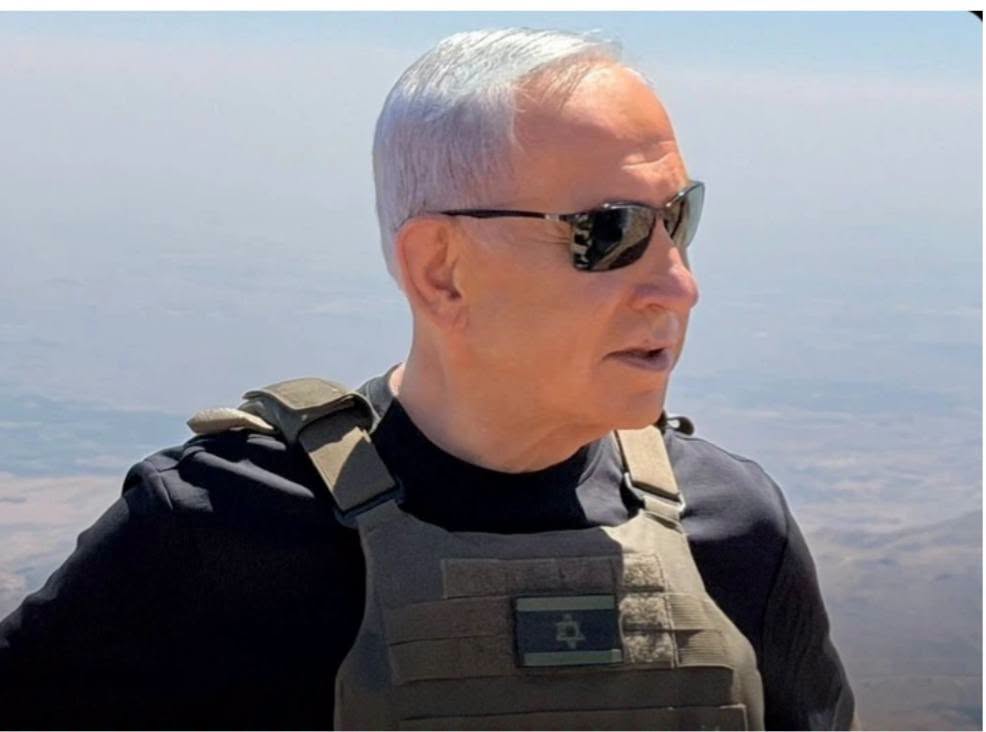
For Israeli Prime Minister Benjamin Netanyahu to enter Syrian territory and reach the Mount Hermon area, forcibly and under the protection of occupation forces, without hesitation or shame, is not merely a passing provocation, nor a fleeting political maneuver that can be dismissed as media posturing.
It is a scene that encapsulates the extent of Israeli arrogance and disregard for all international rules, norms, and conventions.
What audacity! What kind of arrogance allows the head of the occupation government to enter the territory of a sovereign Arab state as if it were unclaimed land?
Who gave him the right? Who said that power grants its possessor the right to violate the borders of states? Who said that the occupation can impose its own law on the region, while others are required to abide by international law?
What is happening can no longer be glossed over or addressed with cold diplomatic language. There is an occupation that acts according to the logic of force, and there is an Arab silence that grows heavier and more painful.
Netanyahu did not enter Mount Hermon because he doesn’t know it’s Syrian territory. Nor did he cross the border because he misread the map.
He knows perfectly well where he stands, he knows perfectly well what this move means, and he knows that the message is not just for Syria.
The message is for the entire region.
A message that says Israel is ready to advance whenever it finds the way open, to impose a new reality by force, and to test the limits of Arab and international reaction each time.
And therein lies the tragedy. The problem is not only with the one advancing, but with the one who allows him to advance without paying a real political price. We have reached a point where the question has become more painful than the event itself:
Is there still an Arab nation?
A nation that sees the land of an Arab state violated, the borders of an Arab state transgressed, and the sovereignty of an Arab state trampled upon, and then finds nothing in the face of this scene but silence, statements, and positions that change nothing on the ground?
We don’t want random wars, military adventures, or empty slogans. But we do want at least one thing:
For the Arabs to take a stance commensurate with the magnitude of the danger.
A genuine political stance. A genuine diplomatic stance. A stance that makes the occupation understand that every transgression has a price, that the region is not without will, and that the Arabs are not so powerless.
What is happening today in Syria should not be viewed as an internal Syrian matter or an isolated incident.
It is a matter of Arab sovereignty.
If violating the borders of an Arab state becomes something that can be overlooked with silence, what prevents it from happening again elsewhere?
Today it’s Mount Hermon.
And tomorrow, what?
Where will this project end?
The most dangerous thing facing the nation is not only the strength of the enemy, but the nation’s habituation to retreating before it. For occupation to become commonplace. For raids to become routine. For incursions to become routine. That violations of sovereignty become mere news items that pass through the news bulletins and are then forgotten.
This is the true catastrophe. Nations are not only defeated when they lose their battles, but also when they lose sight of the gravity of what is happening to them.
Netanyahu’s incursion into Syrian territory in this manner should awaken a profound question within us:
What do we want for the future? Do we accept that the map of the region be drawn by force?
Do we accept that Arab borders become subject to change whenever one party possesses military power?
Do we accept that sovereignty becomes a mere word in statements, while facts on the ground are imposed by force?
And will we continue to stand idly by as this saga of Israeli arrogance unfolds before our very eyes?
For how long? It is time to state it clearly:
Israel does not act with such arrogance in a vacuum. It does so because it senses that the cost of defiance is low, that reactions are limited, that the Arab world is mired in its crises and disputes, and that every country is preoccupied with its internal affairs.
And here we must pause. Arab disputes must not be allowed to become an open opportunity for others. Nor must Arab divisions be a bridge for occupation to cross into more Arab lands. We are facing a moment that demands we ask ourselves honestly:
Where is the Arab decision? Where is the Arab will? Where is the ability to transform anger into action? Where is the capacity to utilize politics, diplomacy, law, economics, and all available means of pressure?
No one is asking the impossible. No one is asking the Arabs to go to war. But what is required is that the nation not remain a mere spectator. For prolonged silence in the face of arrogance ultimately becomes a green light.
And here I fear that a day will come when the question will no longer be:
Why did Netanyahu enter Mount Hermon?
But rather:
Why did we let him go even further?
The Arab nation’s brow is not only stained when its land is occupied, but also when it witnesses repeated aggression and lacks the will to stop it.
And the shame lies not in the nation’s weakness at any point in its history; Weakness can afflict nations.
But the true shame is for a nation to become accustomed to its weakness, and to treat humiliation as an unchangeable fate.
It is high time the Arab nation regained its self-confidence. To understand that the respect others have for it begins with its respect for its sovereignty. And to realize that Arab national security is not a slogan to be raised on special occasions, but a historical responsibility.
As for Netanyahu, he must understand that the region does not belong to him, that history will not grant him a deed to possess land that does not belong to him, and that military power, however great, cannot grant occupation perpetual legitimacy.
Mount Hermon is not just a mountain.
It is a symbol of land, sovereignty, borders, and dignity.
Therefore, what happened should not be treated as just another news item.
It must remain an open question for every Arab:
What is happening?
And what remains of our nation?
This opinion, written by Awni al-Rajoub, was published by the Arabic website Jo24 and reprinted in English in crossfirearabia.com

 Dr Khairi Janbek

 Heba
Heba
 Saleem Ayoub Quna