Bassem Youssef: This Man Can’t be Silenced

Egyptian-American comedian Bassem Youssef announced, Tuesday, he is back on the social media platform X, following a week-long deactivation due to security and safety concerns. 

Youssef, known for his support for Palestinian rights, clarified he deactivated his account after receiving alarming messages suggesting his account may have been hacked and that there were potential safety issues involving people he knows.

“A few days ago, I deactivated my X account. Two reasons: I received concerning messages that gave me and my team the impression that my account has been hacked with the potential of being doxed; also, there were potential safety issues concerning people I know. I only take these issues seriously if it concerns other people, not me,” Youssef explained on X.

“So, I deactivated the account and started to research if this is legitimate or not and if both issues were related or not.”


Last week, his 12-million-followers account disappeared, and the last post was “Antisemitism was an accusation that used to freeze the blood on people’s veins. I see many people now realizing how this fear tactic is used to shut down conversations and scare people.”

He added, “It’s been overused and abused in order to intimidate people. Are you still scared to be called an antisemite by those Zionists? Vote and tell me in the comments. No, I don’t give a… anymore. Or: Yes, I’m still scared.”

Youssef admitted his initial post was unclear.

“In two days, there were many rumors and speculations; I admit the post was not clear. So, I posted again on all my other platforms that I am the one who deactivated my account, and I will be posting on other platforms in the meanwhile,” he said according to Anadolu.

Youssef also shared that he had not posted on any platforms during this time, as he was dealing with personal and health issues.

“My family members were under a lot of pressure, so I had to deal with all that. This caused a major burnout to all of us,” he said.

Although the safety concerns were alleviated and the hacking issue was resolved a few days later, Youssef felt the need to take a break from social media.

“Although the safety concerns were alleviated and the hacking issue was secured a few days later, I needed to get away from social media so I didn’t post anywhere,” he added.

Last October, Youssef did an interview with British journalist Piers Morgan on Israel’s brutal offensive on Gaza that went viral. 

His pointed and humorous critique of the Israeli onslaught against the Palestinians in Gaza and the West Bank got significant attention. 

Hala Diab, Youssef’s wife, is from Gaza, and her criticism of Israel also attracted attention. 

Youssef, a former heart surgeon, has lived and worked in the United States since around 2015 according to the Turkish news agency.

CrossFireArabia

CrossFireArabia
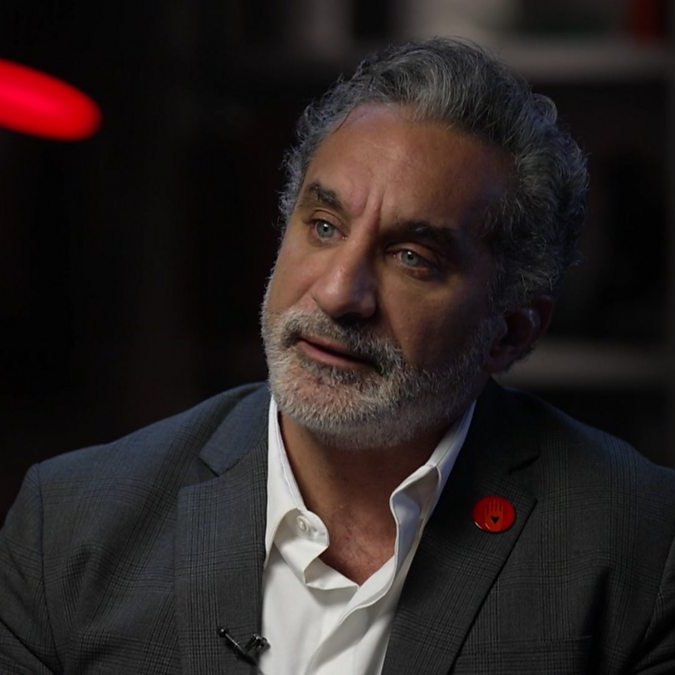
Dr. Marwan Asmar holds a PhD from Leeds University and is a freelance writer specializing on the Middle East. He has worked as a journalist since the early 1990s in Jordan and the Gulf countries, and been widely published, including at Albawaba, Gulf News, Al Ghad, World Press Review and others.

Related Posts

An Egyptian House in a German Town

An Arab house in a German town, all the trappings of a different culture, Egyptian, Jordanian, Syrian, and Yemeni, an Oriental setting in a traditional western German context.

The town is Bruchsal, to the west of Frankfurt, owners, the Burkards, they fell in love with a different culture, and decided to “transport it” to their house and in their lands, having lived in Cairo in the 1970s and 1980s.

Helmut Burkard and his wife Beta decided to pack their belongings and their kids in 1974 and move to Cairo. Neighbors told him “you are mad” to go to the Middle East at that precise moment. “Its dangerous.”

But he wasn’t swayed. They loved every single minute of it. Helmut teaching music at a convent, Beta, an economist by training had become a proper housewife, and the two kids growing up.

Over the years Beta spent her time collecting traditional artifacts, souvenirs, paintings and different copies of the Quran from Cairo’s old Souqs and Bazaars as she had a preordained feeling that one day she and her family would go back to their home on Mozart Way and fill it and make it a house of converging cultures.

And so today as you enter the house, you are immediately struck by the mementos, artifacts, framed pictures, the rugs, swords, scabbards hanging on the different walls of the house. The speak of a different culture, and a far away civilization embedded in a geographical separateness, novel, yet very human.

What’s fascinating about this house is that it’s totally covered with trinkets and memorabilia. The stairs, landing, living room, bedrooms all smell of a civilization that is anything but German, yet relaxing and soothing.

Pottery, pans, Arabic coffee pots, earrings worm by Bedouin women adorned the place from head to foot together with wall paintings by different Egyptian artists.

In fact, if it wasn’t for the large black piano in the living room, and the number of German books, a visitor like way would be forgiven for thinking the house belongs to a foreign family living in rural Germany.

Every wall, every corner, nook and cranny of every room—literally—filled with every aspect of an Arab life which the Burkards lived either in the long stretch in Cairo, and or the vacationing he used to take his family to in different parts of Jordan, Syria and Yemen.

Beta just kept collecting on these holidays inevitably made driving through these areas. “I wanted my family to experience these countries by roads, and not through planes,” he used to say.

The house is an Arabic treasure. On Mozart Way, you can’t say, “oh I want to write an impressionistic piece on this house” simply because of the intricate detail involved in these artifacts. The house tells a story of a past the Burkard’s lived in. If you let Beta go on, she would speak for ages on how she got this piece, and from which Souq she had to go to.

You can’t point to any particular room and say this is the pride and joy of the Burkards. They are all special. Take the living room, for instance. One is struck by its aura of combination of religiosity, culture, art, music and literature that spanned across.

There was picture frame of Al Faateha (Opening chapter of the Quran), engravings of the name of Allah (God) and Prophet Mohammad on different plates.

In a small side section named by Helmut Burkard as the “Arabic room”, there is a mixture of Arabesque and teak, a desk, a large rounded Arabesque coffee table with a copper plate and a traditional wooden shield used as a divide from one section of the house to another.

Of course both husband and wife know what all these means. Helmut speaks good Arabic with an Egyptian accent, so does Beta although she didn’t let on. But Helmut was directly in touch with the local population, that’s why he picked up the accent and the slang.

After Egypt the Burkards went back to Germany, however, Helmut returned to Jordan in 1996 as a fellow teaching in the Music National Conservatory where he remained till 2003. He first came to Cairo when he was in his early 40s, now he was in his 70s, his kids grown up, and his wife Beta attending the garden and on frequent trips to Switzerland which is just around the corner from where they lived. But he was still a “musical fighter”, humming to himself a piece by Mozart or Bach as he went down the corridor.

At the Conservatory, he established an exchange program where German pupils came to Jordan to play music followed by Jordanian pupils going to Germany to play classical music with Arab themes. He called this a “musical culture of dialogue”; the German pupils would also learn different Arabic pieces and even sing them.

Helmut, now in his early 80s, and who brought the last German music group to play in Amman in 2010, is a strong believer in a culture of dialogue between east and west as a means to bringing people closer together.

His house is a testimony to that.

This artical is reprinted from my account on Hubpages

Continue reading
Nakba Art

Art of the Nakba

My painting called”Nakba of Palestine “on May 14 1948 the land of Palestine was stolen by evil wicked power after that the Palestinian disperse all over the world.

Please Share it.

Artist Said Elatab

Continue reading

You Missed

An Egyptian House in a German Town

An Egyptian House in a German Town

Nakba Art

Nakba Art

Palestinian Population Tops 15.5 Million

Palestinian Population Tops 15.5 Million

‘All I Want is to Bury My Family in Dignity’  

‘All I Want is to Bury My Family in Dignity’  

Israeli Army: 18 Soldiers Dead, 910 Injured in Lebanon

Israeli Army: 18 Soldiers Dead, 910 Injured in Lebanon

Watch Out: Israel is Secretly Filling The West Bank With Settlements

Watch Out: Israel is Secretly Filling The West Bank With Settlements