Happy Parents: Premature Babies Returned to Gaza

“I am meeting my daughter for the first time. It’s as if today is the day of her birth. I can’t describe my feelings.”

By Abdel Qader SabbahJawa Ahmad, and Sharif Abdel Kouddous

KHAN YOUNIS, GAZA—Ahmed Al-Harsh waited outside Nasser Hospital in Khan Younis on Monday to meet his son, a toddler and the only other survivor of his entire family.

“I’m waiting for my son Mahmoud. I haven’t seen him in two and a half years except once, before he was transferred to Egypt. I’ve been waiting for two and a half years,” Al-Harsh, 31, told Drop Site News.

Mahmoud is one of 28 Palestinian infants who were evacuated to Egypt as premature babies in November 2023 from the neonatal intensive care unit in Al-Shifa Hospital in Gaza City, as the Israeli military laid siege to the medical complex and raided it. Mahmoud and seven other children were returned to Gaza on Monday to be reunited with their families, or what was left of them.

On October 14, 2023, one week into Israel’s genocidal assault on Gaza, the Israeli military bombed the Al-Harsh’s family home in the Jabaliya refugee camp. Al-Harsh’s entire family was killed in the attack—his four-year-old daughter, his father, mother, brother, sisters-in-law, nephews, and nieces. Al-Harsh initially thought his wife, who was eight months pregnant at the time, had also been killed. He only later learned that she had been gravely injured and had given birth to their son, Mahmoud, in hospital before succumbing to her injuries.

(Left) Ahmed Al-Harsh outside Nasser Hospital in Khan Younis as he waits for his son, Mahmoud, to arrive after 2.5 years in Egypt. (Right) Ahmed Al-Harsh holds up a photo of his son Mahmoud on his phone. March 30, 2026. Screenshots of video provided by Abdel Qader Sabbah.

Al-Harsh was able to see Mahmoud only once before he was taken to the neonatal intensive care unit in Al-Shifa’s hospital for care. He had been staying in Beit Lahia, unable to move amid the escalating Israeli assault. In November, Israel laid siege to Al-Shifa hospital, surrounding the medical complex and cutting it off from the rest of Gaza City before raiding it on November 15. Doctors inside scrambled to keep their patients alive, including the nearly 40 premature babies in the hospital’s neonatal intensive care unit, Mahmoud among them. There was no electricity and incubators were failing. The World Health Organization, which was able to coordinate a one-hour visit to Al-Shifa at the time, described the hospital as a “death zone.”

After much negotiation, 31 premature babies were evacuated from Al-Shifa on November 19 and taken to Rafah. UNICEF said the conditions of the babies had been “rapidly deteriorating” inside the besieged hospital. Five died before they could be evacuated. The next day, 28 of the babies were transported across the border to Egypt for treatment. None were accompanied by family members.

For the past two and a half years, Al-Harsh has seen his son only in photos or videos sent to him from Egypt—first as an infant, then a toddler. “The feeling is indescribable. What can I tell you about this feeling?” he said. “These two years felt like forty, even more—a lifetime. During this time, I was a body without a soul. I couldn’t work or do anything.”

Video of the convoy arriving at Nasser Hospital in Khan Younis bringing eight children who were evacuated from Gaza to Egypt in November 2023. March 30, 2026. Video provided by Abdel Qader Sabbah.

By early afternoon on Monday, the convoy from Egypt finally arrived. A Red Crescent ambulance and UN vehicles escorted a large bus carrying the children. Families crowded around the doors as they pulled up outside Nasser Hospital. The children were passed into the waiting arms of family members, most of them meeting for the first time, in scenes of joy. Al-Harsh appeared overwhelmed with emotion as he held Mahmoud, chubby, bespectacled and crying, in his arms. When Mahmoud grabbed a bottle of water and drank thirstily, Al-Harsh broke down and wept.

“Every human being needs the love of a mother and father. I am 31, I lost my mother and father, and I’m still suffering,” Al-Harsh said. “This boy—where do I find him a mother? Where do I find him his mother? When he grows up and asks about his mother, what do I tell him?”

At least four of the babies who were evacuated to Egypt died while there, Dr. Ahmed Al-Farra, the director of the pediatric department at Nasser Hospital, told Drop Site. He added that the children who returned to Gaza, while healthy, would require additional medical and psychiatric evaluation.

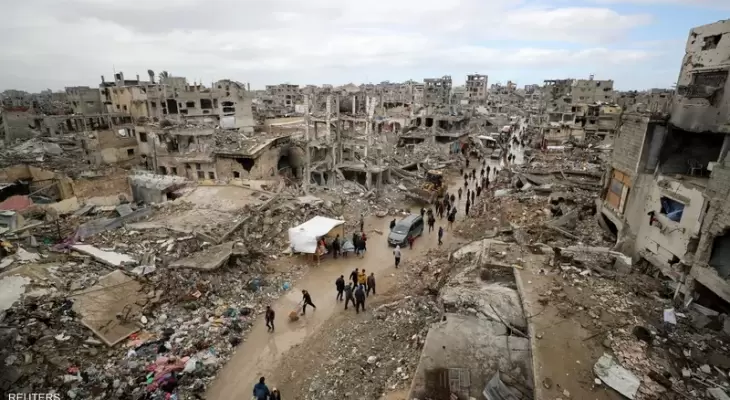
Gaza’s health care system has been systematically destroyed by the Israeli military since October 2023. Every single hospital was attacked and 25 were completely shut down while 13 remain partially functioning, according to Gaza’s Health Ministry. Despite a “ceasefire” that went into effect in October, Israel has continued near daily attacks in Gaza, killing over 700 Palestinians since then. Israel has also continued to severely restrict the amount of humanitarian aid, fuel, medicine and other essentials, allowing in an average of only 200 trucks daily instead of the 600 agreed upon in the deal.

At the onset of the U.S.-Israeli war against Iran on February 28, Israel reinforced a total siege on Gaza, citing “security concerns.” The Kerem Shalom crossing was partially reopened three days later. The Rafah Crossing between Gaza and Egypt—which had only opened in early February for medical evacuations and for Palestinians returning to Gaza—was also closed at the onset of the Iran war and only reopened on March 18. Roughly 20,000 people are on waiting lists for medical evacuation abroad, 4,000 of them children, according to the Health Ministry.

The Gaza Health Ministry this week warned of a severe shortage of generator fuel that threatened hospital operations. The Ministry said that remaining generators are “worn out and prone to repeated breakdowns,” placing critical departments such as intensive care, surgery, neonatal units, and dialysis at risk of shutting down. Israeli forces have allowed the entry of only 1,240 fuel trucks out of the 8,350 that were supposed to enter over the 167 days since the ceasefire agreement took effect—a compliance rate of just 14.8%—according to the latest statistics from officials in Gaza shared with mediators and obtained by Drop Site. The Health Ministry warned that 90 generators are already out of service, while 11 are running on limited supplies. All hospitals in Gaza remain fully dependent on emergency back-up generators, according to OCHA.

Regardless of the continued Israeli siege and daily military assaults, the families who were finally reunited with their children in Gaza on Monday after nearly two and a half years of separation, described the moment as nothing short of miraculous.

Sundus Al-Kurd was among them. She was badly wounded in an Israeli airstrike on her family home in Beit Lahia on October 22, 2023. Her daughter Habibat Al-Rahman was killed in the attack. Eight months pregnant, Al-Kurd was rushed to hospital where doctors operated on her to save her life and conducted an emergency delivery to save her unborn daughter, Bissan.

“On the day I gave birth to my daughter, I lost her only sister,” Al Kurd said.

“When I woke up, I asked, ‘Where is my daughter?’ They told me, ‘Your daughter is fine and doing well,’” she added. “They told me she was in an incubator and that due to my health condition I wouldn’t be able to care for her.”

Al-Kurd continued to recover from her injuries and was unable to see her daughter before the Israeli military attacked Al-Shifa in November 2023.

“I was evacuated from the hospital with difficulty and I asked to take my daughter with me, but they said I wouldn’t be able to care for her due to my medical condition,” she said.

Having lost her other daughter, parents, and two siblings during the war, Al-Kurd said she could not bear the thought of losing Bissan, whom she described as “a gift and compensation from God.” Al-Kurd did not know what had happened to her daughter until much later when she found out she had been among the 28 premature babies evacuated to Egypt.

Sundus Al-Kurd holds up a traditional Palestinian dress she brought for her daughter Bissan, who returned to Gaza after being evacuated to Egypt 2.5 years ago for medical treatment. Khan Younis. March 30, 2026. Screenshot of video by Abdel Qader Sabbah.

“Today, after two and a half years, God willing, we will be reunited with our daughter,” Al-Kurd said. She brought a traditional Palestinian dress for Bissan to wear. When her daughter finally arrived in the convoy to Nasser hospital, Al-Kurd held her tightly before dressing her in the white and red dress as relatives took turns embracing her.

“I am meeting my daughter for the first time,” she said. “It’s as if today is the day of her birth. I can’t describe my feelings.” Drop Site

Continue reading
Netanyahu’s Middle East Vision

By the end of December, Israeli Prime Minister Benjamin Netanyahu is expected to visit Washington to meet US President Donald Trump, marking his fourth visit in less than a year since Trump assumed office. Unlike previous visits, this one comes after President Trump imposed his vision for ending the war in Gaza and outlined his broader concept of regional peace—giving the visit a distinctly political dimension.

At the core of the discussions will be the transition to the second phase of the Gaza ceasefire agreement, the appointment of an American general and a monitoring center, and the mechanism for administering Gaza ahead of the arrival of an international peace force. The visit is also expected to address Israel’s relations with its regional surroundings, particularly Egypt. Reports suggest the possibility of a simultaneous visit by the Egyptian president to Washington, reflecting a clear American desire to initiate direct engagement and promote the concept of “economic peace,” along with major regional projects that Trump views as the backbone of future relations, especially in the energy and gas sectors.

Yet even as President Trump speaks of a regional peace vision, the days preceding the visit remain open to further escalation. Indicators point toward a qualitative Israeli escalation across four fronts: Gaza, the West Bank, Lebanon, and Syria. These fronts have been deliberately kept open, transformed into continuous theaters of operation where Israel calibrates the level of military activity according to its security assessments.

Lebanon remains the most prominent arena of this escalation. Ongoing discussions about Hezbollah’s efforts to rebuild its capabilities coincide with Israel’s continued direct targeting of the group’s positions and operatives. This comes amid growing American pressure on the Lebanese government and army to take concrete steps toward disarming Hezbollah.

While the group is fully aware of its inability to engage in a comprehensive regional war, and the need to avoid providing direct justifications for escalation, it nevertheless finds itself compelled to use the weapons issue domestically to reshape internal power balances. At the same time, Hezbollah seeks to secure the future framework of its relationship with Syria, particularly if the Syrian-Lebanese border shifts from being merely a site of interdiction to a direct target zone.

This reality severely constrains Hizbollah’s response options while granting Israel continued latitude to strike the group’s infrastructure, capitalising on the absence of a decisive resolution to the weapons issue and on Lebanon’s institutional confusion over how to address it, whether through phased timelines or alternative formulas such as placing weapons under army control. From Israel’s perspective, this ambiguity justifies continued targeting until a decisive moment is reached.

Within this context, Israel’s strategy of imposing a new reality across its border fronts aligns closely with the transition to the second phase of President Trump’s plan. This approach corresponds with Israel’s efforts over the past two years to redraw geographical and security realities in Syria, Gaza, Lebanon, and even the West Bank. While the Trump administration opposed a formal declaration of annexation in the West Bank, it did not object in practice to Israel’s on-the-ground measures, allowing these changes to solidify as irreversible facts.

Security measures taken today may therefore establish realities that will be difficult to reverse in the future. From Washington’s perspective, redrawing borders may be seen as laying the groundwork for what it terms “regional peace,” treating the new border realities as spaces for potential economic or developmental investment.

Netanyahu’s visit to the White House thus represents a pivotal moment. He will seek to position himself as a central actor in the next phase, consolidate new realities along Israel’s immediate borders, and secure U.S. backing in addressing non-adjacent fronts, most notably Iraq, and above all Iran.

Iran is left to grapple with an increasingly severe internal reality marked by mounting economic, social, service-related, and security challenges, and is simultaneously categorized as part of the camp of “obstructors of regional peace” in Trump’s framework, opening the door to intensified pressure and varied forms of targeting in the period ahead.

Dr Amer Al Sabaileh, a professor in the University of Jordan contributed this analysis to the Jordan Times.

Continue reading
‘When Israel Stole My Eyes…’

By Fatina Abu Mustafa

Blood covered my face. My hair was burning. The fire in my hair was the only light I could see,” Tasneem whispered, recalling the night her world collapsed.

I can’t imagine an end to this war. I can’t even define the peace of imagining what it would look like, because war has stolen everything from Gazans, even the light in their eyes.

Just months earlier, 19-year-old Tasneem was preparing for her tawjihi, Palestine’s crucial high school exams that decide a student’s future. Like thousands of other students in Gaza, she dreamed of scholarships, university, and a life beyond the blockade. Instead, she was fighting to keep her eyesight, grieving her sister and father, and carrying her schoolbooks through displacement camps.

Her story is one among thousands. According to Gaza’s Ministry of Education, 15,553 school students and 1,111 university students have been killed since the genocide began. Another 23,411 schoolchildren and 2,317 university students were injured, many left permanently disabled. For Gaza’s youth, war has not only destroyed classrooms but also their bodies and futures.

The Night That Changed Everything

It was October 10, 2023, at 2:30 a.m. in Bani Suhaila. Tasneem and her sister Hadeel stood at the window when shelling lit up the street near the Asfour station.

“Suddenly, smoke, dust, and fire blinded me,” Tasneem said. “Blood covered my face. My hair caught fire. I couldn’t see. I couldn’t breathe. My hair burning was the only light around me.”

When she looked back, she saw Hadeel lying on the floor in flames. “That moment is the hardest I’ve ever lived through,” she said through tears.

Tasneem stumbled down the stairs as flames consumed the upper floor. Shattered glass cut deep into her feet. Her leg broke when she slipped. Outside, the sky glowed red and the streets burned.

“I sat on the street with my hands on my head,” she recalled. “I just wanted this nightmare to end.”

Tasneem, after her last surgery in Gaza — blind in one eye, barely seeing with the other.

Loss Upon Loss

Tasneem thought her entire family had died. Whispering the shahada, she braced for death. But her parents were alive, and in the chaos her mother tried to comfort her. “Mama, my face is all distorted. I can’t see, only blood,” Tasneem cried. Moments later, they discovered the unbearable truth: Hadeel had been martyred.

Her injuries were severe; a burst eyeball, retinal detachment, and deep cuts that required stitches. Gaza’s hospitals, overwhelmed and starved of resources, made her wait hours before doctors could treat her.

Just three days later, tragedy struck again. Her father, Adli Baraka, was killed in another Israeli strike. “I felt like I lost all my vision and hope,” she said.

The Fight for Sight

On October 11, a private doctor warned her family that her condition was critical. Without immediate surgery, she would go blind. With Gaza’s health system collapsing, the operation was performed without anaesthesia, crude stitches to hold her eye together.

The Ministry of Health in Gaza reports that around 1,500 people have already lost their eyesight during this genocide, while another 4,000 are at risk due to shortages of medicine and equipment. UNRWA has warned of catastrophic consequences as Israel continues to block vital aid, including supplies for eye surgeries.

For Tasneem, the pain was relentless. Doctors warned her not to cry, not to stress, not to strain her eye. But how could she obey, when she had just buried her sister and father, and was living under bombardment?

Dreams Against the Rubble

On November 3, 2023, after weeks of delays, Tasneem was finally evacuated to Egypt for emergency surgery. By the time she arrived, her right eye was blind. Surgeons injected silicone oil in hopes of saving her remaining sight.

Despite advice to stay in Egypt and continue treatment, Tasneem returned to Gaza. Her younger siblings were still there, and after her father’s death, she couldn’t abandon her mother. She gave up comfort and medical care to be with her family.

Tasnim Baraka after undergoing surgery on her eye in Egypt, November 2023. Her mother took this photo as they hoped for a chance at healing after weeks of devastation.

Now she lives in a tent, suffering headaches, worsening pain, and the weakening of her other eye. And yet, she studies. Every time she fled — from Bani Suhaila, then Rafah, then Deir al-Balah — she carried her schoolbooks with her.

“The doctors told me reading could make my eyes worse,” she admitted. “But I still took my books. They are my last hope.”

Her books are not just paper and ink; they are her defiance. In a genocide that has stripped her of almost everything, they are the one dream she refuses to surrender.

The Unseen Wounds of War

The physical injuries are only part of Tasneem’s struggle. Shame keeps her indoors. “When I wear the eye patch outside, I feel so ashamed,” she said. “I’m a young girl who wants to live like other young ladies.”

Her mother, Ghada, reminds her daily that she is beautiful, no matter the scars. But emotional healing is nearly impossible in a place with no safe spaces, no medical aid, and no support for trauma survivors. Every step of Tasneem’s recovery has come not from international organizations, but from her family’s sacrifice.

A Message to the World

When I asked Tasneem what she wants now, her answer was simple:

“I wish the war would end. I want the suffering to stop. I want proper medical care for my eye and to continue my education like other girls. I don’t want to lose my eyes — I need them as a child needs something with all of its heart.”

Tasneem’s story is one of tens of thousands. Gaza’s children are not just casualties of bombs; they are being starved, blinded, and denied the chance to learn. Her voice is a reminder that these are not numbers — they are young lives, interrupted but still fighting.

“Put yourselves in our place,” Tasneem said, her one good eye filling with tears. “You couldn’t live one minute as we do.”

Quds News Network

Continue reading
Israel, Trump and the Latest Bombing of Gaza

Israel relaunched its bloody war on Gaza, with vehemence and callousness and with the blessing of the Donald Trump administration in the White House.

Its back to the “good old bloody days” of murder, mayhem and slaughter of mostly innocent women and children who have no part in the current war waged between Israel and Hamas.

Unwilling to quench its thirst for blood, Israel relaunched its war on the 364-kilometer Gaza Strip by killing over 322 people in the first five hours of early morning Tuesday while everyone was fast asleep.

Up until then it has been a “slight” rest bite reached through a ceasefire on 19 January between Hamas and Israel through US, Qatari and Egyptian mediators bringing an end to the daily killing of Gazans that today stands at 48,500 people.

Everyone is asking if the ceasefire is wrecked and stands in ruin on day 525, the total length of the carnage started on the people of Gaza soon after 7 October 2023, when about 1200 Israelis were killed.

Whatever the politics of the recent war, it has become amply clear the Israel slaughter has not been aimed at Hamas fighters, which it couldn’t eradicate even after 15 months of war on the Islamic organization but resulted in the mass killing of the women and children of Gaza.

The latest spate of dropping bombs on the people of Gaza, facilitated by the United States which stands as complicit in this genocide, sees no end light, but is seen as just the beginning although Gaza and its infrastructure is already annihilated with its people displaced and living in the wild and under the skies.

The world stands and waits to see, if the genocide will continue from this day onwards, or is it just a pressure tool to get Hamas to release the 59 or so Israeli prisoners it currently holds. If the latter is the case however, Hamas has long shown, it has a long breath and will not release the prisoners that originally were around 250 and now stands at the current number through exchange deals with the fact that the Israeli army has killed around 23 of them in failed rescue operations.

The latest bombings, carried from the air starting from the south of the strip on the southern city of Rafah, Nuseirat, Al Shati and Maghazi camps, and Deir Al Balah in the center of the enclave, including Gaza city and the destroyed northern areas, speaks of dark days are expected ahead.

Hamas are yet to respond militarily. There are couple of issues to consider here. Hamas officials have been talking to the Trump administration officials in the last couple of weeks about different paths.

Will that continue, particularly after this bloody debacle. Prime Minister Benjamin Netanyahu, who long wanted to destroy Hamas, and thus the war to continue, said this time around, the latest military operation in Gaza is being carried out “in consultation” with Trump and his associates.

If this is the case, the latest Israeli deadly spate, may not last long, particularly because Trump is on record of stating that he doesn’t want the war to continue but wants to end it which means he will not continue to supply Israel with weapons indefinitely and there will come a time when he will stop.

But that might be a while before that and he may continue to tolerate the mass bombing of Gaza. However, since he is talking to different parties through his envoy Steve Witkoff, he will likely “manage” what Israel continues to militarily do in the Gaza Strip and be involved in a “stop-go” war process.

The problem with Trump is that also he is looking for different objectives in Gaza. He first wanted to displace its 2.2 million people to neighboring countries like Jordan and Egypt. Now, he appears to be retracting from this position because of Arab and world pressure.  

Will he backdown and order Israel for a quick “fix” and or let the war on Gaza continue by which time Hamas, will once again, start fighting Israel again, both in the Strip and through endlessly targeting its major cities, towns, settlements for the past 15 months.

Despite the fact that Trump said that “all hell will break lose” on Gaza if the war doesn’t stop and Hamas is not brought to heed, the US president is choosing to forget the Houthis, despite mass bombing them in the last couple of days. They promised they will continue to strike Israel if it continues to stand as an obstacle to humanitarian and food delivery to Israel and will not be deterred by US and British bombing of Yemen. And to prove their point, a ballistic missile was fired on the same day, Tuesday, after the Israeli bombing of the Strip.

Hence what Trump wants and what he will get on the ground are two different things. His wish to end the Israel-Hamas war and establish a “new Gaza” will not be achieved through parochial thinking.

The Palestinians are on the ground, they have no wish to go anywhere while Hamas continues to have a formidable fighting capability and have no qualms to going back to war. The fact they are talking to the mediating parties, including the US doesn’t mean they are ready to put their guns down and leave the grounds of Gaza.

Netanyahu must realize that unless he wants the whole Middle East region to be engaged in a perpetual long-term war. The question is Trump and the United States military establishment prepared for that?

The above-analysis is written by Dr Marwan Asmar, chief editor of the crossfirearabia.com website.

Continue reading
Rebuilding Gaza: The Arab Plan V. Trump’s Displacement

By Michael Jansen

The Muslim world has added its considerable weight to the plan adopted by the Arab summit for the reconstruction of Gaza while Palestinians remain in the strip. A meeting last week in Jeddah at foreign minister level of the 57-member Organisation for Islamic Cooperation extended full support to the detailed plan drawn up by Egypt. Therefore, both the Arab world and worldwide Muslim Umma have rejected the proposal of Donald Trump to expel 2.3 million Palestinians from Gaza and transform the devastated coastal trip into a “Middle Eastern Riviera.”

The 91-page $53 billion Egyptian plan itself is a major accomplishment as it was drawn up in less than 30 days. Its framework was presented last month to a mini-summit in Saudi Arabia of the Gulf countries, Egypt and Jordan, and approved on by Arab foreign ministers ahead of the maxi-summit.

https://twitter.com/swilkinsonbc/status/1896998936856105132

During the first six-month $3 billion stage of the plan Hamas would cease administering Gaza and a committee of Palestinian technocrats overseen by the Palestinian Authority would clear rubble from the main north-south Salaheddin highway. Palestinian residents would shift to seven relatively clear sites where 200,000 temporary housing units would be built to shelter 1.2 million. Additionally, 60,000 damaged buildings would be repaired to house thousands. Egypt and Jordan would train a Palestinian police force to enable a reformed Palestinian Authority to take over Gaza’s governance from Hamas. Nothing was said about disarming Hamas’ military wing which could be a contentious issue.

The second $20 billion two-year reconstruction stage would focus on permanent housing and rehabilitation of agricultural land, electricity, water, sewage and telecom-munications. The third 2.5-year stage costing $30 billion would continue with housing and build an industrial zone, a fishing port, a commercial seaport, and an international airport. Funding would be raised from donors in the Gulf, Europe, the US and international financial institutions. Disbursement and investment would be internationally supervised.

It is hardly surprising that the US and Israel should reject the Arab/Muslim plan. US National Security Council spokesman Brian Hughes issued a statement which said, “The current proposal does not address the reality that Gaza is currently uninhabitable, and residents cannot humanely live in a territory covered in debris and unexploded ordnance. President Trump stands by his vision to rebuild Gaza free from Hamas. We look forward to further talks to bring peace and prosperity to the region.” Trump, however, did not propose a Gaza free from Hamas but a Gaza free from Palestinians. This is neither acceptable nor legal under international law.

Despite, Hughes dismissal, Washington appears to be divided. Trump’s regional envoy Steve Witkoff said, “There’s a lot of compelling features” in Egypt’s plan for postwar Gaza, and observed that there was “a path” for Hamas to leave Gaza.

The Israeli foreign ministry said the Egyptian plan “fails to address the realities of the situation.” For the ministry these “realities” were created by the October 7th, 2023, raid on southern Israel by Hamas which killed 1,200. Naturally, the ministry reiterated Israel’s support for Trump’s plan as “an opportunity for the Gazans to have free choice based on their free will.” By this, the ministry meant bombed and starved Palestinians would freely choose to leave Gaza although Gazans have said they have chosen to stay in the strip despite dire conditions.

https://twitter.com/MiddleEastEye/status/1898059822869737723

Gazans are determined to resist a second Nakba, their catastrophic 1948 expulsion from their cities, towns and villages. This left them homeless, landless and stateless and the world has done nothing to remedy their situation over the past 77-years although the “path” to a Palestinian state has been charted since 1988 when the Palestinian National Council issued the Palestinian Declaration of Independence and a call for a mini-state in East Jerusalem, the West Bank and Gaza, 22 per cent of the Palestinian homeland.

 While 30 per cent of Gazans are indigenous, 70 per cent were driven into the Gaza strip from nearby areas. Many still live in UN refugee camps. More than 30,000 took part in the Great March of Return by protesting along the border between Gaza and Israel. The demonstrations began on March 30, 2018, and continued until December 27, 2019. The mainly peaceful protesters demanded the right to go home in areas conquered by Israel in 1948 and an end to the Israeli blockade of Gaza. Israeli snipers opened fire at protesters, killing 266 youngsters and injuring almost 30,000 others, Gaza’s health ministry reported. Many of the injured received crippling wounds in the legs.

These demonstrations should have been proof positive that Gazans are not going anywhere else. For them, Gaza is their home, their present and their future. The Arab plan is designed to provide a decent life for native Gazans and refugees alike in a scrap of territory which amounts to one per cent of their occupied Palestinian homeland.

The writer is a columnist in The Jordan Times.

Continue reading