CrossFireArabia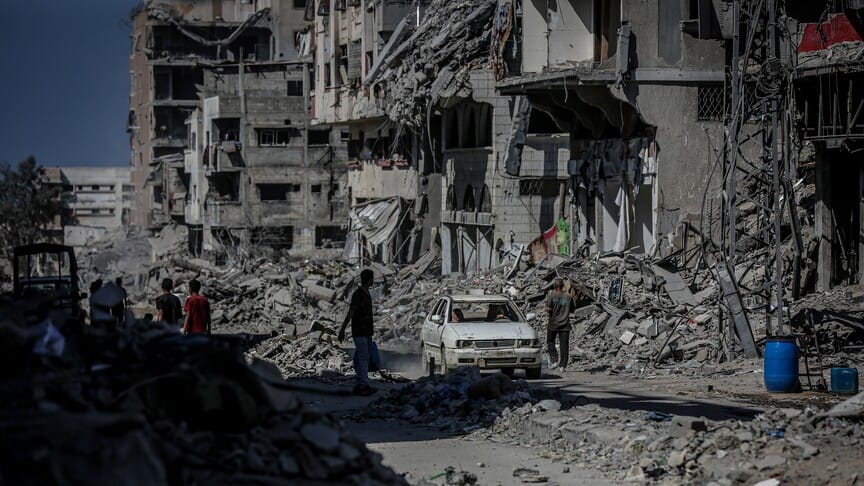
As Palestinian factions meet in Cairo to discuss Gaza’s future governance, aid groups and analysts warn that realities on the ground are moving in the opposite direction of the ceasefire framework meant to pave the way for reconstruction and recovery.
While negotiations continue, Israel has expanded its control over large parts of the enclave, strikes have continued, humanitarian access remains severely restricted and reconstruction has yet to begin, leaving Gaza’s more than 2 million residents trapped in a deep humanitarian crisis.
“The implementation of the first phase of the Gaza ceasefire has remained limited and inconsistent, particularly due to repeated airstrikes,” Riham Jafari, advocacy and communications coordinator at ActionAid Palestine, told Anadolu.
Around 1,000 people have been killed and 3,000 injured since the ceasefire began, according to Gaza Health Ministry figures.
In September, US President Donald Trump announced a 20-point plan outlining a framework, with the first phase including a ceasefire and prisoner exchange between Israel and Palestinian factions.
However, implementation of the agreement remains unfulfilled amid ongoing Israeli military operations and mounting humanitarian restrictions.
Israel deepens territorial control
While the ceasefire framework envisioned a gradual Israeli withdrawal, analysts say developments on the ground point in the opposite direction.
Under the Trump plan, Israeli forces initially withdrew to a demarcation known as the Yellow Line, leaving Israel in control of roughly 53% of Gaza’s territory. Since then, Israeli officials have acknowledged expanding their control further.
In May, Israel said it had increased its control to 60% of the Gaza Strip and Israeli Prime Minister Benjamin Netanyahu said he had instructed the military to take control of up to 70%.
Rob Geist Pinfold, a lecturer in international security at the Defence Studies Department at King’s College London, said Israeli policy has focused on maintaining long-term military control while avoiding direct responsibility for Gaza’s population.
“Israel’s plans for Gaza have been remarkably consistent: refuse any direct rule over or responsibility for the territory’s impoverished residents, take and hold as much territory within Gaza as possible whilst emptying it of residents and stop any credible external actor from rebuilding Gaza.”
According to Pinfold, Israel does not need to occupy the entire territory to achieve its objectives.
“Indeed, doing so would be counter-productive for Israel without ethnically cleansing the territory of its 2 million inhabitants, since it would find itself responsible for their welfare,” he said.
Instead, he said, Israel appears to be seeking greater strategic depth through buffer zones and allowing its military to operate freely against perceived threats. The expansion also further entrenches Israel into Gaza and makes future withdrawals less feasible, he added.
“Israel is happy to expand further into the territory, however, as a way to squeeze Hamas and keep the possibility of a comprehensive ‘voluntary migration’ – that is, in fact, not voluntary – open,” he said.
Pinfold argued that Israel has been able to act with impunity as the US focuses on other priorities, including negotiations with Iran.
Jafari said plans to place 70% of Gaza under Israeli control raise serious concerns for Palestinians confined to the remaining territory.
“Such a move would further restrict the already limited space available to civilians, many of whom have been repeatedly displaced during the ongoing conflict and are struggling to access shelter, food, water, healthcare and other essential services,” she said.
Humanitarian promises unfulfilled
Aid agencies say many commitments outlined in the ceasefire framework’s first phase have yet to be implemented.
Under the agreement, Gaza was expected to receive between 500 and 600 aid trucks daily. According to Jafari, actual deliveries have averaged between 150 and 250 trucks a day, with many carrying commercial rather than humanitarian goods.
More than 95% of Gaza’s population depends on humanitarian aid for daily food.
“Aid is being weaponized by obstructing it,” said Jafari.
Humanitarian groups say the consequences extend beyond food shortages.
Large parts of Gaza remain covered in rubble, with bodies still believed to be trapped beneath collapsed buildings. Damaged sewage systems, mounting waste and overcrowded displacement sites have contributed to growing public health concerns.
“Access to safe water is limited, and solid waste is accumulating in residential areas. This is attracting pests and rodents that contaminate food and living spaces and increase cases of illness, particularly among children,” said Jafari.
According to assessments cited by UN agencies, rodents and other pests were reported at roughly 80% of sites hosting displaced families, affecting an estimated 1.45 million people.
Reports from Gaza have shown children and others suffering from rodent bites, large infestations and a growing number of skin conditions like scabies. At the same time, hospitals have limited essential medications to treat those affected.
Despite ongoing mitigation efforts with pesticides, Jafari said that health risks remain high.
Closure of key crossings
Humanitarian organizations say access restrictions continue to hamper relief efforts.
Since May 24, Israeli authorities have kept the Zikim Crossing in northern Gaza closed, leaving Kerem Shalom as the last remaining crossing for approved cargo entering the enclave.
The Rafah crossing between Gaza and Egypt is strictly limited to pedestrian traffic.
“Furthermore, on 1 June, Israeli forces began routing humanitarian convoys through a new road, with a new checkpoint, to reach Kerem Shalom from inside Gaza,” Jafari said.
“As a result, only some of the supplies planned to be collected from Kerem Shalom could be picked up and the volumes of incoming fuel dropped.”
Israel also temporarily closed the Kerem Shalom and Rafah crossings following an Iranian missile attack on June 8 before reopening them in subsequent days.
On Wednesday, the UN said Kerem Shalom had been reopened but congestion and operational limits continued.
Reconstruction remains stalled
Despite reconstruction being a central objective of the ceasefire framework, experts say virtually no rebuilding has begun.
Former UN Special Rapporteur on the Right to Adequate Housing Balakrishnan Rajagopal said Gaza’s housing stock and civilian infrastructure remain devastated.
“Housing and civilian infrastructure has been totally destroyed and is still being destroyed, including in Gaza City a few days ago,” he said. “Estimates are that over 90% of the built environment is damaged or destroyed.”
He argued that meaningful reconstruction cannot begin until military operations cease, access restrictions are lifted and supplies can enter Gaza in significantly larger quantities.
“This is a grave situation in terms of violation of international law and a fundamental challenge to the idea of an international community based on rule of law,” Rajagopal said.