CrossFireArabia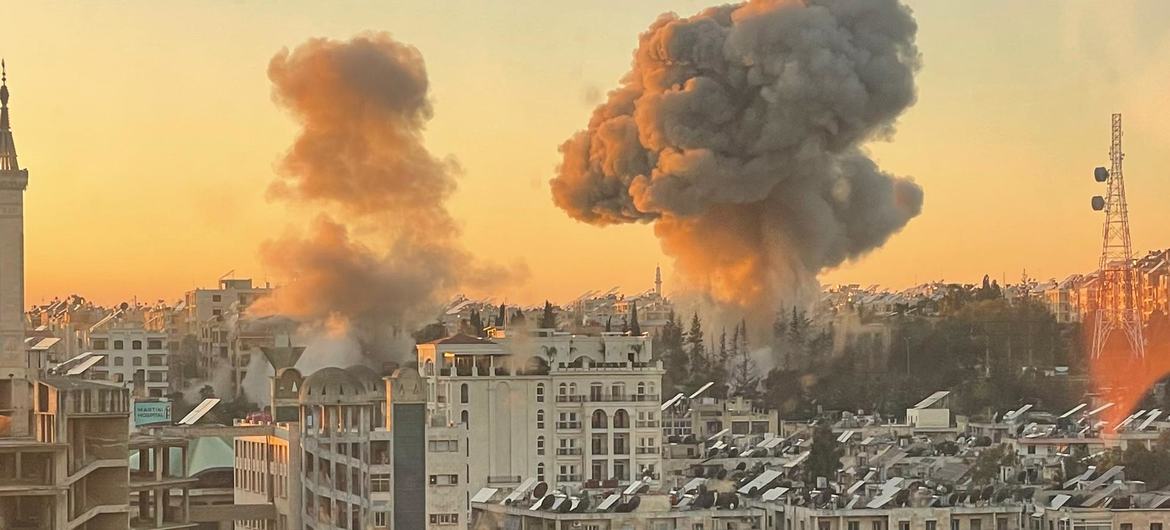
More than 280,000 people have been uprooted in northwest Syria in a matter of days following the sudden and massive offensive into Government-controlled areas led by Hayat Tahrir al-Sham (HTS), which is sanctioned by the Security Council as a terrorist group.
Aid has continued to flow from Türkiye across three border crossings into the embattled northwest and the UN World Food Programme (WFP) said that it had opened community kitchens in Aleppo and Hama – cities now reportedly occupied by HTS fighters.
In neighbouring Lebanon, meanwhile, senior UN aid official Edem Wosornu expressed deep concerns for the safety of more than 600,000 people who have begun to return to their devastated homes, after a ceasefire between Israel and Hezbollah kicked in on 27 November. “I’m sure they are settling back, the problem is what they would find when they go back home,” she told journalists in Geneva, highlighting the potential dangers from unexploded ordnance.
Syrians’ hunger misery
Speaking in Geneva after a joint UN and NGO Emergency Directors assessment mission to the Middle East from 25 November to 1 December, the UN World Food Programme (WFP’s) Samer Abdel Jaber described Syria’s new unfolding emergency as “a crisis on top of another” – a reference to the war that began in 2011, sparked by a civil uprising against the Government.
Since then, it has drawn in regional and international powers and defied the efforts of the Security Council and wider global community to bring it to an end. It’s estimated that hundreds of thousands have been killed and many more are believed to remain in the Government’s prisons.
Mr. Abdel Jaber, who heads WFP’s Emergency Coordination, Strategic Analysis and Humanitarian Diplomacy arm, warned that around 1.5 million people are likely to be displaced by this latest escalation “and will be requiring our support. Of course, the humanitarian partners are working on both sides of the front lines we’re trying to reach the communities wherever their needs are.”
The WFP official noted that the sudden escalation had not shut down three humanitarian border crossings with Türkiye and that aid continues to flow into Aleppo, Syria’s second city.
The UN agency “has opened and supported two community kitchens that are providing hot meals in both Aleppo as well as in Hama,” he said, adding that “the aid partners are on the ground and doing everything they can to basically provide the assistance to the people”.
Millions of Syrians are already in crisis because of the war which has destroyed the economy and people’s livelihoods, threatening their survival. “It’s at a breaking point at the moment in Syria, after 13 or 14 years of a conflict, over three million Syrians are severely food insecure and cannot afford enough food,” Mr. Abdel Jaber said, adding that a total of 12.9 million people in Syria needed food assistance before the latest crisis.
Despite the clear need for more support, international funding for Syria’s $4.1 billion humanitarian response plan “faces its largest shortfall ever”, the WFP official warned, with less than one-third needed for 2024 received to date.
Lebanon returnees in danger
In neighbouring Lebanon, senior UN humanitarian official Edem Wosornu, Director, Operations and Advocacy Division at the UN aid coordination office, OCHA, said that people affected by the war between Israel and Hezbollah fighters “have returned faster than they even left the conflict; more than 600,000 people have begun to go back home, and as we speak, I’m sure they are settling back. The problem is what they would find when they go back home and the need for our response to pivot very quickly.”
Among those in need today are many Syrian refugees who fled the war in their country, only to be displaced several times since their arrival, explained Isabel Gomes, Global Lead of Disaster Management at NGO World Vision International: “There was this particular girl that we spoke with; she told us the story that at the time of the conflict, when she had to move, she was pregnant, close to nine months, and she had to walk kilometres and kilometres and kilometres.
“Then she asked us if she could show us her baby, and we saw her baby was two months. But when we asked if the baby had received vaccines, she said the baby had never received vaccines.”
Returning farming communities also face deadly dangers from the fighting in southern Lebanon’s wartorn zones, OCHA’s Ms. Wosornu explained: “We also are concerned about the impact of mines and unexploded ordnance in the some of these locations.
“We are really asking our mine action colleagues and others to support the Government in demining activities because when people who want to go back home, who’ve gone back home, the farmers who are trying to salvage the rest of the olive harvest, there’s fears that this…could be impacted there.”


 marwan