Gaza and Hiroshima: The US Connection

By Maung Zarni  

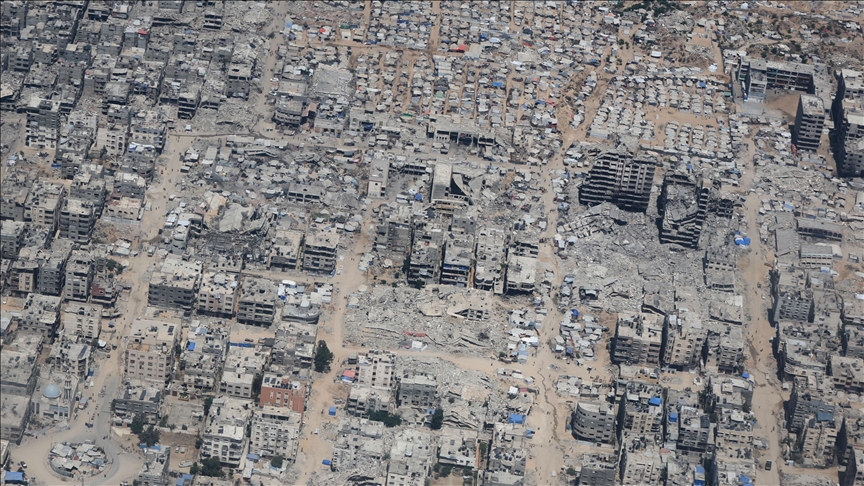
OPINION - 80 years after Hiroshima: American bombs have turned Gaza into Hiroshima 2.0An aerial view of Gaza City as the efforts to drop humanitarian aid supplies through parachute by military cargo planes into the city continues on August 6, 2025.

As evidenced from the freshly emerging videos and photos, Gaza’s physical landscape today resembles Hiroshima on the morning of Aug. 7, 1945, just as Israel’s mass killing of Palestinians of all ages is the direct, intended outcome by Israel’s planners of this “war for annihilation” of an entire Palestinian society mirrored by the near-total destruction of the physical infrastructure that sheltered the 2.3 million Palestinians at the start of the war on Oct. 8, 2023.

The vastly undercounted deaths of over 60,000 – of whom more than 16,000 were babies, and children – by the Gaza Health Ministry must be paired with the staggering number 377,000, a number presented by Dr. Yaakov Garb, professor at Ben-Gurion University of the Negev as “missing” Gazans (presumed dead and buried under dozens of tons of rubble of bombed out Gazan buildings).

Let’s also not forget that Israel had allowed Gaza to exist as its “open-air prison,” to use the term publicly uttered by retired Israeli Navy Adm. Ami Ayalon who also served as the chief of Shin Bet, or Shabek, which runs Gaza like prison guards, since 2007. That was the year when Hamas became the elected government of the 45-kilometer (28-mile) strip along the hydrocarbon-rich Mediterranean Sea, something Israel eyes with its characteristic lust for land and resources.

Chillingly, the common element here is that both Hiroshima and Gaza have been variously vaporized by American weapons.

Obviously, the estimated 80,000 tons of explosives delivered through Made-in-USA 500 and 1,000 kg bombs – all provided by bipartisan Washington – and dropped from F-35s almost daily and nightly over 660 days, could do a similar degree of physical destruction as then-US President Harry S Truman’s bombs did in Hiroshima and Nagasaki.  

Who needs atomic bombs to destroy Gaza?

Here worth noting is the fact that the American creator of history’s first-ever atomic bomb, J. Robert Oppenheimer, the German-trained professor of theoretical physics at the flagship campus of the University of California, in Berkeley, was capable of the painful and honest self-reflection that “I am become death, the destroyer of worlds.”

Alas, there is absolutely no sign of such capacity for honest soul-searching amongst the American political leaders and their foreign policy advisors: the United States continues to be the destroyer of worlds – that is, other peoples’ worlds (wholesale societies, countries, and nations), from the Korean Peninsula to Vietnam, Laos and Cambodia to throughout the Muslim Middle East of Iraq, Libya, Lebanon, Syria, Yemen, and now Gaza and all of the occupied Palestine, as well as Latin America.

In the early autumn of 2016, I visited Hiroshima with an old British friend of mine, Professor Edward Vickers, whose father is a retired Royal Air Force pilot. Ed resides in Japan with his Japanese partner and their children. I was in Kyoto for a small international seminar on comparative cases of genocidal violence, where I presented my main research theme of my own “Buddhist” country’s genocide against Rohingya people, still ongoing to date.

I decided to take a long train journey from Kyoto to Hiroshima and asked Ed to join me at Hiroshima, a place we had both wanted to go. For me, Hiroshima has long had a personal ring: the extended American family (of two sisters, both of whom did their undergraduate degrees at Oppenheimer’s university when the man was on the faculty of physics) which practically adopted me as a young foreign graduate student in Northern California was entangled in the Manhattan Project. The older sister got a job at Los Alamos National Lab where the bomb was developed, specifically as Oppenheimer’s personal secretary. As a matter of fact, her boss walked her down the aisle at a small chapel established for the thousands of project workers as she fell in love with and married a young scientist working on the project.

If it weren’t for the name Hiroshima and our historical knowledge it triggers, we would see neither the traces of the old Hiroshima nor the evidence of the first atomic bomb’s impact on the physical and natural environment.

Israel’s genocidal patron, namely the leaderships of the United States, have shown an utter and complete lack of human empathy, conscience, or regard for the post-Hiroshima, post-Holocaust international law, which they helped create.

The United States has long become death, and destroyer of the worlds, while its corporate political class continues to celebrate its power of annihilation and seeks to send the message that they will continue to destroy the world, natural and human, in order to rule over it. George Orwell got one thing wrong: war is profit (for corporate masters of our universe), not peace. For that reason alone, I am not so sure that we can be optimistic about Gaza’s reconstruction a la post-war Hiroshima, even as a Trumpian dystopian riviera on the unmarked mass graves of hundreds of thousands of Palestinians exterminated in their extended families over two or three generations.

As Rev. Dr Munther Isaac, the renowned Palestinian theologian of Shepherd’s Field, Bethlehem, said in his recent address to the Churches for the Middle East Peace Conference in Atlanta, Georgia, US, the ongoing US-Israel’s joint mass extermination campaign against his fellow people in Gaza (and the West Bank) is the clearest indication of the total collapse of the current moral order of this post-Holocaust world.

In Isaac’s words, “Never again!” is really “Yet again!” while the Zionized Imperialists have integrated elements of both Auschwitz (closed on Jan. 27, 1945) and Hiroshima (destroyed on Aug. 6, 1945) in their annihilation of Gaza, both the physical environment and residential human population. Isaac continued: “The law (now) protects the perpetrators of genocide in Gaza while punishing those who oppose (this crime against humanity.”

In passing, I will point out that even the relentless attempts to deny, defy, and erase truths about the US and Israel by the planners, executioners and supporters of the genocide in Gaza have a precedent in the way the United States as the occupying military power in Tokyo handled the atomic bomb survivors’ attempts to document and tell the factual truths about what the Americans did with it in a single morning at 8.15 am on Aug. 6, 1945.  

Fast forward to 2025

The destroyers of Gaza today see themselves as God’s chosen people with the divine right to perpetrate a Holocaust of their own against the largely Muslim population of Palestine, whose land they have stolen to build “the Jewish national homeland,” under the imperial patronage of first Britain and now the US. There are daily crimes against humanity, war crimes and genocide in Gaza by US and Israel over 660 mornings – and still counting.

So expect these two states to become even more shrill and extreme as they struggle to exterminate factual truths about their victim-livestreamed crimes against Palestinians, specifically, the bogus “antisemitism” laws as defined by the International Holocaust Remembrance Alliance (IHRA) run by the Jewish Supremacist or Jewish Exceptionalist working for the genocidal state of Israel.  

*The author is co-founder of the Forces of Renewal Southeast Asia and a Myanmar genocide scholar and a UK-exiled Myanmar dissident. His Opinions do not necessarily reflect Anadolu’s editorial policy.

CrossFireArabia

CrossFireArabia
Dr. Marwan Asmar holds a PhD from Leeds University and is a freelance writer specializing on the Middle East. He has worked as a journalist since the early 1990s in Jordan and the Gulf countries, and been widely published, including at Albawaba, Gulf News, Al Ghad, World Press Review and others.

Related Posts

Iran is Writing The Final Chapter!

By Ziyad Farhan Al-Majali

In major wars, results are not always measured by the ‘noise volume’, number of airstrikes, or the extent of the military maps displayed on TV screens. Sometimes the noise is louder than the decisive action, and the roar is stronger than the ability to end the battle.

From this perspective, the Israeli-American war on Iran can be read as a tumultuous moment in the history of regional conflict. Here however, it was not the final moment which Israel desired and was looking for.

Tel Aviv wanted to present the war as its declaration of its superiority, one that would be final. It wanted to say that its reach could penetrate deep inside Iran, that the old balance of deterrence was broken, and that the aftermath of the strike would not be the same as it was before.

Therefore, Israel’s “lion roar” was to be loud from the very beginning: Threatening rhetoric, painful strikes, psychological warfare — a clear attempt to portray Iran as a state exposed to Israeli and American power.

But the roar by itself, however loud it boomed, was not enough to bring about a political end. True, Iran suffered heavy blows, with sensitive facilities, infrastructure and sites sustained significant damage, finding itself facing a broad economic, military, and psychological siege and pressure.

Yet, despite all this, the war did not topple the Iranian government, nor did it remove the state from the regional equation, nor did it end its nuclear program as a negotiating issue, nor did it break its deterrent and maneuvering capabilities.

Herein lies the central paradox of this war. Israel raised the stakes to their highest points, but it did not achieve a decisive victory. Israel sought to eliminate the so-called Iranian threat with a single strike or a series of blows, only to discover that Iran is not a military site that can be wiped off the map, nor a single facility whose destruction would end the conflict.

Rather, it is a deep-rooted, expansive state with multiple levers of pressure: From the Strait of Hormuz to Lebanon, from missiles to air corridors, from allies to the capacity for long-term patience. Iran is a tough nut!

Perhaps the most dangerous revelation of the war is that it did not produce a definitive answer, but rather raised even greater questions. Can military force alone reshape Iran? Can bombing impose a stable political settlement? Will weakening Tehran lead to its expulsion from the region, or will it push it to rebuild its influence more cautiously and covertly? Was the war the beginning of the end, or the start of a new phase of a postponed conflict?

Iran emerged from the war wounded, but it didn’t exit the negotiating table. It appeared battered, but it did not collapse. Maybe besieged but it is still holding cards. Whilst today Iran might be in a predicament, but it has not lost its ability to negotiate, to threaten, and wait for the next move.

This is precisely is what is making the outcome far more complex than what Israel has tried to portray: The war may have succeeded in inflicting pain on Iran, but it did not  eliminating the Iranian state and its apparatus.

While Israel may have achieved a significant show of force, it did not achieve an outright and decisive victory. The decisive outcome it sought remained incomplete, and the deterrence it aimed to restore remained contingent on what would follow after the war: Would Iran back down? Would it retaliate? Would it accept American terms? Would it open the Strait of Hormuz according to Washington’s wishes? And would the Lebanese front be detached from Tehran’s calculations, or would it remain part of the long-term equation of retaliation?

Therefore, the war does not appear to be the end of the conflict with Iran, but rather a new chapter in a broader, protracted struggle. In this chapter, Israel raised its voice to the maximum, but it could not write the final chapter. States do not fall through mere bluster, regional projects do not end with a single blow, and conflicts that have accumulated over decades are not resolved in days, no matter how intense the fighting is.

In short, Israel’s “roar” was loud, perhaps painful, and perhaps unprecedented in some aspects, but it was not enough to topple Iran or remove it from the scene. The din of war has risen, the region has been shaken, and calculations have shifted, but Iran remains on the precipice, not outside history.

Therefore, the most accurate description of this phase is not a complete Israeli victory, nor an Iranian resistance without cost, but rather a war whose end is not yet in sight: A war in which Israel roared loudly, but was not able to bring down Iran.

This article was reproduced from the Jo24 Arabic website in Jordan and appears in the www.crossfirearabia.com.

Continue reading
Gaza Fishermen Dream of Life Prior to 7 Oct

CROSSFIREARABIA – The fishing industry, once a pillar of the Gaza economy, now stands in total devastation due to Israel’s continuing war on the 364-kilometer Strip that doesn’t seem to stop despite the fact that a ceasefire was signed on 10 October, 2025.

Zakaria Bakr, General-Secretary of the General Union of Workers in Fishing and Marine Production affirmed that the Gaza fishing sector — which for decades has been a primary source of income for thousands of families and a key pillar of food security — is now in ruins because of the more than two and a half years of Israeli bombing on the Gaza Strip, including on its beaches and coastal areas. Its a narrative of devastation. 

Bakr said the systematic targeting of the fishing industry by Israeli occupation forces has lead to its near-total collapse.

Speaking to Quds Press, Bakr said that this targeting has included an almost complete ban on fishermen and preventing them from going a few hundred meters after the shoreline; a situation  made with vehemence soon after 7 October, 2023 when Israel launched a destructive war on the Strip and with no let up.  

Bakr added that lethal force started to be used against fishermen not to step even meters into the Gaza blue shorelines.  They still take the risk because of the miserable economic situation they have been reduced to. But this has proved costly for more than 230 of them have been shot dead at point  blank range.

The union chief says hundreds have been arrested as well, explaining the fishing sector has been subjected to mass destruction affecting up to 95 percent of its infrastructure, with fishing boats ruined and warehouses struck either by Israeli gunboats and/or missiles from the air.

UN figures as well testify to this fact, stating the fishing infrastructure include ice factories, storage facilities, maintenance workshops and wholesale fish markets which have been destroyed over the past two-and-a-half years of slaughter.

This has led to the near-total collapse of the fishing industry, depriving thousands of families of their only source of income. Today, it’s a stark contrast. Prior to October 2023, there were 4200 registered fishermen with 6000 support workers on the boats and the fishing sector sustained around 100,000 people in Gaza but no more.

The destruction of the sector has created an additional food security crisis. Before October 2023, the fish total annual tonnage production stood at 5,410 according to the UN Food and Agriculture Organization. Today, its less than 7.3 percent.

It is indeed a hard life for fishermen.  Before October 2023 Gaza fishermen used to catch between them, 15,000 to 20,000 kilos, daily. Now, it is down to a trickle with UN feeds reporting a mere 2 to 5 kilograms of fish daily, and I dare say, if they can pass the Israeli gunboats and snipers who are waiting near the coast.

Bakr added that what Gaza’s fishermen are going through from the Israeli gunboat harassment is a blatant violation of the Universal Declaration of Human Rights, particularly the rights to work, life, and dignified living. It directly contradicts the core principles established by the International Labour Organization regarding safe working conditions and the protection of workers, he pointed out.

Bakr said despite the hopelessness of the sector, his union continues to be active, recently sending letters to several international organizations to present them with the grim reality facing the fishing sector in Gaza. These organizations included the United Nations, the International Labour Organization, the UN Food and Agriculture Organization (FAO), International Committee of the Red Cross, as well as other international and human rights institutions.

 “We informed these institutions, on behalf of the fishermen of the Gaza Strip, of the scale of the catastrophe facing this labor-intensive sector, which represents one of the oldest and most important economic, social, and cultural components of Palestinian life and society, and which today, is facing one of the harshest humanitarian and professional crises of modern times,” he added.

He noted that the union has called on international institutions to take a number of urgent measures, most notably providing immediate international protection for fishermen while working at sea, pressuring for the lifting of restrictions on access to fishing areas in a safe and unrestricted manner, and halting all forms of targeting against fishermen and their equipment.

He also called for support in rehabilitating the fishing sector, including boats and related infrastructure, providing urgent assistance programs for affected families, and dispatching fact-finding missions to document violations against fishermen and issue official reports on them.

Bakr stressed that what Gaza’s fishermen are enduring today represents “a stain on the conscience of the international community,” which remains powerless in the face of depriving civilian workers of their most basic rights to work and life.

He called on international institutions to assume their legal and humanitarian responsibilities and to take urgent action to put an end to this tragedy, ensuring that Gaza’s fishermen can safely return to the sea and restore their legitimate right to work and live with dignity.

A once proud fishing industry, today, it is not, thanks to the Israeli bombardment that topped over 100,000 tons of explosives and dynamite. Fishermen and their families will never forgive the hateful and vengeful Israelis who today reduced their sector to 50 small boats for the entire 40-kilometer coastline that stretches from Rafah in the south to Israel in the north.  

The Gaza fishing industry once used to have 2000 fishing vessels with more than a 1000 motorized boats and 900 rowboats generating $10-15 million to Gaza’s local economy, 3 percent of the entire Palestinian GDP.

“All my money is gone. Out of my big 17-meter boat and 10 smaller boats, nothing remains but metal sticking out of the water. The sea was an integral part of the Gazan economy; fishermen would feed their families with their catch and could make a good living. Now, everything is in ruins,” says Jamal Al Moodi, a once proud Gaza fisherman.

Dr Asmar is a writer based in Amman and is the editor of www.crossfirearabia.com

Continue reading

You Missed

Israeli Violates The ‘Gaza Ceasefire’ 10 Times

Israeli Violates The ‘Gaza Ceasefire’ 10 Times

Price of Israel’s War in Lebanon

Price of Israel’s War in Lebanon

Gaza’s Dead Mounts Despite Ceasefire

Gaza’s Dead Mounts Despite Ceasefire

In The Grip of Starvation: Israel Will Not Let Gaza Rest!

In The Grip of Starvation: Israel Will Not Let Gaza Rest!

Trump to Netanyahu: ‘You’re crazy. If it weren’t for me, you’d be in jail’ – Axios

Trump to Netanyahu: ‘You’re crazy. If it weren’t for me, you’d be in jail’ – Axios

Israeli Capitan Killed, 7 Soldiers Injured in Lebanon

Israeli Capitan Killed, 7 Soldiers Injured in Lebanon





