Volunteers Collect Stones From Destroyed Mosque To Rebuild it in The Future
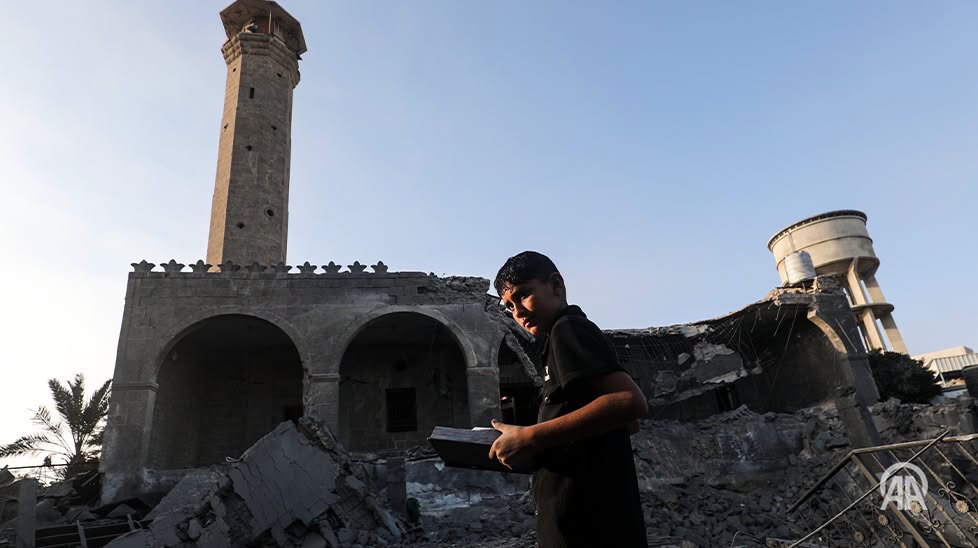
Piece by piece, volunteers in the central Gaza Strip are retrieving stones and historic marble columns from the rubble of the Abu Salim Mosque, preserving what survived an Israeli strike in hopes that it can one day help restore the landmark.
The mosque in Deir al-Balah was struck on Aug. 24, causing extensive damage to the courtyard and part of its main structure.
Days later, volunteers from the Guardians of Heritage team began clearing debris from the mosque and its surroundings, collecting scattered stones and marble columns and moving them to a safe location, an Anadolu correspondent at the scene reported. The Guardians of Heritage is a volunteer group clearing rubble and recovering damaged books from the historic mosque.
The campaign was organized by the Mayasir Association for Culture and Arts, in cooperation with the heritage team, with the recovered pieces set aside for possible reuse in future restoration work.
Saving what survived
Mayor Khalil Abu Samra told Anadolu that the Abu Salim Mosque was built in 1951 at the expense of Hajj Mohammed Abu Salim and designed in an Ottoman architectural style.
“We preserved this mosque for many years,” Abu Samra said, voicing hope that the landmark would be restored “by the hands of the Guardians of Heritage and the Guardians of the Homeland” and return to its former appearance.
Shaimaa al-Natour, coordinator of the Guardians of Heritage campaign, said the team moved to the mosque shortly after it was struck to begin what she described as “preventive conservation measures.”
The first phase focuses on recovering scattered stones and historic marble columns and storing them safely, she said, with later stages expected to focus on restoring the mosque.
Al-Natour said the initiative forms part of broader efforts to protect Gaza’s archaeological and cultural heritage despite extensive damage to historic sites during the Israeli war.
Landmark struck before
Built on elevated ground in Deir al-Balah known locally as Al-Hadba Al-Qibliya, the mosque is one of the city’s prominent religious and architectural landmarks.
It underwent restoration in 2010 that preserved many of its original architectural features.
Israeli shelling also struck the upper section of the minaret in 2014 and damaged its facade, which was later restored in cooperation with the Riwaq Center for Architectural Conservation and the Iwan Center for Heritage Architecture.
The Aug. 24 Israeli strike caused far more extensive damage, with Anadolu footage showing widespread destruction inside and around the mosque.
The damage comes amid a much broader toll on Gaza’s places of worship.
Israel has destroyed 1,050 mosques and partially damaged 191 since the war began, out of 1,275 mosques that stood in the enclave before the war, according to Gaza’s Ministry of Endowments.
As many as 1,313 Palestinians have been killed and 4,361 injured in Israeli violations since a ceasefire was signed last October, according to Gaza’s Health Ministry. Overall, Israel’s war on Gaza since October 2023 has killed at least 73,449 people and injured 174,472. Anadolu

 CrossFireArabia

 marwan