CrossFireArabia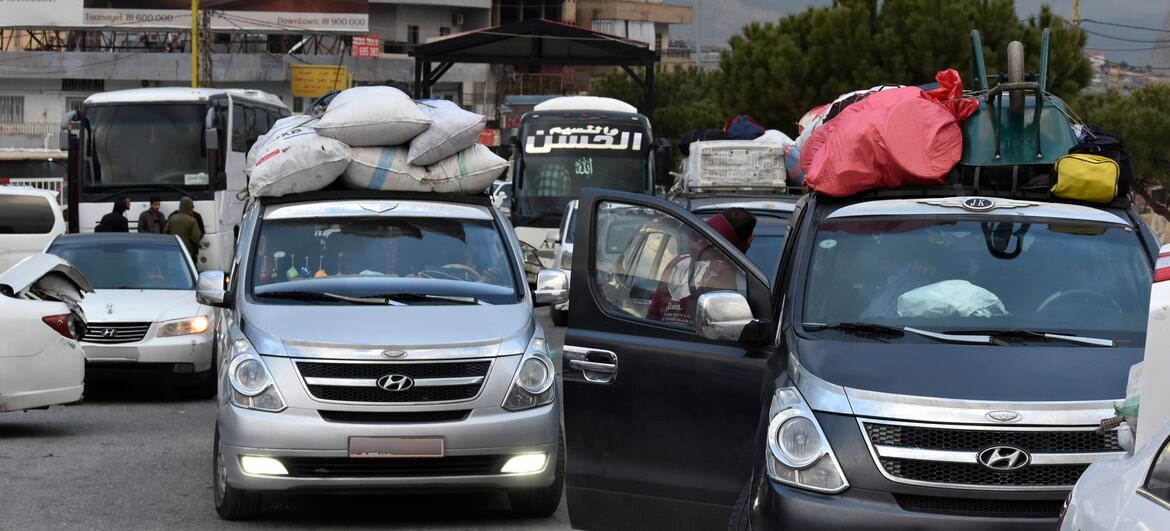
On day 10 of the war engulfing the Middle East, UN agencies on Monday reported massive displacement across the region, along with surging food and fuel prices that risk increasing hunger and suffering for the most vulnerable.
In Lebanon alone, nearly 700,000 people including around 200,000 children have been forced from their homes, “adding to the tens of thousands already uprooted from previous escalations”, the UN Children’s Fund (UNICEF) said.
The development follows a weekend of escalating Israeli and U.S. strikes against Iran, counter-strikes by Iranian forces across Israel and explosions in several Gulf States, along with Israeli strikes targeting Hezbollah in Lebanon.
Heavy toll
In its latest update, the UN relief coordination office, OCHA, said that 294 people had been killed in Lebanon and more than 1,000 injured in the first eight days of the war.
On Saturday, 7 March, 41 people were killed in a single operation by Israeli forces in the town of Nabi Sheet in eastern Lebanon that also left dozens wounded, OCHA said, citing the Lebanese authorities.
In addition to “intensified airstrikes across multiple governorates” of Lebanon, the office also noted that Israeli evacuation orders had been reissued for a third time since the war began, covering the entire areas south of the Litani River, and the second time for Beirut’s southern suburbs.
Civilian toll mounts
Over the weekend, the Israeli health authorities reported that around 2,000 people have been injured in Israel since the conflict erupted on Saturday 28 February; one person was also killed when a missile landed in central Israel on Monday.
Iranian authorities have said that at least 1,330 civilians had been killed in the war amid ongoing Israeli and US strikes, while on Monday, the Bahraini authorities said that more than 30 people had been injured by an Iranian drone attack early Monday, as Qatari officials condemned the killing of two civilians in Saudi Arabia.
Ever greater needs
Echoing the deep concerns across the international community at the impact of the ongoing war on civilians, the UN’s top aid official, Tom Fletcher, warned of wider, secondary impacts in countries including Afghanistan and Pakistan “where needs were already great”.
Added to that, the focus on existing crises such as Sudan, South Sudan and Ukraine is slipping “even further down the list”, the emergency relief chief noted, along with continued disregard for international law and institutions including the UN that were created to prevent conflict.
Strait of Hormuz crisis
As rapidly rising fuel prices at the pump on Monday linked to higher oil barrel costs reflected deep economic uncertainty caused by the war, UN agencies also highlighted “severe global supply chain disruptions” affecting shipping, energy and fertilizer markets.
Attacks on shipping in the Strait of Hormuz have practically halted trade along the narrow channel, which carries nearly one-fifth of global oil shipments, along with large volumes of commercial goods.
On Friday, at least four seafarers were killed and three severely injured in the Strait of Hormuz when their vessel was attacked.
Meanwhile, drone attacks on Omani ports have also raised concerns – and costs – of chartered traffic heading there.
According to the International Maritime Organization (IMO), around 20,000 seafarers remained stranded in the Persian Gulf.
“The conflict is already having immediate food security impacts in the Middle East,” said the UN World Food Programme (WFP), which explained that a significant share of the global fertilizer supply transits through the Strait of Hormuz.
“Any disruption there risks reduced availability, lower crop yields, and hence higher global food prices,” it said.

© NASA
A satellite photo shows the strategically important shipping route of the Strait of Hormuz.
Food security concerns
The UN agency also underscored already high levels of food insecurity in Lebanon before the war, as well as Iran, where households have “limited capacity to absorb further shocks”.
In Gaza, sharp food price increases were triggered by the closure of key aid crossing points from Israel, WFP continued, adding that although Kerem Shalom/ Karem Abu Salem crossing has since reopened, food prices remain high.
“Without consistent access, WFP could be forced to reduce food rations to just 25 percent of daily requirements for approximately 1.3 million people. Fragile gains achieved following the ceasefire risk being reversed without reliable humanitarian corridors,” it said.
Faced with longer transit times and knock-on delays to humanitarian deliveries, the UN agency and partners have increasingly used suppliers and transit corridors through Türkiye, Egypt, Jordan and Pakistan, while making greater use of overland routes between the United Arab Emirates and the eastern Mediterranean coastal region.
WFP also noted that its Dubai humanitarian hub remains operational despite disruption to flights and shipping.


 marwan