CrossFireArabia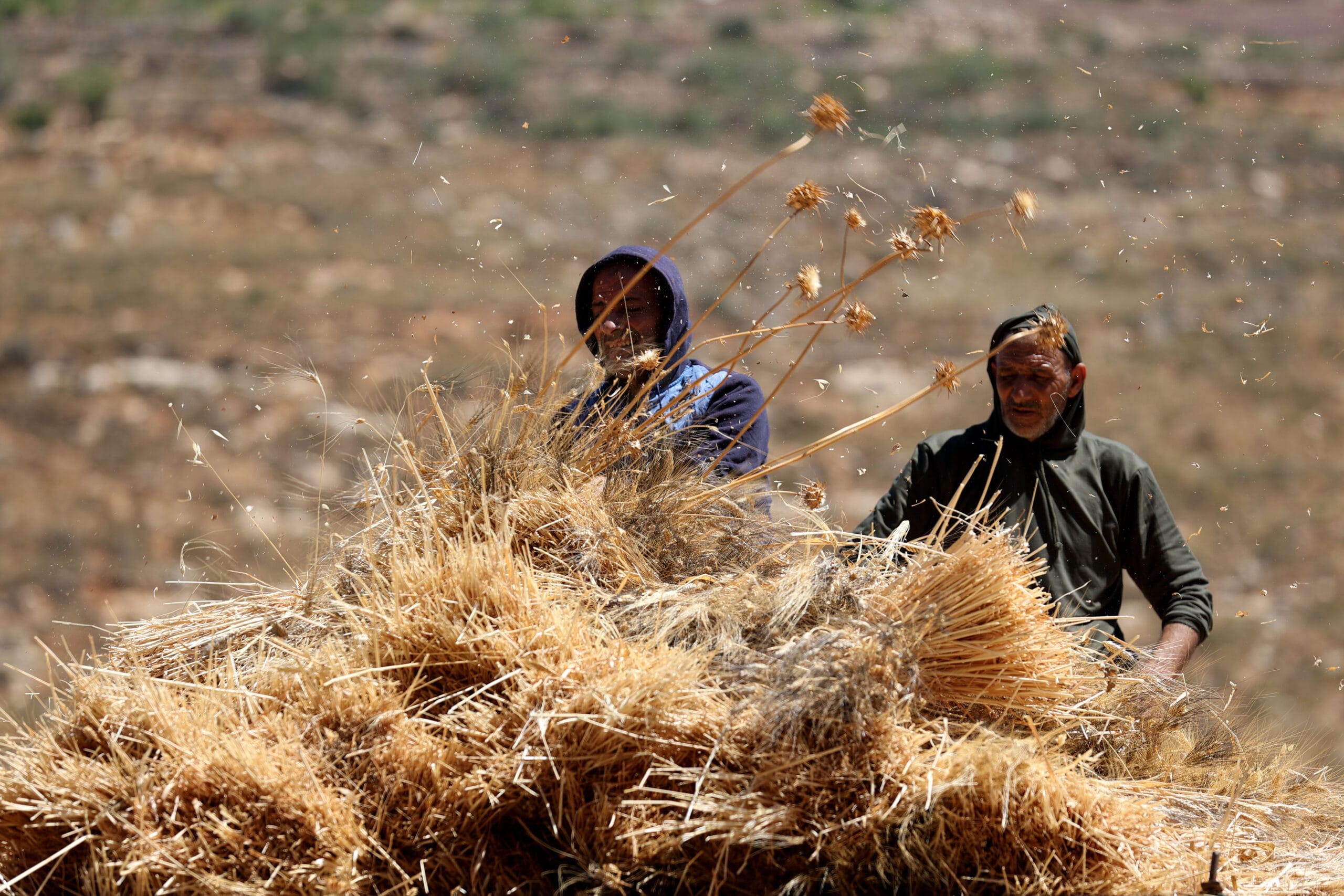
SINJIL, OCCUPIED WEST BANK – In the eastern plain of Sinjil, north Ramallah in the occupied West Bank, dozens of Palestinians are working quickly among the yellow wheat stalks, harvesting their crop this year.
This year’s harvest season is anything but ordinary; it’s a race against time, as farmers fear Israeli settlers will seize their crops by burning or destroying them. This comes amidst a surge in settler attacks on Palestinian farmers and their land.
Residents say they were forced to harvest their wheat and transport it quickly from the fields to the town after repeated attacks by settlers who attempted to burn the crops
and prevent landowners from accessing their land.
The town of Sinjil and its surrounding lands are subjected to frequent attacks by settlers seeking to seize as much land as possible. According to the Sinjil Municipality data, the town has lost approximately 8,000 dunams (a dunam is equal to 1,000 square meters) of its 16,000 dunams.
The town is surrounded by settlement outposts and a barbed wire wall that isolates it from its surroundings. All but one of its entrances are closed, allowing residents to move freely.
Our presence protects our land
Ayed Ghafri, an activist against settlement expansion, said that farmers are working under exceptional circumstances in the eastern plain of Sinjil, a vital area upon which residents depend for cultivating wheat and seasonal crops.
Ghafri told Anadolu Agency: “We are here today in the eastern plain of Sinjil, a vital and strategic area for farmers. We rely on this land for cultivating wheat and seasonal crops.”
He added: “But Palestinian farmers are constantly under threat. Some crops have been vandalized and destroyed, and there have been attempts to burn the wheat more than once.”
He continued: “Recently, farmers tried to work their land, but settlers attacked them and prevented them from doing so.”
He added: “Therefore, we are here today to support the farmers and save the wheat crop, because we believe that leaving it in the ground means it will be subjected to further attacks and the destruction of a large portion of it.”
“Being on the land is the only way to preserve it, and that’s why we are committed to maintaining a continuous presence to affirm its Palestinian identity and protect it,” Ghafri emphasized.
Farmers: “Resilience at an Extra Cost”
Farmers in the area cultivate hundreds of dunams of wheat, but this year’s harvest is taking place amidst growing fears of settler attacks.
Farmer Ashraf Alwan said that about 300 dunams are planted with wheat in the area.
He added: “We came last week to harvest the wheat, but settlers, under the protection of the occupation forces, attacked us and forced us to leave. If it weren’t for the support of the townspeople, we wouldn’t have been able to complete the work.”
He continued: “Today we returned to finish the harvest, but we had to completely change our methods. Under normal circumstances, we would have gathered and threshed the wheat in the field.”
He further explained: “But now we are forced to bring tractors and trucks to transport it to the town center for fear that the settlers will burn or steal it.”
Alwan pointed out that these measures have significantly increased costs for farmers, adding: “The harvest barely covers a small portion of the costs of plowing, planting, harvesting, and threshing, but we are here because it’s no longer a matter of profit and loss, but rather a matter of resilience and holding onto our land.”
He emphasized that “the farmers will not abandon their land despite the attacks, and they will continue to work it and remain on it.”
Farmer Mustafa Shabaneh said that he came with a number of residents to move the wheat from the fields for fear it would be stolen or burned.
He added: “I own seven dunams planted with wheat, and the settlers have tried to burn the crop more than once. On one occasion, they set fire to the area, but the young men of the town intervened and managed to drive them away.”
He continued: “We kept watch over the area, fearing the settlers would reach the crop, but they returned at night with a bulldozer and cleared a path to the farmland. Therefore, we decided to move the wheat from here as quickly as possible to prevent it from being stolen or destroyed.”
In a neighboring field, farmer Ali Bashir anxiously oversaw the harvest.
“Farmers can no longer work normally in this area,” he said. “Even shepherds are afraid to reach their grazing lands because of settler attacks.”
“If settlers come, they might attack you, steal your sheep, or prevent you from accessing your land. People here fear for their crops because there are precedents of crops being burned and farmers being targeted.”
Bashir continued: “We’re supposed to thresh the wheat here in the field, but we transport it hastily because of the fear. This process costs us extra for transportation, harvesting, and threshing, but we have to do it to preserve the harvest.”
He concluded: “What’s happening isn’t just targeting the wheat crop; it’s an attempt to force Palestinians to leave their land so it can be seized. That’s why farmers are clinging to their land and working it despite all the difficulties.”
Accusations of “Ethnic Cleansing”
On June 10, Amnesty International accused Israel of leading and sponsoring a campaign of ethnic cleansing against Palestinians in the West Bank, asserting that arming thousands of settlers has contributed to the escalation of these attacks.
The organization stated that “the Israeli government is implementing the religious-nationalist agenda of the settlement movement and has accelerated the pace of settlement expansion and land confiscation.”
Israel has increased its financial and logistical support for the settlements and supplied the settlers with weapons.
Scattered areas of the West Bank have witnessed a marked escalation in settler attacks, coinciding with the ongoing Israeli military operations that began on October 7, 2023.
Since that date, the Israeli escalation in the West Bank, including East Jerusalem, has resulted in the deaths of more than 1,170 Palestinians and injuries to approximately 12,666 others, in addition to the arrest of around 23,000 people and the displacement of approximately 33,000.
This article was written in Arabic by Qais and Darwesh Omar for Anadolu