Starvation Centers, Death Traps

The deaths of 21 Palestinian civilians by suffocation, crowd crush, and live fire from US security forces operating in coordination with the Israeli army at an aid distribution centre in Rafah expose the Gaza Humanitarian Foundation (GHF) as an active instrument of the systematic mass killing and starvation policies imposed on Gaza.

These centres are no longer relief sites but death traps, deliberately used to lure starving crowds in scenes marked by humiliation and genocide, which constitutes a grave violation of international law and requires the immediate suspension of GHF’s operations, an urgent investigation, and full criminal accountability.

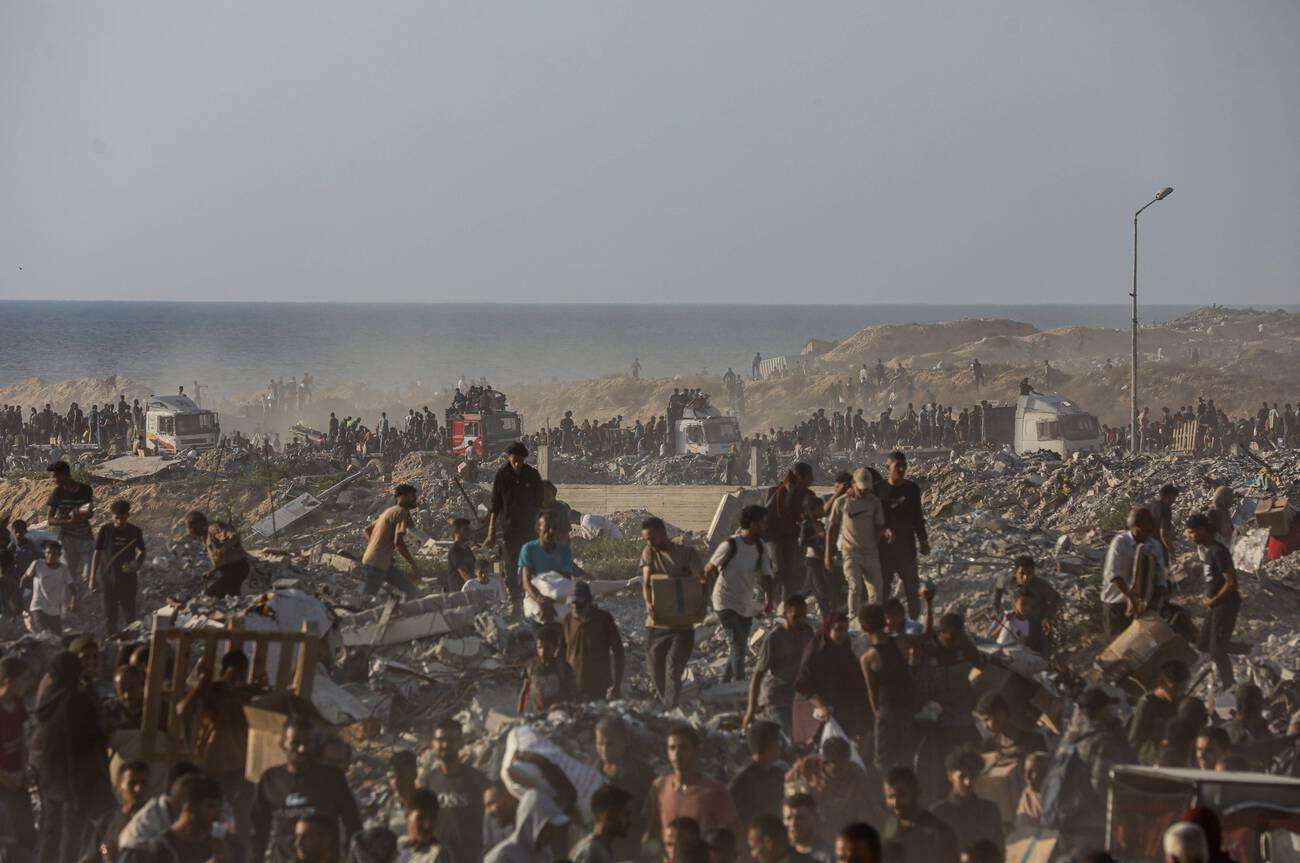
Documentation by Euro-Med Monitor’s field team revealed that the attack on Wednesday, 16 July 2025, occurred in two phases. The first happened around 4:00 a.m., when Israeli forces opened fire on thousands of civilians gathered on al-Tina Street, north of Rafah, as food aid trucks were being unloaded, resulting in multiple deaths and injuries. Despite the gunfire and casualties, thousands remained. They had no choice but to wait or starve, especially after a GHF worker told them distribution would begin at 6:00 a.m.

    Those who fell to the ground could not get up and were trampled. I saw women and children among the victims, and we only managed to escape by stepping over the dead bodies lying there   

Abdul Rahman B., one of the survivors

The second phase happened at 6:20 a.m., when crowds surged toward the outer gate of the distribution centre amid severe overcrowding and the closure of the inner gate. This led to a deadly crowd crush, with no safety measures or immediate intervention to prevent or contain the disaster.

Instead of organising the crowds and ensuring their safety, US special forces used pepper spray and fired sound bombs and tear gas at civilians trapped between the outer and inner gates, triggering panic and chaos. Thousands tried to escape, while some attempted to jump into the distribution centre to avoid overcrowding and certain death, only to be met with live fire as well.

The open fire and the resulting violent crowd crush caused the deaths of at least 21 Palestinians, including seven killed by live ammunition and 15 from tear gas inhalation and the crush, according to the Ministry of Health in Gaza.

A review by Euro-Med Monitor of several casualties found no signs of bullet wounds, supporting the conclusion that most victims died from suffocation or being trampled in a closed, overcrowded space with no protective measures in place.

Abdul Rahman B., one of the survivors, told Euro-Med Monitor’s team: “At around 6:15 a.m., a quadcopter arrived and announced that the distribution centre had been opened and required that we head to the gates.”

“People rushed frantically toward the entrances, and when we reached the front gate, we found the inner gate closed and a heavy presence of US forces accompanied by employees speaking Arabic,” said Abdul Rahman. “They asked us to step back 50 metres and enter in groups of no more than 100, but the crowding was so intense that stepping back was impossible.”

He continued: “Minutes later, they began firing sound bombs, followed by tear gas and pepper spray. People were disoriented and suffocating. Some tried to climb the fences to escape, but snipers shot them. Those who fell to the ground could not get up and were trampled. I saw women and children among the victims, and we only managed to escape by stepping over the dead bodies lying there.”

This incident demonstrates that aid distribution centres were deliberately placed in dangerous locations, designed with narrow paths enclosed by barbed-wire fences that can be easily sealed. These routes cannot accommodate the vast numbers of people in need and are fully controlled by the Israeli army, making them resemble elaborate traps for killing and humiliation rather than corridors for humanitarian aid.

GHF, established by Israel to manage its starvation policy, issued a brief statement claiming to have opened an investigation into the incident. This follows a familiar propaganda pattern: whenever starving civilians are killed, an internal investigation is announced, its results are never released, no one is held accountable, and the same crime is repeated without consequence.

An investigation by an organisation established within a framework designed to perpetuate starvation can hardly be considered credible. Given its direct role in managing starvation, GHF must be immediately dismantled and its mandate withdrawn. It operates under the guise of humanitarian work, failing as a neutral intermediary for aid delivery.

GHF functions as a field instrument of blockade, starvation, and killing by operating distribution centres designed to humiliate civilians and gather them in tightly controlled locations under the pretext of “organising” crowds. Rather than protecting those in need, it facilitates the implementation of engineered starvation and creates a closed environment where civilians are killed in the name of humanitarian aid.

Even when a threat is alleged, international law requires security forces to apply force in a proportionate and graduated manner, using lethal force only as a last resort and in response to an imminent and real threat to life. This standard was not met in the documented cases, making the killings a grave and flagrant violation of international law.

The deliberate targeting of Palestinian civilians as they seek food, along with the use of starvation as a weapon, is a clear violation of international humanitarian and criminal law. These acts constitute war crimes under the Rome Statute, including wilful killing, targeting civilians, and using starvation as a method of warfare, all of which are strictly prohibited in armed conflicts.

The widespread and systematic nature of these violations against the civilian population fulfils the elements of crimes against humanity, particularly killing, persecution, and inhumane acts causing severe suffering or serious physical or mental harm, when committed as part of a systematic attack targeting civilians.

Placing these crimes in their broader context, including the systematic destruction of means of survival, the denial of aid access, and the imposition of deadly living conditions on the civilian population, along with public incitement by Israeli political and military figures, reveals a clear and deliberate intent to destroy the Palestinian population in the Gaza Strip. According to Article II of the Genocide Convention, these acts constitute genocide, specifically through the intentional killing of members of the group and the imposition of living conditions calculated to bring about its physical destruction, in whole or in part.

The international community and complicit governments bear responsibility for the continued crimes against starving civilians at GHF-run aid distribution centres in the Gaza Strip. An immediate halt to GHF operations is essential, along with the launch of an independent international investigation leading to the prosecution of its officials before international and national courts for their involvement in systematic mass killings at distribution sites imposed by the Israeli army as a replacement for the UN mechanism that had operated in the enclave for nearly a year and a half.

International and national judicial bodies must move to hold US President Donald Trump criminally accountable for his complicity in the genocide in the Gaza Strip. This includes his adoption and direct support of the Israeli aid distribution mechanism, imposed by force and transformed into arenas of mass slaughter against starving civilians, as well as his administration’s full-scale provision of military, financial, political, and diplomatic backing that enabled Israel to commit and expand the crime for over 21 months.

The United States, through this organisation and other instruments, continues to provide political, logistical, financial, and military cover for Israel’s crimes, rendering current and former American officials, foremost among them President Donald Trump, subject to international criminal accountability.

Euro-Med Monitor calls for holding all state leaders involved in the genocide committed in the Gaza Strip accountable, whether through direct or indirect participation, by providing political, military, or financial support, or by facilitating its commission in any form. Such acts constitute criminal complicity under Article 25 of the Rome Statute. It holds states that failed to take serious measures to prevent or stop the crime legally responsible under their international obligations, particularly under the Genocide Convention.

A comprehensive and independent international investigation must be launched into the role of the Gaza Humanitarian Foundation in facilitating and executing serious crimes committed against Palestinian civilians. These investigations should address the individual responsibility of the organisation’s founders, directors, logistics coordinators, team leaders, and any other staff members, whether through planning, facilitating, directly contributing, or knowingly failing to prevent the commission of crimes.

We urge all states with territorial or universal jurisdiction to open immediate criminal investigations against all individuals affiliated with the GHF and its contracted private security firms, in order to hold them accountable for their role in crimes committed against Palestinians in the Gaza Strip, particularly including wilful killings, starvation, and cruel or degrading treatment.

All states, both individually and collectively, must fulfil their legal responsibilities by taking urgent action to stop the genocide in the Gaza Strip, through implementing effective measures to protect Palestinian civilians; ensuring Israel’s compliance with international law and the decisions of the International Court of Justice; preventing the implementation of the US-Israeli forced displacement plan; and holding Israel and its more powerful allies accountable for all crimes against the Palestinians in the Strip. The International Criminal Court must implement the arrest warrants for the Israeli Prime Minister and Minister of Defence at the earliest opportunity, in accordance with the principle that there is no immunity for international crimes.

The international community must also impose economic, diplomatic, and military sanctions on Israel for its systematic and grave violations of international law. These sanctions should include an arms embargo; an end to all political, financial, and military support; freezing the assets of officials involved in crimes against Palestinians; imposing travel ban on these officials; suspending the operations of Israeli military and security industries companies in international markets; banning involved companies’ access to banking services; and suspending trade privileges and bilateral agreements that provide Israel with economic benefits that enable its continued crimes.

CrossFireArabia

CrossFireArabia
Dr. Marwan Asmar holds a PhD from Leeds University and is a freelance writer specializing on the Middle East. He has worked as a journalist since the early 1990s in Jordan and the Gulf countries, and been widely published, including at Albawaba, Gulf News, Al Ghad, World Press Review and others.

Related Posts

Israel Killed Raghad on The Way to School

17-year-old Raghad Hussein Ashour left her home, Monday morning, carrying her books and dreams, heading to an educational center in the Rimal neighborhood of Gaza City. She was preparing for her secondary school exams and clinging to her right to education despite the war, displacement, and destruction that has affected schools and all aspects of life in the Gaza Strip.

But her path to knowledge was cut short. Raghad was killed in an Israeli airstrike that targeted a vehicle in the Rimal neighborhood as she was passing near the site of the attack on her way to the educational center. Her academic dreams turned into a new tragedy reflecting the reality for thousands of students in Gaza.

According to her mother, Raghad was an outstanding student and one of the top performers in her studies. She refused to let the war sever her connection to education.

Read also: Student killed while on her way to take her Tawjihi exam in a bombing in Gaza.

After the destruction of schools and the disruption of the educational process, she had become accustomed to moving between the streets of Gaza and cafes in search of electricity and internet access to continue her studies and complete her assignments.

From Beit Hanoun to Displacement

Raghad comes from the town of Beit Hanoun in the northern Gaza Strip, but she and her mother were forced to flee to Gaza City to escape the relentless bombardment there. They settled in a displacement camp near the Saraya area in the Rimal neighborhood, where the young woman continued her studies amidst extremely difficult humanitarian conditions.

Raghad’s suffering wasn’t solely due to the war; she had been orphaned since childhood, losing her father when she was just two years old. She was raised by her mother, who dedicated her life to her upbringing and care.

As the years passed, the only daughter became her mother’s support and companion in facing life’s burdens and losses.

“Who will replace her?”

Standing before her daughter’s body, the grieving mother was unable to comprehend the magnitude of the tragedy. Her words, heavy with anguish, uttered, “My daughter was my only child… my rose was taken from me in an instant. Who will ever replace her?”

She added bitterly, “I used to move her from place to place during the war so she wouldn’t be taken from me. We slept together on the same pillow.”

The mother recounted years of fear for her only daughter, how she tried to protect her from death during repeated displacements and the harsh days of war, before losing her on her way to school.

In poignant scenes captured in widely circulated videos, the mother embraced her daughter’s body, weeping for dreams unfulfilled. She spoke of the joy of success that awaited her, and the future she had envisioned for her despite all the hardships, before those dreams were extinguished by the bombing.

Her death sparked widespread grief and reactions on social media, where many saw in her story a poignant illustration of the suffering of Gaza’s students who cling to education despite displacement, destruction, and the lack of basic necessities. For some, their books have become the final testament to dreams that were never meant to be fulfilled.

The Israeli occupation forces continue to violate the ceasefire agreement and the end of the war of aggression on the Gaza Strip for the 256th consecutive day. This agreement was signed on October 10, 2015, in Sharm El Sheikh, Egypt, under Arab and American mediation. Sanad news agency

Continue reading
Meet Karimeh Abbud – First ‘Lady Photographer’ of Palestine

Ahmad Mrowat’s collection

Ahmad Mrowat’s collection

Late Israeli prime minister Golda Meir once unashamedly said the Palestinians don’t exist and Israel was established on empty lands.

It was a view repeated time and again to justify the Israeli occupation of Palestinian lands and their subsequent grab of more Arab territories.

The photographs of Karimeh Abbud (1893-1940), the first Palestinian woman photographer, debunks that view and makes Israelis like Meir eat their words.

Google honoured her legacy by celebrating Abbud’s 123rd birthday with a Google doodle in 2016 two years before this article was first published.

“Abbud captured vast landscapes, many of which don’t exist today. Through her art, we’re able to experience the beauty of these regions as she saw them nearly 100 years ago,” said Google on November 18, 2016. “Thank you, Karimeh, for making art that endures.”

Only upon closer inspection it is clear that the tree is in fact painted on the negative, curving around her head and through her hands

Google also dwelled on her “photographs of family, friends and the surrounding landscape of Bethlehem, Palestine.”

Darat Al Funun of the Khaled Shoman Foundation in Amman presented the first comprehensive exhibition of photographs by Karimeh Abbud in late 2018 to continue January 11, 2019.

Documentary

The exhibition also included a short documentary on Karimeh’s life and work by Mahasen Nasser-Eldin.

Many art critics have commented on the impressive nature of her photography. In a tribute to Abbud Palestinian art critic Tammam Al Akhal said “she is friend of the light and sun… there is an artistic sense of the equilibrium inside her pictures. She was a true artist when taking a photograph.”

Al Akhal was giving a short presentation on the artistic poise in Abbud’s photographs as the Karimeh Abbud Photography Competition Prize was being launched by Dar Al Kalima University College of Arts and Culture in Bethlehem, Palestine, in 2016. The competition has since become an annual event designed to encourage young talent in art, culture and photography.

The Lady Photographer of Palestine

In her time, she established herself amongst the great photographers of the time with Al Akhal referring to her as standing as “tall as the skyscraper.”

Abbud was born in Bethlehem on November 18, 1893, in a Christian family which had settled in Palestine in the latter half of the 19th century. Her father was Said Abbud, an Anglican-Lutheran priest, who used to travel all over Palestine and take Abbud with him wherever he went.

Ivana Peric wrote that when Abbud was little she would accompany her father on his travels to distant places to serve his congregations in Jerusalem, Bethlehem, Haifa and Nazareth “and this constant travel to Palestinian cities and villages allowed [Abbud] to see the diverse landscape of her homeland first-hand. She wanted to see more and capture the beauty she encountered.”

Reverend Mitri Al Raheb — who became a sort of unofficial biographer of Karimeh Abbud and her family — said when he came to Palestine, her father travelled to many places from Gaza in the south to Shaffa Amer in the north and then finally settled in Bethlehem in 1890. However, the family finally put down roots in Nazareth and this is where Abbud grew up, going to primary school there, then to Jerusalem and later to the American University in Beirut where she studied Arabic literature.

However her true passion was photography. She was merely 17 when her father gave her a camera and she started clicking there and then and didn’t stop until her death. She was buried in the Bethlehem Church where her father preached from the early 1900s until 1947 when he retired and left Palestine in January 1948 because of the troubles in Palestine and returned to Marj Ayoun in southern Lebanon where he originally came from.

During this period, however, the second of his six children quickly established herself by becoming a highly competent photographer, competing in a man’s world alongside such old hacks as Khalil Raad, Hanna Safieh and Fadil Saba and a handful of Armenian photographers who dominated the profession.

Ahmad Mrowat, the director of the Nazareth Archive Project devoted to collecting the works of the “Lady Photographer”, said Saba, the local photographer, moved to Haifa in the early 1930s and this made the emerging photographer a household name. He was invited to cover events all over Palestine, including one celebration in Hebron.

Social revolution

Abbud created a social revolution in photography. Unlike the male photographers who worked out of their own studios, Abbud did much more. She had two studios, one in Nazareth where she also had a laboratory for processing the photos and keeping the negatives in a safe place and adding colour to some of them, and a studio in Haifa. However, she visited homes to take photographs of women and children which male photographers could not do.

Abbud went into the homes of well-to-do and middle class families as Al Raheb points out. Increasingly, these people wanted her to come to their homes because of prevailing social constraints that made it inappropriate for them to venture outside their houses, especially to be photographed in studios.

So Abbud photographed women and children at different social occasions, during parties and marriage ceremonies. Her reputation was quickly cemented in the 1920s and 1930s when she took up the profession full time. In Al Carmel, a local newspaper, she advertised herself as “the only national photographer in Palestine [who] learned this beautiful art by well-known photographic personalities and is specialist in the service of women at reasonable prices…”

There are two points here to consider that could actually be inter-related. Jinan Abdo stresses the national element in this advertisement. She states in a 2012 documentary on Abbud made by Mahasen Nasser-Eldin: “when she calls herself a national photographer that feeds into the national context that was present at the time. In the 1920s, after the British Mandate began, Muslim and Christian associations started to counter the idea that we are sectarian groups and not a nation and to support the idea of the unification of our nation, so the rational element was essential and I think we can look at Karimeh through this national context,” Abdo says.

Dr Issam Nassar, an academic at Illinois State University who teaches Middle East history, focuses on the “micro” element in her photography. “Taking portraits in studios at that time required preparations” whilst “in the clients’ homes… it was more relaxing because people felt at ease in their natural sorroundings.”

Hani Hourani, a social science researcher who studied art and photography, says: “If we look at the family and group photos [taken by Karimeh Abbud] the viewer doesn’t see the traditional style of the setting, the background décor and the fixed distribution of light but the onlooker sees such marked diversity in all these elements.

“The home was an opportunity for more improvisation and diversity in the styles captured by the photo leading many to suggest Karimeh Abbud was a non-traditional photographer calling for change in the way she clicked photos.”

Abbud’s photographs on show at Darat Al Funun were recently acquired accidentally after much cajoling.

Mrowat answered an advertisement placed in an Arab newspaper by an antiquarian Jewish collector named Boki Boazz calling for more information about Karimeh Abbud. That was in 2006.

Mrowat says at first the collector was not willing to divulge any information but after being pressed, it turned out that he had 4,000 photographs which he got hold of in one of the houses in the Qatamon district in Jerusalem after their owners fled in 1948; the photographs, he adds were of Karimeh Abbud because her name was initialled on each of the photographs — the first signed picture postcard belonging to her was dated October 1919.

Mrowat says his heart was set on obtaining the collection which he felt were a very important part of Palestinian heritage, finally persuading Boazz to give up his collection by offering him an old edition of the Torah printed in the Palestinian city of Safad in 1860.

The photos on show form only a part of the collection at Darat Al Funun and are only a fraction of the huge number of photographs said to number 9,000 still believed to be in the possession of the Israeli army as an article in the Haaretz newspaper stated.

The photos present a narrative of the Palestinian society and travel before 1948. Abbud took photos of cities and villages that flourished in the early part of the 20th century.

It was easy for Abbud to get around, Mrowat says, as she was probably the first woman to have an automobile and a driving licence in Palestine and the Arab world. She used to travel frequently to photograph Bethlehem, Jerusalem, Tiberias and Haifa. Many photos were taken of beaches, markets, mosques and churches, providing a unique glimpse of Palestinian life.

Mrowat, Dr Nassar and others suggest she would act, at times, as a tour guide, accompanying visitors to many tourist locations including the Jordan River and Yarmouk River as well as many other places. In between these, she was interested also in photographing the daily lives of Palestinian women, the different stitches they would make as they embroidered their garments which represented different villages, farming, women carrying water and wood as well as other scenes in both the countryside and in towns and cities.

Nassar puts it in another way when he says that Abbud was able to bring out the human aspects of the personalities she was photographing and this added value to her work and individuality because she succeeded in preserving the modesty and humanity of the Palestinian existence “through what professional photographers call the “aura” of the photograph and its phantasmical imagination.”

Al Akhal agrees, saying this is why Abbud’s photographs surpassed time. It was the “professionalism”, “creativity” and “high quality” that produced good negatives and in turn excellent photographs that “allowed her work to continue to be seen long after,” she says. “Through these pictures she [Karimeh Abbud] talks to us in silence, we build a dialogue with her, become friendly with her and construct strong relations with her.”

Through her images, Abbud provided a pictorial documentation of Palestinian life.

Nasser-Eldin, also coordinator of the the Karimeh Abbud Photograph Competition Prize, says “Abbud started what we can call ‘documentary photography’ documenting the lives of people through her studios and through her movement in the country carrying her bulky tripod and her camera wherever she went.

“Through her lens we got to know the forms of Palestinians living in Palestine before 1948. Her photos give us a change concept, a new picture of windows and images of Palestine and Palestinians, totally different from the pictures of orientalists who showed our country [Palestine] was empty of people and/or showed images of people spread out and not as an integrated community with civilisation and culture living in towns and cities and in modernity at that time,” Nasser Eldin added.

Her photos were well-taken and are a vital part of history, so at various times Israel has sought to adopt her as one of its own. This is what one book, published in 2011, titled Karimeh Abbud: Israeli Portrait and Wedding Photography by Monica Millian tried to do. Many have questioned its credibility as it is primarily sourced from Wikipedia and other online resources.

It can easily be understood why Israel would want to “cash in” on such an historic cultural figure, but Abbud is a Palestinian through and through as judged by historical evidence.

Marwan Asmar is a commentator based in Amman. He has long worked in journalism and has a Phd in Political Science from Leeds University in the UK. This article originally written for and appeared in Gulf News and is now reprinted in crossfirearabia.com.

Continue reading

You Missed

‘We Must Resist The Israelisation of Our Societies – Francesca Albanese

‘We Must Resist The Israelisation of Our Societies – Francesca Albanese

Kier Starmer Quits The Labour Party Leadership

Kier Starmer Quits The Labour Party Leadership

Israel Killed Raghad on The Way to School

Israel Killed Raghad on The Way to School

Trump, Netanyahu Rift Hits Rock Bottom: View From Amman

Trump, Netanyahu Rift Hits Rock Bottom: View From Amman

Youngest Palestinian Doctor Gets Guinness

Youngest Palestinian Doctor Gets Guinness

Palestine: 70 Killed Since The Start of 2026

Palestine: 70 Killed Since The Start of 2026