CrossFireArabia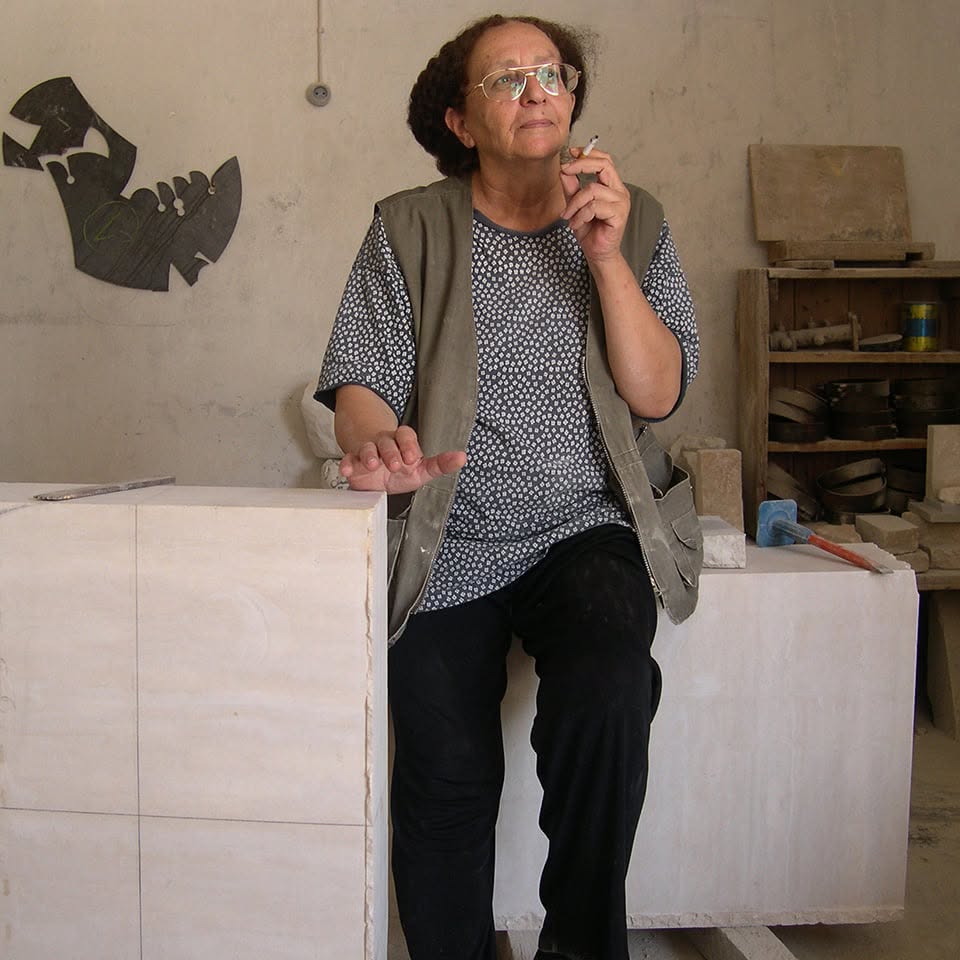
In 1969, the visual artist Mona Saudi was arrested in Copenhagen, Denmark, on charges of involvement in the attempted assassination of Israeli ex-Prime Minister David Ben-Gurion. The attempt occurred while Ben-Gurion was already out of office and on a European tour to seek support for Israel.
This accusation stopped the 24-year-old artist from holding her exhibition at the Copenhagen Public Library. However, it was eventually held at another location in the city, according to the Amman Evening newspaper, which also reported that the accusation halted Saudi’s planned tour to the Netherlands and Sweden.
However, the life story of this pioneering visual artist, who confronted the challenges with a feminine chisel of silk, patience, and tenacity, reveals an early genius. Despite this incident and not yet thirty years old, she went on to hold artistic exhibitions in most European countries.
Between the Nakba and Naksa!
Mona Saudi was born in Amman in 1945. She received her early education at Zein Al-Sharaf School in Amman, then obtained her secondary school certificate from Cairo in the early 1960s, before heading to Paris to enroll at the École Nationale Supérieure des Beaux-Arts, specializing in stone sculpture. She presented her first sculpture in 1965, its theme being motherhood. She held her first exhibitions in Amman in 1963, and in 1964, in Beirut, which was then a beacon of Arab culture. She held her first exhibition at the Capitol Hotel in Beirut.
Mona Al-Saudi’s connection to the Palestinian cause didn’t end with what happened to her in 1969. Her awareness of the Palestinian Nakba was awakened when her aunt and her family arrived in Amman as refugees from Majdal Gaza. After the June 1967 defeat, Mona Al-Saudi became active in Europe, collecting donations for Palestinian refugees who had joined their brethren displaced in 1948.
She also held an exhibition, selling all her paintings and donating the proceeds to the displaced people of her homeland after sending the funds through the International Red Cross. She then returned to Jordan and went to the camps to teach children to draw. Later, she held an exhibition in the Baqa’a camp that included her drawings alongside those of the camp’s children.
Skills, Talents
Mona Al-Saudi’s talents were not limited to painting and sculpture, she also forged her path to poetry. Living in Beirut at the time, she became acquainted with a select group of poets who shaped the modernist cultural climate of that era. She published poems in the “Shi’r” (Poetry) magazine that was founded by Yusuf Al-Khal, whose aim, it was said, was to liberate Arabic poetry from its meters, rhymes, and rigidity, and to embrace the prose style. In a poem published in 1968, titled “Peace Be Upon You, Traveling Birds,” she wrote:
Intoxicated by the air, the night, and the trees
Intoxicated, I traverse the seas of oblivion
I see the shores, then turn away from them with my sail
Towards the endless waters
I count the waves, one by one
I cry out to the sea: More distance… more distance on the weary shores!
Mona Saudi’s diverse talents formed a bridge between the arts. Her poetry and painting drew inspiration from the poems of Mahmoud Darwish, Unsi al-Hajj, Saint-Jean Perrès, and Adonis. She published two collections: “First Vision” in 1970 and “Ocean of the Dream” in 1993.
Her sculptures traveled the world.
Mona Saudi’s sculptures adorned several public squares in the Jordanian capital, Amman, since the 1960s, most notably the granite sculpture “Growth,” which has stood at the Sixth Circle in Amman since 1983. Other sculptures are located in several Arab and Gulf capitals. Her famous sculpture “The Architecture of the Soul” graces the courtyard of the Arab World Institute in Paris.
Throughout her career, spanning more than half a century in the visual arts, she held numerous exhibitions of her sculptures and paintings in the Arab world, Europe, the United States, and Asia. Her works are held in the collections of the British Museum, the National Gallery of Fine Arts in Jordan, the Guggenheim Museum and the Art Institute of Chicago, and the Art Institute of Detroit in Michigan.
Mona Saudi was once asked about the difference between painting and sculpture. With the eloquence of a seasoned artist and a sensitive poet, she replied: “There is speed in painting and a lightness of expression on paper, while sculpture is born from stone through a different process.
One might say that in painting, the artist chatters, while in sculpture one must follow the stone and its capacity to bear detail. This is why sculpture is reductionist to the extreme.” Indeed, Mona Saudi embodied this ultimate reduction in her sculptures, representing a woman who struggled for decades to make stones speak.
Mona Saudi (1945–2022) was a sculptor, writer, and poet. Born in Amman, she lived in Beirut until her death from cancer on February 16, 2022. She is considered one of the greatest sculptors in the Arab world.
Taken from Palestine Heritage