Join The Queue For The Drops
 CrossFireArabia
- August 24, 2026
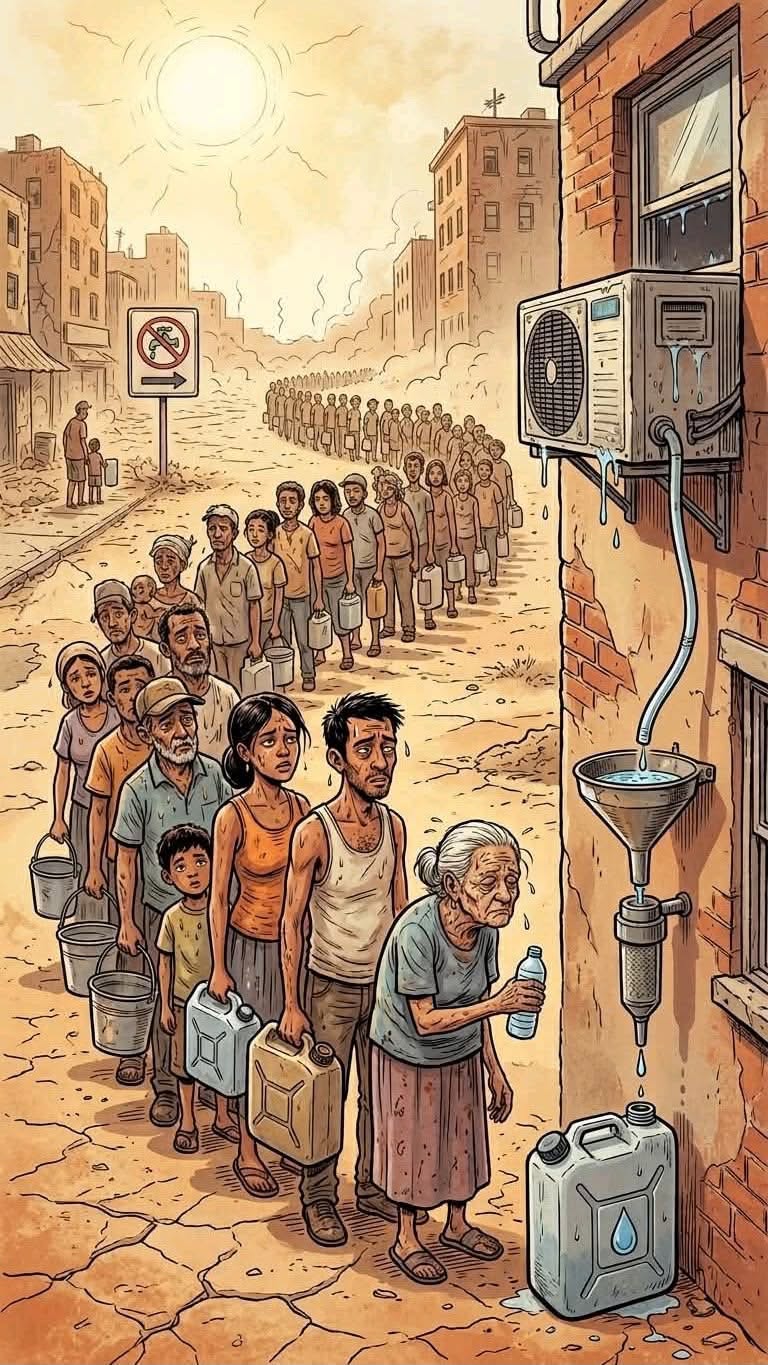
Yousef Abu Jeish is a Jordanian writer and a creative man. This is his latest innovation.
 CrossFireArabia
Yousef Abu Jeish is a Jordanian writer and a creative man. This is his latest innovation.
CrossFireArabia
By Ismail Al Sharif
Imagine you are sitting with your children at home when a violent knock shakes the door. You open it to find a blond, European-looking man holding a weapon in one hand and a Torah or Talmud in the other, with soldiers behind him.
He orders you to leave the house, saying: “God gave me this house 3000 years ago.” You reply, “But it’s my home; I was born here, and my father and grandfather were born here before me.”
They push you aside, storm into your house, and throw your furniture outside. Your children cry, they throw your wife out, and your blood boils. You wrest the weapon from the blond man and shoot him. They kill you, and then a bulldozer comes to demolish your house.
The next day, the world’s newspapers headline: “Army kills terrorist after he tried to attack occupation soldiers.”
You might go out in the morning to graze your sheep, and in the distance, you see a few fair-haired young men who have pitched a tent on a fenced-off plot of land on a hill. At first, the scene seems fleeting, but soon you see them approaching your land, wandering among your olive trees and your flock, then attacking you, stealing your livestock, and burning your trees.
After that, they seize part of your land and annex it to the area they have taken over. The fence extends day by day, growing longer and wider. Over time, your land, and the land of your relatives, friends, and all the people of your village, becomes part of the nucleus of a new settlement.
Roads change, streets are closed, and checkpoints are erected, until reaching a place only a few hundred meters away becomes a journey that takes hours.
These scenes are repeated daily in the West Bank, where settlers terrorize, assault, and kill Palestinians under the protection of the occupation army, while ministers from the occupation government appear in the background of these attacks. The goal is clear: To empty the West Bank of its original inhabitants, both Muslims and Christians, and uproot them from their land, paving the way for its seizure and Judaization.
All of this is happening in full view of the world, amidst President Donald Trump’s objections and the condemnation of the international community, at a time when his 20-point peace plan was announced in a celebratory atmosphere on September 29th of last year.
However, time has revealed that this plan was nothing but ink on paper. The occupation continues to control over 60% of the Gaza Strip, demolishing buildings and bulldozing agricultural lands in the areas under its control. It also continues its daily bombardment of the Strip, which, since the plan’s launch, has resulted in the deaths of approximately 1,200 Gazans and injured more than 3,600 others. This is while the siege continues and humanitarian aid is prevented from entering.
As for the West Bank, settlement outposts have expanded, and the occupation government recognized 19 additional settlements after the plan’s launch. This coincides with an unprecedented escalation in settler attacks, the continued demolition of homes and displacement of their residents, as well as the ongoing incursions into Palestinian cities, villages, and refugee camps.
The government of war criminal Benjamin Netanyahu makes no secret of its plans to annex the West Bank and thwart any attempt to establish a Palestinian state, while its leader orders the occupation army to launch continuous military campaigns in West Bank cities, villages, and refugee camps.
The West Bank today sits atop a powder keg, fueled by accumulated feelings of anger, fear, frustration, and resentment, awaiting a spark that could ignite the situation. Then, the sporadic confrontations could transform into a widespread popular uprising, which could very well extend beyond the borders of the West Bank.
No one knows how wide the circle of confrontation might widen, where it might spread, or the extent of the repercussions it might have in Jerusalem, the Palestinian territories within Israel, and neighboring countries. Arab governments and their armies may find themselves facing mounting popular and political pressure, pushing them either to engage in a confrontation they do not want, or to take positions and actions they have long sought to avoid.
This article was originally written in Arabic by Ismail Al Sharif and published in Jordan’s daily newspaper Ad Dustour and is reprinted in crossfirearabia.com. Mr Al Sharif long worked in newspaper management and publishing in Amman.
CrossFireArabia
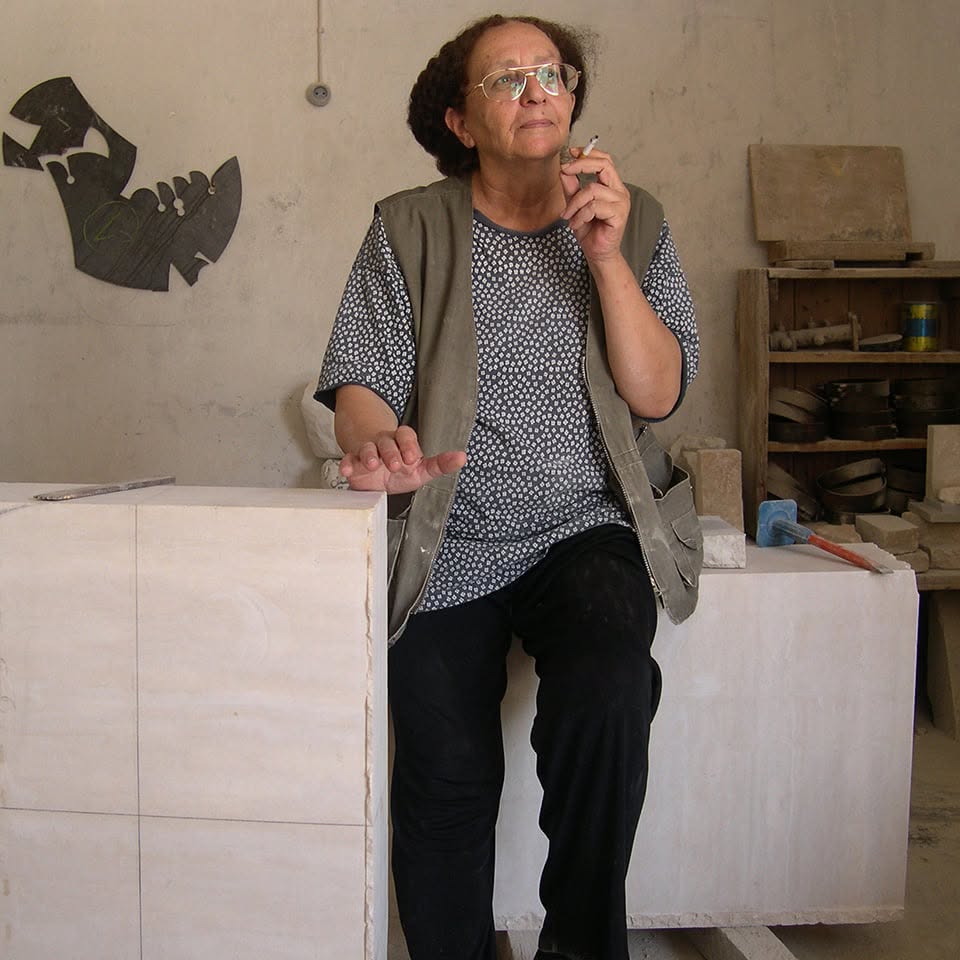
In 1969, the visual artist Mona Saudi was arrested in Copenhagen, Denmark, on charges of involvement in the attempted assassination of Israeli ex-Prime Minister David Ben-Gurion. The attempt occurred while Ben-Gurion was already out of office and on a European tour to seek support for Israel.
This accusation stopped the 24-year-old artist from holding her exhibition at the Copenhagen Public Library. However, it was eventually held at another location in the city, according to the Amman Evening newspaper, which also reported that the accusation halted Saudi’s planned tour to the Netherlands and Sweden.
However, the life story of this pioneering visual artist, who confronted the challenges with a feminine chisel of silk, patience, and tenacity, reveals an early genius. Despite this incident and not yet thirty years old, she went on to hold artistic exhibitions in most European countries.
Between the Nakba and Naksa!
Mona Saudi was born in Amman in 1945. She received her early education at Zein Al-Sharaf School in Amman, then obtained her secondary school certificate from Cairo in the early 1960s, before heading to Paris to enroll at the École Nationale Supérieure des Beaux-Arts, specializing in stone sculpture. She presented her first sculpture in 1965, its theme being motherhood. She held her first exhibitions in Amman in 1963, and in 1964, in Beirut, which was then a beacon of Arab culture. She held her first exhibition at the Capitol Hotel in Beirut.
Mona Al-Saudi’s connection to the Palestinian cause didn’t end with what happened to her in 1969. Her awareness of the Palestinian Nakba was awakened when her aunt and her family arrived in Amman as refugees from Majdal Gaza. After the June 1967 defeat, Mona Al-Saudi became active in Europe, collecting donations for Palestinian refugees who had joined their brethren displaced in 1948.
She also held an exhibition, selling all her paintings and donating the proceeds to the displaced people of her homeland after sending the funds through the International Red Cross. She then returned to Jordan and went to the camps to teach children to draw. Later, she held an exhibition in the Baqa’a camp that included her drawings alongside those of the camp’s children.
Skills, Talents
Mona Al-Saudi’s talents were not limited to painting and sculpture, she also forged her path to poetry. Living in Beirut at the time, she became acquainted with a select group of poets who shaped the modernist cultural climate of that era. She published poems in the “Shi’r” (Poetry) magazine that was founded by Yusuf Al-Khal, whose aim, it was said, was to liberate Arabic poetry from its meters, rhymes, and rigidity, and to embrace the prose style. In a poem published in 1968, titled “Peace Be Upon You, Traveling Birds,” she wrote:
Intoxicated by the air, the night, and the trees
Intoxicated, I traverse the seas of oblivion
I see the shores, then turn away from them with my sail
Towards the endless waters
I count the waves, one by one
I cry out to the sea: More distance… more distance on the weary shores!
Mona Saudi’s diverse talents formed a bridge between the arts. Her poetry and painting drew inspiration from the poems of Mahmoud Darwish, Unsi al-Hajj, Saint-Jean Perrès, and Adonis. She published two collections: “First Vision” in 1970 and “Ocean of the Dream” in 1993.
Her sculptures traveled the world.
Mona Saudi’s sculptures adorned several public squares in the Jordanian capital, Amman, since the 1960s, most notably the granite sculpture “Growth,” which has stood at the Sixth Circle in Amman since 1983. Other sculptures are located in several Arab and Gulf capitals. Her famous sculpture “The Architecture of the Soul” graces the courtyard of the Arab World Institute in Paris.
Throughout her career, spanning more than half a century in the visual arts, she held numerous exhibitions of her sculptures and paintings in the Arab world, Europe, the United States, and Asia. Her works are held in the collections of the British Museum, the National Gallery of Fine Arts in Jordan, the Guggenheim Museum and the Art Institute of Chicago, and the Art Institute of Detroit in Michigan.
Mona Saudi was once asked about the difference between painting and sculpture. With the eloquence of a seasoned artist and a sensitive poet, she replied: “There is speed in painting and a lightness of expression on paper, while sculpture is born from stone through a different process.
One might say that in painting, the artist chatters, while in sculpture one must follow the stone and its capacity to bear detail. This is why sculpture is reductionist to the extreme.” Indeed, Mona Saudi embodied this ultimate reduction in her sculptures, representing a woman who struggled for decades to make stones speak.
Mona Saudi (1945–2022) was a sculptor, writer, and poet. Born in Amman, she lived in Beirut until her death from cancer on February 16, 2022. She is considered one of the greatest sculptors in the Arab world.
Taken from Palestine Heritage
CrossFireArabia
EDITOR’S NOTE: This article was written more than 18 years again in October 2007 for the 7iber.com online portal and is reprinted her
Its election time! As a good non-totalitarian democrat I love the elections, when they happen that is. What I really love about the elections is the time leading up to their finale when voters go up to the polling stations and vote. Although I’ve never voted in my life, I’ve always carefully watched election campaigns, right from start to finish. They are exciting days, of banners hoisted, constituency meets, mini-rallies and all the rest of it.
Prospective candidates, some running for the very first time and of which we are expected to know and vote for, hoist their banners across streets and roundabouts, screaming at the electorate to vote for them because they are the best candidates.
This is the 15th elections for the 15th Lower House, and parliament in Jordan has consistently been in session since 1989, after a long absence of parliamentary life in the country. I am proud to say I covered the 1993 elections, the 1997 ones, and just about missed the 2003 elections because of being away from Jordan.
In all these years, the excitement never faded. Islamic Action Front candidates continuously stood under the IAF banner, but this was never the case with the other political parties, such as the nationalists, the leftists, the middle-of-the-roaders and the tribalists. Although a lot of parties came on the scene after 1993, like Al Ahad, Al Yaqatha and Al Risala and still many others, for some reason or another, many of their candidates preferred to stand as independents arguing they are known for their own independent political personalities rather than as representatives of their parties.
Is this a wrong attitude? Well, maybe. However, once some of them were elected to the Lower House of Parliament, they revealed their true political colors and supposedly argued on party-political lines. Ironically, most of the electorate never knew what those lines were when the MP was just a candidate running for a seat. Many of these parliamentarians argued that they stood a better chance of getting into parliament as individuals rather than under the banner of their political parties. This is due to the belief that such organizations were still seen as relatively new and unknown, despite the fact that many, including leftists, Arab nationalists and Baathists parties, had existed in the 1960s and 1970s, but many of which were effectively banned.
They may of course have been right in their assumptions as political parties were just made legal in the early 1990s, and have thus needed time to be nurtured. As independents, the negative connotations of belonging to political parties would wither away among the electorates who needed to get used to voting for candidates on party political platforms. But the problem with running on independent tickets is that it actually perpetuated individualism, parochialism and depended on the appeal to family, kinship and tribal relations. In past Jordanian parliamentary elections, and even today, the tribal bloc vote has been very important in deciding who wins and who loses.
The effect of this frustrates the process of developing political parties, which, except for the Islamic Action Front, remains weak, ineffective and are no more than talking shop. They have even been used by established politicians to further their own individual political ends and causes. This stands contrary to the need for building modern, strong political parties designed to make democracy and the democratic experiment effective.
Realizing that there is a lot to say about the tribal vote, sometimes political candidates, even Islamists, have been known to appeal to kinship and family relationships as a means of getting into parliament. Once they do, they start the usual game of political party meandering under the parliamentary dome.
That may also be why election banners and slogans on roads are no more than hackneyed, clichéd phrases emptied from their political content. They are read for what they are: brief formulaic statements, lacking the resonance of strong, vibrant agendas and political manifestos that promise change and development, as is the case with elections in more mature democracies around the world.
Political parties in Europe, for instance, are big machines with national and local clout. Everyone, especially the main personalities, know who they are, what they stand for, and what they hope to do once they form the government, or become the party in the majority. In this part of the world, the political culture, machinations and value systems are different and have to be treated differently.
However, in the final analysis, a political party is a political party in which ever part of the world it belongs to; sharing little differences with its counterparts. That’s why such parties have to be strong, come out of their closed shops and enclosures, and appeal to the masses; become broad-based with clout in order to be listened to by decision-makers.
In all fairness however, we have to be gentle with our political parties by understanding the history and the context of where they came from. It took political parties in the western world, centuries to develop and become the national institutions they are today.
They emerged through political struggles and a great deal of pushing and shoving.
But does that mean we have to take that long? Not necessarily, the element of transition from one era to another can take place quickly, but it has to be supported by the state and government. There has to be a political will for democracy, where parties are nurtured rather than left alone.
Jordan is doing well despite different hiccups, but the Arab world in general has to pull itself by the bootstraps if it is to enter into a meaningful political era where representation, democracy and political pluralism is seen as healthy for a society. Our problem now is to move faster in order to catch up with the rest of the world, and develop politically.
In the meantime, let’s for a minute stop and enjoy the political actions of the electoral campaign.
CrossFireArabia
The Civil Defence Department (CDD) and police personnel responded to 54 reports of falling objects and shrapnel in Amman, Zarqa, Jerash, Madaba, Irbid and West Balqa between the morning hours and 7:00 p.m. on Saturday.
The Public Security Directorate (PSD) said the incidents resulted in material damage only, with no injuries reported.
The PSD urged Jordanians to comply with the safety guidelines issued by authorities and to immediately contact the unified emergency number (911) if they observe any suspicious activity.
It called for not approaching any suspicious objects under any circumstances due to the danger they may pose according to the Jordan News Agency, Petra.
Later in the day the Jordan police said they received 73 reports of debris falling on different areas of the Kingdom.