‘Aid Trickle’ Mean People Die Before Reaching Hospitals

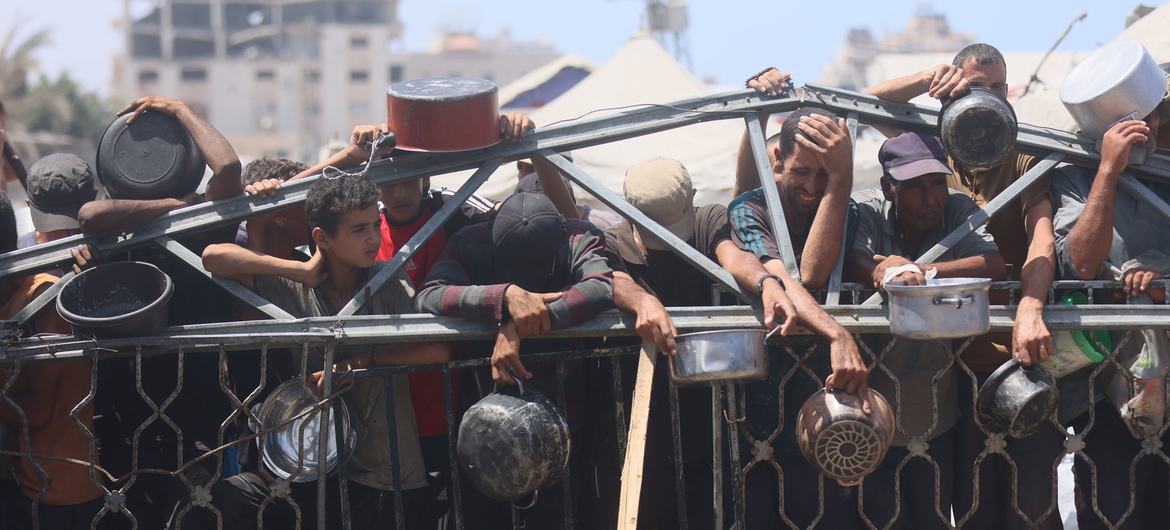
Children in Gaza are dying not just from hunger, but from the total collapse of the systems meant to protect them, UN agencies warned on Tuesday.

With 96 per cent of households lacking clean water, many malnourished children are not surviving long enough to receive hospital care.

James Elder, Spokesperson for the UN Children’s Fund (UNICEF), told a media briefing in Geneva that it would be a mistake to assume that the situation was improving.

There’s a sense through the world’s press that things are improving,” he said. “But unless there is sustained humanitarian aid…there will be horrific results.

He emphasised the scale of need: “When food comes in which supports 30,000 children, there are still 970,000 children not getting enough. It is a drop in the ocean.”

Aid still a trickle

The UN relief coordination office, OCHA, said that although unilateral pauses have allowed some aid into Gaza, the current trickle is vastly insufficient.

“There should be hundreds and hundreds of trucks entering Gaza every day, for months or years to come,” said Jens Laerke, OCHA spokesperson. “People are dying every day. This is a crisis, on the brink of famine.

Thousands of tons of pre-funded aid remain stuck just outside the enclave, he added, as bureaucratic delays and lack of safe access continue to block distribution.

Urgent scale-up needed

In New York, UN Deputy Spokesperson Farhan Haq also noted the impediments to bringing in and distributing sufficient aid.

“Massive food shortages continue to impact people’s chances for survival,” he said. “As malnutrition levels rise, children’s immune systems are weakened, hindering their development and growth far into the future.”

Last Thursday alone, 71 kitchens delivered over 270,000 hot meals across Gaza, including 10,000 to health facilities. But that figure falls far short of what’s needed to feed more than two million people.

We need an urgent scale-up of supplies, as well as an environment that allows humanitarians to reach people in need safely, rapidly and efficiently,” Mr. Haq added.

Health challenges continue

Some medicine has entered Gaza in recent days, but supplies remain limited. Health workers continue to operate under extreme pressure and shortages.

The World Health Organization (WHO) reported 46 cases of Guillain-Barré syndrome in July, including two deaths. The condition, which affects the nervous system, has been linked to compromised immunity, poor nutrition and hygiene-related infections.

The situation of pregnant women and nursing mothers is equally alarming. The UN reproductive health agency, UNFPA, said that 40 per cent of pregnant or breastfeeding women are suffering from severe malnutrition, with newborn deaths and stillbirths on the rise.

Meanwhile, three UN fuel tankers reached Gaza City on Monday. The fuel will power critical health, water and sanitation services, but OCHA stressed this only allows operations to run at “bare minimum” capacity according to UN News.

CrossFireArabia

CrossFireArabia
Dr. Marwan Asmar holds a PhD from Leeds University and is a freelance writer specializing on the Middle East. He has worked as a journalist since the early 1990s in Jordan and the Gulf countries, and been widely published, including at Albawaba, Gulf News, Al Ghad, World Press Review and others.

Related Posts

Albanese Calls For World Force to Protect Civilians in Gaza, West Bank

UN Special Rapporteur Francesca Albanese called Sunday for an “international protection presence” in the occupied West Bank, East Jerusalem and Gaza, saying such a deployment was “absolutely urgent.”

“Third states have an obligation, per the ICJ, to act to end Israel’s unlawful occupation,” Albanese wrote on the US social media platform X, referring to a July 2024 advisory opinion by the International Court of Justice that deemed Israel’s occupation of Palestinian territory unlawful and said states must not assist in maintaining it.

Albanese also questioned whether UN Secretary-General Antonio Guterres’ diplomatic efforts and the General Assembly’s “Uniting for Peace” mechanism could overcome the Security Council’s deadlock on the conflict.

The mechanism allows the General Assembly to consider international peace and security issues when the Security Council cannot act because of a lack of unanimity among its permanent members. The council has repeatedly been unable to take action on Gaza and the West Bank amid vetoes by the US. Anadolu

Continue reading
40 Million Tons of Rubble: Gaza Ministry Faces Challenges in Removing it

Gaza’s Ministry of Public Works and Housing confirmed that Israel’s ongoing targeting of tents and shelters of displaced people in the enclave is a systematic policy of destroying the basic necessities of life. It noted the amount of rubble that has piled up in the various regions of the Strip has exceeded 40 million tons.

Ministry spokesman Najla Hammad told the Sanad News Agency, Monday, the ministry is facing unprecedented challenges in removing the rubble because of the severe shortage of heavy machinery due to the Israeli-imposed blockade and the closure of crossings.

Hammad pointed out that the recent Israeli aggression has displaced more than 80 families, leaving them homeless and exposed, noting the ministry received widespread appeals to replace the tents that have been damaged and/or completely destroyed.

Read also: “Public Works”: Only 5% of shelter supplies enter Gaza

She added what is making things worse is that the Israeli occupation is preventing the entry of tents, tarpaulins, and shelter supplies and the reduction of usable land in the Gaza Strip to less than 30%.

Hammad explained that crews are continuing to work on opening main roads and providing alternative spaces for service facilities and educational centers but tough going. However, she announced the completion of the removal of the rubble at the site of the Hijazi Clinic in northern Gaza, in cooperation with the United Nations Development Programme (UNDP), and its handover to the Ministry of Health for reconstruction.

She indicated that the demolition and clearing of rubble is currently limited to only 4 out of the 10 sites previously identified, due to security restrictions and a lack of heavy equipment. The teams are operating with only one excavator and a very limited number of trucks.

Hammad noted the use of local alternatives and solutions, such as recycling crushed rubble to level roads and areas threatened by flooding, and melting plastic and aluminum to recycle supplies for health units in the camps is also moving.

UN reports confirm that the scale of destruction and rubble in the Gaza Strip surpasses that of major wars and conflicts in modern history. International organizations warn that preventing the entry of machinery, engineering equipment, and shelter materials exacerbates the humanitarian, environmental, and health catastrophe, hindering the provision of even the most basic services to more than two million displaced people lacking safe shelter.

The Ministry of Public Works and Housing in Gaza previously warned in August of the severe deterioration in the housing sector due to the widespread presence of tons of rubble. It emphasized that the aid and tents permitted entry by the Israeli occupation amount to no more than 5% of the actual needs of the displaced, given the strict restrictions at the crossings and the repeated forced displacement.

Recently, the Ministry of Public Works and Housing launched an emergency program to repair and renovate partially damaged homes in the Gaza Strip, a step aimed at persuading and facilitating the return of displaced families to their homes and original areas.

Last June, Hammad, announced a comprehensive plan for managing, storing, and crushing rubble for reuse, as part of the ongoing efforts to address the issue of debris resulting from the conflict.

Hammad said that the Ministry is presently working with the UNDP and have to-date  constructed more than 15 shelters that have accommodated over 1,700 displaced families in the Gaza Strip, including five centers in the south that alone have housed approximately 700 families.

Continue reading

You Missed

Albanese Calls For World Force to Protect Civilians in Gaza, West Bank

Albanese Calls For World Force to Protect Civilians in Gaza, West Bank

40 Million Tons of Rubble: Gaza Ministry Faces Challenges in Removing it

40 Million Tons of Rubble: Gaza Ministry Faces Challenges in Removing it

Join The Queue For The Drops

Join The Queue For The Drops

‘My Way Out of Insanity’

‘My Way Out of Insanity’

The Child, Tree and The Dark

The Child, Tree and The Dark

Palestinian Dr Held Over Social Media Posts Suffers Heart Attack in Israeli Detention

Palestinian Dr Held Over Social Media Posts Suffers Heart Attack in Israeli Detention





