Al-Shifa Medical Complex Director Muhammad Abu Salmiya, warned, Wednesday, of an impending humanitarian catastrophe threatening the lives of thousands of patients and those wounded due to the depletion of chemotherapy and other life-saving medications, amidst a complete paralysis of the healthcare system in the Gaza Strip.
Abu Salmiya confirmed, in statements reported by Sanad that more than 4,000 cancer patients in the Gaza Strip have been completely deprived of treatment now for over a month.
He pointed out the chemotherapy shortage is raising the death rate among cancer patients to about four to five cases daily, given the continued Israeli blockade preventing the entry of diagnostic, therapeutic, and nuclear scanning equipment.
He explained medical teams exhausted all available alternative medications, including previously extended-expiration shipments. He emphasized the absence of any component in the chemotherapy protocol completely negates the effectiveness of the treatment, leaving breast, colon, and lung tumors to spread unchecked.
Abu Salmiya added the crisis has extended to other patient groups; children with diabetes are suffering from a complete lack of insulin pens, while kidney failure patients are facing a severe shortage of calcium supplements and blood-strengthening hormones. This is occurring alongside the spread of skin and intestinal diseases and dehydration among displaced people living in tents.
He pointed out that international and UN organizations, such as the World Health Organization, Red Cross, and Doctors Without Borders, have closely observed this collapse, which coincides with the influx of 100s of martyrs and wounded to hospitals as a result of the ongoing escalation of violence.
Abu Salmiya called on the international community and the guarantors of the recently signed agreements to take urgent action and exert pressure to open the crossings and allow the regular entry of medicines and medical supplies to salvage what can still be saved.
On Tuesday, the Ministry of Health in Gaza warned of a catastrophic health crisis due to the severe and unprecedented shortage of essential medicines for cancer patients, emphasizing that the provision of medical services to this group has reached its most critical point ever.
Medical reports and UN statements continue to emerge regarding the collapse of the health system in Gaza, with 26 out of 38 hospitals out of service, in addition to the shortage of basic medicines exceeding 50%, the shortage of medical supplies reaching 70%, and the shortage of laboratory tests reaching more than 87%, which threatens the lives of thousands of patients.
The current Israeli military onslaught on Gaza is so fierce that hundreds of thousands of Palestinian have already left the downtrodden city. It is a ramshackle place that is once again becoming a ghost town of debris as once-plush residential towers are now beaten down by Israeli bombs with the stench of gun-powder and sick human flesh that lies hidden below the rubble.
Israel’s latest attempt to invade Gaza City started on 16 September, 2025 and since then it has been bombing the once-dazzling urban conurbation from the air, land, and sea, causing widespread destruction and significant civilian casualties, whilst creating yet another mad wave of displacement to the south of the Strip.
Figures of forced displacement are not precise but the city a, conglomerate of 1.3 million people, has been reduced by much less. The Israeli army likes to boost of its handiwork. After the first week of ariel bombardment, it said 40 percent of the population has left, and today it says that 450,000 people have gone. The Gaza Media Office puts the number at only 270,000.
Despite the Israeli leaflets dropped from the air telling people to leave Palestinian sources still say that around 900,000 are staying put. Many say they are not going anywhere because of the limited space down in the south, and the fact it costs $3000 dollars to get down there, something which they don’t have.
One put it bluntly and callously, accepting fate as it comes. “Since, we are going to die anyway through Israeli bombs, it’s better to die here,” he added. The acceptance of fate however may be related to the fact that some of the people may have moved up to 20 times since the war started on Gaza soon after 7 October, 2023.
Last Thursday, World Health Organization (WHO) chief Tedros Adhanom Ghebreyesus said that the Israeli assault, currently centred on Gaza City, is “driving new waves of displacement, forcing traumatised families into an ever-shrinking area unfit for human dignity”.
“The injured and people with disabilities cannot move to safety, which puts their lives in grave danger,” Tedros said. “We call for an immediate end to these inhumane conditions. “We call for an immediate end to these inhumane conditions. We call for a ceasefire.”
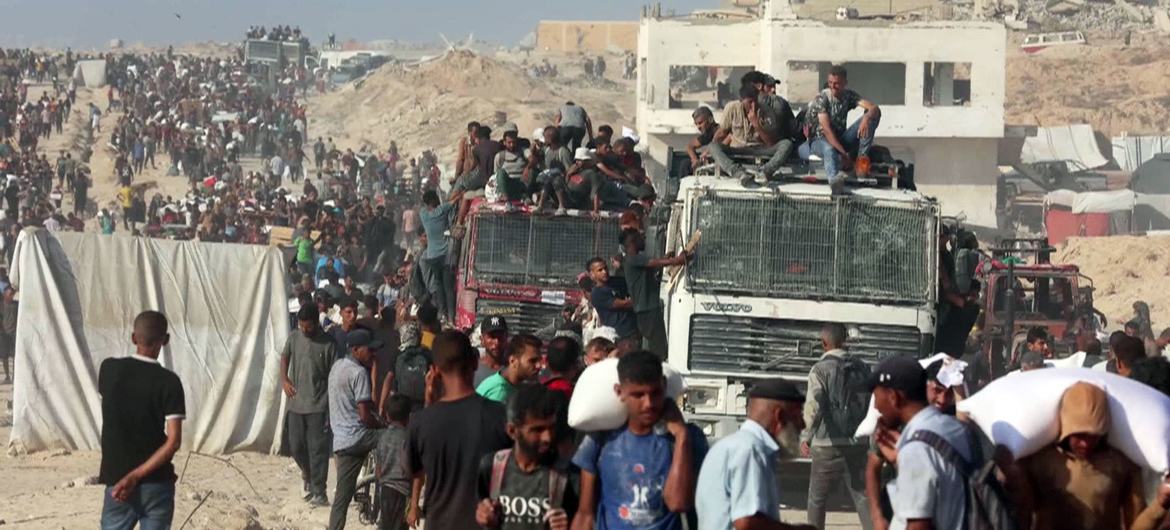
Case stories of thick swarves of displaced people speak of hellish conditions as they can be seen on the Al Rasheed Road connecting the north of the Gaza Strip to its southern side. If people can afford they can use transport but many, including whole families of men, women and children are moving on foot, hungry, with no water and many collapsing on the road as some have been moving for hours on end. For night rest, they make do with resting their limbs, again with no food on the sides of the road.
The social media have been rife with stories about forcibly displaced Palestinians on the road. Many of them say they don’t know where they are going, although the end of the road is to Al Mowasi, an area to the southwest of Khan Younis and which the Israeli has designated as a “safe” place but which it keeps bombing from the air whenever it feels like it.
One elderly man called Abu Nader Siam, walks slowly holding a cane in his right hand with his wife, Zakia Siam, at his left. He is exhausted as reported in the UN News.
“I come from the Tal al-Hawa neighborhood in Gaza City. They [Israelis] have left no house or neighbourhood except to bomb it,” he said. “The shelling continues, and they have dropped leaflets ordering us to evacuate. We walked for six hours because we couldn’t find a car or any transportation.”
Zakia Siam spoke about their non-stop journey after the shelling reduced their house to rubble. “We went to the Shujaiya neighbourhood, and then we were displaced to the Sha’af neighbourhood in Gaza City before it was bombed,” his wife said.
“Afterwards, we went to the seashore west of Gaza City and my husband and I stayed there for two nights without a tent. We sat on the sidewalk next to the tents and hid next to one of them, then continued walking.”
Another civilian, Mrs. Um Shadi al-Ashkar, carried a bag of belongings as she headed for southern Gaza. “There is death, shelling, bombing and destruction of houses (in Gaza City),” she said.
“Even if they had dropped leaflets, if there had been no shelling, no one would have left Gaza City, they would have stayed in their homes. But there is death and devastation.”
The fight for Gaza city is in full-swing. The Israeli army knows what its up against, adding it could take months, or even up to a year to completely take over the city from Palestinian resistance groups. Meanwhile, they know the city is a Hamas stronghold which they can’t railroad through their tanks. That is why for the time being they put the ground invasion on hold and bombing the city from the air and sea.
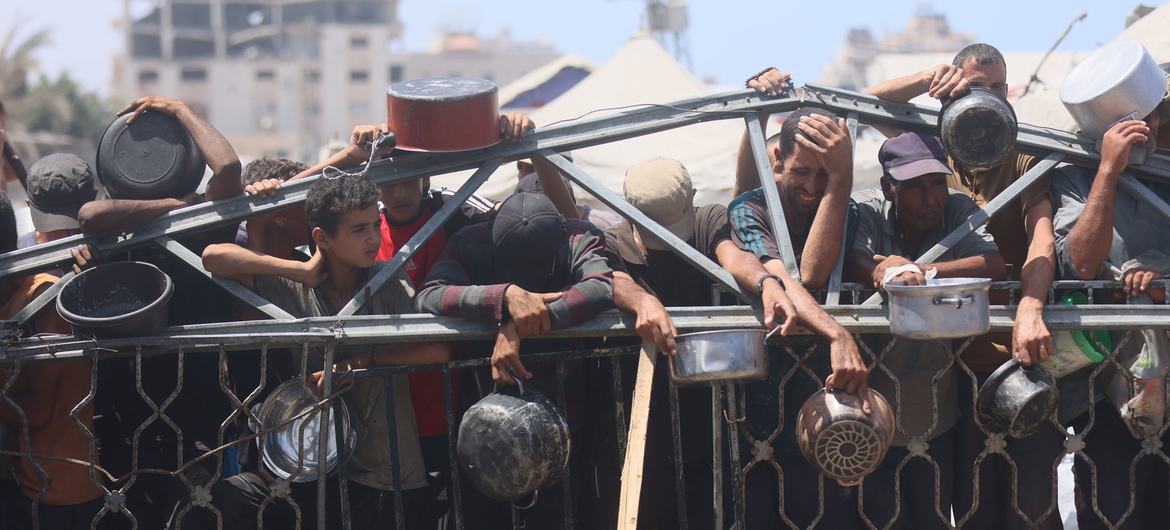
More than 100 aid organizations have accused Israel of weaponizing starvation by blocking life-saving aid from entering Gaza, leaving vast quantities of relief supplies stranded in warehouses while more Palestinians starve.
In a joint statement on Thursday, the groups, including Doctors Without Borders and Oxfam, said that aid trucks have massed on Gaza’s borders amid Israel’s blockade of the famine-stricken territory, and new rules are being used by Israel to deny the entry of food, medicine, water and temporary shelters.
“Despite claims by Israeli authorities that there is no limit on humanitarian aid entering Gaza, most major international NGOs [nongovernmental organisations] have been unable to deliver a single truck of life-saving supplies since 2 March,” the groups said.
“Instead of clearing the growing backlog of goods, Israeli authorities have rejected requests from dozens of NGOs to bring in life-saving goods, citing that these organisations are ‘not authorised to deliver aid’,” the groups added.
Relief organisations that have worked in Gaza for decades are now told by Israel that they are not “authorised” to deliver aid due to new “registration rules”, which include so-called “security” vetting.
Hospitals in Gaza are now without basic supplies as a result, and children, the elderly and those with disabilities are “dying from hunger and preventable”, the statement noted.
The more than 100 relief organisations have called for pressure to be exerted on Israel to end its “weaponisation of aid”, for Israel to end its “bureaucratic obstruction” and for unconditional delivery of life-saving humanitarian aid to Gaza according to the Quds News Network.
Bushra Khalidi, Oxfam policy lead, said her organisation has more than $2.5m worth of humanitarian aid supplies that “have been rejected from entering Gaza by Israel”.
MSF’s emergency coordinator in Gaza, Aitor Zabalgogeazkoa, said the restrictions on aid are part of Israel’s militarised distribution of relief supplies, spearheaded by the controversial US- and Israeli-backed Gaza Humanitarian Foundation (GHF).
“The militarised food distribution scheme has weaponised starvation and curated suffering. Distributions at GHF sites have resulted in extreme levels of violence and killings, primarily of young Palestinian men, but also of women and children, who have gone to the sites in the hope of receiving food,” Zabalgogeazkoa said.
At least 859 starving Palestinians have been killed by Israeli forces and American mercenaries while seeking food near or at GHF distribution sites since May.
Israel’s Diaspora Minister Amichai Chikli, who had a role in the new rules imposed on aid groups, told the AFP news agency that registration of humanitarian groups could be rejected if Israel deems that its activities deny the democratic character of Israel or ” promote delegitimisation campaigns”, such as the movement to boycott Israel over its war on Gaza.
The joint outcry comes as two out of three famine thresholds for food consumption have been breached across most of Gaza, with acute malnutrition levels in Gaza City confirming aid agencies’ repeated warnings, according to the Integrated Food Security Phase Classification (IPC).
“Mounting evidence shows that widespread starvation, malnutrition, and disease are driving a rise in hunger-related deaths,” the IPC assessment maintained.
“The worst-case scenario of Famine is currently playing out in the Gaza Strip.”
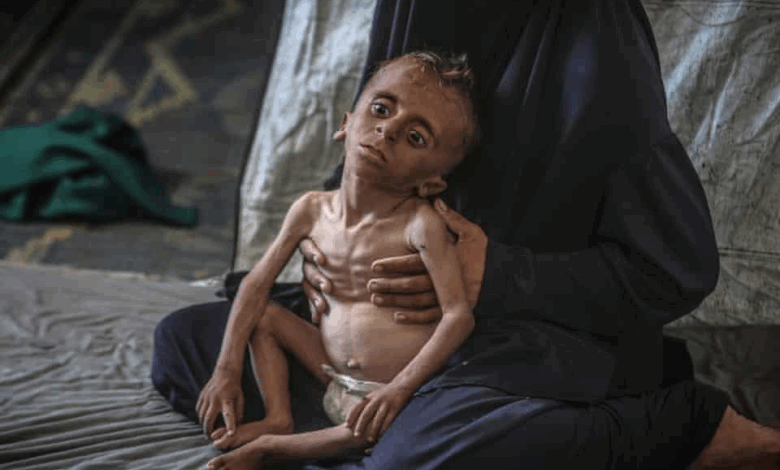
UNICEF has warned that Gaza faces a grave risk of famine, with one in three people going days without food.
Over 100 humanitarian organizations, including Amnesty International, Doctors Without Borders (MSF), and Oxfam, warned that “mass starvation” is spreading across Gaza, with their colleagues in the enclave wasting away from hunger.
The World Health Organization (WHO) said Gaza City has been the area “worst-hit” by malnutrition in the Gaza Strip, with nearly one in five children under five there now acutely malnourished.
The World Food Programme (WFP) has warned that thousands of Palestinians in Gaza are “on the verge of catastrophic hunger,” with one in three people in the enclave going days without food.
Children in Gaza are dying not just from hunger, but from the total collapse of the systems meant to protect them, UN agencies warned on Tuesday.
With 96 per cent of households lacking clean water, many malnourished children are not surviving long enough to receive hospital care.
James Elder, Spokesperson for the UN Children’s Fund (UNICEF), told a media briefing in Geneva that it would be a mistake to assume that the situation was improving.
“There’s a sense through the world’s press that things are improving,” he said. “But unless there is sustained humanitarian aid…there will be horrific results.”
He emphasised the scale of need: “When food comes in which supports 30,000 children, there are still 970,000 children not getting enough. It is a drop in the ocean.”
Aid still a trickle
The UN relief coordination office, OCHA, said that although unilateral pauses have allowed some aid into Gaza, the current trickle is vastly insufficient.
“There should be hundreds and hundreds of trucks entering Gaza every day, for months or years to come,” said Jens Laerke, OCHA spokesperson. “People are dying every day. This is a crisis, on the brink of famine.”
Thousands of tons of pre-funded aid remain stuck just outside the enclave, he added, as bureaucratic delays and lack of safe access continue to block distribution.
Urgent scale-up needed
In New York, UN Deputy Spokesperson Farhan Haq also noted the impediments to bringing in and distributing sufficient aid.
“Massive food shortages continue to impact people’s chances for survival,” he said. “As malnutrition levels rise, children’s immune systems are weakened, hindering their development and growth far into the future.”
Last Thursday alone, 71 kitchens delivered over 270,000 hot meals across Gaza, including 10,000 to health facilities. But that figure falls far short of what’s needed to feed more than two million people.
“We need an urgent scale-up of supplies, as well as an environment that allows humanitarians to reach people in need safely, rapidly and efficiently,” Mr. Haq added.
Health challenges continue
Some medicine has entered Gaza in recent days, but supplies remain limited. Health workers continue to operate under extreme pressure and shortages.
The World Health Organization (WHO) reported 46 cases of Guillain-Barré syndrome in July, including two deaths. The condition, which affects the nervous system, has been linked to compromised immunity, poor nutrition and hygiene-related infections.
The situation of pregnant women and nursing mothers is equally alarming. The UN reproductive health agency, UNFPA, said that 40 per cent of pregnant or breastfeeding women are suffering from severe malnutrition, with newborn deaths and stillbirths on the rise.
Meanwhile, three UN fuel tankers reached Gaza City on Monday. The fuel will power critical health, water and sanitation services, but OCHA stressed this only allows operations to run at “bare minimum” capacity according to UN News.
The daily struggle to survive an ongoing war in Gaza and to protect one’s family – while reporting on the fear and chaos that conflict brings – has become an unrelenting obligation for a UN News correspondent in the embattled enclave.
Some 21 months have passed since the 7 October armed attacks on Israel which sparked the current brutal conflict.
Thousands have died and much of Gaza has been laid to waste, but life must continue, according to the correspondent, who is remaining anonymous for security reasons.
“Those who live here in Gaza don’t need long explanations to understand the meaning of this war.
It is enough to listen for a few minutes: Planes buzz incessantly overhead, and airstrikes silence everything except fear which, although invisible, fills every space between our tents and seeps into our bodies.
A young boy is rescued after he was caught in an attack on a school shelter.
At night, there’s absolute darkness except for the flashes of bombing.
We sleep knowing that waking up is not guaranteed.
Every morning in Gaza is a new attempt to live, and every evening a challenge to survive. This is the harsh reality we live in.
I am one of more than two million Palestinians living under the burden of displacement. I document stories of war and despair while experiencing their full bitterness.
Since our home was destroyed in November 2023, the tent has become our safety. My family, once part of my private world, is now part of the stories I share with the world.
Here, life is simple and tragic.
Sleeping on the hard ground, cooking over firewood and the exhausting pursuit of a morsel of bread are no longer options, but a way of life imposed by the cruelty of war.
In the face of my eldest son, who is not yet 14, I see a reflection of a war that has stolen his childhood and imposed burdens on him greater than his years.
He has become an expert at water distribution routes, haggling for bread and carrying heavy gallons of water. I feel boundless pride in his courage, yet simultaneously a painful sense of powerlessness because I can’t protect him from what’s happening around us.
Oasis of hope
My wife is trying to create an oasis of hope for our other children. My two eldest daughters continue to learn online when the internet is intermittently working and to read whatever books are available.
My youngest daughter draws on worn pieces of cardboard while my youngest son, who is four, has no memory of anything other than the sound of explosions.
We stand helpless in the face of his innocent questions. There are no schools, no education, only desperate attempts to keep the brightness of childhood alive in them, in the face of a brutal reality.
More than 625,000 children in Gaza have been deprived of an education.
This is due to the destruction of schools and the lack of a safe environment in which to learn.
The future of an entire generation is threatened.
UN News
A drawing depicts people dying as they try to access food from a truck in Gaza.
Bearing witness
I work alongside other journalists. We wander between hospitals, streets and shelters.
We carry our journalistic equipment not only to document events, but also to be a voice for those whose voices have been silenced.
We film a child suffering from severe malnutrition, listen to the story of a man who has lost everything and witness the tears of a woman unable to provide food for her children.
We document a scene which is repeated daily: Thousands of people rush to reach a flour truck. They run after the trucks, collecting the last grains of flour from the ground.
They don’t care about danger as the hope of getting their hands on a loaf of bread is more precious than life.
Each time, casualties fall along the convoys’ routes and militarised distribution points.
We walk the streets, alert to every sound, as if we’re waiting for the end with every turn we make.
There’s no longer time for surprises or sadness, only constant tension and anxiety that has become part of the survivors’ DNA here.
This is the reality that cameras don’t capture, but it is the daily truth we try to explain to the world.
A WHO worker assesses a destroyed hospital in northern Gaza.
Tears of UN colleagues
We document the efforts of the United Nations and its various organizations.
I see staff sleeping in their cars to be closer to the crossings, and I see our UN colleagues crying as they listen to the stories of my fellow Gazans.
There is not enough aid. The crossings open and close abruptly, and some areas are deprived of supplies for days.
The western areas of Gaza City are overcrowded. Tents are spread out on every corner, on the sidewalks and among the rubble of destroyed homes, in dire conditions.
Empty markets
The value of the local currency has evaporated. Those with money in their bank accounts pay fees of up to 50 per cent to withdraw it, only to find themselves facing nearly empty markets. Whatever is available is being sold at exorbitant prices.
Vegetables are scarce, and when available, a kilogramme can cost more than $30. Fruit and meat are a distant memory.
The health system is in a state of complete collapse as 85 per cent of Gaza’s hospitals are no longer functioning and most dialysis and chemotherapy services have stopped.
Medications for chronic diseases are unavailable. I am unable to secure medicine for my parents, who suffer from diabetes and high blood pressure, and there is no hope of surgery which could save my brother’s arm, which was injured in an airstrike.
A young boy carries a water bottle through an area where people are living in tents.
Witness to everything
Sometimes, I feel caught between two identities, the journalist documenting the suffering and the human experiencing it.
But, perhaps this is where the strength of our journalistic mission from the Gaza Strip lies: to be a voice from the heart of the tragedy, to convey to the world the reality of what is happening on a daily basis.
Every day in Gaza poses a new question:
Will we survive?
Will our children return from their search for water?
Will the war end?
Will the crossings be opened so aid can be delivered?
From here, we will continue, because untold stories die and because every child, woman and man in Gaza deserves to have their voice heard.

 CrossFireArabia