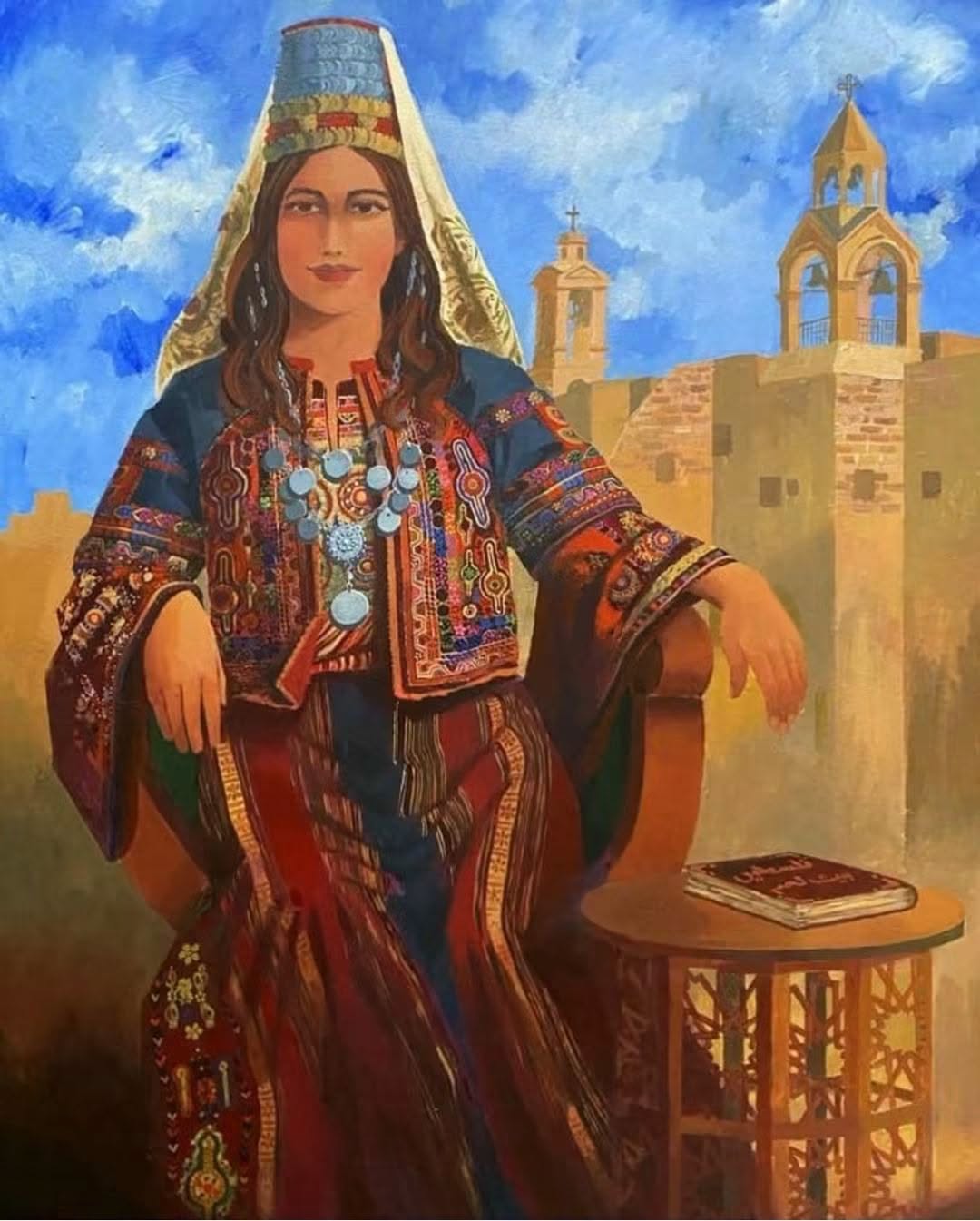
‘Art is Resistance’ Says Sliman Mansour

Sliman Mansour, a prominent figure in modern Palestinian art, emphasized the importance of “rehumanizing” the Palestinian people, noting that he spent his youth fighting against the erasure of Palestinian identity.

“The Israelis and the West – they’ve been trying very hard to dehumanize us. As artists and people who deal with culture, it’s our role to rehumanize the Palestinian people,” Mansour told Anadolu.

The 77-year-old renowned artist, sculptor, writer and cartoonist, who depicts the historical struggle of Palestinians through his paintings, said he sees art as a form of resistance.

Born in 1947 in the town of Birzeit in the West Bank city of Ramallah, Mansour has portrayed the Palestinian resistance through his art for over half a century.

“I would like to show that Palestinians cherish their land and are holding onto it, and they are saying in poems about the beauty of the land. In my art, I want to show the beauty of the landscape of the land. I want to show that we live in a very unjust situation,” he said.

‘Don’t forget Palestine’

“I’m not thinking about the whole people. I think about the Palestinian people, and especially those who live outside who never saw Palestine. My message for them is: Don’t forget Palestine and Palestine is beautiful. In my art, there is no message of hate. It’s beauty and love.”

Mansour, who lived through the Six Day War between Arab states and Israel in June 1967, often draws attention to the conflicts and pressures faced by Palestinians.

Using symbols derived from Palestinian culture, history, and traditions, Mansour underscores the deep attachment Palestinians have to their land, which serves as a significant source of inspiration for his work.

“Everybody is fighting about the land, and the land is my main inspiration. I was born in a village and I experienced the land and working in the land and living in a village,” he said. “I think the memories of childhood always stay with people, even if they leave the village. From these memories, I think I take my imagination and I take my inspiration,” he said.

Saying that Jerusalem is a symbol of Palestine, and the Dome of the Rock is a symbol of Jerusalem, Mansour said he reflected this idea in a painting titled, The Camel of Hardships, which contained his first political message.

“But the first main painting that I did that had very obvious political meanings is the old man carrying Jerusalem on his back. I have a big family outside, living in the US and everywhere. I noticed that everybody was outside of Palestine. He goes out and he thinks he’s free from all the political pressures.

“But no, he’s always carrying his Palestinian on his back. If you are a Palestinian, you are a problem just because you exist. I wanted to show this fact about Palestinians who live abroad,” he said.

Mansour said in his 1989 work titled, Rituals Under Occupation, he depicted crowds carrying a cross covered with the Palestinian flag and extending toward the horizon.

He received inspiration from a Palestinian judge who lived in the Old City in Jerusalem and had a son who could not walk. Mansour said the Palestinian identity is a “big burden” for them.

“I talked to him (the judge) and he said that everybody in the world has his own cross, and Palestinian people have, all of them, have one big cross,” he said.

“The Palestinian identity is a big burden for us. Our existence is a problem. The flag became one of the main important images of Palestinian identity. The flag is the Palestinian identity, and it’s forever. We don’t see the end of it,” he added.

Mansur pointed out that one of the most frequently used symbols in his work is the olive tree, highlighting his 2021 piece, From the River to the Sea.

“It’s half olive tree and half orange tree. The olive tree symbolizes the land that was occupied in 1967. The orange tree — it symbolizes the land that was occupied in 1948,” he said.

Olive tree, orange tree

Saying that he does not only address the Israeli occupation but also underscores the resilience of the olive tree in the painting, Mansour clarified: “Olive trees – it can live in very rough places on the mountains and without water, and its roots are very long inside the land.

It symbolizes perseverance and the feeling of being that – holding the land and not giving up. In my opinion, Palestinians are like the olive tree,” he added.

Highlighting the Israeli occupation with barbed wire in his paintings, Mansour said: “Barbed wire symbolizes the occupation. It symbolizes also the settlements.”

“Because in every settlement, you see these barbed wires all around the settlement. For Palestinians, when they see barbed wires, it’s either a settlement or a military base or something. It symbolizes the occupation. They want to forbid you to come near that area,” he said.

Adding he is not always hopeful as an artist, Mansur referred to his 2018 work, Temporary Escape, where he expressed those feelings.

“I made this painting during this time when I felt very, very depressed and hopeless. When you live in occupied land, you are the target of many media people that — they aim to defeat you. I mean, defeat you from the inside. Sometimes they succeed, but then you wake up after a while. This is a fight that you have to go in,” he added.

Mentioning the impact of art on the Palestinian resistance, Mansour stated: “If the artist is really truthful with his feelings, he could be effective or she could be effective.”

“Some artists, they do it just because they have to do it. It doesn’t affect anybody. But my art is still, until now, it’s effective because I do what I like to do. It comes out from my heart,” he said.

“It’s not enough to come from your heart. You have to feel a belonging to the culture of your people. It’s not enough to feel belonging, but you have to study it. If you want to express your art through this culture, you have to know this culture very good. I think I have been through that,” he added in an interview with the Turkish news agency.

CrossFireArabia

CrossFireArabia
Dr. Marwan Asmar holds a PhD from Leeds University and is a freelance writer specializing on the Middle East. He has worked as a journalist since the early 1990s in Jordan and the Gulf countries, and been widely published, including at Albawaba, Gulf News, Al Ghad, World Press Review and others.

Related Posts

Israeli Capitan Killed, 7 Soldiers Injured in Lebanon

The Israeli army acknowledged, Monday, the death of a captain and medical doctor in the Givati ​​Brigade and the wounding of seven other soldiers, including four officers and a battalion commander, in an attack carried out by Hezbollah using explosive-laden drones.

In a statement, the army said the deceased was a medic from the Shaked Battalion (424) of the Givati ​​Brigade and was killed during fighting in southern Lebanon.

Israeli Army Radio reported that Hezbollah launched six explosive-laden drones around noon, Monday, toward a group of soldiers and a Nimer armored vehicle belonging to the Givati ​​Brigade, which was stationed on the outskirts of the town of Zawtar al-Sharqiya, near the Shaqif site.

The radio added that among those seriously wounded were the operations officer of the Shaked Battalion and a platoon commander in the same battalion, while the battalion commander, a lieutenant colonel, was also wounded.

This attack comes a day after the Israeli army radio also announced the death of a soldier from the Givati ​​Brigade’s reconnaissance unit and the wounding of four other soldiers in an explosion caused by an explosive-laden drone that targeted them, Saturday, evening in the Zawtar al-Sharqiya area of ​​southern Lebanon.

The southern Lebanese front is witnessing a continuous escalation, amid ongoing clashes between Hezbollah and Israeli occupation forces according to Qudspress.

Continue reading
Football and Borrowed Boots!

Matches organised by a former professional player are providing a brief respite from the harsh reality of life for the thousands living in overcrowded tents, schools or damaged buildings in the shattered Occupied Palestinian Territory of Gaza.

In the Al-Mawasi area west of Khan Younis, where tents stretch across the sand and snaking queues form for water and food, Asaad Al-Azzabi prepares for a match a world away from what he once knew.

Before the war, Mr. Al-Azzabi played for Al-Tajammu Club in Rafah, where he and his teammates had access to pitches, training halls, coaches and equipment. 

A displaced football player from Rafah prepares his cleats in a sand camp in Al-Mawasi, west of Khan Younis, Gaza.
UN News Asaad Al-Azzabi’s torn boots.

Borrowed boots

Now, he’s lucky if he can find boots to play in. “Sometimes I borrow a pair from a friend or patch them up with tape,” he says.

His home is now a tent in Al-Rahma Camp, a shelter for people displaced from Rafah, where access to clean water and sanitation services is scarce. He lives alone, after his wife left for Jordan with their son, who has cancer, to seek treatment.

According to UN data, around 1.7 million people are living in around 1,600 displacement sites across the Gaza Strip, most of them in temporary or informal locations. Most residents rely on water brought in by truck and are forced to cope with restrictions on the entry of equipment, fuel and repair materials.

Amid the struggle to meet basic needs, Mr. Al-Azzabi is preparing for the match with nearby Sheikh Al-Eid Camp. He explains the game plan to his players by drawing on the sand, before the team sets off on foot toward a pitch located among the tents of displaced people. 

The match appears to be more than a sporting activity – it is a respite from the daily hardships of life in the camps. 

Children and young men gather around the sandy pitch, applauding players, some of whom arrived after spending hours standing in queues for food, water or battery charging.

A group of Palestinian refugees, including Asaad Al-Azzabi, gathers to watch a soccer match at a makeshift field in the Al-Mawasi displacement camp, west of Khan Younis, Gaza.
UN News Displaced people from Rafah watching the match between Al-Rahma Camp and Sheikh Al-Eid Camp.

Something out of nothing

Referee Alaa Abu Taha, a referee with the Palestinian Football Association and a displaced resident of Rafah, says football has become the “only outlet” for many people in Gaza.

“With the most limited resources, we try to play. Now there is no sports infrastructure. The pitch we are standing on now was originally prepared for basketball and volleyball, but our people create everything out of nothing,” he says.

Gaza’s sports sector has suffered widespread destruction since the outbreak of the war. According to the Palestinian Football Association, hundreds of athletes have been killed, including many footballers, while hundreds of sports facilities have been damaged or destroyed, including pitches, club headquarters and training halls. 

In Al-Mawasi these losses have not prevented players from organising a championship between displacement camps. 

The big match

The match kicks off in front of a small crowd of displaced spectators, with Mr. Al-Azzabi taking part in boots held together by plastic tape. At the end of the match, Al-Rahma Camp defeats Sheikh Al-Eid Camp 2–1.

A Palestinian football player lifts a soccer trophy in a refugee camp in Gaza, surrounded by celebrating teammates and children.
UN News Asaad Al-Azzabi celebrating with the crowd of young men and children.

After the final whistle, young men from the camp lift him and his teammates onto their shoulders, while children and young people celebrate among the tents. For a few brief moments, the sound of displacement recedes from the scene, and football emerges as a rare space for joy.

“Under these difficult circumstances, to be able to come out and play a match like this is a very good thing,” says Mr. Al-Azzabi. “Congratulations to our camp. I dedicate this championship to my wife and son in Jordan, and I wish my son a speedy recovery.”

For him, the game is more than a sporting victory. It is a message to his distant family and an attempt to preserve what remains of his life as a former player, chasing the ball as if it were the last thing connecting him to who he was before the war. UN News

Continue reading

You Missed

Stories From Hell: Food at Gun-point

Stories From Hell: Food at Gun-point

Aid Flotilla: Activists Subjected to Torture

Aid Flotilla: Activists Subjected to Torture

9 Killed, Dozens Injured in Israeli Strikes on Flats in Gaza

9 Killed, Dozens Injured in Israeli Strikes on Flats in Gaza

‘Insulting Phone Call’, Beirut, Iran and Changing Dynamics

‘Insulting Phone Call’, Beirut, Iran and Changing Dynamics

Highest in 2026: Israel Kills 199 Palestinians in May

Highest in 2026: Israel Kills 199 Palestinians in May

For South Lebanon, All You Need is Few Miracles!

For South Lebanon, All You Need is Few Miracles!