Gaza’s 12 Universities Will Rise Up Again

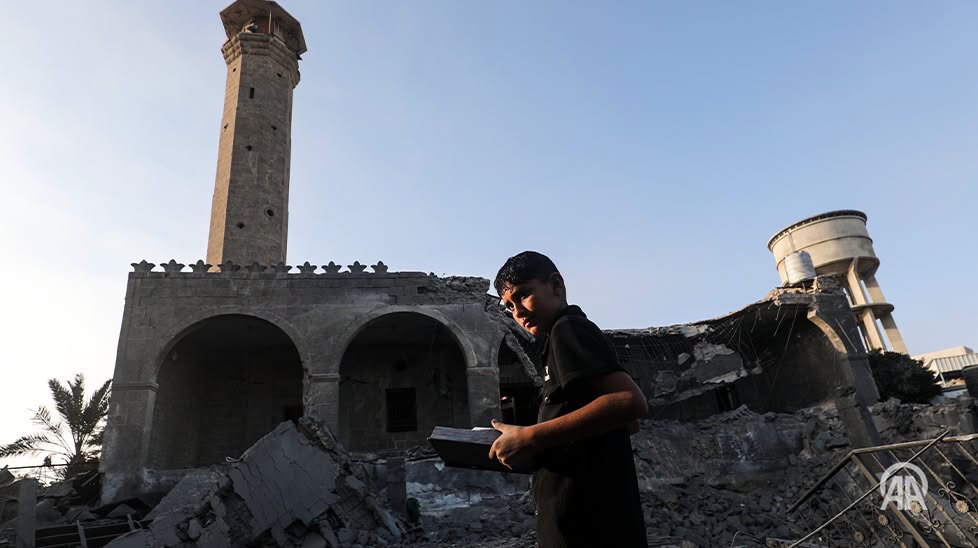
In their war on Gaza, the Israelis pulverized the educational sector in the enclave. There are no schools, no colleges and no universities due to the mass bombs deliberately targeting these institutions since 7 October, 2023.

Over 90,000 Palestinian university students in Gaza have no universities to go back to when the war ends.

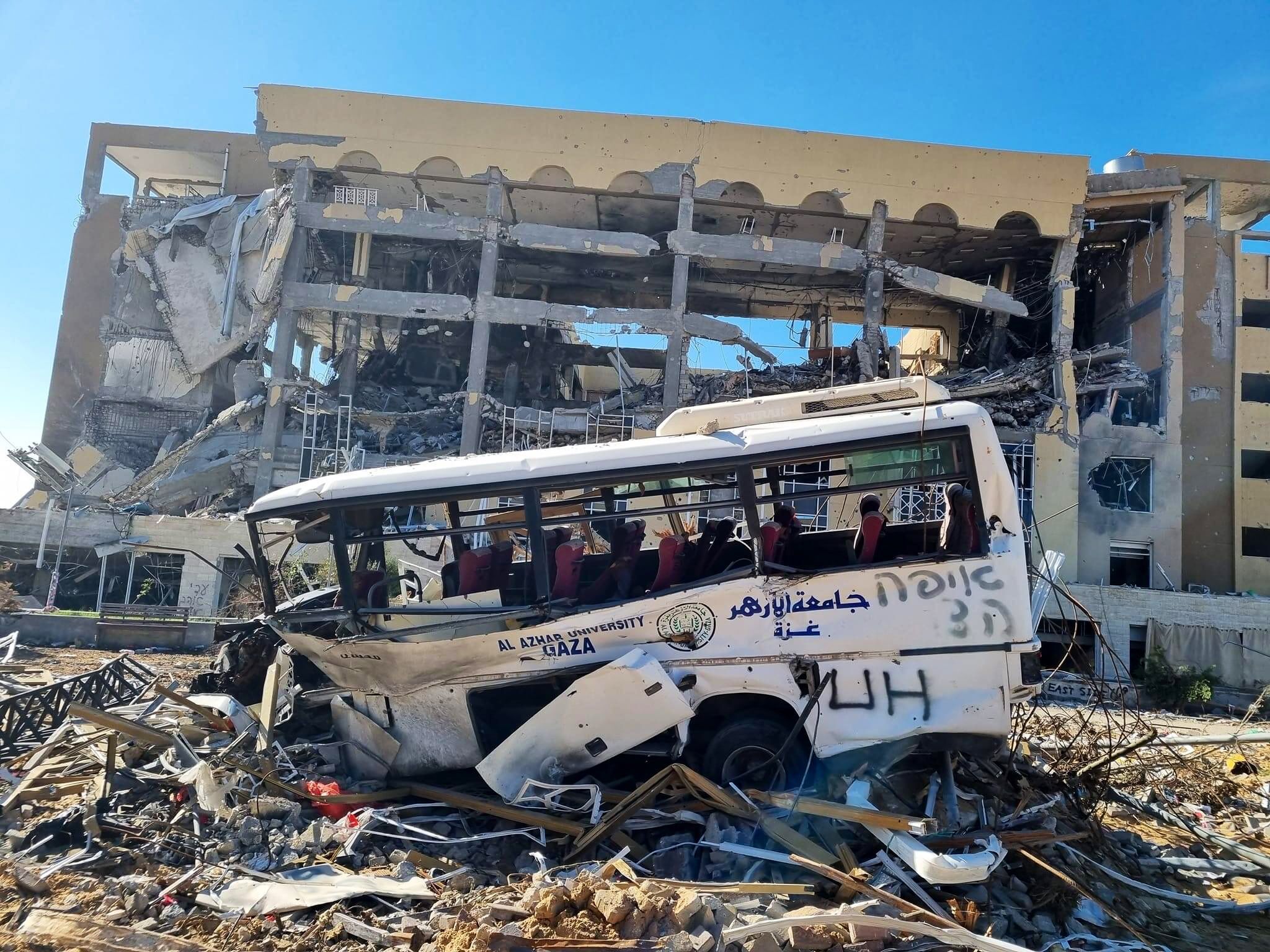
Israel’s bombings have turned all of the 12 universities in the Strip into piles of rubble, campuses are a wreck, student lecture halls no longer exists, tumbledown buildings have become the standard textbook case of woes and misery underlined by running sewers and dirty water floods.  

Besides, the mass attack on the higher educational system by Israeli warplanes targetted and killed nearly 100 Palestinian scholars, deans, scientists and professors, calling this criminal rampage as scholastide with the Israeli intention of destroying the whole system of education in the Gaza Strip as UN experts pointed out.

To demonstrate his outrage, Palestinian-American Dr Tariq Haddad refused to meet US Secretary Anthony Blinken after Israel killed 100 people from his family in its Gaza genocide. Among his family, included physicians and professors who were murdered wantonly.

The attack on the universities was deliberate attempt to destroy Palestinian culture and learning.  Al-Aqsa University in Khan Yunis, in the south of the Gaza Strip, was completely decimated, made dysfunctional by an Israeli regime that has long forgotten knowledge culture and civilization.

Al Aqsa University began to be destroyed slowly since the end of 2023. As Palestinians started to move in search of safe areas, they found Al Aqsa University. It had been turned into a place for the thousends of displaced people being forced out of their homes by Israeli warplanes.

Once the Israeli army started to hear of that, they increased the bombing of this institution accomplanied by carnage, killing and mayhem.

The same is the case with the Islamic University in Gaza which was completely destroyed by the Israeli occupation forces.

The Islamic University was the biggest educational learning in Gaza, yet all of its faculties were completely destroyed soon after 7 October.

There are plenty of pictures that show “before and after” – a horrendous, vicious attack on educational learning.

One Israel soldier relished his destructive work so much, decided to film himself walking through Al Azhar University which is now lie in a desolate, dilapidated state.

In a mock display, he walks among its ruins, saying the university is now closed for reconstruction and asking the Israeli soldiers who have now come to occupy its wrecked and debris-ridden halls, if they want to sign up for the new semester.

In rememberance of their destructions, Middle East Eye ran a piece on those higher learnings that once existed. Besides the Islamic University of Gaza and the Aqsa University, there was Al Israa University, Al Azhar University, Palestine Technical College, University College of Applied Sciences, University of Palestine, Gaza University, Hassan II University of Agriculture and Environmental Sciences and Dar Al Kalima University.

But there all gone now. US Congressman Bernie Sanders tries to emphasize the point across to the US Senate about student protesters in US university campasses for the support of Palestine. He told Senators in Gaza there are no student protesters because every one of the 12 campuses there were destroyed by the Israelis.

Another Israeli soldier found it appropriate to take a selfie of himself behind a book shelves in Al Aqsa University which he just set on fire.

The rampage of the University which is located in Khan Younis, to the South of Gaza City, was second largest city in Gaza, occupied for the best part of three months by the Israeli army in a bid to get rid of Hamas and Palestinian resistance fighters.

Israeli soldiers gave up last April and left. They hadn’t destroyed the resistance, but what they decimated Khan Younis, its university, colleges and schools. It was pure terroristic vandalism.

The photo of the Israeli soldier went viral. It shows him holding a book while a fire burns behind him in the Al Aqsa University library that is one of the largest book depositories in the Gaza Strip.

Despite the killing of its doctors, nurses, computer scientists, engineers, teachers, lectures, workers, journalists and many other professions, Palestinians are still hopeful about the “day after” when the war will end.

The image of 21-year-old Duaa from deep down Gaza is heartening. It is a call for the outside world to let her continue her studies despite the fact “…we are living in a state of occupation war that destroyed my home, my country, and my university…” she said.

And there are many like her which means the destroyed universities will be rebuilt one day and the educational system will be rebuilt and reconstituted despite the Israeli slaughter because Palestinians will not go anywhere accept stay in Gaza.

  • CrossFireArabia

    CrossFireArabia
    Dr. Marwan Asmar holds a PhD from Leeds University and is a freelance writer specializing on the Middle East. He has worked as a journalist since the early 1990s in Jordan and the Gulf countries, and been widely published, including at Albawaba, Gulf News, Al Ghad, World Press Review and others.

    Related Posts

    Hormuz: Mines, Strategy or Business?

    By Ismail Al Sharif

    The US thought that assassinating senior Iranian leaders would bring down the regime, but this did not happen.

    Iran’s inability to match American military and technological superiority led it to adopt a number of strategies, most notably what is known in the military literature as the Mosaic Defense Doctrine. This doctrine is based on dismantling its military central command into small, independent units, each operating autonomously and making its own decisions without consulting the higher command.

    From Day 1 of the war, Iran adopted this approach. However, the lack of coordination and the disintegration of the military hierarchy led to chaos and confusion which affected the management of its operations. The situation became contradictory; the politicians were declaring one thing and military commanders acting in a completely different manner and direction.

    This was reflected on the ground through extremely dangerous behavior. Military units, using small boats, indiscriminately laid naval mines to deter enemy ships. However, the lack of coordination here backfired resulting in the Iranian navy officers losing their ability to pinpoint the coordinates of the mines they planted in the Hormuz Strait with no accurate maps or reliable records. Some of these mines may have been completely displaced by the currents of the sea. This was further complicated by the fact that these mines were not primitive but far from it; they were sophisticated and able to detect sound and pressure, and thus able to track the passage of large ships and submarines, and detonate automatically upon approach.

    However, mine removal is not easy task, as history shows. Even today, news reports continue to surface of mines in various parts of the Kingdom, half a century after the last war. Indeed, mines from World War II are still being discovered on land and at sea.

    Even with Britain’s pledge to remove mines after the war, and despite possessing the latest specialized technologies in this field, the task remains arduous, protracted, and uncertain. The specter of a sudden explosion looms, reminding us that the danger of mines is not easily eliminated.

    But the decisive factor in weakening navigation in the Hormuz Strait is not primarily military, but rather material. Commercial ships are massive investments, with some vessels valued at around $150 million and their cargoes potentially worth hundreds of millions of dollars. Therefore, a single mine explosion can cause catastrophic losses to both the ship and its cargo. Consequently, no ship sails without insurance; ports, banks, and shipping companies refuse to deal with uninsured vessels, and without insurance, global shipping grinds to a halt.

    Herein lies the real surprise: the fate of the Strait is no longer dependent on Iran’s pronouncements regarding its opening or closure, but has effectively fallen into the hands of insurance companies. With the escalating risks, insurance costs have skyrocketed; “war risk” premiums have jumped from approximately 0.25% of the ship’s value to nearly 1% or more, exceeding a massive $1 million per voyage. And it doesnt stop there; seven major insurance companies announced their complete withdrawal, issuing notices of coverage cancellation just within just 72 hours.

    And here comes the decisive turning point: Once the insurance coverage is lost, maritime traffic ground to a halt. During this 39-war, ships have effectively ceased sailing with the number of vessels transiting the Strait plummeting by more than 80%. Around 150 oil tankers remain anchored offshore, and major shipping companies suspended their operations, as if this vital artery of global trade had been frozen by a financial, rather than a military decision.

    The US government attempted to provide alternative insurance coverage, but this effort failed and US President Trump’s pronouncements regarding mine removal were inconsistent with the reality.

    The issue of reopening the Strait has once again become a prominent topic, but the deeper truth is that its fate is no longer determined by political statements or military actions, but rather by the decisions of insurance experts. Even if the war were to end immediately, ships would not resume sailing right away. Insurance companies need time to reassess the level of risk, and they base their decisions not on political logic, but on cold, hard numbers and rigorous data.

    This article was originally published in Arabic in Addustour daily newspaper and republished in English in crossfirearabia.com.

    Continue reading
    A War That is Not Likely to Stop

    By Dr Marwan Asmar

    It’s day 22 of the US-Israeli war on Iran and it’s turning out to be a spiraling bloody conflict that is becoming difficult to contain with ballistic missiles at the top of the attack with reports that Tehran and Hezbollah has attacked Israel with at least 1200 missiles since 28 February 2026.

    American President Donald Trump thought the war would be easy, slick and short leading to the collapse of the Islamic government of Tehran. But this has turned out to be a short-sighted, parochial view that meanings nothing to today’s international relations.

    Today, the Iranian government is fighting in all three fronts: Striking at American bases in the surrounding Gulf region. Striking at American naval ships, tightly closing the Hormuz Strait to international shipping, especially to US and Israeli vessels and massively striking at the heart of Israel on a daily basis. 

    On day 22 the war has failed to reach the US/israeli objective which is to change the regime in Tehran. Instead the Islamic government with its Islamic Revolutionary Guard Corp (IRGC) has remained intact, strong and fighting with their different missiles and drones that are being introduced for the first time to strike US military bases, navel ships and on Israeli cities and military installations the latest of which on locations very near the Dimona nuclear reactor in which 175 people have been injured.

    While US-Israeli coordinated strikes on Iran and its capital Tehran are deadly – with so far over 7000 strikes and bomb drops, the Iranian military machine is proving formidable. Despite the killing of its leadership lead by Iran’s spiritual leader Ali Khameini on the first day of the war as well as 13 subsequent leaders and ministers, Iran today is fighting in what has become a war with strategic equations.

    And despite the killing of Ali Larijani, secretary of the Supreme National Security Council, and who came to direct the efforts of the war, today the IRGC is the primary player that is leading the what has become a deadly fight. They have not been affected by the strikes on the country despite the American and Israel public relations campaign that is constantly stating that Iran’s arsenal has been greatly diminished and is about to give up. 

    As evidence of that is the fact that USS destroyer Abraham Lincoln has been constantly hit and has finally been moved more than 1000 kilometers of Iran’s coast deep down the Arabian Sea, albeit to a safe place.  

    This is while also, the USS destroyer Gerald Ford has been taken to Greece for repairs because of fire on its deck. Trump has said already that the Iranian navy has been destroyed but the fact is they continue today to patrol the Hormuz Strait tightly controlling the entry and exit of ships, vassals and oil tankers. 

    The mighty US navy and their Israeli allies and their military might and superior air power that are said to control the Iranian airspace or so-called, haven’t been able to unlock the IRGC control over the strategic waterway resulting in soaring oil prices that today exceed $100 and are in an upward spiral while creating enormous disruption in trade, commodities and medical merchandise.

    Today, the world is experiencing its worst economic days thanks to the intransigence of the US president and Israel, a state that is also experiencing its worst days because of the extent of the missiles that are penetrating their anti-rocket batteries and are falling on its cities, neighborhoods, destroying and damaging their buildings and homes whilst keeping millions of Israelis down underground shelters at all hours of the day and night because of their Prime Minister Netanyahu who has been the prime instigator of this war on Iran and forcing the hand of the US into this conflict.  

    However, Iran has proved to be not an easy ride surprising everyone with its technological gadegatories and different state-of-the-art missiles.

    Today it is refusing to get back to the negotiating table at the end of week 3 of the war despite the pleas made by Trump and his envoys Gerard Kusher and Steve Witkoff who have been sending emails, messages to Iran’s Foreign Minister Abbas Aragchi to stop the war and establish a negotiated settlement. 

    The Iranian government have said they are not interested in a deal that is likely to be broken at the whim of Trump like what happed in the June 2025 12-day when the US president stopped the fighting at the please made by Israel. Today Aragchi says any agreement to a ceasefire must be made through ironclad conditions to make sure that Iran won’t be attacked again just when these countries feel like it.

    Meanwhile the war goes on and Israel continues to be attacked which the US administration at the White House continuing to search for a way out to stop a war that is in nobody’s interest.

    Marwan Asmar is an Amman-based writer who blogs at crossfirearabia.com

    Continue reading

    You Missed

    Zamir: Israel May Resume War on All ‘Active Fronts’

    Zamir: Israel May Resume War on All ‘Active Fronts’

    Haaretz Emigré: ‘Israel is a Broken Society’

    Haaretz Emigré: ‘Israel is a Broken Society’

    11 Israel Soldiers Commit Suicide in April

    11 Israel Soldiers Commit Suicide in April

    Palestinian Pound Lives on!

    Palestinian Pound Lives on!

    Israeli Settlers Uproot 400 Olive Trees

    Israeli Settlers Uproot 400 Olive Trees

    Amidst Death, Palestinians Celebrate in Group Wedding!

    Amidst Death, Palestinians Celebrate in Group Wedding!