Living in a Tent: Gazans Pour Out Their Woes

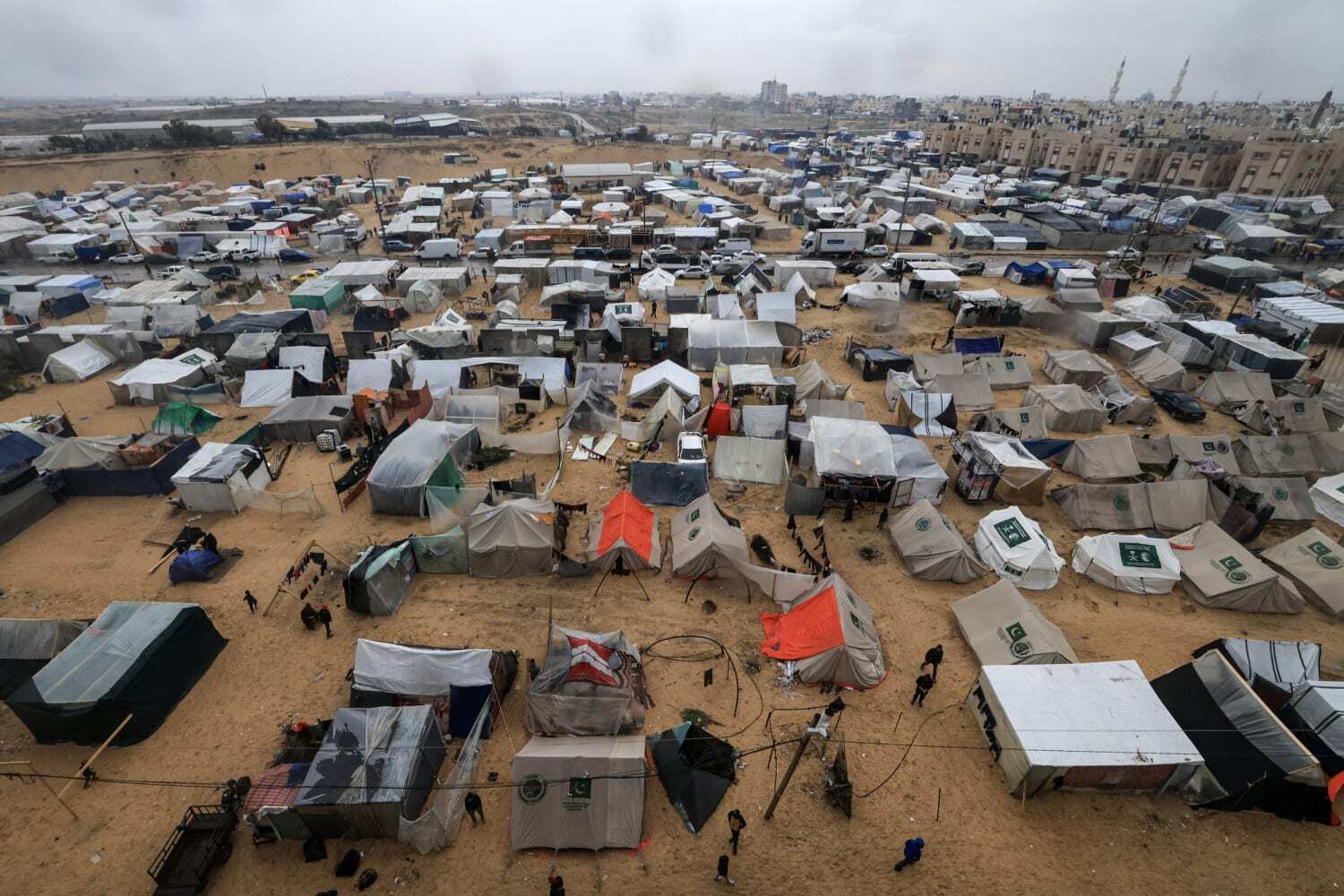
Across vast agricultural lands and along the coast in central and southern Gaza, tens of thousands of tents have become shelters for hundreds of thousands of Palestinians displaced by the ongoing, bloody Israeli war for the 10th consecutive month.

Once a symbol of the Nakba (catastrophe) and displacement for more than seven decades, the tent has now become a dream for thousands of displaced families in Gaza, despite the harsh living conditions it imposes.

What is it like to live in a tent? This question might seem devoid of emotions and disconnected from the harsh realities of Gaza amid the Israeli genocide that has taken many Palestinian lives but failed to break their will and determination to cling to their land. However, the  question is crucial to understand the extent of the Palestinian tragedy and resilience.

The Palestinian Information Center (PIC) interviewed some of those that were displaced and are now living in tents to see the harsh situation they are now under.

Quest for a tent


Whilest all those interviewed speak of the difficulty of living in a tent – suffering the harsh hot summers and cold winters – for many of the displaced, the tent has become a dream come true as it is easily hoisted and dismantled quickly. This is important for those displaced who needed to move more than once because of the Israeli army gunfire, tanks, drones and warplanes.

Mohammed Said said he bought a tent for 1,200 shekels ($330) after he could no longer bear living in a “khas,” a makeshift shelter made of wooden sticks covered with nylon or any other available material.

He explained a khas provides no privacy because of the mostly nylon material its made of and its impossible to move when forced to relocate. Thus, he went for a tent, having relocated at least twice already.

Various NGOs provide tents for free, but with demand shooting up some of the tents have started to be sold, forcing people to buy them due to the lack of alternatives. Today tents vary in shape and size, according to how much you want to pay.

Finding a place to set up the tent
After getting a tent, the second challenge is to find a place to set it up. Such areas are currently limited to around Khan Yunis and Deir al-Balah.

Khaled Al-Masri said he had to move his tent several times to be close to water sources and/or the scarce aid.

“Today, there are camps made up of a group of tents overseen by an association or individuals’ initiatives to provide some aid, ensure water access, and establish shared bathrooms. Other tents are set up randomly on agricultural land and near destroyed homes,” he said.

Life in the tents


Living in tents are tales of pain and suffering, varying according to the family’s resources, number size, tent location and the supervising entity.

A small family with a tent in an area receiving aid can adapt better and suffer less compared to an extended family with a small tent in an area lacking in services.

With the scorching summer heat, living in a tent among hundreds of others in Gaza feels like a living hell said  Amani Hamdan.

Hamdan told PIC she was forced to live in a tent on a land of a friend of her husband.  She is joined by her mother-in-law, disabled sister-in-law and her four children.

 “We relocated at least seven times from Khan Yunis since our house was bombed. Initially, we had no tent and suffered much until we managed to obtain one, and its only advantage is it can be unhooked easily if we need to move again.

Living in a tent is harsh and difficult, a  primitive life. And with no walls, and privacy, our voices reach the people in the tent next door and theirs reach us,” she added.

Suffering in tents


“We can hardly move around inside the tent, some  sleep on mattresses, some without, part of the tent holds food supplies. The temperature is scorching, forcing us out of the canvas. In winter, we were drenched by rain; now, the heat is unbearable, but we thank God for what we have,” Hamdan added.

“We cook on fire outside the tent, bake bread in a shared oven, share a bathroom, and bathe rarely, needing prior coordination with the other tent partners. The children start their morning search for wood, while my husband travels long distances for water that is sometimes brought by volunteers. Life has become primitive with no kitchen, bathroom, or water faucets.”

What is a tent?


After enduring the harsh tent life for months, engineer Mohammed Munir wrote about its meaning, “To burn while sitting inside, to suffocate with no air or cooling. It’s like a greenhouse during the day.”

 “A tent means living on the ground, separated only by fabric, coexisting with all the insects of the earth as you are now their guest,” He wrote on Facebook.

“Normal activities become complicated, like taking a nap or a bath, walking comfortably, sitting peacefully, feeling safe, or sleeping without back pain from the hard ground, all of our dreams are now out of reach.

A tent means no privacy, speaking in whispers inside your tent while your neighbor hears you. With tents set up on sand and agricultural land, it means living with all types of insects and with no hygiene,” Munir concluded.

The meaning of a tent


“A tent means having no wall to lean on, no private life,” Sama Hassan wrote.

 “Displacement means not to live in safety or stability. We first moved from Gaza City to the north in search of ‘fake’ safety until the missiles to land on us. We then fled to southern Gaza in the first Friday of the war and stayed in Khan Yunis for two months, then moved to Rafah when the city was invaded in early December 2023.

 With each relocation, I lost a thread of my privacy, becoming more displaced and homeless like thousands in Gaza. A tent is harsher than a shared room in a stranger’s house as the bathroom is either within the tent, set up primitively, or shared, half a kilometer away, established by a charity. If a woman needs to use it at night, she must wake a man to escort her,” she ended by saying.

Life in a tent is hard for women, who must fully dress as they usually do when they go out of the house. She maintains dressed at all time despite the heat, lack the freedom of movement. In the tent, fires are lit, cooking is made, washing dishes, with large water containers placed in the corner.

Bathing in a tent involves women surrounding the one washing with thick blankets, like forming a small tent within the main tent, with the woman hurrying before the others tire of holding the blankets.

If living in a tent is already insufferable, doing so amid the ongoing Israeli genocide and bombings is even more so, because the strikes continue targeting as what happened to us in Rafah and Khan Yunis. This is beyond words.

In recent months, Israeli bombs have burned tents and killed dozens, leaving survivors to search for the remains of their their loved ones before finding a new place to set up another tent if one is available, continuing their struggle.

CrossFireArabia

CrossFireArabia
Dr. Marwan Asmar holds a PhD from Leeds University and is a freelance writer specializing on the Middle East. He has worked as a journalist since the early 1990s in Jordan and the Gulf countries, and been widely published, including at Albawaba, Gulf News, Al Ghad, World Press Review and others.

Related Posts

‘All I Want is to Bury My Family in Dignity’  

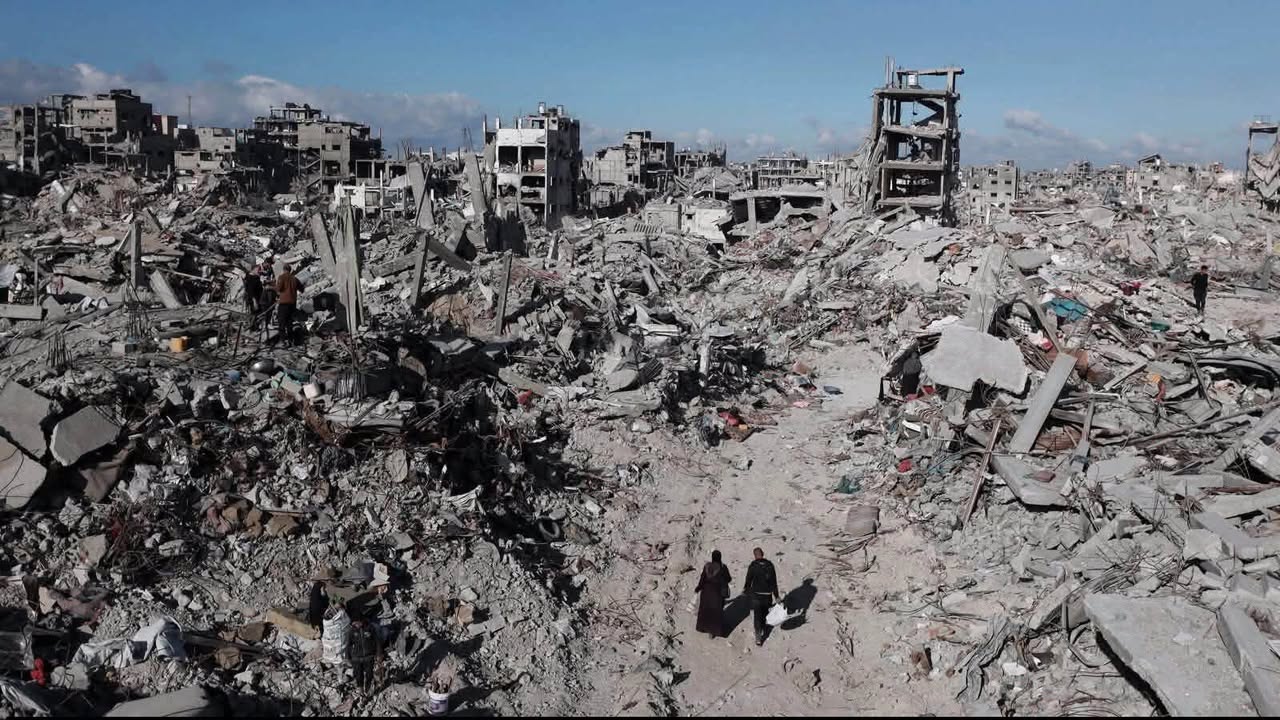
GAZA – Abdel Rahman Khalla no longer holds any dreams of a life; there is no home waiting for him, no family to return to, and no future he can envision as he once did. After losing 39 members of his family under the rubble of their home in northern Gaza, all hopes and aspirations dwindled to a single wish: To find the bodies of his loved ones and bury them with dignity.

Amidst the heavy stones, the dust, and the agonizing wait, he now asks for nothing more than a simple human right: A grave to embrace those who have passed away, and an end befitting the story of a family wiped out by war.

He has decided to dig and undertake this task himself.

Amid the rubble of a five-story building, Khalla stands as the sole witness to one of the most horrific massacres in northern Gaza. He lost about 39 members of his family in a single attack on their home in the Jabalia al-Nazla area on 21 December, 2023.

Read also: Gaza: Civil Defense begins recovering bodies from rubble

Abdul Rahman, the sole survivor of his family, recounts the details of the tragedy, which continues till this day. He says that 39 people, including women and children, were inside the house at the time of the bombing. All were killed under the rubble and no one else emerged alive.

He adds that only 18 bodies were recovered, while the rest, 20 to 21 others, are strill trapped under the debris – over 30 months later because there was no heavy machinery to remove the rubble and debris. Today, Israel continues to block such machinery from entering Gaza.

Abdul Rahman confirmed to the Sanad News Agency they exhausted all avenues, appealing to the Red Cross, Civil Defense, and the Jabalia al-Nazla Municipality, as well as the Qatari and Egyptian committees, requesting such heavy equipment to help in recovering the bodies but all of their appeals went unanswered.

“After 30 months of suffering, we decided to dig with our bare hands,” Abdul Rahman explained, adding the members of his surviving family had only begun manually removing the rubble four days prior, using simple and worn-out tools such as shovels, picks, and light rakes, despite the dangerous situation and the sheer size of their building that collapsed.

But during these arduous efforts, they only managed to recover two bodies; one belonging to his uncle, and the other who remains unidentified. About 19 bodies remain buried under the rubble, awaiting recovery and a proper burial.

Abdel Rahman appeals to the Egyptian Committee and the Reconstruction Committee for urgent intervention, requesting they send bulldozers and trucks to remove the rubble and debris. He emphasizes his family is not asking for the impossible, but simply for their right to reach their loved ones and bury them with dignity.

The tragedy of the Khalla family is not just another statistic in the war’s record, but a human story that speaks of all the suffering of Gaza, where entire families still live amidst the ruins of their homes, searching for their martyrs and awaiting for a long-delayed mercy.

Despite the ceasefire agreement in Gaza that came into effect on October 10, 2025, the Israeli occupation authorities continue to evade their obligations by preventing the entry of hundreds of heavy vehicles needed to remove the thousands of tons of rubble scattered throughout the Strip.

According to data from the Government Media Office, the occupation destroyed 90% of the civilian infrastructure in Gaza during the two years of its offensive, leaving behind more than 70 million tons of rubble, in one of the region’s largest humanitarian disasters in the world.

The Civil Defense Authority indicated in previous statements that dozens of families in Gaza continue to send appeals for help in recovering their relatives months after their martyrdom, but the Authority is unable to respond due to the lack of necessary equipment.

This article was in the Arabic Sanad Lil Anba website and reproduced in crossfirearabia.com.

Continue reading
‘Living Graves’, Is How Palestinian Journalist Describes Israeli Prison

Veteran Palestinian journalist Ali Samoudi described Israeli prisons as “living graves” after his release on Thursday, appearing in severely deteriorated physical condition following his arrest by Israeli forces last year.

Samoudi, who worked for the Palestinian newspaper Al-Quds and international media outlets, said he lost 60 kilograms (about 132 pounds) while in Israeli prison. “My weight was 120 kilograms (about 264 pounds); now my weight is 60 kilograms,” Samoudi said.

According to Samoudi, prison conditions were harsh and cruel, and prisoners suffered. “The food is very bad. Even a cat would not eat what they eat,” he said. “Prisoners have nothing. No notebook, no pen, nothing,” he added, calling on the families of detainees to take care of their well-being. 

He was arrested in April 2025 on false claims of transferring funds to the Palestinian Islamic Jihad. Samoudi and his family strongly denied the allegations.

In a statement issued in January, the Palestinian Journalists Syndicate said al-Samoudi has not been granted a fair trial and that his arrest is “a blatant violation of international law and press freedom”.

The syndicate also warned “that his life is now at risk” due to the harsh and inhumane treatment he has been experiencing in prison.

Samoudi’s son, Mohammed, said his father was an “independent journalist who isn’t affiliated with any party,” adding he was “surprised to hear him being accused of ties with Islamic Jihad. I was in shock.”

Mohammed said the forces raided their home at around 5 A.M., searched the premises and destroyed some of the family’s belongings before taking his father away. He said he didn’t know where his father is being held, but said the family is particularly worried because he is diabetic and suffers from high blood pressure, and therefore needs a special diet and medications.

On May 8, 2025, Wafa reported that an Israeli court had issued an administrative detention order against him for a period of six months.

This was because the Israeli army said it did not have “sufficient evidence” to formally charge him and had hence issued an administrative detention order.

In a statement issued to the United States news group CNN, the Israeli army said: “As sufficient evidence was not found against him, and in light of the accumulated intelligence material, security authorities requested to consider issuing an administrative detention order.”

The military claimed the order was justified as Samoudi’s “presence” posed “a danger to the security of the region”.

Since then, Samoudi has been held in administrative detention and his detention order has been repeatedly renewed.

Samoudi also witnessed the Israeli killing of Al Jazeera journalist Shireen Abu Akleh in Jenin in 2022 and was himself injured that day.

“I was there personally and witnessed the whole thing,” he said about the killing of his colleague. “There was no one there apart from the Israeli force, and they were the ones who shot at us.”

The Palestinian Prisoners’ Society said Samoudi is among more than 3,530 Palestinians held under administrative detention, in addition to over 40 journalists still held in Israeli prisons, including four women.

The group renewed calls for the release of all detained journalists and urged the international community to take responsibility for ongoing violations against prisoners.

More than 9,600 Palestinians remain in Israeli prisons, including women and children, facing torture, starvation and medical neglect, which have led to the deaths of dozens, according to Palestinian and Israeli rights groups. – Quds News Network

Continue reading

You Missed

An Egyptian House in a German Town

An Egyptian House in a German Town

Nakba Art

Nakba Art

Palestinian Population Tops 15.5 Million

Palestinian Population Tops 15.5 Million

‘All I Want is to Bury My Family in Dignity’  

‘All I Want is to Bury My Family in Dignity’  

Israeli Army: 18 Soldiers Dead, 910 Injured in Lebanon

Israeli Army: 18 Soldiers Dead, 910 Injured in Lebanon

Watch Out: Israel is Secretly Filling The West Bank With Settlements

Watch Out: Israel is Secretly Filling The West Bank With Settlements