Pentagon Probe Finds US Forces Behind Deadly Strike on Iran School

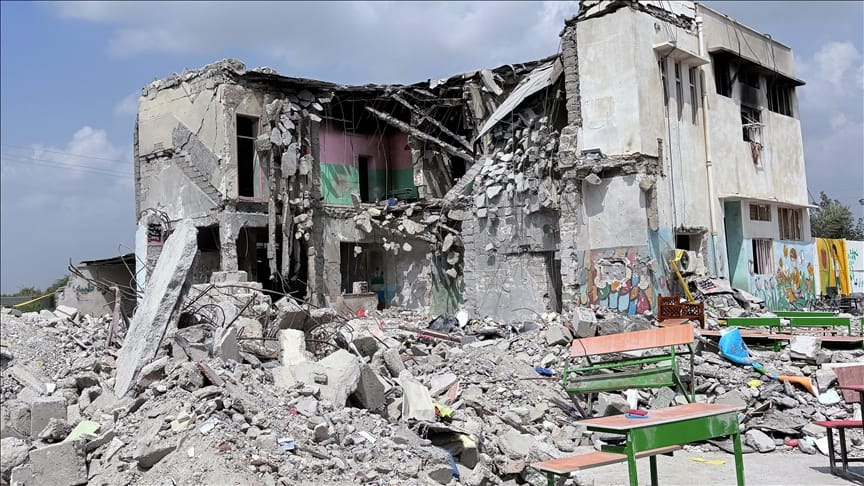
A preliminary US military investigation has concluded that American forces were responsible for a Feb. 28 deadly strike on an Iranian elementary school, the New York Times reported Wednesday, citing US officials and others familiar with the findings.

The strike on the Shajarah Tayyebeh elementary school was the result of a targeting error in the early hours of the war that Israel and the US started against Iran, the investigation found. Officers at US Central Command (CENTCOM) generated strike coordinates using outdated Defense Intelligence Agency data that still identified the school building as part of an adjacent Iranian military base, a designation that was no longer accurate.

The Pentagon did not respond to Anadolu’s request for comment.

The findings align with a series of earlier analyses. CBS News had reported that a preliminary US assessment found American forces were “likely” responsible, citing possible use of dated intelligence.

The report aligns with earlier analyses by the Bellingcat investigative outlet and the New York Times, both of which found evidence that a Tomahawk missile, a weapon only the US is known to possess among the warring parties, struck a compound of Iran’s Islamic Revolutionary Guard Corps (IRGC) near the school.

US President Donald Trump initially blamed Iran for the strike, saying Tehran’s munitions lacked accuracy. The attack killed scores, many of them children, according to Iranian officials.

Multiple outlets, similar conclusions

Several other outlets also pointed to US responsibility based on satellite imagery, geolocated videos and expert assessments.

The Wall Street Journal, citing an American official, reported that US military investigators believe American forces were likely responsible, though no conclusion had been reached. The official claimed there were indications that the building had been used as an IRGC headquarters.

The New York Times, drawing on satellite imagery and geolocated videos, found the school was struck at the same time as precision hits on an adjacent IRGC naval base, with a former US Air Force official suggesting the most likely explanation was “target misidentification.”

BBC Verify reported multiple impact sites and burn marks around the school and nearby IRGC facilities, with analysts saying the damage pattern suggested the use of a penetrating munition.

A reconstruction by Britain’s The Guardian also placed the school directly adjacent to an IRGC compound, separated only by a wall built in recent years.

Middle East Eye, citing survivors and first responders, reported a possible “double-tap” strike — a second explosion hitting the area shortly after the first, striking those who had taken shelter.

CBC News noted the attack coincided with the first wave of US-Israeli strikes across southern Iran.

UNESCO described the killing of students as a “grave violation” of protections for educational facilities under international humanitarian law and called for a full investigation. No side has formally claimed responsibility.

  • CrossFireArabia

    CrossFireArabia
    Dr. Marwan Asmar holds a PhD from Leeds University and is a freelance writer specializing on the Middle East. He has worked as a journalist since the early 1990s in Jordan and the Gulf countries, and been widely published, including at Albawaba, Gulf News, Al Ghad, World Press Review and others.

    Related Posts

    Israel Kills 200 Lebanese Children – UNICEF

    More than four children have been killed or injured every day on average in Lebanon in the first 25 days of a temporary ceasefire with families still unable to return to their homes, said Save the Children.

    New data from Lebanon’s Ministry of Health on Tuesday showed that 22 children have been killed and 89 injured since the temporary ceasefire started on 17 April. This brings the number of children killed in Israeli strikes since renewed escalation in hostilities in Lebanon on 2 March to almost 200 with about 2,900 people killed.

    The violence and renewed displacement orders have forced more than one million people – or one in six of the population – from their homes with many now living with relatives, in host communities or in collective shelters.

    The number of families living in collective shelters has increased 5% since the conditional ceasefire due to renewed displacement orders by Israeli forces and as families return home to find destroyed houses and damaged farmland so move back the collective shelters. There are now 44,800 children among about 125,000 people in collective shelters.

    Thousands of children have been living in collective shelters for over two months in overcrowded conditions with inadequate water, sanitation and hygiene facilities leading to reports of scabies and growing health concerns.

    Parents are reporting widespread behavioural changes among children living in collective shelters due to a lack of routine and reduced school engagement including loss of appetite and trouble sleeping. Many children are struggling to continue learning with some schools used as collective shelters and also difficulties accessing online learning due to limited electricity, and poor connectivity.

    Tala*, 10, has been living in a collective shelter after being displaced from southern Lebanon, said:

    “I just want the war to end so I can go home to my village and sleep in my own bed. I really miss school, I want to see my teachers and be with my friends, and study and play again.”

    Nora Ingdal, Save the Children’s Lebanon Country Director, said:

    “This ‘so called’ ceasefire that still sees more than four children killed or injured every day is not a ceasefire for children. Attacks on civilians have not stopped – it has simply continued under another name. Colleagues have told me that the airstrikes feel more intense in some areas than they ever did before. Children are not safe until there is a permanent and definitive ceasefire with no violations.”

    With further peace talks set to take place on Thursday to determine next steps between Lebanon and Israel, Save the Children is calling on the international community to urgently work toward a permanent and definitive ceasefire and ensure flexible and sustained funding to protect children and allow families to return home to resume their lives.

    Save the Children has worked in Lebanon since 1953. In collaboration with partners and local authorities, we are distributing essential items in hard-to-reach areas in the south, provide psychosocial support for children, educate families and children about the risks of unexploded ordnance, ensure access to safe water and sanitation facilities, and distribute essential items for those displaced.

    ENDS:

    Sources:

    Lebanon Ministry of Health

    Israeli strikes have killed 380 in Lebanon since truce: Health ministry

    Lebanon Ministry of Health

    Lebanon-Emergency-Sitrep-23-2026.pdf

    Continue reading

    You Missed

    Jordan 2007! Elections and Hiccups: Looking Backwards

    Jordan 2007! Elections and Hiccups: Looking Backwards

    Iran is Writing The Final Chapter!

    Iran is Writing The Final Chapter!

    Gaza Fishermen Dream of Life Prior to 7 Oct

    Gaza Fishermen Dream of Life Prior to 7 Oct

    Giant Phillippines Volcano Shows no Rest!

    Giant Phillippines Volcano Shows no Rest!

    The Chinese Fortune Cookie and The “Thucydides Trap”! A  View From Amman

    The Chinese Fortune Cookie and The “Thucydides Trap”! A  View From Amman

    Israel Kills 200 Lebanese Children – UNICEF

    Israel Kills 200 Lebanese Children – UNICEF