Analysts: US Fails on Houthis After Six Weeks of Bombing

After nearly six weeks of intensive US airstrikes on different areas and cities of Yemen the Houthi Ansar Allah continues to assert that its military operations in the Red Sea and against Israeli targets will not stop until the ongoing Israeli war on the Gaza Strip ends.

Houthi military spokesman Yahya Saree, Saturday, announced the targeting of the Israeli Nevatim Air Base in the Negev with a ballistic missile, as well as two other sites in the Tel Aviv and Ashkelon areas and the targeting of warships on the US aircraft carrier SS Harry Truman in the northern Red Sea are just part of the continuing ongoing military strikes.

However in response to these attacks the US aircraft launched two airstrikes last Friday night on the Ras Isa oil port in the coastal province of Al Hudaydah, which Washington considers a major source of fuel used to finance the Ansar Allah group’s activities.

According to Dr Liqaa Makki, senior researcher at the Al Jazeera Center for Studies, the USA has failed miserably in its strikes against the Houthis because of its inability to move to the second phase. He said that as a result they are  discussing an alternative scenario for this military campaign against the Houthis.

Makki believes that US President Donald Trump has reached a dead end, and that the ceiling he set regarding the Houthis is proven unrealistic, pointing out the United States, despite its military strength, is failing in Yemen because it is fighting a group, not a state.

On the other hand, military and strategic expert Brigadier-General Elias Hanna, believes that both sides are losing, whilst the image of the United States is being damaged, given the scale of the US military campaign and Trump’s engagement with the Houthis, who previously declared that  “we [US] will withdraw from all the world’s wars.”

Reports estimate the cost of the airstrikes carried out by the US military on Houthi positions amounted to approximately $1 billion in the first three weeks of the military campaign alone.

The Associated Press reported the value of the seven downed American drones made by the Houthis exceed $200 million, and the continued loss of American drones makes it difficult for the US leadership to accurately determine the extent of the damage to the Houthis’ weapons stockpiles.

Brigadier-General Hanna said that Washington lacks a comprehensive strategy in its dealings with the Houthis, and that the political goal it announced—restoring deterrence and opening shipping lanes—has not been achieved.

He also pointed out the US military is targeting the centers of gravity within the Houthi military system to disrupt it, a strategy Israel has used with the Palestinian resistance but has failed to achieve.

Appeasing the Houthis

In light of Washington’s inability to achieve its goals against the Houthis, Brigadier-General Hanna believes the pressure being exerted on Israeli Prime Minister Benjamin Netanyahu regarding the entry of aid into the Gaza Strip is part of an effort to appease the Houthis so that they will halt their operations in the Red Sea and against Israeli targets.

Trump’s upcoming visit to the region also requires a de-escalation. According to the military and strategic expert, the US president cannot arrive while the Houthis are launching missiles.

In the same context, the senior Al Jazeera’s Makki expects  that a Gaza ceasefire will soon be reached before Trump’s visit, allowing the Houthis to halt their operations as they have initially linked the cessation of their operations to an end to the war on Gaza and to the cessation of US strikes against them.

American officials have previously revealed to CNN that the US military has struck more than 700 Houthi targets and carried out 300 airstrikes since the campaign began in mid-March, “forcing them underground and creating confusion and chaos within their ranks.”
Continue reading
Netanyahu Has Irked Trump. Why?

What should one make of the recent White House meeting between US President Donald Trump and Israeli Prime Minister Benjamin Netanyahu?

Well, this time Netanyahu was almost summoned to the White House to be told few home truths. This meeting was not like the first time when Netanyahu came to the White House in early February when it was all glow to be unexpectedly told that Trump wants the USA to take over Gaza.

This time around, the meeting was more subdued, almost in a rush, like an after-thought on the part of Trump who keeps chopping and changing as he figures out how he wants to conduct America’s foreign policy in his second “robust” administration.

This time around, although Trump displayed the usual friendliness to Netanyahu, he was somewhat distant because of the tariffs the White House is set upon to start imposing on the rest of the world including best-friend Israel. Its leaders, businessmen are still in shock because Washington has slammed a 17 percent tariff on its products entering the United States.

Israeli industrialists continue to be up-in-arms. It was they who appealed to Netanyahu to seek Washington clarification because they argued that the new tariffs will cost them up to $3 billion in losses, reduce Israeli exports by 26 percent and increase unemployment by 26,000. They are already in a bad situation because of the war on Gaza but this latest step will surely cripple them.

At the White House meeting last Monday, with a chitchat in front of the cameras that looked as if it was a rehearsed meeting with Trump dominating the conversation and everyone taking their que to speak only when they are told, he pointed out to Netanyahu that he “may not” consider reversing tariffs on Israeli exports because “we give Israel $4 billion a year. That’s a lot.” He really sounded like lecturing to the Israelis.  

For a man considered to be greatly influenced by the Israeli lobby that seemed to be tough talking for in the immediate conversation Trump told Netanyahu that there would be and for the first time direct face-to-face talking with Iranians about their nuclear file.  

This seemed to be another unsuspecting blow. If there was a “shock” on his face, Netanyahu didn’t show it as he just nodded; the Israeli Prime Minister was looking for a tough military stance on Iran, possibly going to war and striking the country’s nuclear facilities. It was he, who persuaded Trump in 2018 to exit from the 2015 nuclear deal brokered by the UN with other world powers of Britain, France, Russia, China and Germany at the behest of the Barack Obama administration.

Now with Trump in the driving seat, and wanting a “tainted-Donald” deal, Netanyahu couldn’t but agree with an alluring American president. If he had any misgivings, he kept them to himself except to say Tel Aviv and Washington had an objective not to let Iran have nuclear weapons, but Tehran constantly said and throughout the past years that their nuclear program was for peaceful purposes unlike the clandestine extensive Israeli nuclear program.

Although he may not have outwardly shown it, Trump may have been a little irritated by Netanyahu in other ways. Take Gaza for example when Israel restarted its war on the enclave on 19 March exactly two months after a ceasefire took effect ending a 15-month genocide and which was brokered by Trump and his team lead Steve Witkoff.

The recent talks in the White House, and shown in front of the cameras suggest Trump would have like more time for the Doha negotiations to take hold between Hamas and Israel to see the release of the 59 remaining hostages – which include one American who is still deemed to be alive – hidden in the Gaza enclave.

The relaunching of the war, and so quickly, and with the breaking of the 19 January ceasefire is adding to the tension between Washington and Tel Aviv and is sending signals that Netanyahu wants to continue the war in Gaza and doesn’t particularly care about the remaining hostages, and whether they come out of their nightmare dead or alive.

Trump, and as shown by the White House meeting, is showing a diversion from thoughts projected by Netanyahu. As well as Iran, he has told Netanyahu, he favors Turkish President Recep Tayyip Erdogan and that he has a ‘very, very good relationship with Turkey and with their leader…”, adding that “I happen to like him, and we never had a problem” and he offered to mediate between Israel on any problem between the two countries.

Such words may have suddenly added to the glum mood of the Israeli PM who fears that Turkish influence in Syria despite the fact it is Israel that is today bombarding different Syrian cities and occupying parts of their territory, a situation that increased after the toppling of the Bashar Al Assad regime on 9 December, 2024 by a new government in Damascus, and which is seen as a threat to Israeli security by Tel Aviv.

What is worrying Netanyahu is the fact Trump recognizes Turkish influence and Syria and Ankara’s relationship with the new government in Damascus, and apparenty the man in the White House, is “ok” with it.

With all this going on, Netanyahu is not sure anymore of the way the White House is going despite the fact that Washington continues to be the main supplier of weapons to Tel Aviv. But with Trump as “fickle-minded” as he is, all cards are on the table for a new and changing relationship between the USA and the rest of the world with the strong possibility of including Israel in the new international set of thinking.

This comment is written by Dr Marwan Asmar, chief editor of the crossfirearabia.com website. 

Continue reading
Netanyahu’s Trap!

The already fragile ceasefire in Gaza was further shattered as Israeli Prime Minister Benjamin Netanyahu declared that Israel had “resumed combat in full force” against Hamas in the Gaza Strip on March 18, during the Muslim holy month of Ramadan. In the hours following Netanyahu’s announcement, Israeli airstrikes – which had already been routinely violating the ceasefire in recent weeks – killed more than 400 Palestinians, including a significant number of children. Later that day, Israeli forces launched a new ground offensive, reportedly killing at least 48 more Palestinians, according to local health workers.

Vowing to eradicate Hamas, Netanyahu described the renewed phase of state terrorism as “just the beginning”. Meanwhile, Israeli sources confirmed that the assault was conducted in “full coordination” with the United States. Also on Wednesday, Israel carried out an attack on a UN facility in central Gaza City, killing a foreign staffer and wounding five others. Jorge Moreira da Silva, Executive Director of the UN Office for Project Services, condemned the strike, stating: “Israel knew this was a UN compound where people were living and working. It is a well-known location.”

From the outset, Netanyahu’s office has justified the assault by accusing Hamas of preparing new attacks, refusing to release hostages, and rejecting all proposals put forward by US presidential envoy Steve Witkoff and other mediators. At the UN Security Council meeting on Gaza, convened just hours after the renewed Israeli offensive, the US envoy placed exclusive blame on Hamas for the collapse of the ceasefire. According to the Israeli government, approximately 59 Israeli captives remain in Gaza, with fewer than half believed to be still alive. Hamas, however, denied rejecting the US envoy’s proposal, accusing Netanyahu of deliberately resuming hostilities to sabotage the ceasefire agreement. The group characterized Israel’s actions as a “unilateral” annulment of the existing deal.

Arab countries, including Egypt and Qatar – both key mediators in the peace negotiations – have strongly condemned Israel’s latest military escalation. On March 20, the US State Department reaffirmed the “bridge proposal” put forward by the US President Donald Trump’s administration last week. It aims to extend the first phase of the ceasefire and hostage release agreement between Israel and Hamas, and remains on the table. Given this backdrop, the question arises: What is driving Netanyahu’s genocidal ambitions?


A zero-sum game?

Netanyahu appears to be maneuvering to reduce the original multiphase ceasefire agreement to just its first phase, securing the release of all Israeli hostages before resuming his military campaign in Gaza. Hamas, however, recognizes the trap. At present, neither the US nor mediators like Egypt and Qatar can offer Hamas any guarantees that if it releases all remaining hostages – both dead and alive – Israel will commit to entering the second phase of the agreement.

It is worth recalling that Israel had already delayed negotiations for the second phase, which was initially scheduled to begin 16 days after the agreement took effect. By the time phase one was set to conclude on March 1, Israel had refused to advance talks, effectively stalling the diplomatic process.

Since March 2, Israel has taken increasingly punitive measures against Gaza. According to the UN, it has blocked the entry of all lifesaving supplies, including food, medicine, fuel, and cooking gas, affecting 2.1 million people. It has also sealed off all crossing points and, on March 9, ordered a complete shutdown of Gaza’s electricity supply. The blackout has severely impacted desalination plants, which provide clean drinking water to some 600,000 people. Yet, despite these actions, Israel continues to evade accountability for its collective punishment of Gaza’s population.

What is Israel’s endgame for Gaza?

Israel appears to be accelerating efforts to implement what some critics describe as a plan to radically reshape Gaza’s demographic and political future. Netanyahu, frustrated by his failure to eliminate Hamas and achieve clear strategic objectives, is pampered by Trump’s proposal to “take over” and “own” the Gaza Strip. At present, Netanyahu is exploiting the geopolitical status— including high-level talks between Trump and Russian President Vladimir Putin over Ukraine and the US military campaign against the Houthis in Yemen—which have diverted international attention away from Gaza. This distraction provides him with an opportunity to escalate the attacks with fewer diplomatic constraints.

However, Netanyahu’s thirst for blood is not only deepening the humanitarian catastrophe in Gaza but also exacerbating regional tensions, pushing the Middle East toward prolonged instability. His actions risk triggering wider spillover effects, particularly in Lebanon and Syria, and further escalating an already volatile landscape. The pressing question remains: does Israel have a long-term strategy for Gaza, or is it merely waging a campaign of destruction with no viable political exit strategy? Another crucial consideration is, following their emergency summit in Cairo on March 4, how will the Arab League reconcile Egypt’s reconstruction plan with Israel’s relentless aggression?

The urgency of a concerted diplomatic and strategic effort to curb Israeli aggression and expansionism cannot be overstated. Without immediate intervention, the entire region will bear the long-term consequences of unchecked military escalation and political destabilization.

Serhan Afacan is associate professor at Marmara University’s Institute for Middle East Studies and president of Center for Iranian Studies (İRAM).

Continue reading
Genocidal Maniac From The Start!

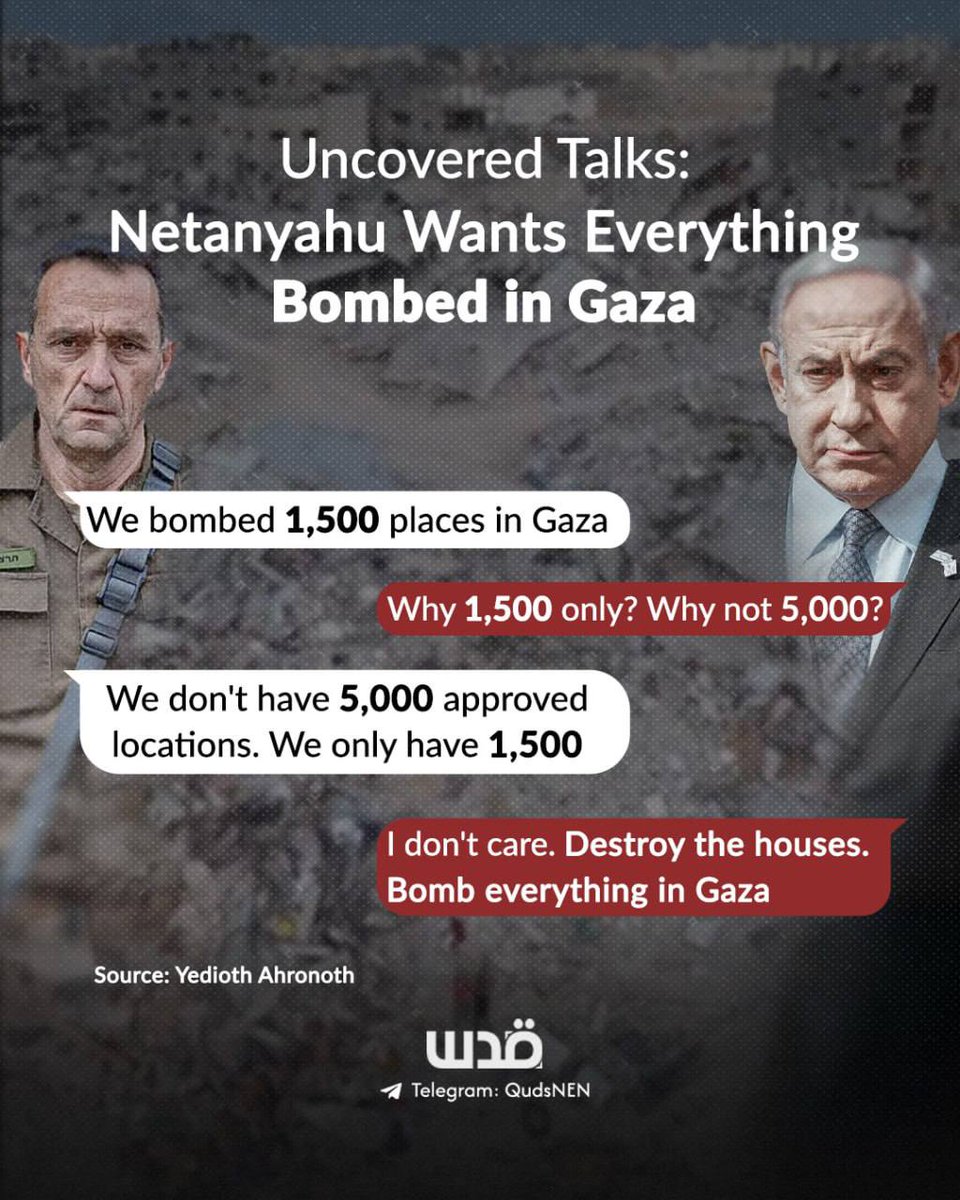
Israeli Prime Minister Benjamin Netanyahu erupted in anger during a cabinet meeting at the beginning of Israel’s genocide in Gaza, after Chief of Staff Herzi Halevi briefed ministers on the first 48 hours of attacks and reported that Israeli warplanes had struck 1,500 targets. Netanyahu objected, asking, “Why not 5,000?”

Continue reading
US-Hamas Talks: Netanyahu’s Double-Wound

The current talks between US officials and Hamas leaders in Qatar is certainly a deep wound for the Israeli Prime Minister Benjamin Netanyahu who had long promised that he would finish off the Islamic organization in Gaza for good.

Indeed, it’s a double-wound for Netanyahu and his extremist government who had been under an illusion, perhaps a strong word to use, that US President Donald Trump would long share the Israeli extremist objectives of taking over Gaza, getting rid of its people en masse, and end Hamas rule in the 364-kilometer enclave.

Trump, especially over the past few weeks, had certainly given the Israelis that impression, especially when he blurted out at a devastating press conference with Netanyahu in the White House in early February 2025, that what he wants is to create a Middle East Riviera in Gaza that would include ‘voluntarily’ displacement of the 2.2 million Palestinians living there and swiftly end Hamas-rule. The president added what he wants to do is for the United States to take over Gaza and make it a top property front-beach development.

The whys, ifs, and hows didn’t matter whilst the details were left to be ironed out for later, while the focus zoomed on what Trump was saying which literally seemed to be straight off the top of his head as unrehearsed “blabber” non – certainly not members of the new administration – knew about as the new man in the White House dictated his shallow views and hearsay. 

To Netanyahu it was music to his ears and he couldn’t believe what he was hearing. He just stood, smiled, glared and looked into the cameras pleased with his friend. To say the least however, he was gob-smacked and taken off-guard.

Trump’s bombshell announcement created an almost mass hysteria among the Palestinians, Arab world and internationally with people aghast, not knowing what to say, what to do and how to respond. Trump had then just announced the trampling on decades of international law – behest through the United Nations resolutions condemning Israeli occupation of Palestinian territories of the West Bank and Gaza and its heinous and vile military rule.

Enters Hamas in US thinking

However, Netanyahu’s smirk was soon wiped off when it became clear that Trump was offering him Dutch-courage support while directly talking to Hamas officials at the same time. The Israelis become livid, especially when they got to know about the on-going meetings through third parties and leaked sources.

Today, Netanyahu is in a state of a quandary. For the first time he is finding that the political strings and threads are no longer in his court anymore as was the case with the former administration and despite the fact Trump just unfroze the MK-84 2000-pound bombs to Israel which Joe Biden slammed on Israel in May 2024 and adding that the security of Israel remains his top priority.

But today Netanyahu has become deeply-troubled with what is being regarded as double-talk and double-dealing! The bombs supply were to be a palliative to what is being “cooked” behind closed doors.

In Trump, and through his team led by Steve Witkoff and Adam Boehler, Netanyahu is finding out that the new republican president in the White House is not an easy man and despite the strong Israeli lobby in Washington he doesn’t necessarily mean what he says and he is always looking out for America as the No. 1 interest. It is high politics trickery designed to get things done.

For the first time in this 16-month war on Gaza which Israeli started after 7 October, 2023, Netanyahu is finding himself in a corner, no longer able to pay just lip-service to the multitude of talks held in Doha and Cairo over the months of 2024 and which led to nowhere but increased the destruction of Gaza and the killing of its people.

Although Trump maybe a very good friend to Israel – a claim registered in his earlier administration when he moved the US Embassy to Jerusalem, a first-ever move by a US president and openly-backed the continued occupation of the Golan Heights, the businessman-politician is not interested in wars and has moved immediately to stop the three-year-old Ukraine war with Russia and now is dilly-dallying with Gaza.

The current talks in Doha are aimed to extend the ceasefire to be executed in three stages reached on 19 January, just one day before Trump officially entered the White House.  While stage I has just ended, the Netanyahu government is foot-dragging, not wanting to move onto the second and third stage mainly because of ideological, domestic political reasons and his eminent threat of going to prison on corruption charges.

Netanyahu fears continuing the ceasefire deal would mean the end of his government that is controlled by extremists who want the war on Gaza to continue and have stated time and again that they would bring the government down if Netanyahu makes a deal that is less than re-occupying Gaza and stamping out Hamas which continues to be a fanciful dream.

Present talks

But the present US talks in Gaza with the Islamist organization that ruled the enclave since 2007, and under a tight Israeli siege that continues today, is creating a flurry of muted tense relations between Tel Aviv and Washington occasionally coming out in-the-open as was the case through a leaked phone call between Boehler, a new man in charge of the hostages file in the US administration and Israeli Strategic Affairs Minister Ron Dermer, a close Netanyahu ally.

His protest was made recently by refusing to go with his Israeli team to join the latest bout of negotiations in Doha to kick-start the second stage of the ceasefire and release more hostages at their current number of 60  including one US-Israeli soldier and four American bodies that have been killed by Israeli bombardment and kept during Israel’s war on the enclave in the last months.

At the present time four meetings were held between American and Hamas officials with the last headed by chief of the movement Khalil al-Hayya. To say the least, Israel is irritated, angry, and dumbfounded and what is happening. Netanyahu is simply flabbergasted at Trump which he always regarded as a deep personal friend of him and Israel. He  and Dermer had impressed on the US administration not to take Hamas directly but it is clear the latter has not and is not heeding to the suggestion and going their own separate way.

Through different media sources and to the annoyance of the Israelis Boehler has stressed that talks so far has been “very helpful” and indicated that a resolution of the freeing of the hostages held by Hamas in Gaza would be finalized in the next few weeks.

 The world is watching to see how this intricate situation will unfold. The Trump administration is trying to play down their meetings with the Hamas leaders, but this is not working, especially as  Boehler keeps talking to the media about how constructive the talks are going and the fact that these Hamas leaders are “pretty nice guys,” and these “guys are just like us,” as he recently told CNN.

The next few weeks will show more. When he came to office, Trump said that if Hamas doesn’t surrender, he would turn Gaza into hell. Judging from what is happening on the ground today such a comment is merely rhetorical.  

The above-analysis is written by Dr Marwan Asmar, chief editor of the crossfirearabia.com website.

Continue reading