Trump’s War Through Politics

By Dr Amani Al-Qarm

About 2,500 years ago, there was a Chinese general named Sun Tzu, renowned for his military genius and unique philosophy on achieving decisive victory. He compiled his vision in a famous book called “The Art of War.” Sun Tzu states in his book that subduing the enemy without fighting is better than winning a hundred battles, and that a skilled commander feeds on his enemies.

This means exploiting the enemy’s resources, weaknesses, and even strengths, striking at their strategy and alliances, and besieging them to achieve victory, rather than relying solely on one’s own resources. In other words, achieving victory at the lowest cost is preferable to destroying a country, and capturing the head of state is better than killing him.

The Trump administration’s slogan, “Peace Through Strength,” is not new to American administrations, but it was perhaps more blatant and explicit during Trump’s presidency, as was the case with everything else under his rule: no embellishment, no lofty phrases, no justifications to appease hypocritical Western arrogance, such as democracy and human rights. There are only declared and clear objectives: oil, minerals, money, and control without cost.

The entire world is watching the current unique American approach to dealing with the Islamic Republic of Iran. Just when the world expected an American strike on Iran, the door was opened for negotiations under the auspices of the massive aircraft carrier USS Lincoln and its destroyers and missiles stationed in the Arabian Sea.

This leaves allies and adversaries alike bewildered and unable to predict the outcome, while Trump maintains the element of surprise and the timing of the strike. It seems that Trump is not content with the slogan “Peace Through Strength” alone, but has added to it some of the principles of General Sun Tzu’s doctrine. Trump Feeds on His Enemies:

Iran is in a state of weakness unprecedented in decades. Internally, the country is seething with poverty and oppression, and the recent protests are unlike any before. Internal affairs are no longer purely domestic; they now carry external costs, given the threats the US president has made against the Iranian regime throughout the past month.

Furthermore, the country is strategically exposed. Its alliances have been shattered, and it and those who deal with it economically and militarily are besieged. The time is ripe to pounce on the prey. And because, as Tzu said, subduing the enemy without cost is better than winning a hundred battles, Trump has opened the door to negotiations to achieve his objectives.

What does Trump want from Iran? Is he negotiating to restore relations between the two countries? Or to liberate the Iranian people? Of course not. He seeks victory without a fight. The collapse of the country as a result of war would transform it into scattered chaos throughout the region, as has already been witnessed in Iraq, Libya, Yemen, and Syria.

Therefore, containing it to the greatest extent possible and completely changing its hostile behavior since 1979 is preferable to destroying it. And to strip it of everything it considers its sources of power: eradicating any nuclear ambitions, eliminating its missile program, and reducing its regional role to the bare minimum, while also constantly reminding it that America is serious and ready to confront it. From America’s perspective, qualitative and nuclear superiority should belong only to Israel in the region.

What happens next depends on Iranian behavior. Will it submit and be pragmatic, as it has been in the crises that have characterized its relationship with the United States since 1979, or will the Iranian regime feel that this crisis is existential, thus raising the voice of ideology where there is no turning back?

This article is republished from the Arabic Al Rai Al Youm website.

CrossFireArabia

CrossFireArabia
Dr. Marwan Asmar holds a PhD from Leeds University and is a freelance writer specializing on the Middle East. He has worked as a journalist since the early 1990s in Jordan and the Gulf countries, and been widely published, including at Albawaba, Gulf News, Al Ghad, World Press Review and others.

Related Posts

A Middle East Whirlpool! View From Amman

By Saleem Ayoub Quna

Unlike the grey terrain of the Middle East, known for its harsh aridity and barren landscapes, the region’s still-unsettled, multi-front conflicts that erupted after the 7 October, 2023 surprise Palestinian assault on Israeli settlements around Gaza Strip, almost literally, become associated in the public imagination with the colour blue: The sea, its waves, its vessels and its strategic waterways.

The Palestinians called that watershed event Al-Aqsa Flood. Israel described 7 October as a second Holocaust. If the Palestinians deliberately chose the word flood for its religious and symbolic connotations, the Israeli way of describing it, indicated how serious and tough their losses and injuries were.

What followed was a succession of milestones and unprecedented developments across the Middle East. They continue to unfold dramatically, resembling the abrupt and unpredictable movements of hurricanes and tempests on the high seas.

Yet the side-conflicts and mini-wars that followed 7 October have neither followed a single pattern nor obeyed the same rules. Instead, events have moved in different, sometimes opposing directions — unlike the orderly circular motion of an actual whirlpool. It is almost as though every confrontation has chosen a course of its own: The predictable alongside the unpredictable, the rational alongside the seemingly illogical.

It therefore takes more than intelligent guesswork or clever political analysis to determine which direction these events will ultimately take, and which may prove more dangerous — not only to the region and its inhabitants, but also to the many international powers with interests at stake.

If we were to capture the current Middle Eastern scene in a single frame, we might portray it as an extraordinary, almost unbelievable collision of man-made tides, currents and sub-currents, all moving simultaneously through one increasingly turbulent sea.

Because the first shots fired on 7th October around Gaza strip, from a Palestinian point of view, came as a last desperate call and reminder of the injustice they are suffering, they soon found their echoes in the four corners surrounding it: In south Lebanon, Yemen to the south and Iraq and Iran to the east. Even to the west, there were international sailors who belonged to the Peace Flotilla, trying to bring medicine and food to the starving children of Gaza!

One of the most significant currents emerged on Israel’s northern front.

What initially appeared to be a relatively “controlled” confrontation between Israel and Hezbollah steadily intensified until September 2024, when Israel killed the party’s leader Hassan Nasrallah. Only a few months later came another geopolitical earthquake: The collapse of Bashar al-Assad’s government in Damascus in December 2024.

Each development sent another powerful current through the already boiling waters of the wider Middle Eastern whirlpool.

Then came an even larger artificial wave.

In June 2025, the United States launched Operation Midnight Hammer, striking Iran’s three principal nuclear sites at Fordow, Natanz and Isfahan while diplomatic efforts surrounding Iran’s nuclear programme were still underway.

Washington described the operation as an attempt to inflict decisive damage on Iran’s nuclear capabilities. Tehran responded with retaliatory action against American military interests in the Gulf.

But that was not the end of the storm.

On 28 February, 2026, the world witnessed another major escalation when the United States and Israel launched coordinated, large-scale attacks against Iran. The two allies acted jointly but gave their military campaigns different names: Washington called its operation Epic Fury, while Israel called its campaign Roaring Lion.

The strikes hit Iranian military infrastructure and senior leadership and inflicted substantial damage. Yet they failed to produce one of the most far-reaching political outcomes sought by US-Israeli advocates of the military campaign: The toppling of the Iranian regime.

And so the whirlpool continued.

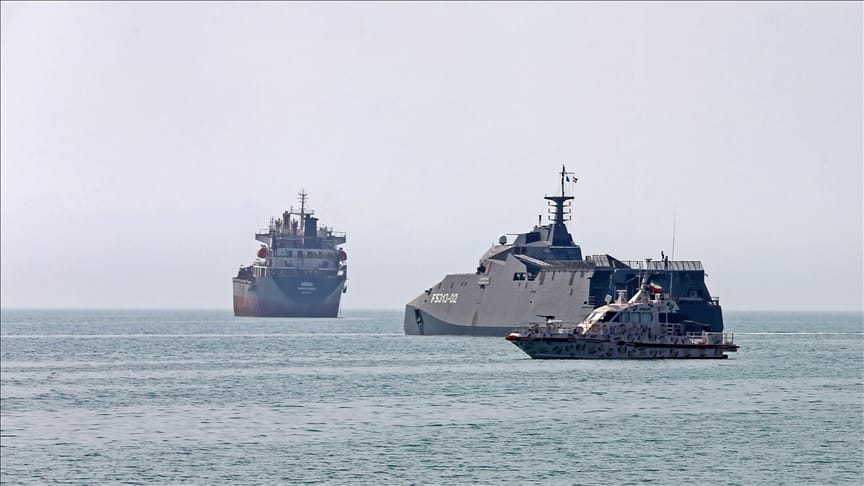
Iran responded not simply through missiles and military retaliation, but by shifting the struggle towards one of the most strategically sensitive waterways on earth: The Strait of Hormuz.

Through restrictions on shipping, attacks on vessels and increasingly assertive claims over the waterway, Tehran transformed Hormuz into another major front in the confrontation. The strait — through which a substantial share of the world’s energy supplies traditionally passes — became yet another current dragging regional powers and the wider international community deeper into the turbulence.

Here, the metaphor of the whirlpool becomes more than literary.

Gaza, Lebanon, Syria, Iran, Yemen, Iraq, the Red Sea, the Arabian Gulf and the Strait of Hormuz are no longer easily separable theatres. Each produces currents that flow into the others. A military strike in one location generates political pressure somewhere else; an assassination changes the balance of power hundreds of kilometres away; a blocked shipping lane reverberates through global markets thousands of kilometres beyond the Middle East.

And all the while, new currents are being created faster than old ones can disappear.

What begins on the shores of Gaza does not remain in Gaza. What happens in Beirut, Damascus, Tehran or the Strait of Hormuz does not remain there either.

The Middle Eastern whirlpool has become too wide, too violent and too interconnected to contain its turbulence within the region itself.

And as it keeps spinning, its waves will continue to splash far beyond the shores of the Middle East — reaching, sooner or later, virtually every corner of the globe.

Conclusion: As long as the waters surrounding the Middle East remain crowded with warships, missiles, blockades, retaliatory strikes and the debris of foreign intervention, the region’s old whirlpool will continue to spin.

Continue reading
‘No Need For Your Crocodile Tears’
  • HebaHeba
  • August 13, 2026

By Ismail Al Sharif

“I’ll say it frankly: We should have exerted more pressure on Israel to adopt a different approach in Gaza” – Jake Sullivan, National Security Advisor to ex-President Joe Biden.

A striking phenomenon is recurring in American politics: Some presidents, cabinet members, and senior officials become more outspoken in their stances toward the Israeli occupation entity after leaving office, expressing regret for decisions that contributed to the injustice inflicted upon the Palestinian people.

This may be due to their liberation from diplomatic and partisan constraints, the pressures of Zionist lobbies, and the influence of tainted money, or perhaps their consciences awaken belatedly as they feel closer to death, realizing the enormity of the injustice they participated in or condoned.

Examples of this are numerous. Among the most prominent is former US President Jimmy Carter, who, after leaving office, shifted from a traditional pro-Zionist rhetoric to criticizing the Israeli occupation and its policies. Then there is Chuck Hagel, former US Secretary of Defense, who held the United States responsible for the Zionists’ continued aggression and described their practices as terrorism— but only after his retirement, of course.

Robert Gates, the former Secretary of Defense, also criticized war criminal Benjamin Netanyahu, calling him ungrateful.

More recently, Jake Sullivan, former National Security Advisor, and Antony Blinken, Biden’s lackluster Secretary of State, joined the ranks of those who have expressed regret. Both men have blood on their hands from the blood of Palestinian children and played a shameful role in supporting the Israeli entity during one of the greatest acts of genocide in modern history.

This was revealed in a lengthy investigation published in The New Yorker magazine last 20th July, titled “How Biden Enabled Israel’s Aggression Against Gaza – and Iran,” with the subtitle: “Top officials from the previous Administration now express regret over their failure to rein in Netanyahu.”

However, this regret will not absolve them for they knew full well that the Zionists were committing genocide in Gaza. On 5 March, 2024, five months after the start of the genocide, Mirjana Spoljarić, president of the International Committee of the Red Cross (ICRC), sent a confidential letter to President Biden. The ICRC, in addition to its humanitarian mission, is obligated under the Geneva Conventions to provide states with information and advice to help them avoid committing war crimes.

In her letter, Spoljarić reminded President Biden that the organization had condemned the “horrific” massacre perpetrated by Hamas against Israelis on 7 October 2023 and that it had continued to press the movement “tirelessly” for the release of the “hostages” it was holding.

However, this time she appealed to Biden with “grave concern,” warning that Israel, which had continued to bombard Gaza with heavy munitions since that October, was ignoring the ICRC in an unprecedented manner.

In her letter, she wrote: “The way Israel conducts hostilities is inconsistent with the laws of armed conflict, particularly the obligations to protect civilians, to distinguish between military objectives on the one hand and civilians and civilian infrastructure on the other, to ensure the humane treatment of detainees and the dead, to protect medical facilities and personnel, and to provide and facilitate the delivery of humanitarian aid.”

Despite these clear warnings, the United States remained a key partner in the genocide, providing weapons, money, and political and international cover to Israel. And now some of its officials come to shed crocodile tears for the children of Gaza!

I say to them: You have no right to repent now, after all these martyrs, after all these tragedies, to say: “We are sorry, we made a mistake.” You knew, and you had the power to pressure and prevent, but you chose to support, arm, and cover up. You bear the burden of what happened, and the blood of the children of Gaza will haunt you and pursue your names to the dustbin of history.

This piece by Ismail Al Sharif was originally published in the Arabic Addustour daily and reprinted in English in Crossfirearabia.com.

Continue reading

You Missed

40 Million Tons of Rubble: Gaza Ministry Faces Challenges in Removing it

40 Million Tons of Rubble: Gaza Ministry Faces Challenges in Removing it

Join The Queue For The Drops

Join The Queue For The Drops

‘My Way Out of Insanity’

‘My Way Out of Insanity’

The Child, Tree and The Dark

The Child, Tree and The Dark

Palestinian Dr Held Over Social Media Posts Suffers Heart Attack in Israeli Detention

Palestinian Dr Held Over Social Media Posts Suffers Heart Attack in Israeli Detention

Israel Violated The Ceasefire 4379 Times in 315 Days

Israel Violated The Ceasefire 4379 Times in 315 Days





