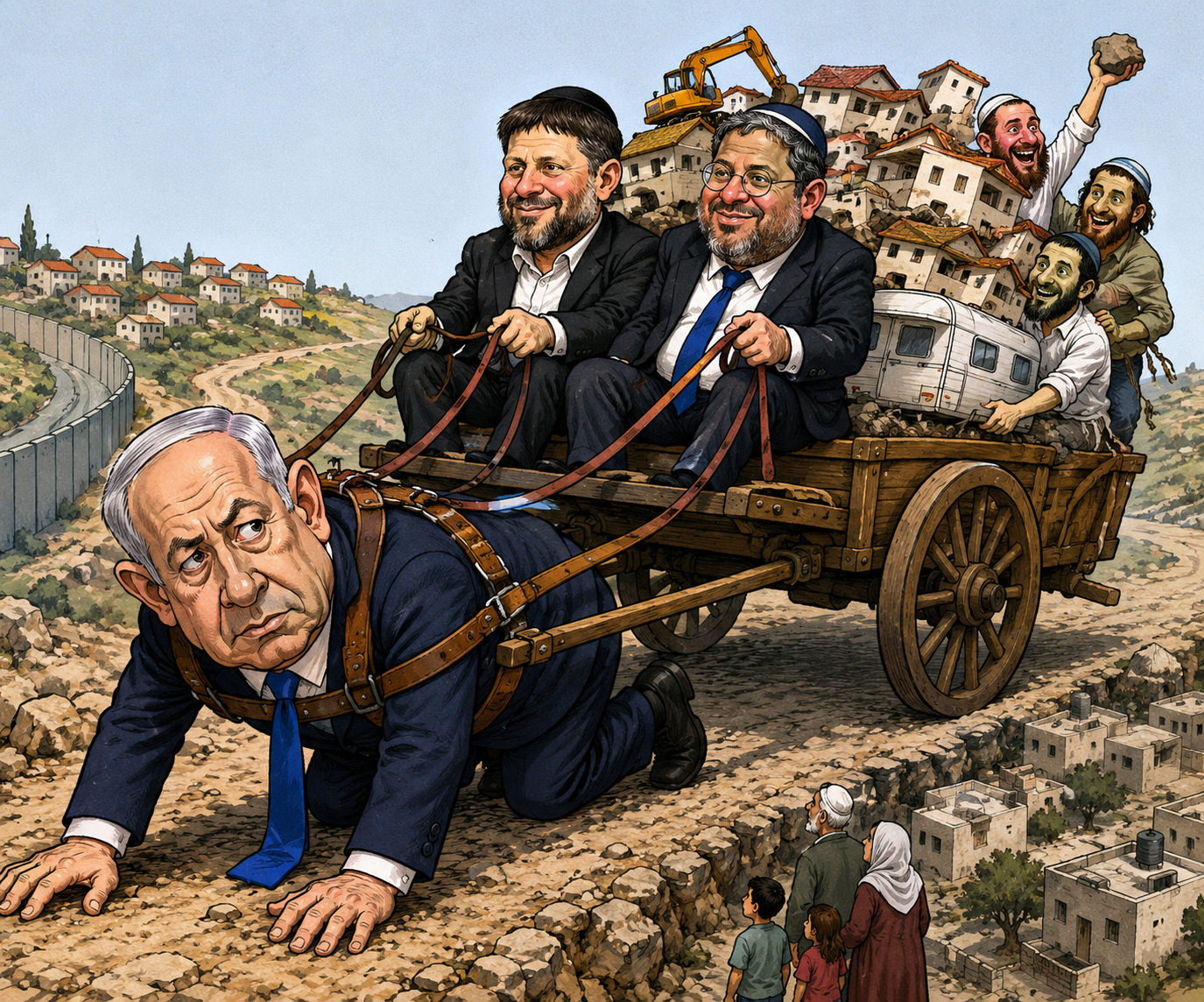
Netanyahu and The Settlers: Cart and Horse in Action

By Mohammad Abu Rumman

Perhaps the most surprising aspect of the latest events in the West Bank was not what the settlers did — that is hardly new or unexpected — but what Benjamin Netanyahu himself said. The Israeli prime minister denounced the “criminal acts of violence” committed by settlers in the villages of Qusra and Jalud, describing those responsible as a “handful of rioters” whose actions harm law-abiding settlers, interfere with the army’s work, and damage Israel’s standing in the world. This is precisely where the paradox lies: What exactly is Netanyahu condemning? Do the settlers’ actions really contradict his government’s policies, or do they ultimately serve the same project, albeit through different means and methods?

What is happening in the West Bank did not begin over the past few days, nor with the latest attacks. It has been developing for years along a clear trajectory, one that has accelerated dramatically under the current government and since the Gaza war. The United Nations has documented unprecedented levels of settler violence, with more than 1,430 attacks this year affecting some 260 Palestinian communities. Nearly 3,800 Palestinians have been displaced in 2026 as a result of settler violence, demolitions and evictions. These figures cannot simply be viewed as a collection of isolated security incidents; they point to a much deeper transformation taking place on the ground.

Settler violence, in fact, is only one part of a much larger picture. Nearly a thousand checkpoints, barriers, gates, and roadblocks now fragment the West Bank, turning everyday Palestinian life into a continuous struggle with geography, time, permits, and restrictions. In the northern West Bank, the situation has become even more severe, with tens of thousands displaced from the Jenin, Tulkarm and Nur Shams refugee camps, alongside extensive demolitions, bulldozing, and the physical reshaping of these areas.

The E1 settlement project takes the issue to another, more strategic level. Moving forward with E1 would effectively sever geographical continuity between the northern and southern West Bank and further isolate East Jerusalem, making the prospect of a contiguous and viable Palestinian state increasingly detached from realities on the ground. Add to this the transfer of significant powers within the Civil Administration to the authority of Bezalel Smotrich, who has made no secret of his objective of preventing the establishment of a Palestinian state; the empowerment of Itamar Ben-Gvir; repeated incursions into Al Aqsa Mosque and attempts to alter the long-standing status quo; settlement expansion; and a broader set of legislative and administrative measures moving in the same direction. What emerges is not a series of disconnected policies, but an integrated effort to determine the future of the West Bank on the ground before any political settlement can take place.

Against this backdrop, Netanyahu’s reference to a “handful of rioters” becomes difficult to take seriously. It suggests that the settlers operate in a political vacuum or somehow act against the direction set by the government and the state. Yet, however chaotic and violent their actions may appear, the outcome converges with a clearly defined political project: Pushing Palestinians away from their land, expanding settler control, fragmenting Palestinian geography and effectively closing the door on the possibility of a Palestinian state.

The real explanation for Netanyahu’s condemnation may therefore lie in his own words: these attacks, he said, “damage Israel’s standing in the world”. That sentence reveals the essence of the problem from his perspective. The concern appears to be less about the direction of these actions than about their method and image; less about their political consequences than about their transformation into openly violent scenes captured by international media — as happened when an NBC News crew itself came under attack by settlers — at a moment when Israel’s international image has become increasingly associated with the Gaza war, settlement expansion, and settler violence.

Netanyahu’s condemnation can therefore be understood as carrying a dual message. To the outside world, it says that the Israeli government neither endorses nor approves of such violence, even as its policies on the ground move in broadly the same direction. To the domestic audience, the message may be that what is required is not necessarily a change of course, but a more disciplined and calculated management of that course — one that does not further inflame the mounting crisis surrounding Israel’s international image and standing.

This is why Netanyahu’s condemnation is itself worthy of condemnation. The problem in the West Bank has long ceased to be simply a group of extremist settlers acting beyond the state’s control. It is part of a political project in which government policy, settlement expansion, security measures, legislation, and the Civil Administration increasingly converge to reshape the territory and demography of the West Bank and create realities that will be exceedingly difficult to reverse.

When Netanyahu finds himself condemning the natural consequences of a project that his own government has done so much to accelerate, the paradox becomes impossible to miss: He is not merely condemning the settlers. In effect, Netanyahu is condemning himself.

By Mohammad Abu Rumman is a columnist in The Jordan Times.

CrossFireArabia

CrossFireArabia
Dr. Marwan Asmar holds a PhD from Leeds University and is a freelance writer specializing on the Middle East. He has worked as a journalist since the early 1990s in Jordan and the Gulf countries, and been widely published, including at Albawaba, Gulf News, Al Ghad, World Press Review and others.

Related Posts

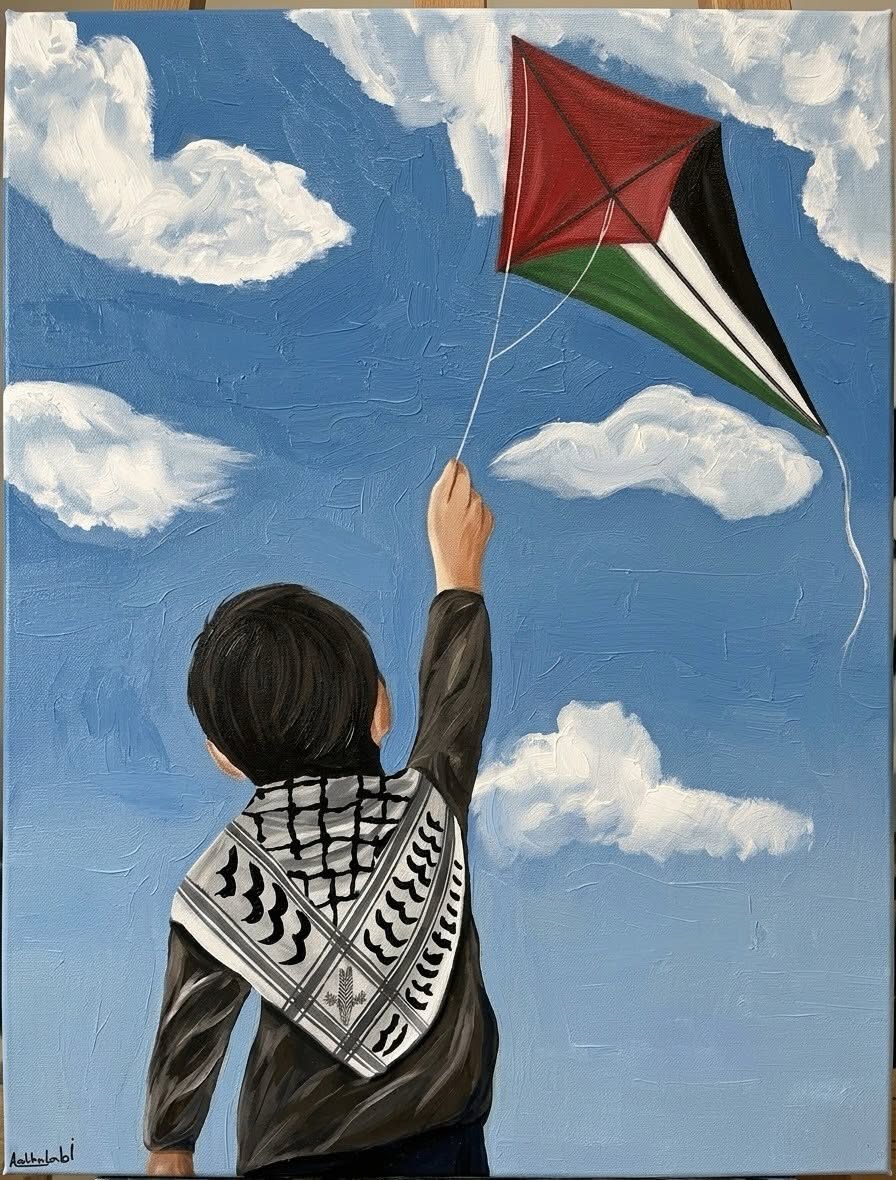
Flying Kites and The Politics of Fear

By Dr Oroub El-Abed

There is something profoundly unsettling about a military power becoming alarmed by children flying kites:

In Gaza, where childhood has already been stripped of so many of its ordinary meanings, even a kite has now entered the vocabulary of warfare. In August 2026, several kites drifted from Gaza toward Israeli communities near the border. Israel’s own military reported that the kites it recovered carried no suspicious material and posed no danger. Yet Israeli leaders responded by treating their appearance as a potential act of war. Defence Minister Israel Katz announced that a balloon would be treated like a kite and a kite like a drone, “with or without explosives.” Prime Minister Benjamin Netanyahu and Katz subsequently warned that those responsible could be targeted and that populations could be evacuated from areas identified as launch sites.

By 25 August, Palestinian committees in Gaza were asking parents to prevent their children from flying kites, not because kites themselves had become dangerous, but because the children holding their strings might become targets. One mother told Reuters that her ten-year-old son had always flown kites during the summer but that she would no longer allow him to do so.

The gravity of that moment

There is, of course, a history that cannot simply be erased. During Gaza’s Great March of Return beginning in 2018, incendiary kites and balloons were used by Palestinians and caused fires in agricultural fields inside Israel. Activists have examined those incendiary devices as an unusual form of anti-colonial resistance, while Israel characterised them as terrorism and a security threat. But recognising that history makes the present distinction more important, rather than less important. The kites now causing alarm were reportedly not incendiary: a children’s kite is equated with an armed drone, the category of “security threat” expands almost without limit.

Every aspect of Palestinian life has become securitised.

Even a woman in labour at a checkpoint, carrying a newborn into the world, is subjected to the same architecture of suspicion and control. A neighbourhood can be transformed overnight into a military zone following an act of resistance. And now even the sky above a displacement camp, entered only by a child’s kite, can be drawn into this expanding geography of securitisation.

Shrinking of the spaces in which Palestinians can safely live ordinary lives

Across the occupied West Bank, settler attacks have intensified. In July 2026, the UN human rights office warned of escalating settler violence, killings, destruction of property and attacks affecting Palestinian communities. OCHA has documented assaults on homes, restrictions on agricultural land, damage to livestock and olive trees, intimidation and displacement, particularly around newly established settlement outposts.

The International Court of Justice concluded in its July 2024 advisory opinion that Israel’s continued presence in the Occupied Palestinian Territory is unlawful and found its settlement policies and associated practices in breach of international law. Yet territorial expansion continues while Palestinians possess overwhelmingly unequal military and political means with which to resist it.

Historical continuity that deserves examination.

The connection between Zionists Guerrilla attacks during the British Mandate and the present, is not that history simply repeats itself. The Zionists operations continue to be inhumane, savage and far from civilised,  territorial expansion remains remarkably persistent.  From the depopulated villages documented by Walid Khalidi, to the history of transfer examined by Nur Masalha, to Edward Said’s insistence on recovering the Palestinian standpoint, and Rashid Khalidi’s account of a century-long colonial confrontation, Palestinian scholarship provides its own intellectual vocabulary for understanding what we are witnessing today: displacement is an unfinished process of contesting Palestinian presence on the land. The problem today is that intimidation, territorial acquisition and displacement continue to interact at a regional level as well.

Israeli military actions have extended repeatedly into Lebanon and Syria, including recent strikes in Syria, creating an increasingly dangerous geography in which borders no longer insulate neighbouring populations from Israeli military power. The language is invariably security. Yet for the people experiencing bombing, displacement, occupation or territorial encroachment, “security” looks remarkably different depending on which side of military power one inhabits.

And perhaps this is why the kite is so revealing. The kite made of plastic bags carries almost nothing. It is fragile. It is made to rise, not conquer. For a child surrounded by destroyed buildings and displacement tents, flying one may represent one of the few remaining possibilities of movement. The child’s body is confined; the kite is not.

Perhaps that is precisely why the reaction to it deserves our attention. Children cannot be asked to surrender childhood because an occupying military power has progressively widened its definition of threat. The most disturbing image coming from Gaza this week may therefore be neither a missile nor a tank: It may be a mother telling her child:

Do not fly your kite. They may see it.

That sentence should disturb the conscience of the world. Because when even a child’s kite becomes too dangerous to fly, what is being taken away is more than a toy. It is the remaining space in which a Palestinian child is permitted simply to be a child.

Dr Oroub El-Abed originally wrote this piece for Middle East Monitor and is reposted here in crossfirearabia.com. She is an Associate Professor at Bir Zeit University and specializes in refugees issues.

Continue reading
Beware! Qusra and The Next Nakba
  • HebaHeba
  • August 26, 2026

By Ramzi Baroud

If you want to understand the bleak future awaiting the occupied West Bank, do not look away. Just pay attention to the events unfolding in the small Palestinian town of Qusra, south of Nablus.

The story of the future of the West Bank begins here.

While much of the media is treating reports emerging from the area as simply another episode of “settler violence,” it is not. Qusra represents something far more consequential: a glimpse into the new Plan Dalet that Israel has in store for Palestinians.

Plan Dalet was the military blueprint through which Zionist forces conquered much of historic Palestine, village by village, during the Nakba.

The plan did not suddenly emerge in 1948. It built on military schemes dating back to 1945, developing into a strategy for conquering Palestinian towns and villages, destroying communities and expelling their inhabitants.

The significance of this history today is not merely symbolic. The Nakba was a process, implemented in stages. So, too, is the annexation of the West Bank.

Nor is this merely an intellectual argument. Israeli officials have openly invoked a new Nakba as an intended outcome. In November 2023, Avi Dichter declared: “We are now rolling out the Gaza Nakba,” adding, “Gaza Nakba 2023. That’s how it’ll end.”

True to form, this new Nakba carries many of the characteristics of the old one: coordinated violence, massacres, ethnic cleansing, forced displacement and land confiscation.

The genocide in Gaza represents the zenith of this violence — a more devastating manifestation, but a continuation of the original sin upon which the Israeli state was established.

While all eyes were on Gaza beginning on October 7, 2023, the West Bank was largely ignored, allowing Israel the space to escalate violence in all its forms to levels unseen in decades.

The result has been staggering. Since October 7, 2023, Israeli forces and settlers have killed more than 1,100 Palestinians in the West Bank, including over 240 children, and wounded thousands more. Tens of thousands have been detained, while more than 33,000 Palestinians remain displaced from the Jenin, Tulkarem and Nur Shams refugee camps alone.

Now, back to Qusra.

Beginning on August 9, armed Israeli settlers surrounded three Palestinian homes in the Ras al-Ain area on the outskirts of the town.

They blocked access to the houses, erected tents outside them and cut water and electricity supplies. Families, including young children, were effectively trapped inside.

The Israeli military subsequently declared the surrounding area a closed military zone, restricting access by Palestinians, activists and journalists.

What emerged was not simply settler violence but a division of labor: settlers create the crisis; the army imposes the restrictions; Palestinian movement is curtailed; and the victims themselves are pressured to leave.

And the siege continued. As I write these words, the siege of the Qusra homes has concluded its second week.

Qusra is not incidental to this strategy. Israel has already confiscated its land for the settlement of Migdalim, while nearby outposts including Esh Kodesh have long been associated with attacks and attempts to seize Palestinian agricultural land.

Control of such areas is essential to the larger project of connecting settlement blocs, fragmenting Palestinian territory and transforming Palestinian communities into isolated enclaves.

A few years ago, the Israeli government behaved as though its plan to formally annex large swathes of the West Bank had been placed on hold. Yet, since October 7, annexation has moved from aspiration to obsession — in both words and action.

National Security Minister Itamar Ben-Gvir oversawthe mass distribution of weapons after October 7, arming thousands of civilian security-squad members with rifles amid an already heavily armed settler population.

Meanwhile, Finance Minister Bezalel Smotrich has systematically worked to transfer powers over the West Bank from military administration to Israeli civilian authorities — one of the clearest institutional mechanisms of annexation.

And now another piece is falling into place: Defense Minister Israel Katz has ordered preparations to transfer law-enforcement responsibility over Israeli settlers in the West Bank from the military to the Israeli police, another critical legal step toward annexation.

The picture is becoming complete: settler militias, government funding, weapons, the army, police, civilian bureaucracies, courts and political decisions originating at the highest levels of the Israeli state.

Seen in this wider context, Qusra becomes a microcosm — and potentially a testing ground — for the mechanisms through which larger-scale annexation can be implemented. These realities echo the past. The Nakba did not simply ‘happen,’ but followed years of planning and incremental military schemes. That is why Qusra matters.

Some governments are warning of accelerating annexation; others sanction individual settlers, as though targeting a few extremists could reverse a blueprint implemented by an entire state apparatus.

Palestinians in the West Bank are fully aware of the challenge awaiting them. Urging the Palestinian Authority, which maintains security coordination with Israel, to suddenly devise a ‘strategy’ is painfully redundant.

But for the rest of us who understand the horrors of the Nakba — and the reverberations of that catastrophe from Deir Yassin to the genocide in Gaza — recognition is no longer enough.

The price of silence is already being paid by every Gazan living among the ruins of the Strip and every Palestinian in the West Bank confronting the violence of settlers and their military partners.

It needs to end now, before Qusra becomes the blueprint for what comes next: today, Qusra; tomorrow, the whole of the West Bank.

Ramzy Baroud is a journalist, author and the Editor of The Palestine Chronicle. He is the author of eight books. His latest book, ‘Before the Flood,’ was published by Seven Stories Press. His other books include ‘Our Vision for Liberation’, ‘My Father was a Freedom Fighter’ and ‘The Last Earth’. Baroud is a Non-resident Senior Research Fellow at the Center for Islam and Global Affairs (CIGA). He contributed this article to The Jordan Times.

Continue reading

Leave a Reply

Your email address will not be published. Required fields are marked *

You Missed

Netanyahu and The Settlers: Cart and Horse in Action

Netanyahu and The Settlers: Cart and Horse in Action

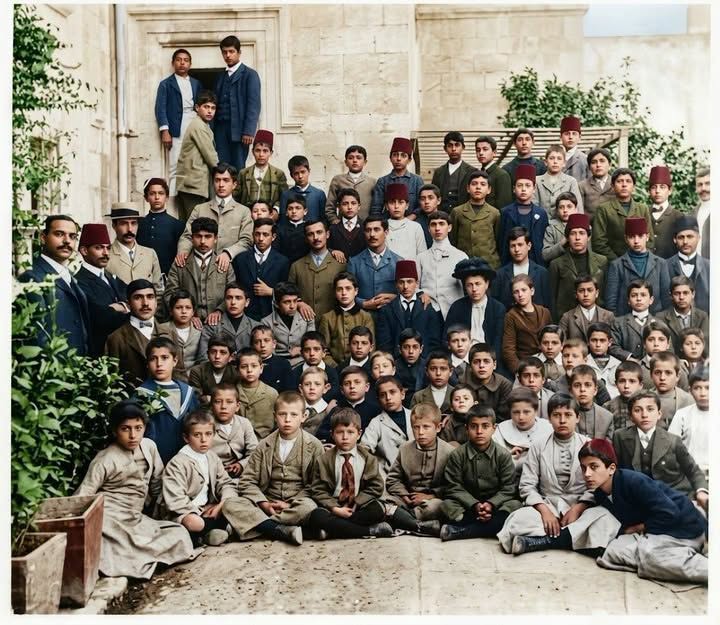
Pupils From The Bishop’s School, Jerusalem

  • By Heba
  • August 30, 2026
  • 13 views
Pupils From The Bishop’s School, Jerusalem

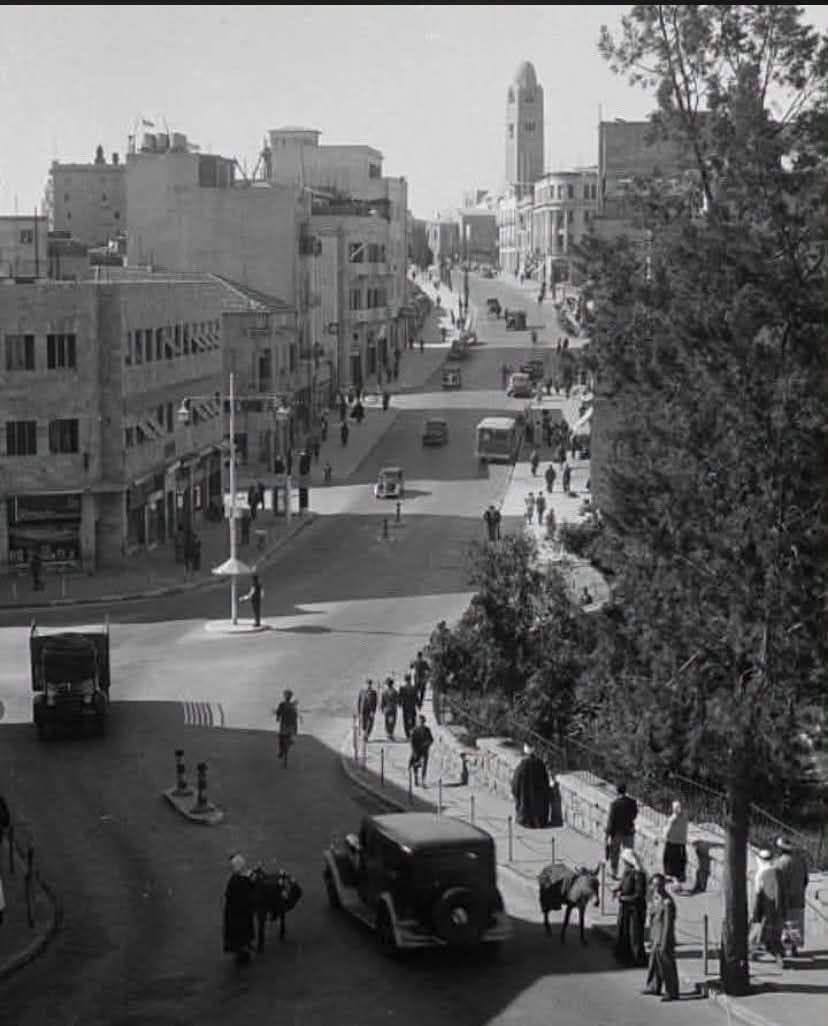
Jerusalem’s Mamilla in The 1940s

  • By marwan
  • August 30, 2026
  • 13 views
Jerusalem’s Mamilla in The 1940s

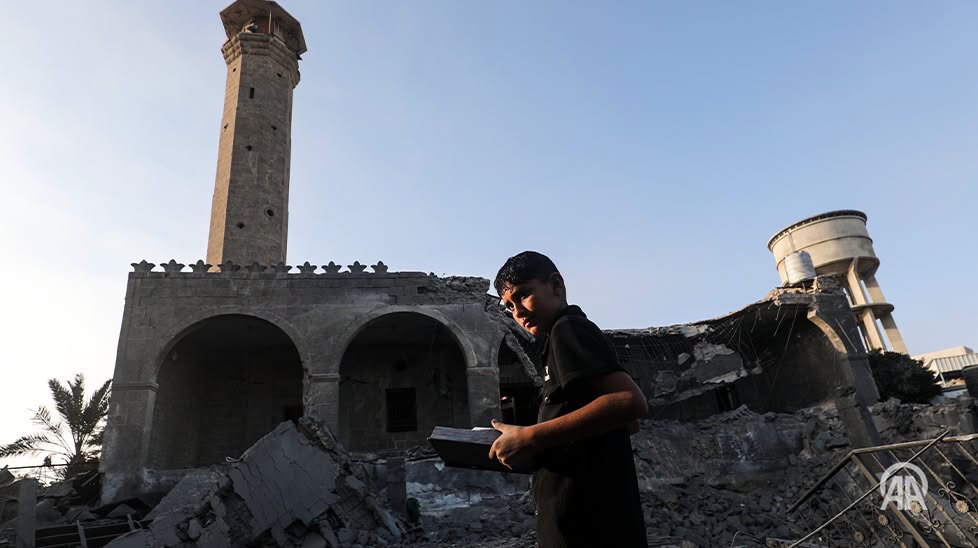
Volunteers Collect Stones From Destroyed Mosque To Rebuild it in The Future

  • By marwan
  • August 30, 2026
  • 14 views
Volunteers Collect Stones From Destroyed Mosque To Rebuild it in The Future

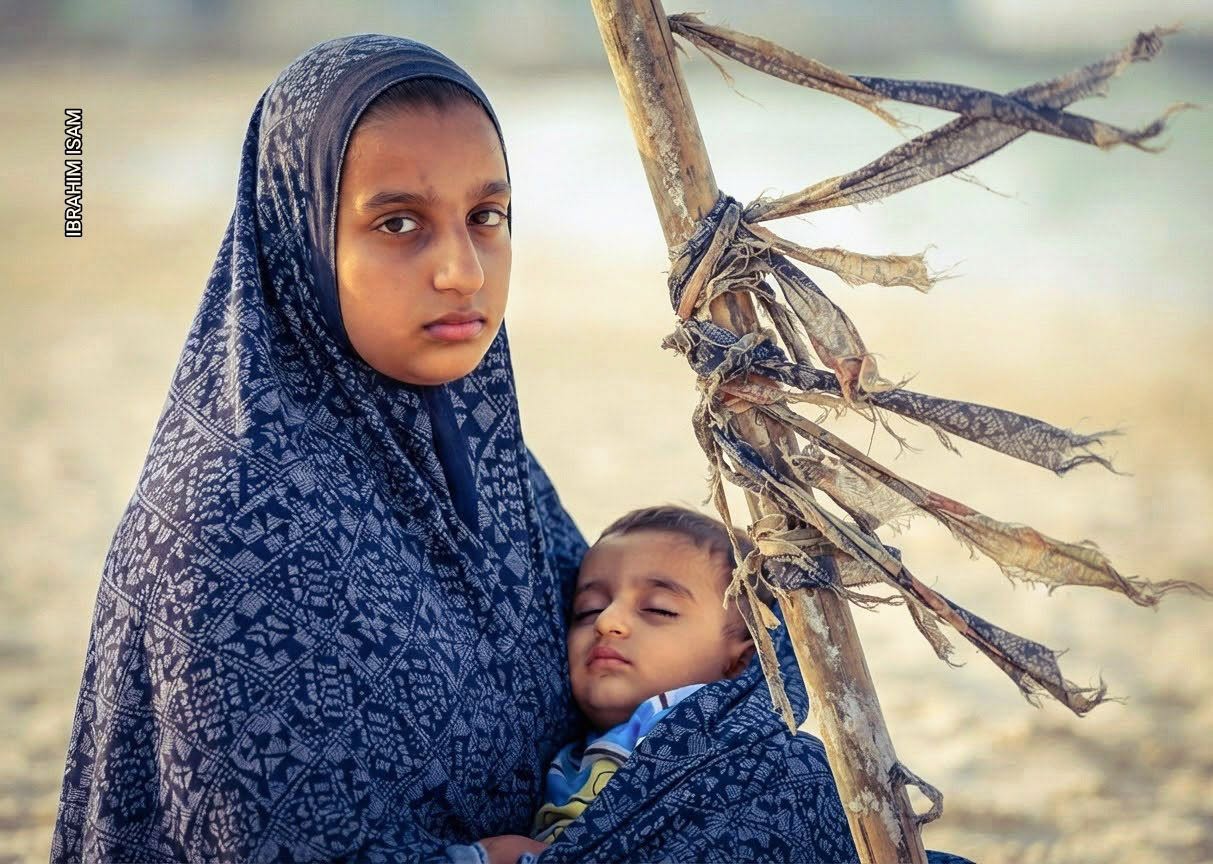
Destitution Gaza: Girl With The Child

  • By marwan
  • August 30, 2026
  • 11 views
Destitution Gaza: Girl With The Child

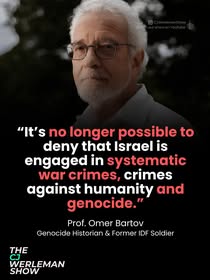
Omer Bartov: ‘Its Genocide’

Omer Bartov: ‘Its Genocide’