Amidst Hamas Fighters 4 Female Israeli Soldiers Release

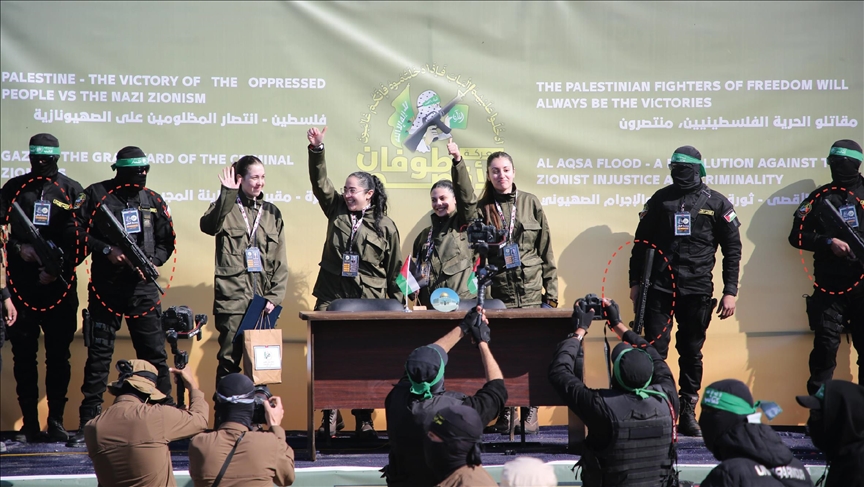
In a dramatic display of power, elite fighters from the Palestinian resistance group Hamas appeared with Israeli Tavor rifles during the handover of four female Israeli soldiers in Gaza City.

The rifles, reportedly seized during the Oct. 7, 2023 attack on Israeli military bases and settlements near Gaza, were prominently featured on podium set up at Palestine Square in Gaza City to hand over the four soldiers.

“Hamas chose to include fighters from an elite unit carrying Tavor rifles from the Israeli army’s elite unit during the handover process,” Amir Bohbot, a military correspondent for the Israeli news web Walla, said, citing a military source.

“These rifles were most likely seized on Oct., 2023,” he added.

Hamas released four female Israeli soldiers early Saturday under the first phase of a ceasefire and prisoner exchange agreement with Israel.

The freed soldiers are members of the Israeli army’s surveillance unit at the Nahal Oz base.

The four freed soldiers wearing the Israeli military uniform smiled and waved on a stage set up at the square as they were transferred to representatives of the International Committee of the Red Cross (ICRC).

“The handover event organized by Hamas was meticulously planned and executed at Palestine Square in Gaza City,” the Israeli Channel 12 said.

“Hamas exploited this dramatic moment to convey propaganda messages, erecting a platform in the middle of the square with symbols of the Israeli army and the Shin Bet security service, along with a Hebrew headline: ‘Zionism will not win’.”

Message of superiority

The Israeli channel said long convoys of armed men from Hamas and Islamic Jihad groups streamed into the square since early morning.

“Activists carrying weapons and organization flags were positioned around the central platform in a pre-planned formation to create an image of victory for the cameras broadcasting the release of the captives to the entire world,” it added.

“The carefully chosen setting and decor – Israeli symbols and Hebrew inscriptions – show a planned effort by Hamas to turn the ceremony for the release of the female soldiers into a propaganda show,” the channel said.

“Hamas invested significant resources in designing the square, with the aim of conveying a message of control and superiority.

“The female soldiers were brought to the podium, where they held each other’s hands, smiled and waved,” the channel commented.

Some 200 Palestinian prisoners are also scheduled to be released on Saturday in exchange for the four freed Israeli soldiers.

Under the first phase of the Gaza ceasefire day, Israel is planned to withdraw from the Netzarim Corridor area that separates northern Gaza from its south, allowing displaced Palestinian to return to their areas in northern Gaza.

The first six-week phase of the Gaza ceasefire agreement took effect on Jan. 19, suspending Israel’s genocidal war that has killed nearly 47,300 Palestinians, mostly women and children, and injured more than 111,400 since Oct. 7, 2023.

On the first day of the ceasefire, Israel released 90 Palestinian detainees in return for three Israeli captives set free by Hamas.

The three-phase ceasefire agreement includes a prisoner exchange and sustained calm, aiming for a permanent truce and the withdrawal of Israeli forces from Gaza.

The Israeli onslaught has left more than 11,000 people missing, with widespread destruction and a humanitarian crisis that has claimed the lives of many elderly people and children in one of the worst global humanitarian disasters ever.

The International Criminal Court (ICC) issued arrest warrants in November last year for Israeli Prime Minister Benjamin Netanyahu and his former Defense Minister Yoav Gallant for war crimes and crimes against humanity in Gaza.​​​​​​​Israel also faces a genocide case at the International Court of Justice for its war on the enclave.

CrossFireArabia

CrossFireArabia
Dr. Marwan Asmar holds a PhD from Leeds University and is a freelance writer specializing on the Middle East. He has worked as a journalist since the early 1990s in Jordan and the Gulf countries, and been widely published, including at Albawaba, Gulf News, Al Ghad, World Press Review and others.

Related Posts

UNICEF: 300 Children Died in 300 Days in Gaza

CROSSFIREARABIA – UNICEF stated that no less than 300 children were killed in the Gaza Strip during the past 300 days when a ceasefire was declared on 10 October, 2025. It warned of more victims amongst children being killed despite promises to stop attacks.  “A ceasefire that leaves, on average, one dead child every day simply fails the children. Children have heard promises before. This time, the agreements must be translated into action,” said Edward Beigbeder, UNICEF Regional Director for the Middle East and North Africa.

Continue reading
Dalal Abu Amneh: A Musician, A Neurologist

She is a Palestinian singer, producer, and a PhD researcher in neurology from the Haifa Institute of Technology, the Technion.

Dalal Abu Amneh was born in Nazareth on 9 August, 1983 and became captivated by science and music at a young age. In music, Dalal got to be known for her melodious voice and ability to perform various musical styles.

In this she forged a global Palestinian identity producing all of her musical projects while making three albums: “Ya Baladi,” “Ya Sitti,” and “Nour,” underlined in the spirit and heritage of the Palestinian and Arab people while at the same developing didactic vocal styles including classical Tarab, Andalusian singing, Sufi spiritual chanting, and her revival of Palestinian and Levantine folk traditions.

Dalal grew up in an artistic family. Her mother, Juhaina Al-Hawari, has a beautiful voice but has not pursued a professional musical career, but looked after her children. Her father, Ghazi Abu Amneh, plays the oud and owns a fish restaurant. She has four sisters: Nida, Salam, Jihan, and Faten. Salam and Jihan work in the arts and singing, while Nida and Faten work in visual arts due to their hearing impairments.

Dalal began singing at the age of four, participating in the Princess of Spring competition and winning the title in 1987 with her song “Maryam Maryamti.” By the age of 16, she was known for her masterful performances of classical Arabic songs and traditional roles, in addition to her renditions of Palestinian and Levantine folk songs. Leading musicians in the Arab world, such as Salah El Sharnouby and Asala Nasri, have praised her voice, which they said blends authenticity with modernity.

Dalal is commited to socially-conscious art and is working to develop Palestinian art scene in a way to preserve its authenticity while appealing to younger generations and western audiences to strengthen Palestinian identity and support the Palestinian cause.

Over the years, Dalal participated in major international and Arab festivals, such as the Jerash Festival and the Arab Music Festival at the Cairo Opera House and represented Palestine in several Arab operettas, including “Land of the Prophets” (2012) and “Call of Freedom” (2014).

She also regularly participates in cultural and artistic events locally, regionally, and internationally. In addition to her performances with her own band, Dalal is the principal singer of the MESTO World Orchestra, performing traditional Arab and Palestinian songs with western musicians and orchestral arrangements worldwide.

Dalal released several popular songs, including “Ana Qalbi wa Rouhi Fidaak” (My Heart and Soul Are Yours) in 2001, with lyrics by Adnan Abbasi, music by Alaa Azzam, and arrangement by Habib Shehadeh. It was recorded at Karam Matar Studios.

She also released “Khallini Fi Balak” (Keep Me in Mind) in 2003 and two albums: “Kareem Ya Ramadan” (Generous Ramadan) in 2007 and “An Baladi” (About My Country) in 2013, an album that explores Palestine from various perspectives and through diverse musical styles.

One of her songs, “Ain Al-Adhraa” (The Virgin’s Eye), was a radio hit, and “Bokra Jadeed” (Tomorrow is New) was among the five songs selected for the Euromed International Festival in 2006. Dalal, also known as Amna, combined her artistic career with her academic studies.

She graduated from the Bishop’s School (Clerical School) in Nazareth in 2001. She earned a bachelor’s degree in Cognitive Science and Psychology from the Hebrew University in Jerusalem, followed by a MA degree. She was then accepted to study medicine at the Technion in Haifa.

She became the first Palestinian Arab to study this specialized field, which combines computer science, medicine, biology, biophysics, psychology, and philosophy. In 2006, she enrolled in the graduate program at the Technion where she earned a MSC degree in Medical Sciences, specializing in neuroscience.

In 2011, she began working as a researcher and doctoral candidate at the same institute in the field of neuroscience, where she is developing a new technological method for treating chronic neurological diseases such as multiple sclerosis.

She is a Palestinian singer, producer, and a PhD researcher in neurology from the Haifa Institute of Technology, the Technion.

Dalal Abu Amneh was born in Nazareth on 9 August, 1983 and became captivated by science and music at a young age. In music, Dalal got to be known for her melodious voice and ability to perform various musical styles.

In this she forged a global Palestinian identity producing all of her musical projects while making three albums: “Ya Baladi,” “Ya Sitti,” and “Nour,” underlined in the spirit and heritage of the Palestinian and Arab people while at the same developing didactic vocal styles including classical Tarab, Andalusian singing, Sufi spiritual chanting, and her revival of Palestinian and Levantine folk traditions.

Dalal grew up in an artistic family. Her mother, Juhaina Al-Hawari, has a beautiful voice but has not pursued a professional musical career, but looked after her children. Her father, Ghazi Abu Amneh, plays the oud and owns a fish restaurant. She has four sisters: Nida, Salam, Jihan, and Faten. Salam and Jihan work in the arts and singing, while Nida and Faten work in visual arts due to their hearing impairments.

Dalal began singing at the age of four, participating in the Princess of Spring competition and winning the title in 1987 with her song “Maryam Maryamti.” By the age of 16, she was known for her masterful performances of classical Arabic songs and traditional roles, in addition to her renditions of Palestinian and Levantine folk songs. Leading musicians in the Arab world, such as Salah El Sharnouby and Asala Nasri, have praised her voice, which they said blends authenticity with modernity.

Dalal is commited to socially-conscious art and is working to develop Palestinian art scene in a way to preserve its authenticity while appealing to younger generations and western audiences to strengthen Palestinian identity and support the Palestinian cause.

Over the years, Dalal participated in major international and Arab festivals, such as the Jerash Festival and the Arab Music Festival at the Cairo Opera House and represented Palestine in several Arab operettas, including “Land of the Prophets” (2012) and “Call of Freedom” (2014).

She also regularly participates in cultural and artistic events locally, regionally, and internationally. In addition to her performances with her own band, Dalal is the principal singer of the MESTO World Orchestra, performing traditional Arab and Palestinian songs with western musicians and orchestral arrangements worldwide.

Dalal released several popular songs, including “Ana Qalbi wa Rouhi Fidaak” (My Heart and Soul Are Yours) in 2001, with lyrics by Adnan Abbasi, music by Alaa Azzam, and arrangement by Habib Shehadeh. It was recorded at Karam Matar Studios.

She also released “Khallini Fi Balak” (Keep Me in Mind) in 2003 and two albums: “Kareem Ya Ramadan” (Generous Ramadan) in 2007 and “An Baladi” (About My Country) in 2013, an album that explores Palestine from various perspectives and through diverse musical styles.

One of her songs, “Ain Al-Adhraa” (The Virgin’s Eye), was a radio hit, and “Bokra Jadeed” (Tomorrow is New) was among the five songs selected for the Euromed International Festival in 2006. Dalal, also known as Amna, combined her artistic career with her academic studies.

She graduated from the Bishop’s School (Clerical School) in Nazareth in 2001. She earned a bachelor’s degree in Cognitive Science and Psychology from the Hebrew University in Jerusalem, followed by a MA degree. She was then accepted to study medicine at the Technion in Haifa.

She became the first Palestinian Arab to study this specialized field, which combines computer science, medicine, biology, biophysics, psychology, and philosophy. In 2006, she enrolled in the graduate program at the Technion where she earned a MSC degree in Medical Sciences, specializing in neuroscience.

In 2011, she began working as a researcher and doctoral candidate at the same institute in the field of neuroscience, where she is developing a new technological method for treating chronic neurological diseases such as multiple sclerosis.

Continue reading

You Missed

UNICEF: 300 Children Died in 300 Days in Gaza

UNICEF: 300 Children Died in 300 Days in Gaza

Dalal Abu Amneh: A Musician, A Neurologist

Dalal Abu Amneh: A Musician, A Neurologist

Israel Slams 100s of Fines on Moathneen in Arab Cities

  • By marwan
  • August 6, 2026
  • 5 views
Israel Slams 100s of Fines on Moathneen in Arab Cities

When Will The Israeli Bombs Stop Falling?

When Will The Israeli Bombs Stop Falling?

Israeli Troops Raid Qalandiya For 2nd Day

  • By marwan
  • August 6, 2026
  • 8 views
Israeli Troops Raid Qalandiya For 2nd Day

Stitch in Time – Palestine

  • By Heba
  • August 6, 2026
  • 7 views
Stitch in Time – Palestine