In The Line of Fire: Gaza Families Fear The ‘Yellow Line’

By Mohamed Solaimane

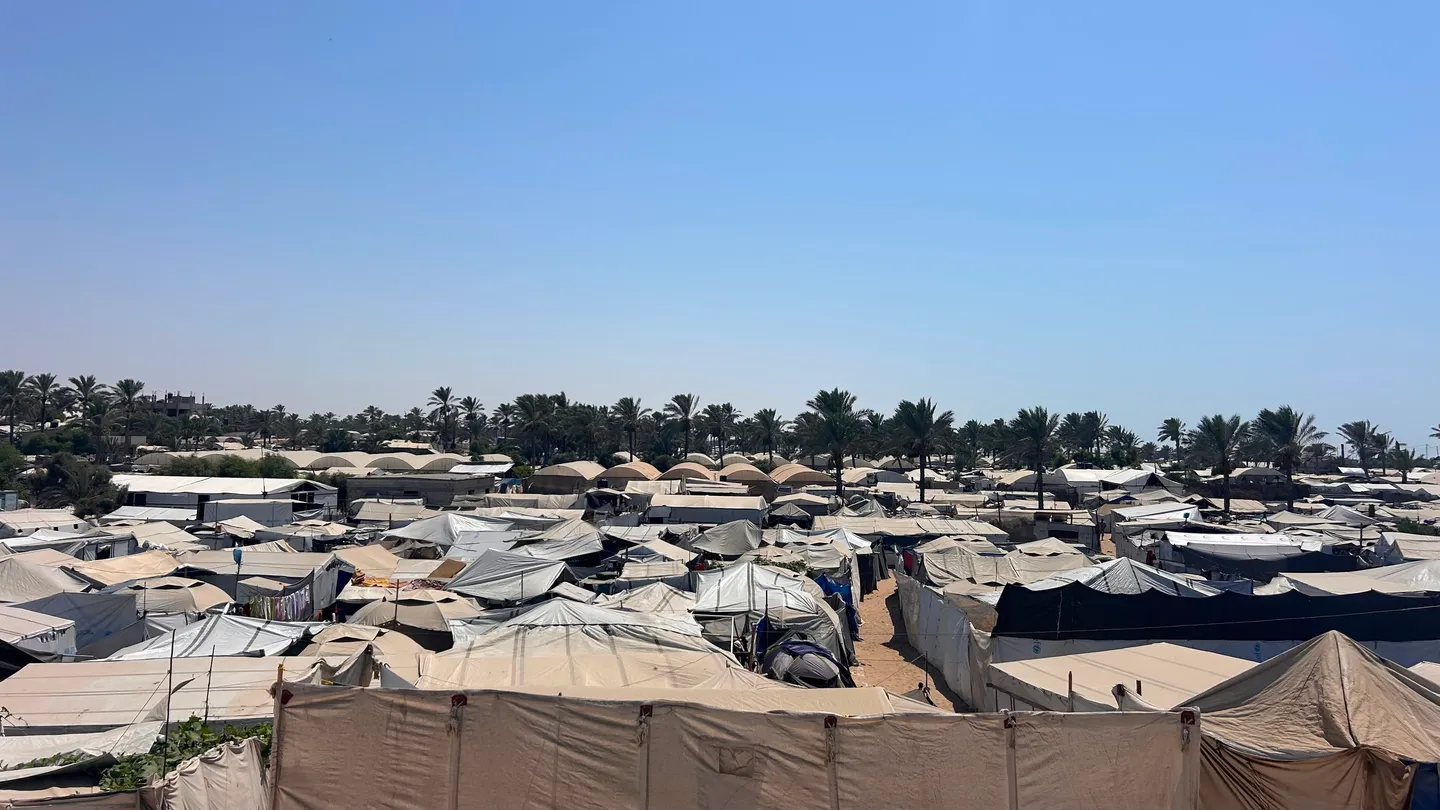
Hanan al-Dali was tidying up her threadbare tent on a humid August weekend when the staccato bursts of gunfire rang out.

She dropped everything to grab her three young children, the oldest just nine years old, and dropped to the ground. By now, it’s become almost routine – everyone flat on the floor, hands over their heads.

Al-Dali, 31, rarely lets her children roam outside the tent, despite the suffocating heat. It’s simply too dangerous.

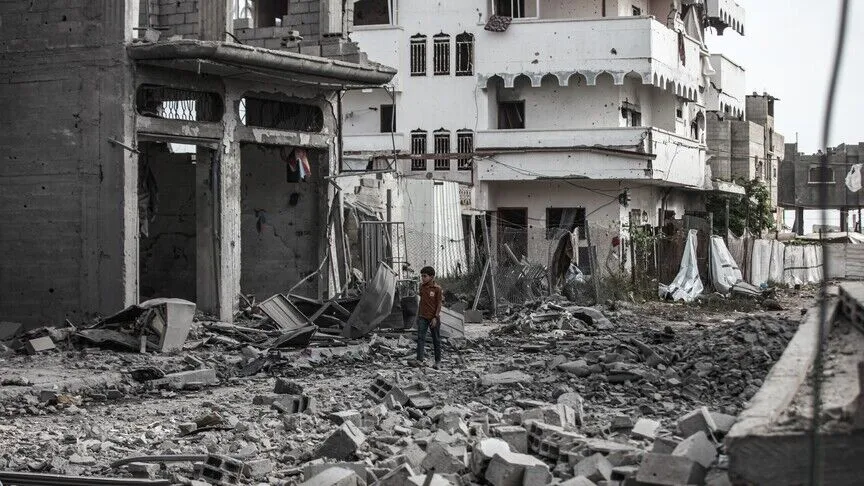
They live just a hundred meters from the Yellow Line, the boundary that marks the start of Israeli-controlled territory in Gaza.

Despite a supposed ceasefire in October 2025, the violence has never stopped.

As world leaders prepare to gather in New York for the UN General Assembly’s high-level debate on September 22, Gaza will have endured nearly three years of war since October 2023. 

Though a ceasefire took effect on 10 October 2025, it’s the latest in a long line of UN-backed decisions Israel has disregarded.

“We could no longer bear the shelter, the crowding, the lack of hygiene, and the disease, so we chose to take the risk near the Yellow Line,” she tells TRT World.

“But I never imagined the risk would be like this. Gunfire reaches us daily, and sometimes we don’t sleep for fear the Israeli army might storm in.”

https://youtube.com/watch?v=oYJLtGCMIxc%3Fenablejsapi%3D1%26origin%3Dhttps%253A%252F%252Fwww.trtworld.com%26widgetid%3D1%26forigin%3Dhttps%253A%252F%252Fwww.trtworld.com%252Farticle%252Feb2eb6c61b74%26aoriginsup%3D1%26gporigin%3Dhttps%253A%252F%252Fwww.trtworld.com%252F%26vf%3D1

Nine months since the so-called truce, Israel’s control over the devastated Palestinian enclave has now grown to over 65 percent, according to a UN body

That’s up from 53 percent when the “Yellow Line” was first drawn.

The October truce, under a 20-point US plan, was endorsed by a Security Council resolution on November 17, 2025. It followed an earlier ceasefire beginning January 19 the same year.

While this second truce reduced the fighting, deadly violence near the frontline has carried on. Gaza’s Ministry of Health said that more than 1,200 Palestinians have been killed since the ceasefire, as of early August 2026.

Al-Dali has had to watch the Yellow Line creep closer, steadily bringing the violence closer to their doorstep.

“We thought it would recede as the army withdrew. But it advanced and got closer to us.

Al-Dali’s husband was wounded in an Israeli strike in May 2025. It left him blind in one eye, unable to speak, and without movement in his right hand.

Most of his days are occupied with seeking whatever treatment he can find in the enclave, which faces catastrophic medical shortages amid Israel’s ongoing blockade.

Still, she hopes the UN’s upcoming session will bring action, not just resolutions, to force Israel “to end the genocide, destruction, and starvation it is inflicting on the people of Gaza”.

Hanan rarely lets her children roam outside the tent, despite the suffocating heat.

Hanan rarely lets her children roam outside the tent, despite the suffocating heat.

Two kilometres away, Osama Ahmad Said, 54, and his family are sheltering in a bombed-out timber shop.

He tells TRT World that he can view his own ruined home only from a distance, since it sits beside the line.

He hauls water from hundreds of metres away, as donors are too afraid to reach the area. Even UNRWA, once a critical aid source, has stopped providing assistance, he said.

Israel has abandoned every commitment, said Said, yet what saddens him most is the UN’s failure to enforce its own resolutions.

“If the UN holds its annual meetings just to produce words, with no enforcement or pressure, then what’s the point?” he asked.

“We have a saying: whoever feels safe from punishment behaves badly. As long as Israel remains beyond accountability, the Palestinian people’s Nakba will go on without end.”

Even so, Palestinians are committed to the UN, he says. “We demand mechanisms to enforce its resolutions, because we believe in peace and justice.”

A pattern of UN resolutions, rarely enforced

In late July 2026, Hamas agreed to a US-brokered 15-point disarmament roadmap. Trump hailed it as a “historic” step toward ending the war. Under the roadmap, Hamas would disarm in stages. Israel would withdraw in parallel, pulling back to the Yellow Line.

But on August 9, Netanyahu rejected the deal outright. Israeli forces, he insisted, would not withdraw until Hamas was “genuinely” disarmed first.

Hamas has said it won’t surrender its weapons until Israel withdraws to the Yellow Line, as the original ceasefire promised. 

The deal remains stalled, and people like al-Dali and Said remain trapped in its shadow.

The tragedy unfolding in Gaza goes far beyond a humanitarian crisis, says Hussein Hammad, a Palestinian human rights defender.

It’s “a comprehensive, sustained collapse of the entire system of life, driven by Israel’s effort to turn Gaza into a hostile environment,” Hammad tells TRT World.

He pointed to an unemployment rate of nearly 85 percent, the repeated displacement of roughly two million people, generations of orphans, and the resurgence of diseases like polio amid collapsed sanitation.

Politically, he says, Israel has engineered Gaza into isolated “cantons,” with buffer zones and the Yellow Line blocking movement and cutting off food and water.

All of that comes even as UN bodies repeatedly rule against Israel.

In 2024, the ICJ ordered Israeli forces to fully withdraw. The General Assembly agreed and called for a September 2025 deadline. Israel ignored both.

Security Council resolutions have gone unenforced due to the US veto, and a UN commission concluded in September 2025 that Israel had committed genocide, which Israel denies.

Hammad calls the UN’s failure to enforce resolutions “a fatal marriage of structural flaws and international political complicity.”

UNRWA has long been a backbone of Palestinian survival, but it is now under pressure as Israel seeks to limit its capacity to respond.

UNRWA has long been a backbone of Palestinian survival, but it is now under pressure as Israel seeks to limit its capacity to respond.

The General Assembly “passes resolutions by sweeping majorities, but these are non-binding,” he says, while the Security Council “is completely hijacked by the US veto.”

The UN has reached a historic level of impotence, he said, unable to even protect its own staff – 397 have been killed during the war. Israel meanwhile declared the UN Secretary-General a persona non grata.

“The world’s largest organisation has turned into little more than a narrator of tragedies,” Hammad adds.

Former UNRWA spokesperson Sami Mshasha tells TRT World the problem isn’t a lack of resolutions but that “enforcement remains hostage to the will of member states”.

The General Assembly lacks an executive body to compel parties, he says, while Security Council action under Chapter VII can be politically blocked from within.

Gaza laid bare the consequences of such a compromised structure, says Mshasha.

The Council passed Resolution 2728 in March 2024, demanding a Ramadan ceasefire, then Resolution 2735 in June, endorsing a three-phase truce. “Yet neither was implemented in time.”

UN committee report, he points out, found the Council’s failure wasn’t due to reluctance to invoke Chapter VII, since it was applied in Iraq and Libya. 

That exposes “clear political selectivity.” What happened, he says, is “not simply a ‘UN failure’ but the failure of an international system whose enforcement mechanisms collided with political power.”

“It’s a credibility crisis, not a competence crisis,” Mshasha adds.

Gaza’s last lifeline

UNRWA has long been a backbone of Palestinian survival, stepping in to secure healthcare, food, and water sanitation. It’s now buckling under similar pressures, as Israel seeks to gut the humanitarian agency and limit its ability to respond.

In 2024, Israel’s Knesset designated the agency a terrorist organisation and passed laws to ban its activities. 

Israel also convinced 16 donor states – including the US, Germany, the UK, Canada, and Japan to withdraw funding– pausing $450 million in aid.

Hammad describes UNRWA’s situation as “a reflection of an Israeli political decision to liquidate the refugee cause by destroying their agency.” It’s been reduced to “a mere relief organisation in maximum-emergency mode”.

RelatedTRT World – Most Gaza oxygen stations forced out of service over Israel’s total blockade

Even on a reduced budget, the UNRWA has tried to keep up its work.

“It is inaccurate to say UNRWA now has no role in Gaza, and equally inaccurate to say it operates as before the war,” Mshasha says.

Per its latest report, UNRWA runs six health centres and 61 mobile teams, providing 70,000 weekly consultations and delivering water to over 860,000 people daily.

Yet, according to Mshasha, direct food aid – which once reached 1.9 million people – collapsed once UNRWA exhausted its stockpile and was barred from entering Gaza directly, since March 2025.

In 2026, UNRWA faced a $100 million deficit, with just 44 percent of its budget funded.

Mshasha calls that proof that donors have abandoned their commitments, even as needs multiplied.

A weaker UNRWA could leave a vacuum nothing else could fill, said Mshasha, given its 11,500 staff and network built over decades,  a concern the Colonna Commission also raised.

“This reality makes UNRWA exceptional,” he says, “because it treats the Palestinian as a refugee with legal rights registered since 1949, the year following the Nakba. 

That is why Palestinians still see in its card their last proof of identity and rights, despite all its administrative flaws.”

(This article is published by TRT World in collaboration with Egab)

  • CrossFireArabia

    CrossFireArabia
    Dr. Marwan Asmar holds a PhD from Leeds University and is a freelance writer specializing on the Middle East. He has worked as a journalist since the early 1990s in Jordan and the Gulf countries, and been widely published, including at Albawaba, Gulf News, Al Ghad, World Press Review and others.

    Related Posts

    Four Days in Cairo: A Journey Into The Faces of Egypt

    By Dr Marwan Asmar

    EDITOR’S NOTE: This article has been made with the help of AI. I just fed it the information and it came up with the “writing glow”. I feel almost like an “information thief” but in today’s technological gadgetories we are bound to adopt. The question then becomes are we real writers or have we become mere hybrids? Can we call ourselves writers? But remember these technologies are only as good as the information we give them. I am consoling myself in a sense but I believe this is really a worthwhile article.

    Some trips are remembered because of the places we visit. Others stay with us because of the people who shared them with us. Our four-day journey to Cairo was a combination of both. It was a family trip—my wife and I, our son who came from Germany to join us, three nieces and a nephew—and although it lasted only from 15 to 18 July, it somehow felt much longer. Cairo has that effect on you. Every day is crowded with people, places, sounds, history and impressions.

    We left Amman in the early hours of the morning, when the city was still quiet, and a few hours later landed at the Cairo International Airport. Cairo was already awake and bustling.

    A mini-bus was waiting to take us across the enormous city to the new and impressive Giza Palace Hotel. Plush, modern and comfortable, the hotel is an interesting introduction to the new face of Greater Cairo. Around us were wide highways, new developments and a city expanding relentlessly into areas that only a few decades ago were desert.

    But we had not come to Cairo to stay inside a hotel. Our journey began almost immediately.

    Wednesday: Into the Heart of Cairo

    While the rest of the family followed their own plans, my wife and I decided to separate from the group and head straight back into Downtown Cairo. And there was really only one place to begin: The famous Tahrir Square.

    Tahrir is more than a traffic circle or a public square. For anyone familiar with Egypt’s modern history, the name itself carries enormous significance. Yet standing there, what struck us first was not politics or history but Cairo itself.

    Noise. Cars. Horns. People. Movement.

    Cairo seems incapable of standing still. We managed to find a taxi and plunged deeper into the city toward Khan al-Khalili.

    Here, Cairo changed again.

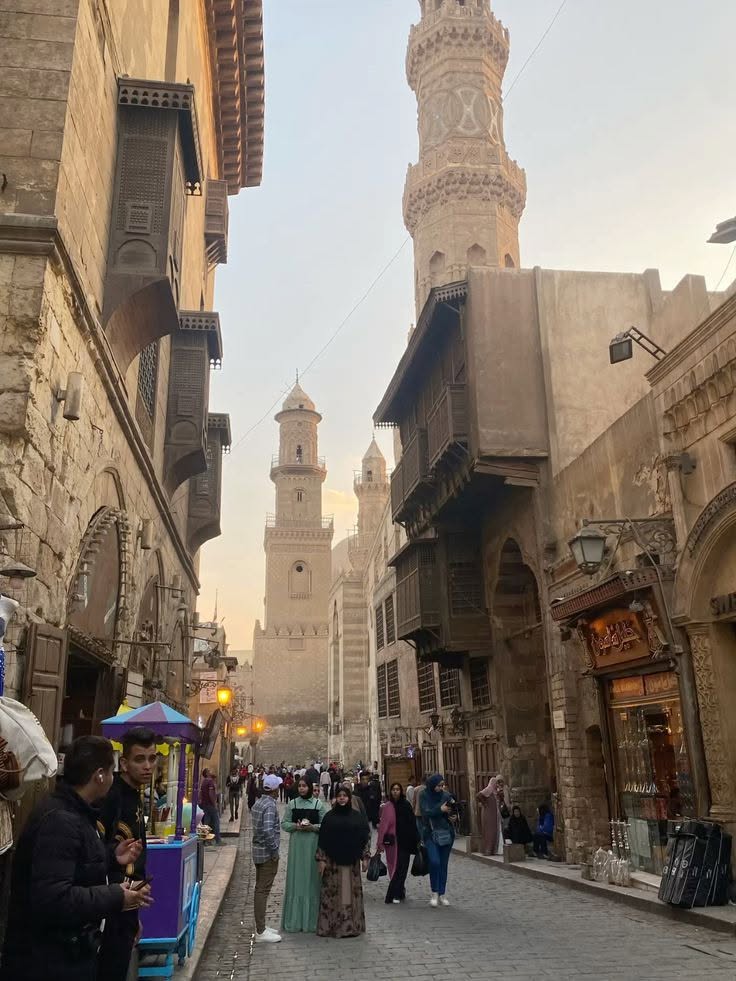
    The broad streets of Downtown gave way to the atmosphere of old Cairo: Narrow streets, small shops, street sellers, cafés, souvenirs, lamps, jewellery, spices and people constantly negotiating, selling, buying and talking.

    The street sellers were part of the experience. They called to us, displayed their goods and tried every possible way to persuade us to stop. There was something wonderfully theatrical about it all.

    Khan al-Khalili is not a place to hurry through. You wander. You look. You bargain. And occasionally you buy something you never intended to buy.

    Nearby stood another Cairo landmark: Al-Azhar, one of the great historic centres of Islamic scholarship. The mosques of the surrounding area were magnificent, and suddenly the commercial noise of the market existed beside another world of minarets, courtyards, stone and centuries of religious learning.

    That is something Cairo does exceptionally well. It places different worlds beside one another without feeling the need to separate them.

    By the end of the day, however, history, walking, traffic and the July heat had taken their toll. Exhausted but satisfied, we made our way back to the hotel.

    Thursday: Mummies, Pyramids and the Nile

    The following morning, Thursday, we rejoined the family.

    Our first major destination was the National Museum of Egyptian Civilization, where one of the most memorable experiences was seeing Egypt’s famous royal mummies.

    There is something difficult to describe about standing only metres away from the preserved remains of people who ruled Egypt thousands of years ago.

    These were names we had encountered in books and documentaries, belonging to a civilization so ancient that it can sometimes seem almost mythical. Yet here they were.

    The experience makes history unexpectedly personal.

    From Egypt’s ancient rulers we travelled to the monuments that have come to symbolize their civilization throughout the world: Pyramids of Giza.

    No number of photographs quite prepares you for the pyramids.

    Their familiarity almost works against them. We have seen their triangular outlines thousands of times. But when you actually stand beneath them and see the enormous stones from which they were constructed, their scale becomes real.

    And naturally, there were the camel owners.

    They enthusiastically urged us to ride, adding another layer of noise, humour and negotiation to the experience. Around one of the world’s greatest archaeological sites, everyday Egyptian life continued at full volume.

    That evening brought another change of atmosphere. We walked along the Nile near Zamalek.

    The riverfront was alive. Families, young people, couples and tourists were everywhere. Restaurants and cafés were busy, while boats covered in lights moved along the water offering evening trips on the Nile.

    After the dust and heat of Giza, the Nile provided a completely different Cairo—cooler, more relaxed and intensely social.

    The city seemed to have come to the river for the evening.

    Friday: Civilization, Salah al-Din and Another Cairo

    Friday began with a visit to one of Cairo’s malls before we continued exploring the city.

    We again encountered the enormous historical depth of Egypt through its museums, while our route also took us past the imposing Citadel of Salah al-Din.

    The Citadel rises dramatically above Cairo, a reminder that this city’s history did not begin and end with the Pharaohs. Cairo is also a great medieval Islamic city, shaped by dynasties, armies, scholars, merchants and rulers who left behind mosques, fortifications and entire neighbourhoods.

    By then, however, another important Egyptian experience was waiting for us: food. We stopped at a grand restaurant and enjoyed a hefty fish meal—the kind of meal that makes further sightseeing immediately afterwards seem unnecessarily ambitious.

    Later, the rest of the family continued to Tagamoa El Khames (Fifth Settlement) and one of its large malls. My wife and I decided that we had done enough exploring for one day and stayed behind at the hotel.

    Sometimes knowing when to stop is also part of travelling although one of my nieces later told me it’s a massive mall nothing like she’d ever seen before.

    The Cairo Between the Monuments

    Looking back, some of the strongest impressions of the trip did not come from any particular tourist attraction. They came from simply looking at Cairo and its people lounging about and going about their business.

    The enormous highways were particularly striking. On one of my sojourns I counted up to 15 lanes of traffic, almost or more than the width of a football field. Modern Cairo has built an extraordinary network of wide roads, bridges and elevated highways cutting across and around the metropolitan area. They give the impression of a city determined to keep expanding.

    Then there were the buildings. Tall residential blocks rose everywhere, many in dark grey colour that seems characteristic of parts of Cairo’s urban landscape. Some appeared unfinished; others seemed to merge into enormous working-class neighbourhoods stretching towards the horizon and on either side of a plush highway.

    Then, sometimes only a short drive away, another Cairo appeared. Modern towers. Expensive residential developments. Shopping malls. Hotels. Landscaped compounds and impressive buildings.

    The contrasts were impossible to miss, it’s a didactic Cairo.

    Old and new. Rich and poor. Monumental and ordinary.

    Ancient pyramids stand beside a modern metropolis. Medieval mosques exist amid the noise of cars and motorcycles. Working-class neighbourhoods stretch for kilometres, while new affluent districts continue to rise farther into the desert.

    And running through it all is the wonderful blue Nile, nice to fathom rather than read about.

    Perhaps this is what makes Cairo so fascinating. It does not present itself neatly to the visitor. It is noisy, crowded and occasionally exhausting. Its traffic can test anyone’s patience. On the city roads you have to learn to be patient. But it is a city that is also full of life.

    Cairo does not whisper its presence, it echoes it and announces it.

    Saturday: Back to Amman

    On Saturday, 18 July, our mini-bus once again carried us through Cairo’s roads, this time toward the airport.

    Four days earlier, we had arrived as a family ready for a short holiday. Now we were leaving with memories of Tahrir Square, Khan al-Khalili, Al-Azhar, royal mummies, the pyramids, camel owners, Salah al-Din’s Citadel, huge meals, shopping malls and evenings beside the Nile.

    But perhaps the most valuable memory was simply that we had experienced it together.

    My wife and I had our own Cairo adventure on that first day. Our son had travelled from Germany to be with us. Our nieces and nephew shared the larger family journey. For four intense days, three generations of experiences, personalities and interests were packed into one enormous city.

    As the plane carried us back toward Amman, Cairo was left behind—but certainly not forgotten.

    There are quieter cities. There are easier cities. There are cities that reveal themselves more gracefully.

    But few cities possess Cairo’s extraordinary combination of history, chaos, grandeur, contradiction and life. It was only four days. 

    But it is a trip we will remember for a very long time.

    Continue reading
    Click in Gaza

    By Ibrahim Isam

    As I often do at sunset, I was trying to photograph the children as silhouettes—small figures dissolving into the last light of the day.

    I captured one image that I liked very much. Perhaps because it seemed open to many interpretations, as if the photograph had left a small door ajar for the viewer’s imagination. I hurried back to a place where I could find an internet connection, eager to share it before the moment disappeared.

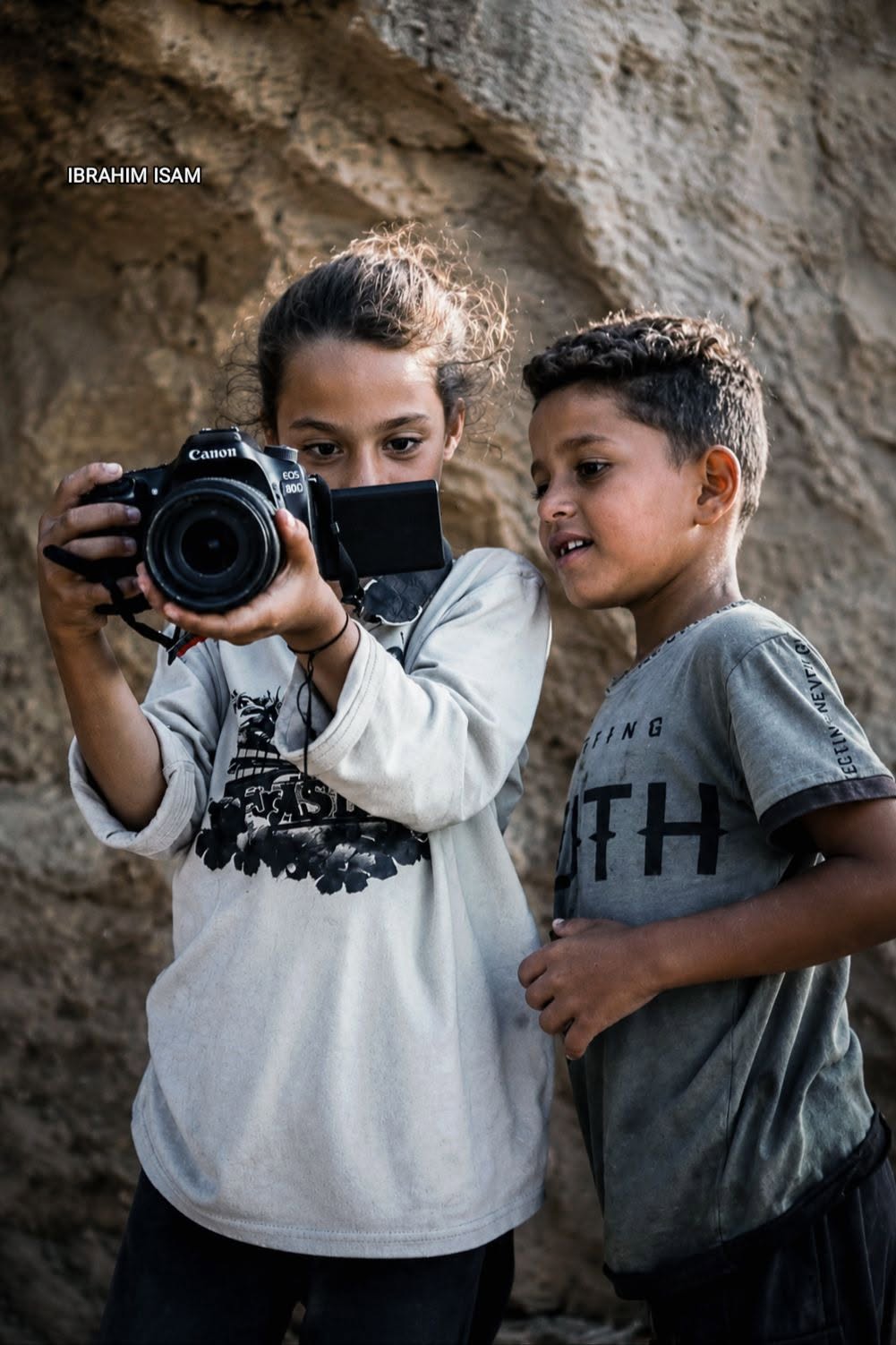
    But on the way, I saw the two of them.

    I wanted to photograph them. They agreed, but only on one condition:

    “We’ll pose—but you have to photograph us with the camera.”

    I had no choice. My camera was with me, but I could not use it for the portrait they wanted. So I took out my scratched-lens phone and tried, with that imperfect little lens, to give them what they had asked for.

    I thought I was simply taking their picture.

    Then, some time later, I looked at it again.

    And somehow, it felt as though I had not entirely taken the photograph.

    Perhaps they had.

    Perhaps they had simply chosen, for themselves, how they wanted to be seen.

    Continue reading

    Leave a Reply

    Your email address will not be published. Required fields are marked *

    You Missed

    In The Line of Fire: Gaza Families Fear The ‘Yellow Line’

    In The Line of Fire: Gaza Families Fear The ‘Yellow Line’

    Kushner Tells Netanyahu Not to Move ‘Westwards’ in Gaza

    Kushner Tells Netanyahu Not to Move ‘Westwards’ in Gaza

    A Middle East Whirlpool! View From Amman

    A Middle East Whirlpool! View From Amman

    Prisoner Mohammad Arab Hadn’t Seen His Face in 2 Years!

    Prisoner Mohammad Arab Hadn’t Seen His Face in 2 Years!

    UN: 3000 Settler Attacks on West Bank Palestinians Since 2025

    UN: 3000 Settler Attacks on West Bank Palestinians Since 2025

    Four Days in Cairo: A Journey Into The Faces of Egypt

    Four Days in Cairo: A Journey Into The Faces of Egypt