Israeli Gunboats Fire at, Injure 5 Gaza Fishermen
 CrossFireArabia
- August 31, 2026
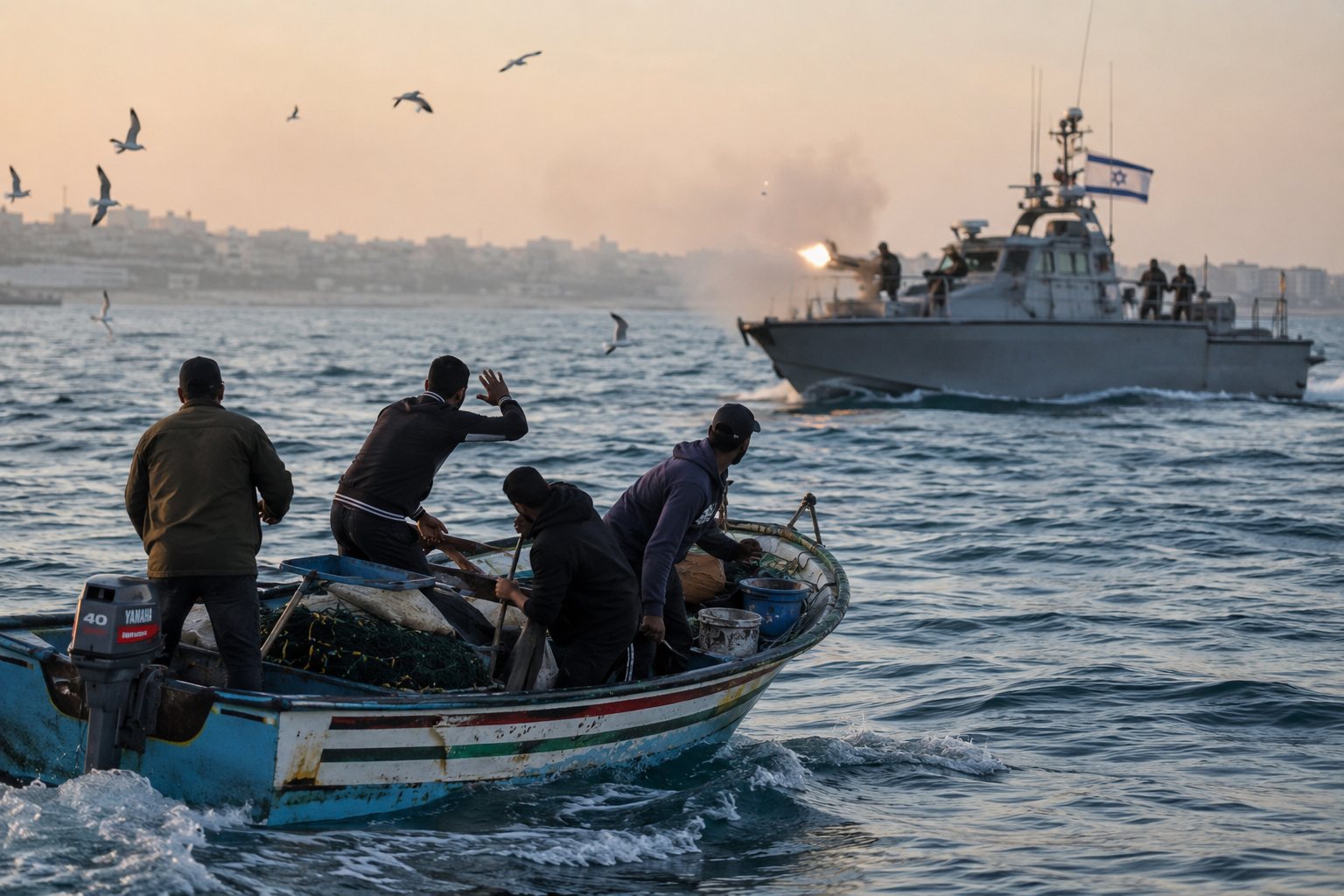
The sea, which Gaza fishermen traditionally frequent to provide for their families, has remained hazardous and not safe even after the 10 October, 2025 ceasefire was declared. Early Monday morning, five Palestinian fishermen were wounded by Israeli gunboats gunfire while working off the coast of Gaza City. This incident adds to a long list of attacks targeting fishermen.
The Palestinian Red Crescent Society reported that its crew transported five wounded fishermen from the Gaza port area. Three were taken to the Society’s field hospital, Al-Saraya, while the other two were transferred to Al-Shifa Hospital for treatment.
The fishermen were injured while working off the coast of Gaza City after Israeli gunboats opened fire on their boats.
Livelihood Under Fire
The Palestinian Ministry of Agriculture stated that the attack represents another instance of the repeated targeting of fishermen and is part of a policy aimed at cutting off the livelihoods of those working in the maritime and agricultural sectors and depriving them of their most basic rights.
The Ministry stated that the attacks have transformed fishing, a vital source of income for many Palestinian families, into a life-threatening activity for those working at sea. It called upon human rights and international organizations to intervene, halt these violations, and provide protection for fishermen and farmers.
Thus, Gazan fishermen no longer go to sea solely to face the difficulties of fishing, fuel and equipment shortages, and damaged boats, but also the risk of being shot at, at a time when job opportunities and income sources have become extremely limited in the Gaza Strip.
They are not the first victims. United Nations data reveals that today’s incident is not an isolated one but part of a continuing pattern of attacks and restrictions targeting the fishing sector in Gaza.
In a previous report, the United Nations Office for the Coordination of Humanitarian Affairs (OCHA) cited the Office of the United Nations High Commissioner for Human Rights (OHCHR) as documenting 28 attacks on fishermen and fishing sites between 7 October, 2023, and 31 December, 2024. The Palestinian Ministry of Agriculture stated that, as of 11 December, 2024, the Israeli army killed approximately 200 fishermen and workers in the fishing sector, out of nearly 6,000 who were employed in this profession before the war.
During the period from 1 January to 16 May, 2025, the OHCHR documented 28 incidents against fishermen, resulting in the deaths of 11 fishermen and injuries to 34 others, in addition to the brief detention of two fishermen before their release.
These figures indicate that targeting fishermen was not a phenomenon limited to the early days of the war, but continued afterward through gunfire, restrictions on access to the sea, and the destruction of fishing equipment.
In its June 2026 report, OCHA stated that access to the sea remained prohibited and fishing activities were effectively restricted, depriving fishermen of their livelihoods and limiting the chances of early economic recovery in the sector. The report also noted the continued occurrence of Israeli gunfire incidents near fishermen or on the shore.
OCHA emphasizes that the restrictions on access to the sea are part of broader restrictions on livelihoods in Gaza, including limitations on access to agricultural land, movement, and the entry of essential goods and supplies.
For the fishermen, the injury of five of their colleagues is not just another incident; it means that going out to sea in search of food and income can end in injury, the loss of their boat, or the loss of their livelihood.
Thus, the sea transforms from a space meant to provide food and work into one fraught with danger and restrictions. In Gaza, a fisherman needs nothing more than a boat, a net, and safe waters to support his family, but when the sea itself becomes a source of danger, the search for fish becomes a search for survival as per the Palestinian Information Center.