Ugly War: Amputating The Palestinians?

One of the many ugly consequences of wars and conflict is injuries leading to a loss of limbs. Gaza, which now has the highest number of child amputees per capital anywhere in the world, is no exception.  

“I was going to buy falafel,” says Mohammed Hassan. “On the way home, I looked up and saw a rocket heading towards me. I tried to run, but it was too fast. I found myself pinned to the wall, and my foot had been blown off.”

Brought to Al-Shifa Hospital in Gaza City, the young boy looks down at his heavily bandaged left leg, and the stump where his foot used to be.

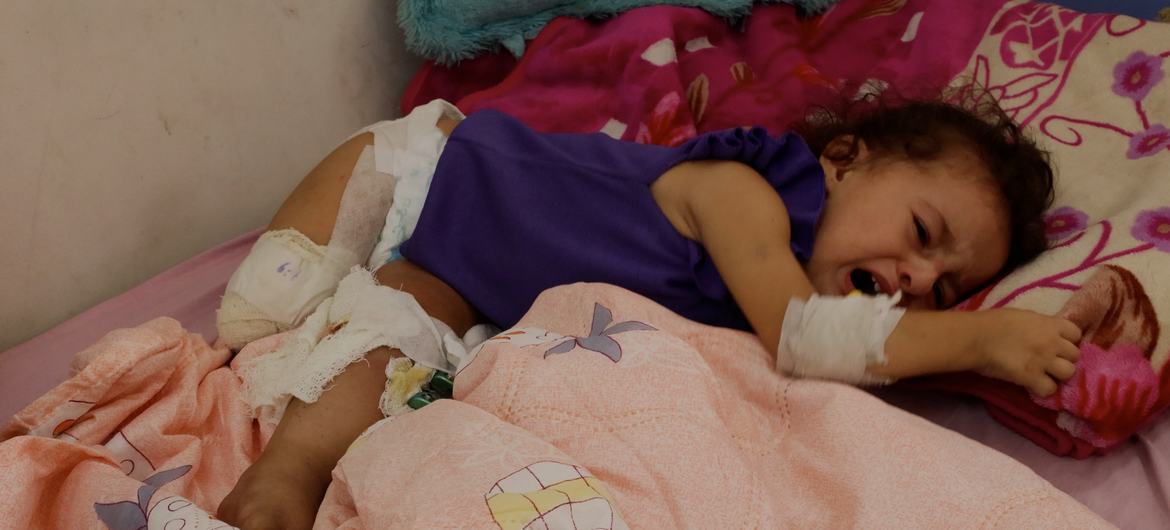
In another area of the hospital, a small child, Maryam Abu Alba, is crying in pain. “The neighbour’s house was bombed, and their home was hit,” says her grandmother. “One of her legs had to be amputated, and metal plates had to be inserted into the other one, which was fractured. She is in severe pain.”

Earlier this year, the UN humanitarian aid coordination agency OCHA estimated that 4,500 new amputees require prosthetics, in addition to the 2,000 existing cases requiring maintenance and follow-up care, while about 24,000 injured people required rehabilitation.

Health facilities are overwhelmed with many patients undergoing multiple surgeries without adequate medical supplies, including anaesthesia.

Palestinian child Mohammad Hassan sitting on a hospital bed in Gaza after his left leg was amputated by a strike.

UN News

Palestinian child Mohammad Hassan sitting on a hospital bed in Gaza after his left leg was amputated by a strike.

Desperately seeking food

In May, as supply routes for UN humanitarian convoys were interrupted, the number of distribution points of aid dropped from 400 dotted across the Gaza strip to a handful of hubs operated by the Gaza Humanitarian Foundation.

Given the shortage of humanitarian aid and diminished capacity, thousands of Palestinians have been killed or injured since May while seeking food.  Among the wounded are children and parents who, despite losing limbs, continue to search for food and water.

This comes as a UN-backed food security report has just concluded that famine is confirmed in Gaza governorate, where half a million people are trapped in conditions of starvation, malnutrition and death.

Ibrahim Abdel Nabi was one of the many Palestinians who headed to the hubs in the hope of finding desperately needed provisions for their families.

In his tent at a displacement site in the coastal Al-Mawasi area of Khan Younis, Mr. Nabi, surrounded by his wife and children, explains how the journey ended in disaster and life-changing injuries.

“When I arrived at the Al-Alam area, west of Rafah, I was hit by an explosive bullet in my leg. I was bleeding for about an hour and a half, and no one came to help me. They were all trying to find food for their children.”

Eventually, a group of people came to his rescue and took him to the nearby Red Cross hospital.

“I stayed there for about a month and a half, undergoing about 12 operations. I became malnourished and lost a lot of blood. Infection spread, and more of my leg had to be amputated.”

Ibrahim Abdel Nabi, a Palestinian displaced in Gaza, sitting on a chair while his wife helps him wear the handmade prosthetic limb.

Ibrahim Abdel Nabi, a Palestinian displaced in Gaza, sitting on a chair while his wife helps him wear the handmade prosthetic limb.

‘I made my prosthetic leg’

As Mr. Nabi was trying to recover, he was aware that his family were still in need of food. Despite the pain, he decided to make a simple prosthesis from materials he could find to allow him to get back on his feet and make fresh attempts to find food and water.

“The prosthesis injures my leg,” he said. “It causes inflammation and increases the pain. We don’t have medical care or supplies, but I will use it no matter how much it hurts.”

As he speaks, Mr. Nabi’s wife begins to cry. “God willing, we will live through this experience,” she says.

Mr. Nabi gets up on crutches and heads to a nearby tent, where his wife helps him to put on the crude prosthesis.

“Don’t strain yourself,” she repeats, over and over. “Take your time. Walk slowly.”

UN News

CrossFireArabia

CrossFireArabia
Dr. Marwan Asmar holds a PhD from Leeds University and is a freelance writer specializing on the Middle East. He has worked as a journalist since the early 1990s in Jordan and the Gulf countries, and been widely published, including at Albawaba, Gulf News, Al Ghad, World Press Review and others.

Related Posts

11 Israel Soldiers Commit Suicide in April

Israeli soldiers continue to commit suicide in what is becoming a disturbing phenomenon that is becoming linked to Israel’s war on Gaza since October 2023, and now the war ongoing Lebanon.

The Israeli media have continued to report on what is becoming a rising trend of soldiers taking away their lives in Israeli society.

In its Sunday edition of 26 April the Israeli Haaretz newspaper highlighted the fact that eight Israeli soldiers and police officers committed suicide this month alone. The paper adds that three reservists who took part in the war on Gaza also ended their lives this month, making the total to 11 in less than one month.

The number of suicide rates have been increasing since 2023. Then 17 took away their lives, including seven after the 7 October, when the Israeli genocide on Gaza began. Thus, after that, 21 soldiers ended their lives in 2024 and increasing to 22 in 2025. In between the figures it is estimated that 279 soldiers attemoted suicide but didn’t succeed.

Statistics show in the previous decade the average suicides were 12 per year stabilizing from the 28 cases peak of 2010.

Data reports for 2026 shows that reserve soldiers formed the highest number of suicides, at least five cases as compared to three among conscripts and two cases in the ranks of those who take up soldiering as an occupation.

The Israeli military establishment is finding itself unable to control the suicide phenomenon with those in leadership roles realizing the fact that soldiers who are suffering from psychological distress are not seeking help. Haaretz quotes one officer in human resources as saying the army “thought at the beginning of the war it can control the situation but it later blew in its face”.

Psychological experts say the recent rising suicide rates is to do with the fact Israel has never experienced the present kinds of wars it is presently involved in like Gaza and/or Lebanon. The soldiers are under continuous pressure to fight and the fact that the reservists are being called up more than once magnifies the crisis that already exists.

Haaretz points out the army has decreased its support for soldiers who need psychological treatment and sends them back to the warfront before evaluating their psychological state. The soldiers are continually  under pressure by their officers to go back to fight or else face arrest.

Also, the declared numbers don’t show the real picture, the newspaper argues, pointing out that there are soldiers who committed suicide after they left the military service with the Israeli army admitting that by the end of 2025, there were 15 cases of this kind. The paper said there were four such cases with three in the last month.

This article is based on a report in Arabic published in the Palestine Information Center and it is republished at crossfirearabia.com.

Continue reading

You Missed

11 Israel Soldiers Commit Suicide in April

11 Israel Soldiers Commit Suicide in April

Palestinian Pound Lives on!

Palestinian Pound Lives on!

Israeli Settlers Uproot 400 Olive Trees

Israeli Settlers Uproot 400 Olive Trees

Amidst Death, Palestinians Celebrate in Group Wedding!

Amidst Death, Palestinians Celebrate in Group Wedding!

Iranian Missiles Cause ‘Extensive’ Damage to US Bases Than Previously Thought – Report

Iranian Missiles Cause ‘Extensive’ Damage to US Bases Than Previously Thought – Report

Why is Iran’s FM in Oman?

Why is Iran’s FM in Oman?