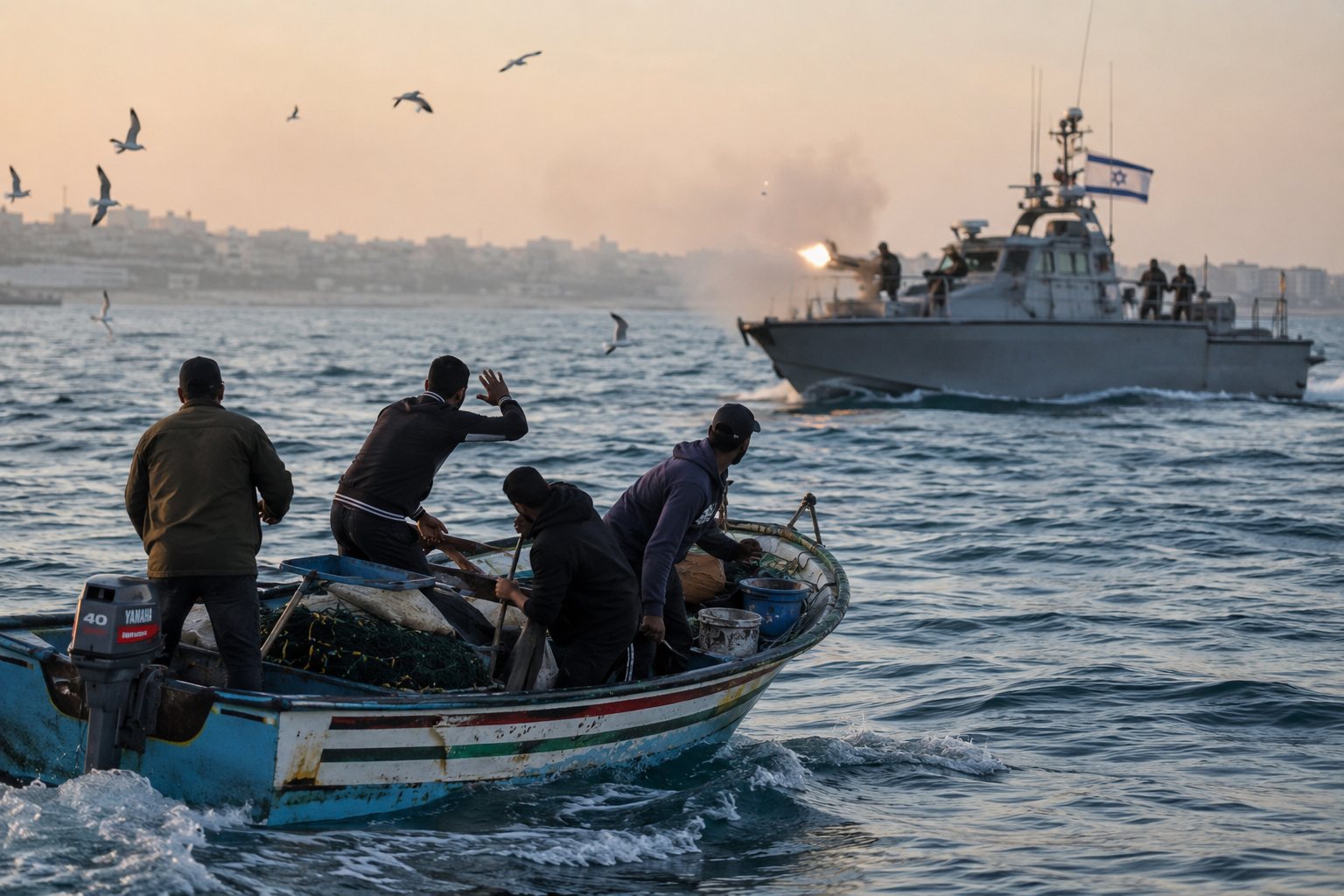
The sea, which Gaza fishermen traditionally frequent to provide for their families, has remained hazardous and not safe even after the 10 October, 2025 ceasefire was declared. Early Monday morning, five Palestinian fishermen were wounded by Israeli gunboats gunfire while working off the coast of Gaza City. This incident adds to a long list of attacks targeting fishermen.
The Palestinian Red Crescent Society reported that its crew transported five wounded fishermen from the Gaza port area. Three were taken to the Society’s field hospital, Al-Saraya, while the other two were transferred to Al-Shifa Hospital for treatment.
The fishermen were injured while working off the coast of Gaza City after Israeli gunboats opened fire on their boats.
Livelihood Under Fire
The Palestinian Ministry of Agriculture stated that the attack represents another instance of the repeated targeting of fishermen and is part of a policy aimed at cutting off the livelihoods of those working in the maritime and agricultural sectors and depriving them of their most basic rights.
The Ministry stated that the attacks have transformed fishing, a vital source of income for many Palestinian families, into a life-threatening activity for those working at sea. It called upon human rights and international organizations to intervene, halt these violations, and provide protection for fishermen and farmers.
Thus, Gazan fishermen no longer go to sea solely to face the difficulties of fishing, fuel and equipment shortages, and damaged boats, but also the risk of being shot at, at a time when job opportunities and income sources have become extremely limited in the Gaza Strip.
They are not the first victims. United Nations data reveals that today’s incident is not an isolated one but part of a continuing pattern of attacks and restrictions targeting the fishing sector in Gaza.
In a previous report, the United Nations Office for the Coordination of Humanitarian Affairs (OCHA) cited the Office of the United Nations High Commissioner for Human Rights (OHCHR) as documenting 28 attacks on fishermen and fishing sites between 7 October, 2023, and 31 December, 2024. The Palestinian Ministry of Agriculture stated that, as of 11 December, 2024, the Israeli army killed approximately 200 fishermen and workers in the fishing sector, out of nearly 6,000 who were employed in this profession before the war.
During the period from 1 January to 16 May, 2025, the OHCHR documented 28 incidents against fishermen, resulting in the deaths of 11 fishermen and injuries to 34 others, in addition to the brief detention of two fishermen before their release.
These figures indicate that targeting fishermen was not a phenomenon limited to the early days of the war, but continued afterward through gunfire, restrictions on access to the sea, and the destruction of fishing equipment.
In its June 2026 report, OCHA stated that access to the sea remained prohibited and fishing activities were effectively restricted, depriving fishermen of their livelihoods and limiting the chances of early economic recovery in the sector. The report also noted the continued occurrence of Israeli gunfire incidents near fishermen or on the shore.
OCHA emphasizes that the restrictions on access to the sea are part of broader restrictions on livelihoods in Gaza, including limitations on access to agricultural land, movement, and the entry of essential goods and supplies.
For the fishermen, the injury of five of their colleagues is not just another incident; it means that going out to sea in search of food and income can end in injury, the loss of their boat, or the loss of their livelihood.
Thus, the sea transforms from a space meant to provide food and work into one fraught with danger and restrictions. In Gaza, a fisherman needs nothing more than a boat, a net, and safe waters to support his family, but when the sea itself becomes a source of danger, the search for fish becomes a search for survival as per the Palestinian Information Center.
KHAN YOUNIS, GAZA—Ahmed Al-Harsh waited outside Nasser Hospital in Khan Younis on Monday to meet his son, a toddler and the only other survivor of his entire family.
“I’m waiting for my son Mahmoud. I haven’t seen him in two and a half years except once, before he was transferred to Egypt. I’ve been waiting for two and a half years,” Al-Harsh, 31, told Drop Site News.
Mahmoud is one of 28 Palestinian infants who were evacuated to Egypt as premature babies in November 2023 from the neonatal intensive care unit in Al-Shifa Hospital in Gaza City, as the Israeli military laid siege to the medical complex and raided it. Mahmoud and seven other children were returned to Gaza on Monday to be reunited with their families, or what was left of them.
On October 14, 2023, one week into Israel’s genocidal assault on Gaza, the Israeli military bombed the Al-Harsh’s family home in the Jabaliya refugee camp. Al-Harsh’s entire family was killed in the attack—his four-year-old daughter, his father, mother, brother, sisters-in-law, nephews, and nieces. Al-Harsh initially thought his wife, who was eight months pregnant at the time, had also been killed. He only later learned that she had been gravely injured and had given birth to their son, Mahmoud, in hospital before succumbing to her injuries.
(Left) Ahmed Al-Harsh outside Nasser Hospital in Khan Younis as he waits for his son, Mahmoud, to arrive after 2.5 years in Egypt. (Right) Ahmed Al-Harsh holds up a photo of his son Mahmoud on his phone. March 30, 2026. Screenshots of video provided by Abdel Qader Sabbah.
Al-Harsh was able to see Mahmoud only once before he was taken to the neonatal intensive care unit in Al-Shifa’s hospital for care. He had been staying in Beit Lahia, unable to move amid the escalating Israeli assault. In November, Israel laid siege to Al-Shifa hospital, surrounding the medical complex and cutting it off from the rest of Gaza City before raiding it on November 15. Doctors inside scrambled to keep their patients alive, including the nearly 40 premature babies in the hospital’s neonatal intensive care unit, Mahmoud among them. There was no electricity and incubators were failing. The World Health Organization, which was able to coordinate a one-hour visit to Al-Shifa at the time, described the hospital as a “death zone.”
After much negotiation, 31 premature babies were evacuated from Al-Shifa on November 19 and taken to Rafah. UNICEF said the conditions of the babies had been “rapidly deteriorating” inside the besieged hospital. Five died before they could be evacuated. The next day, 28 of the babies were transported across the border to Egypt for treatment. None were accompanied by family members.
For the past two and a half years, Al-Harsh has seen his son only in photos or videos sent to him from Egypt—first as an infant, then a toddler. “The feeling is indescribable. What can I tell you about this feeling?” he said. “These two years felt like forty, even more—a lifetime. During this time, I was a body without a soul. I couldn’t work or do anything.”
Video of the convoy arriving at Nasser Hospital in Khan Younis bringing eight children who were evacuated from Gaza to Egypt in November 2023. March 30, 2026. Video provided by Abdel Qader Sabbah.
By early afternoon on Monday, the convoy from Egypt finally arrived. A Red Crescent ambulance and UN vehicles escorted a large bus carrying the children. Families crowded around the doors as they pulled up outside Nasser Hospital. The children were passed into the waiting arms of family members, most of them meeting for the first time, in scenes of joy. Al-Harsh appeared overwhelmed with emotion as he held Mahmoud, chubby, bespectacled and crying, in his arms. When Mahmoud grabbed a bottle of water and drank thirstily, Al-Harsh broke down and wept.
“Every human being needs the love of a mother and father. I am 31, I lost my mother and father, and I’m still suffering,” Al-Harsh said. “This boy—where do I find him a mother? Where do I find him his mother? When he grows up and asks about his mother, what do I tell him?”
At least four of the babies who were evacuated to Egypt died while there, Dr. Ahmed Al-Farra, the director of the pediatric department at Nasser Hospital, told Drop Site. He added that the children who returned to Gaza, while healthy, would require additional medical and psychiatric evaluation.
Gaza’s health care system has been systematically destroyed by the Israeli military since October 2023. Every single hospital was attacked and 25 were completely shut down while 13 remain partially functioning, according to Gaza’s Health Ministry. Despite a “ceasefire” that went into effect in October, Israel has continued near daily attacks in Gaza, killing over 700 Palestinians since then. Israel has also continued to severely restrict the amount of humanitarian aid, fuel, medicine and other essentials, allowing in an average of only 200 trucks daily instead of the 600 agreed upon in the deal.
At the onset of the U.S.-Israeli war against Iran on February 28, Israel reinforced a total siege on Gaza, citing “security concerns.” The Kerem Shalom crossing was partially reopened three days later. The Rafah Crossing between Gaza and Egypt—which had only opened in early February for medical evacuations and for Palestinians returning to Gaza—was also closed at the onset of the Iran war and only reopened on March 18. Roughly 20,000 people are on waiting lists for medical evacuation abroad, 4,000 of them children, according to the Health Ministry.
The Gaza Health Ministry this week warned of a severe shortage of generator fuel that threatened hospital operations. The Ministry said that remaining generators are “worn out and prone to repeated breakdowns,” placing critical departments such as intensive care, surgery, neonatal units, and dialysis at risk of shutting down. Israeli forces have allowed the entry of only 1,240 fuel trucks out of the 8,350 that were supposed to enter over the 167 days since the ceasefire agreement took effect—a compliance rate of just 14.8%—according to the latest statistics from officials in Gaza shared with mediators and obtained by Drop Site. The Health Ministry warned that 90 generators are already out of service, while 11 are running on limited supplies. All hospitals in Gaza remain fully dependent on emergency back-up generators, according to OCHA.
Regardless of the continued Israeli siege and daily military assaults, the families who were finally reunited with their children in Gaza on Monday after nearly two and a half years of separation, described the moment as nothing short of miraculous.
Sundus Al-Kurd was among them. She was badly wounded in an Israeli airstrike on her family home in Beit Lahia on October 22, 2023. Her daughter Habibat Al-Rahman was killed in the attack. Eight months pregnant, Al-Kurd was rushed to hospital where doctors operated on her to save her life and conducted an emergency delivery to save her unborn daughter, Bissan.
“On the day I gave birth to my daughter, I lost her only sister,” Al Kurd said.
“When I woke up, I asked, ‘Where is my daughter?’ They told me, ‘Your daughter is fine and doing well,’” she added. “They told me she was in an incubator and that due to my health condition I wouldn’t be able to care for her.”
Al-Kurd continued to recover from her injuries and was unable to see her daughter before the Israeli military attacked Al-Shifa in November 2023.
“I was evacuated from the hospital with difficulty and I asked to take my daughter with me, but they said I wouldn’t be able to care for her due to my medical condition,” she said.
Having lost her other daughter, parents, and two siblings during the war, Al-Kurd said she could not bear the thought of losing Bissan, whom she described as “a gift and compensation from God.” Al-Kurd did not know what had happened to her daughter until much later when she found out she had been among the 28 premature babies evacuated to Egypt.
Sundus Al-Kurd holds up a traditional Palestinian dress she brought for her daughter Bissan, who returned to Gaza after being evacuated to Egypt 2.5 years ago for medical treatment. Khan Younis. March 30, 2026. Screenshot of video by Abdel Qader Sabbah.
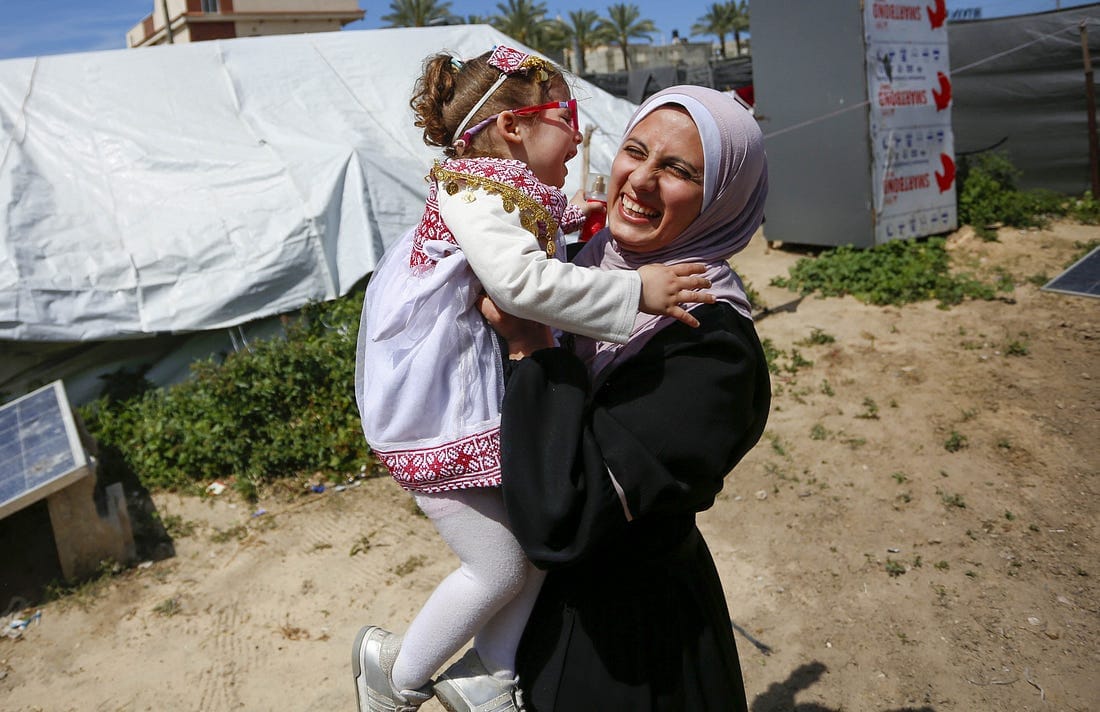
“Today, after two and a half years, God willing, we will be reunited with our daughter,” Al-Kurd said. She brought a traditional Palestinian dress for Bissan to wear. When her daughter finally arrived in the convoy to Nasser hospital, Al-Kurd held her tightly before dressing her in the white and red dress as relatives took turns embracing her.
“I am meeting my daughter for the first time,” she said. “It’s as if today is the day of her birth. I can’t describe my feelings.” Drop Site
As World Cancer Day is marked on Wednesday, thousands of patients in Gaza face worsening illness, untreated pain and closed crossings – despite the limited opening of the vital route through Rafah this week.
“We are dying. Every day, between two and three patients die inside this hospital,” says Munther Abu Foul, a cancer patient lying on his bed in Gaza’s largest hospital. “I can’t get out of bed because of the pain. We want a solution – open the crossings.”
His words capture the reality facing thousands of cancer patients across the Strip, where access to specialist care has collapsed and evacuation for treatment abroad remains out of reach for many.
Local health organisations warn that around 11,000 patients are currently deprived of specialised or diagnostic cancer treatment inside Gaza.
Some 4,000 patients who received medical referrals to hospitals outside the Strip have been waiting for more than two years to travel.
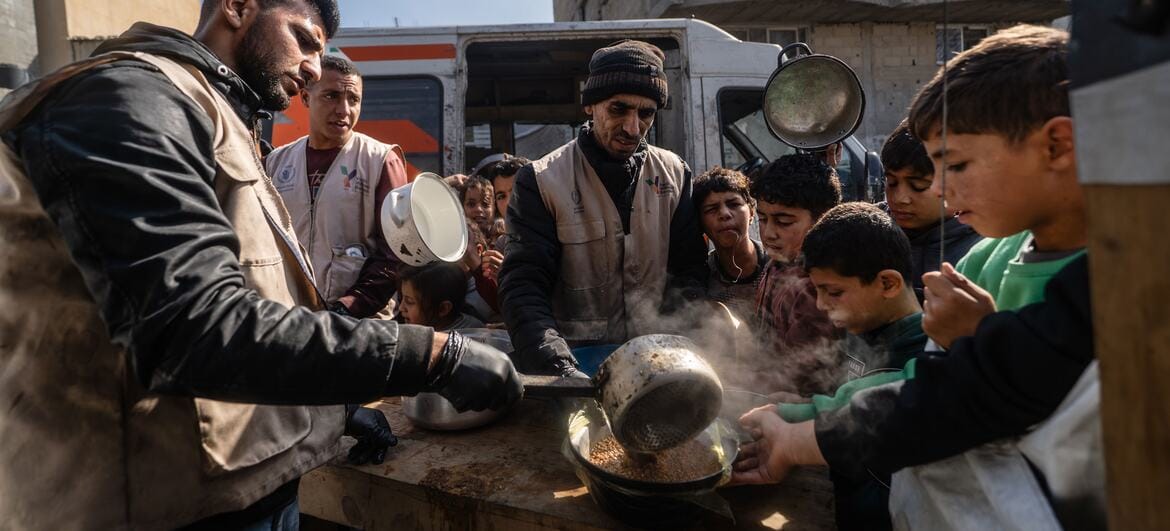
UN News visited Al-Shifa Hospital in Gaza City, documenting the dire conditions inside its oncology department. Patients crowd corridors and wards, waiting for consultations or treatments that are no longer available.
Essential medicines and equipment are in short supply, while many patients endure chronic pain that leaves them barely able to move.
UN News
A man takes care of his brother, a cancer patient at Al-Shifa hospital in Gaza City.
‘Every day, two or three patients die’
Mr. Abu Foul flips through his medical transfer papers, issued long ago for treatment outside Gaza. He has not been able to travel for more than two years.
“The health situation in the Gaza Strip is dilapidated,” he says. “There is no treatment or medicines, and we are dying. Every day, two to three patients die here inside this hospital. I can’t get out of bed because of the pain.”
He appeals directly for help. “We want a solution. Open the crossings properly so that God will release us from this suffering. Everyone will be held accountable.”
Nearby, Mohamed Hammou tends to his elderly mother, who is also battling cancer. He says families are forced to watch loved ones deteriorate without care.
We want a solution. Open the crossings properly so that God will release us from this suffering – Abu Foul
“This is how we stand in front of a patient who is dying, without treatment or any medical facilities that help them recover,” he says. “This does not please God and it does not satisfy people. We call on Islamic, Arab and international nations to look at the sick with mercy.”
A brother in pain
In another ward, Raed Abu Warda cares for his brother Hamid, whose cancer has worsened after long delays in treatment. What began as a small, benign illness has become a life-threatening condition.
“He has been suffering from cancer for two years,” Raed explains. “He waited all this time for the crossing to open so he could be treated outside. His pain has increased, as you can see.”
He gestures towards a wound that has opened beneath his brother’s chin. “The disease has created this wound, and his condition is getting worse every day. I stand watching my brother and mourning his condition because of the pain.”
UN News
The health situation in the Gaza Strip is deteriorating for those suffering from life-threatening cancers, despite the limited opening of the Rafah crossing.
The number of patients seeking care at Gaza’s oncology departments continues to rise, even as hospitals face severe shortages of medicines, equipment and specialised staff. For newly diagnosed patients, the future is increasingly uncertain.
Evacuations far short of needs
With the limited reopening of the Rafah crossing, the World Health Organization (WHO) is supporting the evacuation of patients and their companions from Gaza, focusing on ensuring safe transport. Yet the scale of need far outstrips what is currently possible.
All we ask for is a way to live
More than 18,000 patients – including around 4,000 children – are waiting to be evacuated abroad for medical treatment, according to WHO.
The UN Office for the Coordination of Humanitarian Affairs (OCHA) reported last week that Gaza’s Ministry of Health had recorded more than 1,200 patient deaths while people were waiting for medical evacuation. Around 4,000 cancer patients remain on critical waiting lists, trapped between closed crossings and a health system pushed beyond its limits.
For patients like Munther Abu Foul, time is running out. “We are dying,” he repeats. “All we ask for is a way to live.” – UN News
Israeli forces killed at least 31 Palestinians in Gaza on Saturday as airstrikes and shelling continued across the besieged enclave, despite a Trump-brokered ceasefire.
The Ministry of Health said dozens of civilians were killed or wounded in new attacks by the Israeli army, while Hamas stated that Israel is deliberately undermining the ceasefire agreement and committing fresh massacres across the strip.
Hospital sources said Israeli fire killed 31 Palestinians outside Israeli deployment zones in Gaza City and Khan Younis, in central and southern Gaza, since dawn on Saturday. At least 24 of the victims were reported in Gaza City and northern areas of the enclave.
Al-Shifa Hospital said the death toll rose after Israel attacked a police headquarters in Sheikh Radwan neighborhood of Gaza City. Emergency and ambulance services also confirmed that two Palestinians were killed in an Israeli strike on Al-Nasr neighborhood in western Gaza City.
Field reports showed that Israeli attacks focused on residential neighborhoods and areas sheltering displaced families. These areas included Al-Tuffah and Sheikh Radwan in Gaza City, as well as displacement camps and tents in Al-Mawasi area west of Khan Younis.
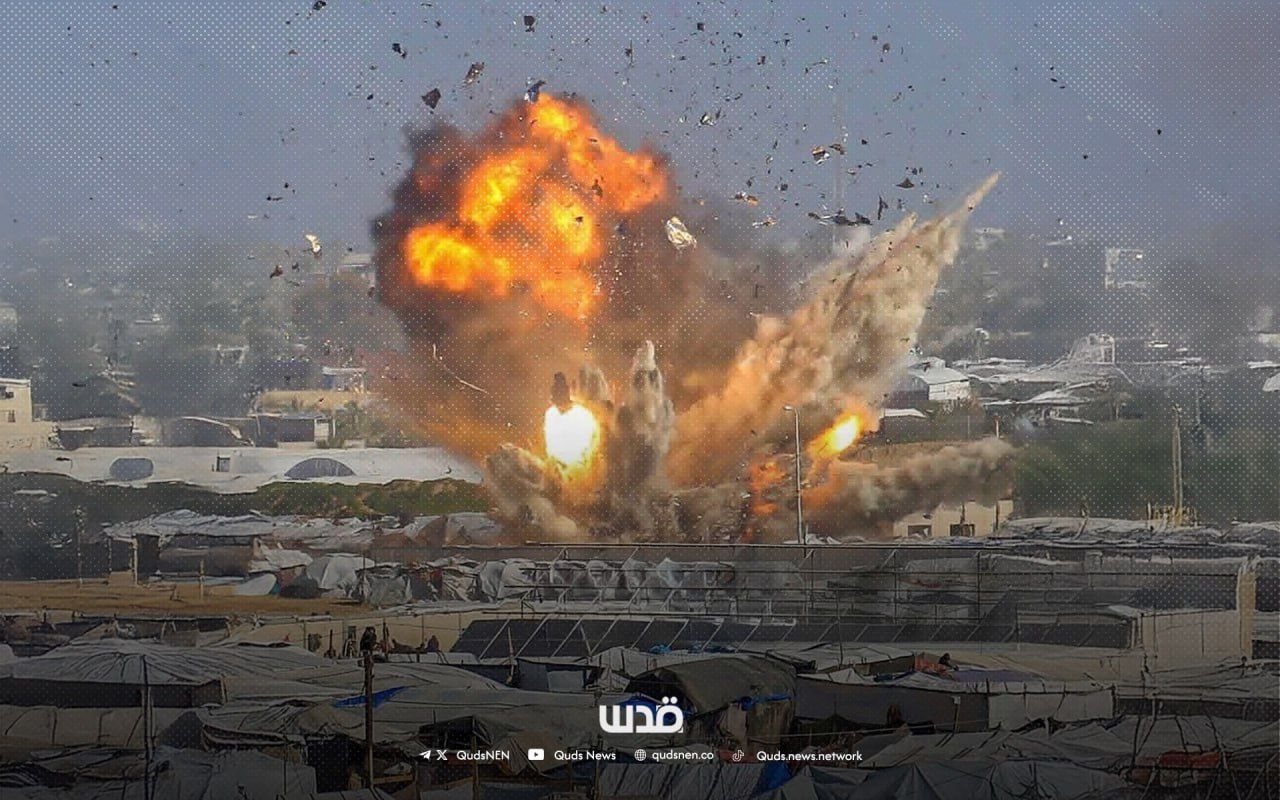
The latest strikes triggered large fires in displacement tents at “Ghaith” camp west of Khan Younis, according to Gaza Civil Defense. Rescue teams said the fires added a heavy burden as they responded to bombardment and widespread blazes at the same time.
Gaza’s Interior Ministry said the Israeli attack on Sheikh Radwan police headquarters showed clear disregard for the ceasefire and the international mediators backing it. The ministry said the strike killed five police officers and injured 15 others, in addition to civilians and displaced people who were near the site.
The ministry urged mediators to take responsibility and pressure Israel to stop its violations and spare civilians and civilian facilities from continued attacks.
Earlier on Saturday, hospital sources said Israeli fire killed 12 Palestinians, including six children, in Gaza City and Khan Younis.
In southern Gaza, an Israeli airstrike on “Ghaith” displacement camp in Al-Mawasi killed seven members of one family after their tent was hit in a densely populated area for displaced civilians. The Civil Defense said several others were wounded in separate strikes that targeted tents sheltering displaced families.
Israeli artillery shelling in areas inside Israeli troop deployment zones in Al-Tuffah neighborhood, northeast of Gaza City. Ambulance services also said Israeli strikes hit a residential apartment in Gaza City, killing and injuring several Palestinians.
Gaza Civil Defense spokesperson Mahmoud Basal said most of Saturday’s victims were children. He said Israeli strikes do not distinguish between civilians and fighters and described the situation as a systematic humanitarian catastrophe. He added that Israeli forces used high-explosive missiles, causing widespread destruction and fires.
Palestinian Red Crescent spokesperson Raed Al-Nims said ambulance crews face unprecedented challenges as Israeli attacks continue to hit homes and displacement camps, while most medical facilities remain damaged. He called on the international community to pressure Israel to halt its violations and allow medical teams to work without obstruction according to the Quds News Network.
Israeli Claims and Palestinian Response
The Israeli newspaper Maariv quoted the Israeli army as claiming that its air assaults in Gaza would continue, claiming it responds to alleged “serious incidents” that allegedly violated the ceasefire. The army claimed that it targeted Hamas and Islamic Jihad commanders, weapons depots, and military infrastructure.
Hamas rejected the Israeli claims and said the continued targeting of displaced people’s tents marks a dangerous escalation and a deliberate collapse of the ceasefire. The resistance movement described the attacks as a new massacre and a blatant violation of the agreement.
Hamas said Israeli actions confirm the continuation of a war of destruction against Gaza and a disregard for mediation efforts. It called on guarantor states and the US administration to intervene and stop policies that undermine the ceasefire.
The movement also demanded an immediate transition to the second phase of the agreement, including opening the Rafah crossing in both directions and enabling the national committee to operate freely in Gaza.
Since the ceasefire took effect in October, Israeli forces have killed 524 Palestinians and wounded 1,360 others.
The International Committee of the Red Cross said continued Israeli bombardment places extreme pressure on Gaza’s collapsed health system. Egypt’s Foreign Ministry also condemned repeated Israeli violations of the ceasefire, warning they pose a direct threat to the political process.
Airstrikes, drone attacks and hypothermia continue in Gaza despite the ceasefire, with more than 100 youngsters killed since early October, the UN Children’s Fund (UNICEF) said on Tuesday.
“That’s roughly a girl or a boy killed here every day during a ceasefire,” UNICEF spokesperson James Elder told reporters in Geneva.
“These children are killed from airstrikes, drone strikes, including suicide drones,” he said, speaking from Gaza City. “They’re killed from tank shelling, they’re killed from live ammunition, they’re killed from [remote-controlled] quadcopters.”
Mr. Elder pointed out that more children have also died of hypothermia in the last few days, as harsh winter conditions expose the most vulnerable Gazans.
Sheer cold kills six children
“We’ve now gone to six children who died of hypothermia just this winter,” he said. “I wish I could take a camera and show you 30, 40-kilometre [per hour] winds ripping through tents on the beach. It’s bitterly cold, it’s bitterly wet.”
The UNICEF spokesperson stressed that the ceasefire has allowed “genuine progress” in primary healthcare, with UNICEF and partners setting up the first health clinics in the north of the Strip and expanding immunization services.
But desperately needed medical evacuations of children remain at a standstill.
Mr. Elder noted “no noticeable improvement” both on approvals to get children with life-threatening injuries out of Gaza and in convincing more host countries take in the young patients.
He said that in his latest mission to the enclave, he spoke to many children and families denied evacuation despite completing an arduous, formal process.
These included a nine-year-old with shrapnel lodged in his eye who “will lose sight in an eye, maybe both”, a girl in Al Shifa hospital in Gaza City who “may well die” and another child whose leg needs amputating. “All three of those are absolute candidates for medical evacuation; all three of those have so far been denied,” Mr. Elder explained.
Before war erupted in Gaza following Hamas-led attacks in Israel on 7 October 2023, between 50 and 100 patients were evacuated from the enclave every day, according to the UN World Health Organization (WHO).
In an alert on Tuesday, the agency warned that extensive clearance procedures by the Israeli authorities continue to cause delays to deliveries of medicine and food.
“Some essential medical items are classified as ‘dual-use’ and denied entry,” WHO said in a post on X, in reference to goods that are primarily intended for civilian use but which the Israeli authorities believe could be diverted by Hamas or other militant groups for military purposes.
International NGO ban looms
The UNICEF spokesperson also highlighted the dangers of a recent Israeli ban on international NGOs, which will come into effect in the coming month and mean “blocking life-saving assistance”, he alleged. Mr. Elder also stressed the importance of allowing international media into the enclave, which has not been granted despite the ceasefire.
“There needs to be a lot more pressure on allowing international journalists to come in,” he said. “This is my seventh mission [to Gaza] and every time I see the 360-degree devastation, flattening of homes, my jaw drops.”
“It is absolutely as staggering yesterday as it was the first time I saw it more than two years ago,” he insisted.
Mr. Elder warned that two years of war have “left life for Gaza’s children unimaginably hard,” explaining that “the psychological damage remains untreated, and it’s becoming deeper and harder to heal, the longer this goes on”.
“A ceasefire that slows the bombs is progress, but one that still buries children is not enough,” he concluded as reported in UN News.

 CrossFireArabia