Ugly War: Amputating The Palestinians?

One of the many ugly consequences of wars and conflict is injuries leading to a loss of limbs. Gaza, which now has the highest number of child amputees per capital anywhere in the world, is no exception.  

“I was going to buy falafel,” says Mohammed Hassan. “On the way home, I looked up and saw a rocket heading towards me. I tried to run, but it was too fast. I found myself pinned to the wall, and my foot had been blown off.”

Brought to Al-Shifa Hospital in Gaza City, the young boy looks down at his heavily bandaged left leg, and the stump where his foot used to be.

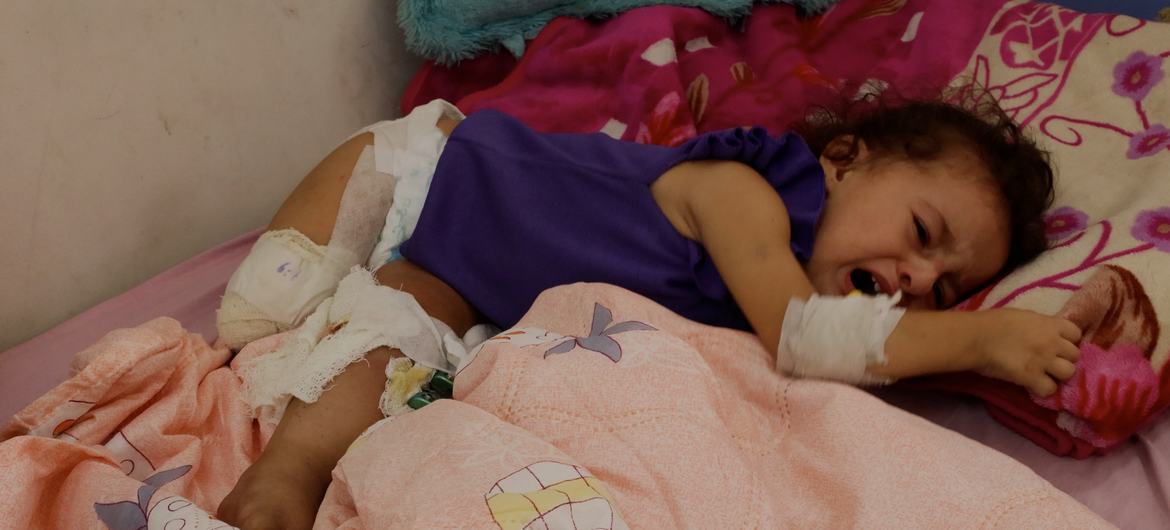
In another area of the hospital, a small child, Maryam Abu Alba, is crying in pain. “The neighbour’s house was bombed, and their home was hit,” says her grandmother. “One of her legs had to be amputated, and metal plates had to be inserted into the other one, which was fractured. She is in severe pain.”

Earlier this year, the UN humanitarian aid coordination agency OCHA estimated that 4,500 new amputees require prosthetics, in addition to the 2,000 existing cases requiring maintenance and follow-up care, while about 24,000 injured people required rehabilitation.

Health facilities are overwhelmed with many patients undergoing multiple surgeries without adequate medical supplies, including anaesthesia.

Palestinian child Mohammad Hassan sitting on a hospital bed in Gaza after his left leg was amputated by a strike.

UN News

Palestinian child Mohammad Hassan sitting on a hospital bed in Gaza after his left leg was amputated by a strike.

Desperately seeking food

In May, as supply routes for UN humanitarian convoys were interrupted, the number of distribution points of aid dropped from 400 dotted across the Gaza strip to a handful of hubs operated by the Gaza Humanitarian Foundation.

Given the shortage of humanitarian aid and diminished capacity, thousands of Palestinians have been killed or injured since May while seeking food.  Among the wounded are children and parents who, despite losing limbs, continue to search for food and water.

This comes as a UN-backed food security report has just concluded that famine is confirmed in Gaza governorate, where half a million people are trapped in conditions of starvation, malnutrition and death.

Ibrahim Abdel Nabi was one of the many Palestinians who headed to the hubs in the hope of finding desperately needed provisions for their families.

In his tent at a displacement site in the coastal Al-Mawasi area of Khan Younis, Mr. Nabi, surrounded by his wife and children, explains how the journey ended in disaster and life-changing injuries.

“When I arrived at the Al-Alam area, west of Rafah, I was hit by an explosive bullet in my leg. I was bleeding for about an hour and a half, and no one came to help me. They were all trying to find food for their children.”

Eventually, a group of people came to his rescue and took him to the nearby Red Cross hospital.

“I stayed there for about a month and a half, undergoing about 12 operations. I became malnourished and lost a lot of blood. Infection spread, and more of my leg had to be amputated.”

Ibrahim Abdel Nabi, a Palestinian displaced in Gaza, sitting on a chair while his wife helps him wear the handmade prosthetic limb.

Ibrahim Abdel Nabi, a Palestinian displaced in Gaza, sitting on a chair while his wife helps him wear the handmade prosthetic limb.

‘I made my prosthetic leg’

As Mr. Nabi was trying to recover, he was aware that his family were still in need of food. Despite the pain, he decided to make a simple prosthesis from materials he could find to allow him to get back on his feet and make fresh attempts to find food and water.

“The prosthesis injures my leg,” he said. “It causes inflammation and increases the pain. We don’t have medical care or supplies, but I will use it no matter how much it hurts.”

As he speaks, Mr. Nabi’s wife begins to cry. “God willing, we will live through this experience,” she says.

Mr. Nabi gets up on crutches and heads to a nearby tent, where his wife helps him to put on the crude prosthesis.

“Don’t strain yourself,” she repeats, over and over. “Take your time. Walk slowly.”
UN News

Continue reading
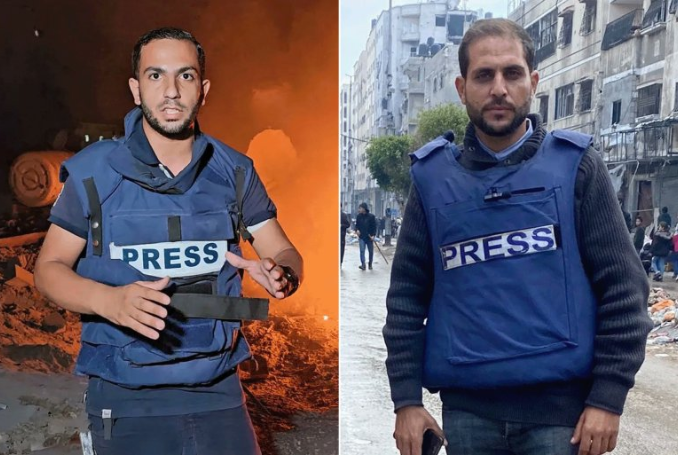
Silencing Messengers: Israel Kills Five Journalists

Al Jazeera correspondents Anas al-Sharif and Mohamed Qraiqea were killed Sunday, along with three other Al Jazeera journalists, in an Israeli strike targeting a journalists’ tent near the Al-Shifa Hospital in western Gaza City, according to the Gaza Media Office.

The Qatar-based channel quoted the director of the Al-Shifa Medical Complex in Gaza who said, “Al Jazeera correspondents Anas al-Sharif and Mohamed Qraiqea were martyred in an Israeli strike on their tent,” without providing details.

The channel later confirmed that al-Sharif and Qraiqea were killed in an Israeli strike.

Al Jazeera Media Network early Monday condemned the “planned” assassination of its correspondents and cameramen in the Gaza Strip, calling it “a desperate attempt to silence voices ahead of the occupation of Gaza.”

“The order to kill Anas al-Sharif, one of Gaza’s bravest journalists, and his colleagues is a desperate attempt to silence voices ahead of the occupation of Gaza,” it said.

Al Jazeera’s statement noted that “many Israeli army officials repeatedly incited and called for targeting Anas al-Sharif and his colleagues,” as it held “the occupation army and its government responsible for targeting and assassinating its team.”

The statement added that “the assassination of our correspondents by the Israeli occupation forces is another blatant and deliberate attack on press freedom.”

The Gaza Media Office announced in a statement that the number of journalists killed since the start of Israel’s genocide in Gaza on Oct. 7, 2023, has risen to 237, following the killing of al-Sharif and Qraiqea, along with three other journalists.

It identified the other journalists killed as photojournalists Ibrahim Dahir and Moumin Alaywa and an assistant photojournalist Mohammed Noufal.

“The assassination was carried out with premeditation and deliberation, through a deliberate, intentional, and direct targeting of the journalists’ tent in the vicinity of Al-Shifa Hospital in Gaza City. This heinous crime also resulted in the injury of several other fellow journalists,” it added

The Director of the Al-Shifa Medical Complex in Gaza City, Dr. Mohammed Abu Salmiya, told Anadolu that the deaths from the strike on the tent in front of the complex’s gate have risen to seven, including five journalists.

Meanwhile, the Israeli army admitted in a statement to killing al-Sharif in Gaza City, while ignoring the killing of Qraiqea and the three other journalists in the same strike.

In his will that was written Aug. 6, which he requested be published after his death, al-Sharif wrote: “This is my will, and my final message. If these words reach you, know that Israel has succeeded in killing me and silencing my voice. Peace be upon you and Allah’s mercy and blessings.”

“Allah knows that I gave all the effort and strength I had to be a support and a voice for my people, ever since I opened my eyes to life in the alleys and streets of Jabalia refugee camp. My hope was that God would prolong my life so I could return with my family and loved ones to our original hometown of occupied Asqalan (al-Majdal), but God’s will came first, and His decree is carried out,” he said.

“I have lived pain in all its forms, and tasted grief and loss many times. Yet I never hesitated to convey the truth as it is, without distortion or falsification, hoping that Allah would bear witness against those who remained silent, those who accepted our killing, those who suffocated our breath, and whose hearts were unmoved by the scattered bodies of our children and women, and who did not stop the massacre our people have been subjected to for more than a year and a half.

“I urge you to hold fast to Palestine, the jewel in the crown of Muslims, and the heartbeat of every free person in this world.

“I urge you to care for its people, for its wronged little children who were not given enough time in life to dream or to live in safety and peace, whose pure bodies were crushed beneath thousands of tons of Israeli bombs and missiles, torn apart and scattered across the walls.

“I urge you not to let chains silence you, nor borders hold you back. Be bridges toward the liberation of the land and its people, until the sun of dignity and freedom rises over our usurped homeland.

“I urge you to care for my family. Take care of the apple of my eye, my beloved daughter Sham, whom the days did not allow me to watch grow up as I had dreamed as reported by Anadolu.

“And care for my dear son Salah, whom I had hoped to support and walk beside until he grew strong enough to carry my burdens and continue the mission.

“I urge you to care for my beloved mother, whose blessed prayers carried me to where I am, whose supplications were my fortress and whose light guided my path. I pray that Allah will comfort her heart and reward her abundantly on my behalf.

“Also take care for my life partner, my beloved wife, Umm Salah, Bayan, from whom the war separated me for long days and months, yet she remained true to our bond, steadfast like the trunk of an olive tree that does not bend, patient and trusting in Allah, carrying the responsibility in my absence with all strength and faith.

“I urge you to stand by them and be their support after Allah Almighty. If I die, then I die steadfast in my principles, and I bear witness before Allah that I am content with His decree, faithful in meeting Him, and certain that what is with Allah is better and everlasting.

“O Allah, accept me among the martyrs, forgive me my past and future sins, and make my blood a light that illuminates the path of freedom for my people and my family. Forgive me if I have fallen short, and pray for me to receive mercy, for I have remained true to the covenant, never changing or wavering.

“Do not forget Gaza … And do not forget me in your sincere prayers for forgiveness and acceptance,” he wrote..

Israel is facing mounting condemnation for its genocidal war on Gaza, where it has killed more than 61,000 victims since October 2023. The military campaign has devastated the enclave and brought it to the verge of famine.

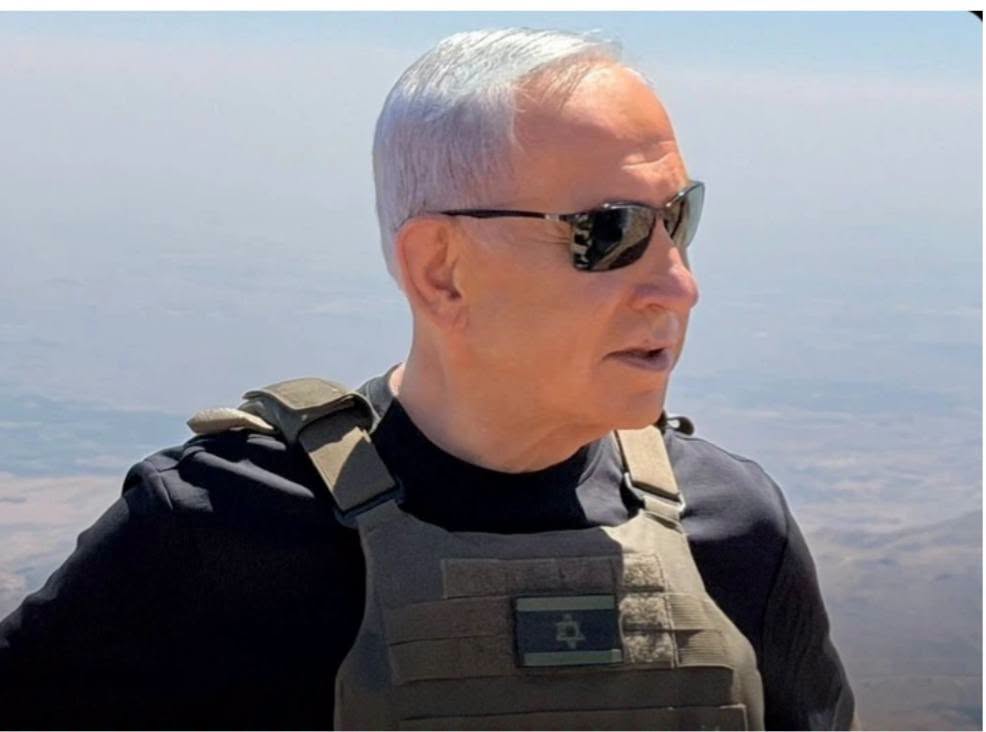
Last November, the International Criminal Court issued arrest warrants for Israeli Prime Minister Benjamin Netanyahu and his former Defense Minister Yoav Gallant for war crimes and crimes against humanity in Gaza.​​​​​​​​​​​​​

Israel also faces a genocide case at the International Court of Justice for its war on the enclave.

Continue reading
MSF: Gaza Uninhabitable, Turned to Rubble, People No Longer Recognize Their Homes

While the ceasefire in Gaza, Palestine, was implemented on 19 January, after 15 months of all-out war on the people trapped there, all components of society have been destroyed making it almost uninhabitable. Médecins Sans Frontières (MSF) teams are now able to reach the north of the Strip – which was previously besieged by Israeli forces – to assess the medical and humanitarian needs. The situation is appalling; there is nothing left.

Our colleagues no longer recognise their own neighbourhoods, hospitals have been razed, and people are settling in the rubble of their homes with no other shelter to face the winter conditions. Caroline Seguin, MSF’s emergency coordinator, shares insights and photos from the ground.

1. What is the situation in north Gaza?

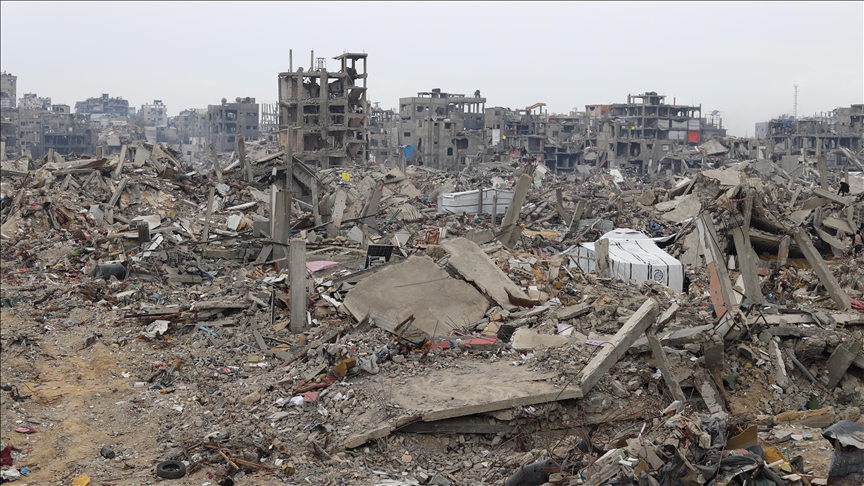
In the North Governorate, the level of destruction is total, it’s a flat land. I’ve never seen anything like it in my life. Our Palestinian colleagues are no longer able to recognise their own neighbourhoods, some were in shock, others literally collapsed.

In Gaza City we were already shocked by the level of destruction, but then we went north to Jabalia, we couldn’t say a word. There is nothing there anymore. Only ruins and the smell of death everywhere because of the dead bodies still trapped under the rubble.

2. What is the state of the health system?

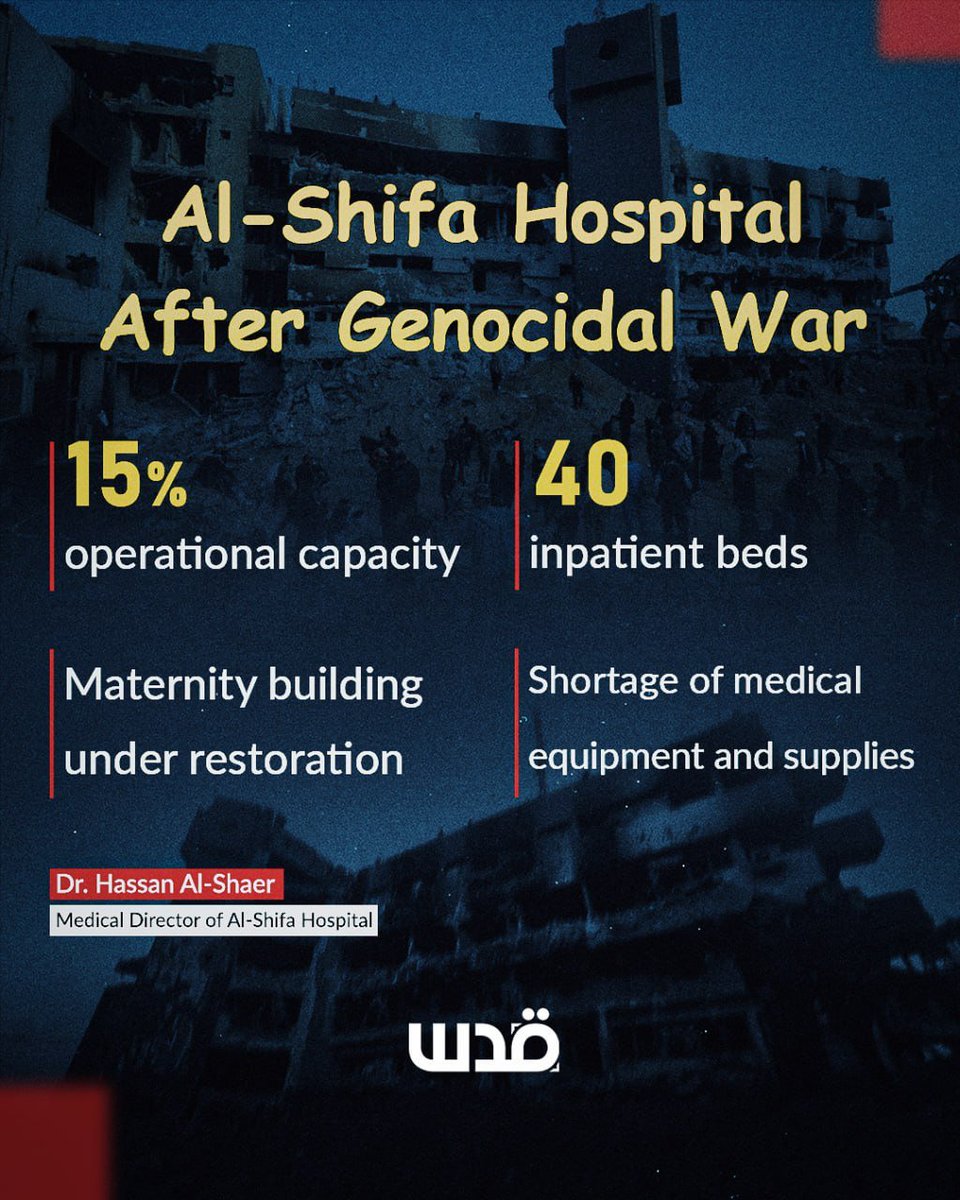
There is no health system anymore in the northern part of the Strip. Kamal Adwan hospital has been razed, while Al Shifa, Al Awda and Indonesian hospitals are seriously damaged and only partially functioning. We were utterly shocked to observe that in Indonesian hospital every medical machine seemed to have been deliberately destroyed; they were smashed to pieces, one by one, to make sure no medical care could be provided anymore. You have to ask, what is the motivation of such action? These machines are made to save people’s lives, mothers, fathers, children. It’s devastating to see the state of these hospitals.

The provision of medical care is largely insufficient compared to the needs of the hundreds of thousands of people living in the area. For example, between North Governorate and Gaza city, there are only six paediatric intensive care beds compared to 150 before the war and the number of patient hospital beds has plummeted from 2,000 to 350.

3. Are supplies reaching north Gaza?

The flow of vital supplies has improved since the ceasefire, but the level of needs is so high that people are still lacking basic items. The need for food, water, tents and shelter materials in this area remains critical. Water shortages are a real challenge given the high level of damage to water facilities and because they are in inaccessible locations in the buffer zones.

Our teams have started water trucking activities in Jabalia and Beit Hanoun and they repair damaged boreholes, but this is a temporary solution and is not sufficient for the massive needs. The problem is that because of the war we have located our activities in the south and it now takes time to redeploy them to the north.

After four weeks since the implementation of the ceasefire, we are still not seeing the massive scale up of humanitarian aid needed in northern Gaza. The humanitarian community is failing to provide vital services to a population in dire need of humanitarian and medical support. Both Israel and international actors need to urgently ensure the delivery of vital supplies such as shelter and food and to increase the capacities for its distribution.

4. What is the reality for people in northern Gaza today?

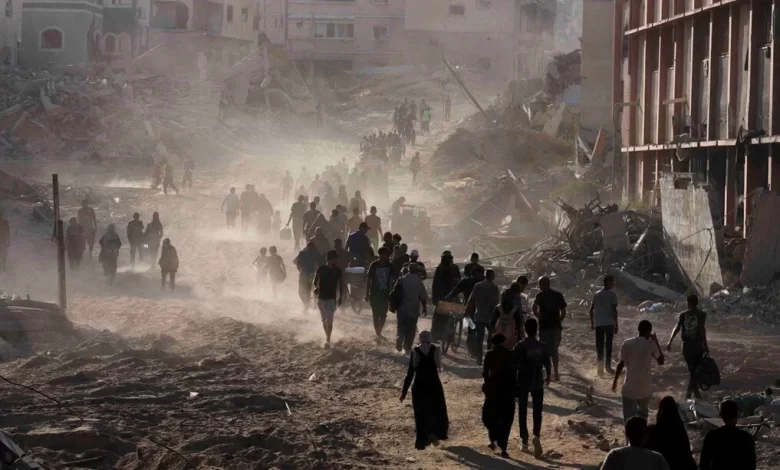
People are living in dire conditions. They try to settle as best they can on the ruins of their houses but it’s extremely difficult. The winter weather means people have to face very cold temperatures, heavy rains and strong winds, and they don’t even have walls around them to protect themselves. They don’t have access to healthcare, decent housing or water.

However, the conditions they had to face during the 15 months of war, being displaced and living in tents were even worse. After this hardship, people need to reunite with their loved ones and want to stay and rebuild their lives. Many of them have no intention of leaving. It is essential to ensure consistent, safe, and secure delivery of humanitarian assistance to people who have suffered unimaginable trauma.

Reliefweb

Continue reading
Murder, Mayhem and Israel

The Government Media Office in Gaza reported that Israel’s genocide has killed more than 61,000 people and displaced over two million. The office detailed the toll during a press conference at Al-Shifa Hospital on Sunday.

At least 47,487 victims arrived at hospitals, while 14,222 remain missing under rubble or in the streets. The number of wounded has reached 111,588.

Israeli forces have kidnapped over 6,000 Palestinians, subjecting them to severe abuse and torture. Dozens have died in custody. Forced displacement has affected over two million people, some uprooted more than 25 times under dire conditions.

Genocide Against Women and Children

The genocide has taken a devastating toll on children and women. Among the dead are 17,881 children, including 214 newborns who died amid the attacks. Over 38,000 children have been orphaned, with 17,000 losing both parents. Israeli forces have also killed 12,316 women.

Israeli bombings have wiped out entire families. The report recorded 9,268 massacres against families, erasing 2,092 families from civil records. Another 4,889 families were nearly wiped out, leaving only one survivor in each case.

Attacks on First Responders and Infrastructure

Israeli strikes have killed 1,155 medical workers, 205 journalists, and 194 civil defense personnel. More than 150,000 housing units have been damaged.

Israel’s war has also decimated Gaza’s healthcare system. At least 34 hospitals are out of service. The transportation sector has suffered losses exceeding $1.5 billion.

Education Under Attack

Israeli airstrikes have damaged 1,661 educational institutions, including 927 schools, universities, and daycare centers that were completely destroyed. Another 734 facilities suffered partial damage. The war has killed 12,800 students and nearly 800 educators. Around 785,000 students have been denied access to education.

The Government Media Office declared Gaza a disaster zone, warning that basic survival resources have collapsed. It urged international intervention to save 2.4 million people at risk of starvation, dehydration, and disease.

The office placed full responsibility on Israel, the Biden administration, and all those who have politically, economically, and militarily supported Israel’s actions.

Authorities in Gaza have outlined a post-war reconstruction plan in coordination with local and international organizations. They are calling for urgent relief, including the entry of 200,000 tents, 60,000 mobile homes, and essential shelter supplies according to the Quds News Network.

Continue reading