Dr Khairi Janbek
By Dr Khairi Janbek
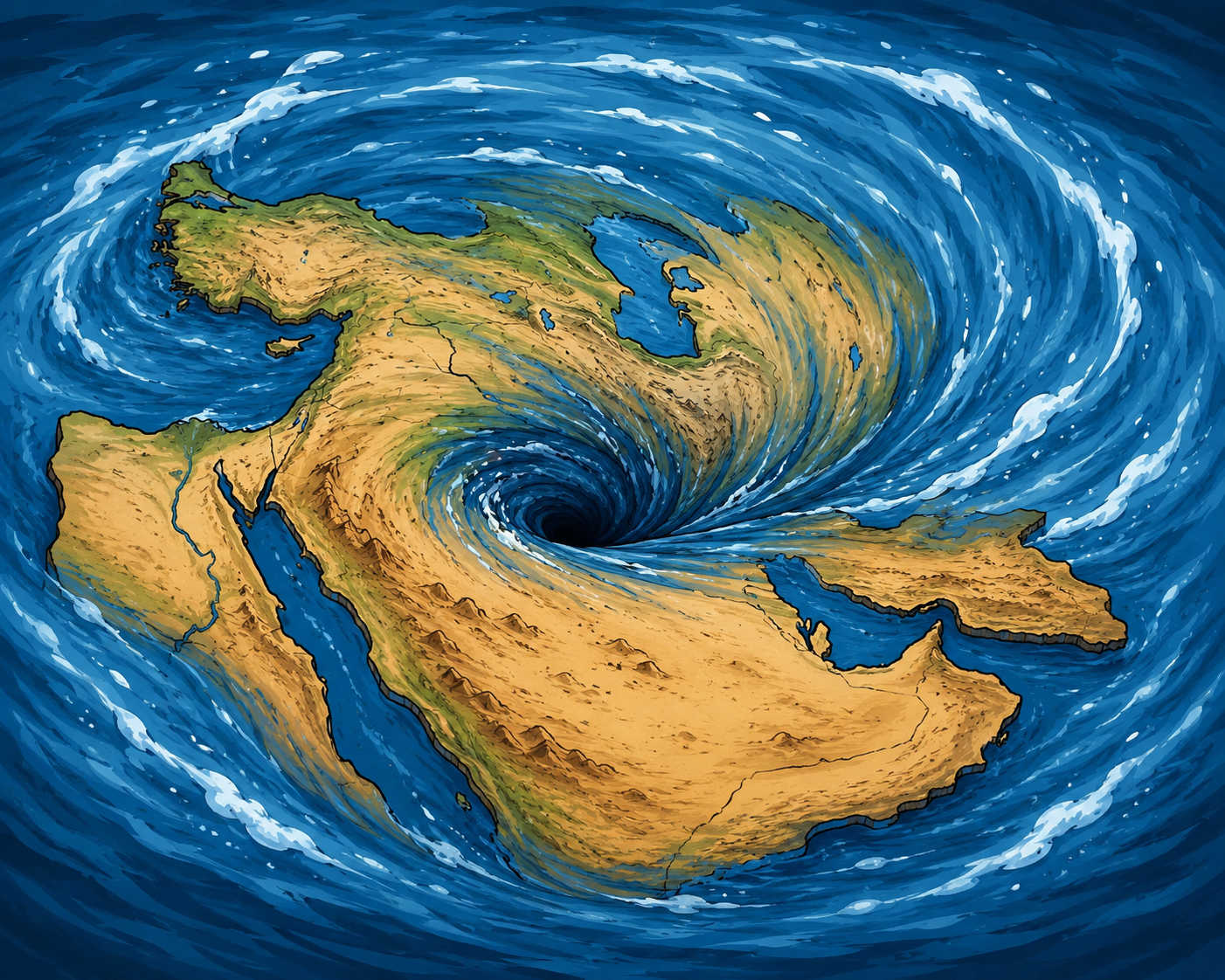
Every time the “new Middle East” which by the way has exciting resonance, be it conspiratorially or optimistically, is raised, one sees the new concept as exactly resembling exactly the old Middle East or is of the same replica.
We have grown accustomed to seeing the big turmoil in the Middle East, wars and regime changes, and each time we fall into the trap of seeing a conspiracy to change the boundaries of the Middle East, boundaries created with accords between Britain and France after WWI and which all countries of the region decry and condemn yet ironically fighting tooth and nail to preserve.
But what is this bogey which insinuates conspiracies and evil behind the cloak of a new Middle East.
Infact it started off idealistically as a reformist movement, basically economic as well as political reform, but with constant instability in the region, the term started to take another meaning, basically new alignments and new political understandings for the countries of the Middle East.
Essentially the way one sees it, the term now refers not to geography or reform – economic or political – but rather who are going to be the major players in the regions, who will be pulling the strings and will they relate to each other despite their contradictions and convergences.
For much of the recent history of the region the Trinity of Turkey, Israel, and Iran were the frame which contained the Arab problems within the Arab world, but as we have been seeing in recent history, these major players became part of the problems of the Arab world through their interference, seeking expansion or guaranteeing what they claim to be their national security concerns.
Now, and in the Donald Trump era, the concept of a new Middle East is still on track regarding the notion of who will be the new forces pulling the strings in the area, as for all intents and purposes, Iran as it seems has been relegated to a more background position regarding the affairs of the region, and Turkey with a circumscribed role, especially that the PKK, the leitmotif of Turkish interference in the area have laid down their arms.
Of course, now Israel is the power par excellence and the major player, but it needs a balancing actor from the Arab world this time, and the most likely candidate is Saudi Arabia.
However a Saudi balancing actor to Israel, is just not an easy feat to achieve, because such an actor cannot be based on contradictions alone, but also requires convergence. And this supposed convergence relies on the point of principle, the two-state solution to the Palestinian problem.
Now one is really not aware of the reasons behind Netanyahu’s rejection of the two-state solution, but certainly he is a hostage of his political alliances that keep his government afloat, thus making him avoid going back to court, and even worse, a possible jail term. As certainly for his allies, the rejection of a two-state solution is a point of principle.
Consequently, one believes, without the common ground with Saudi Arabia, of putting back on the table the issue of the two-state solution, there won’t be a new Middle East of two major actors, but rather one temporary major actor, being Israel for a temporary new Middle East!

 Saleem Ayoub Quna
 Heba
Heba