CrossFireArabia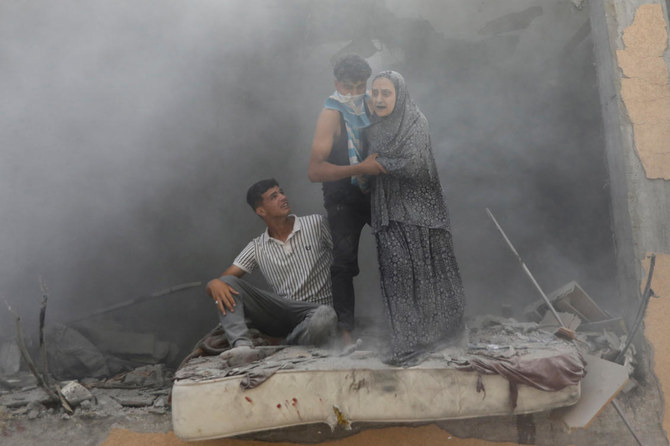
The US continues to provide military aid to Israel for its operations in the Gaza Strip, despite mounting civilian casualties and violations of international law Anadolu news reports.
Besides being Tel Aviv’s most important political ally, Washington remains the largest supplier of weapons to the Israeli military.
The Congress approved $17 billion in military aid to Israel under a $95 billion foreign military assistance package in April.
Israel has killed more than 38,000 Palestinians since a cross-border attack that claimed 1,200 lives. The actions have triggered a humanitarian disaster.
Israeli Prime Minister Benjamin Netanyahu’s handling of the Gaza assault has unsettled US President Joe Biden. Still, there has not been a serious restriction on arms supply.
Netanyahu even accused the Biden administration of restricting military aid, with US officials confirming a pause in shipment that included 2,000-pound bombs, citing concerns over civilian casualties in the besieged enclave according to the Turkish news agency.
Leaked figures to the media, however, suggest that Washington’s action came too late and may not be effective in practice.
Official sources, who spoke to Reuters on condition of anonymity, revealed that from Oct. 7-June 28, the US shipped at least 14,000 MK-84 bombs used in bomber aircraft to Israel, along with 6,500 227 kg bombs, 3,000 precision-guided Hellfire missiles, 1,000 bunker-buster bombs, 2,600 small-caliber bombs dropped from aircraft and other munitions.
The Biden administration also allowed a symbolic one-time shipment of one-ton aircraft munitions in May.
An internal memo shared among Democratic leaders in the House of Representatives and other members of Congress said the halted shipment of one-ton bombs accounted for less than 1% of military support provided by the US to Israel since Oct. 7.
US has sent weapons to Israel by air
An official speaking to CNN did not deny shipment flights were detected between US Air Force bases and Israel, and said the flights represent a steady flow of Pentagon aid to Israel.
The CNN said from October to January 2024, an average of 15 cargo flights occurred daily, later decreasing to about five.
Records indicated that tracking some military flights was difficult due to frequent transponder shutdowns.
Research by the Haaretz newspaper in Israel revealed that 173 military and civilian cargo flights originating from US military bases worldwide transported weapons and ammunition to Israel.
Most of the flights landed at the Nevatim Airbase near the southern Israeli city of Be’er Sheva.
There were 22 flights in October, 47 in November, 32 in December, 20 in January, eight in February, 11 in March, 17 in April, seven in May and nine in June.
The shipments are said to have included 155mm artillery shells, Joint Direct Attack Munition guidance kits, bombs, missiles for Israel’s air defense system, and drones and ammunition for the Iron Dome defense system.
Israel receiving $310 billion in aid from US
The US provides Israel with $3.8 billion in military aid annually, regardless of whether it is involved in a conflict.
According to the most recent records compiled by the Council on Foreign Relations, Israel appears to have received the largest share of US foreign aid since its establishment in 1948, totaling $310 billion.
US legally ensures Israel’s ‘qualitative military edge’ in region
In 2008, another law passed in the US introduced the concept of “Qualitative Military Edge,” a multi-faceted endeavor to ensure Israel has access to technologically advanced defense systems. It is also said to involve building operational capability through exercises, training, and personnel exchanges.
Hence, Israel is expected to be the first country to access the most advanced US military weapons and platforms.
Israel has so far received 39 out of the 50 advanced F-35 fighter jets it purchased from the US. But a $3 billion agreement was signed last month for an additional 25 of the fighter jets, world’s most advanced, which would bring the Israeli Air Force’s F-35 fleet to 75 in the coming years.
Israel’s use of US weapons violated international law
A State Department report in May said Israel’s use of US-provided weapons in Gaza likely violated international humanitarian law.
The report, after a presidential review following pressure from lawmakers and others, however, stopped short of making any final conclusions, and did not link specific US weapons to individual attacks by Israeli forces in Gaza, Anadolu ends its feature.



 marwan